Thank you for visiting SNEWPapers!
Sign up free
New York Dispatch
New York, New York County, New York
What is this article about?
This essay extols the enduring purity of Ancient Masonry as a system rooted in truth, morality, and divine worship, unaffected by modern innovations or operative labor. It traces its history through learned religious institutions from ancient Egypt and Solomon's Temple to mediaeval Europe, highlighting figures like King Alfred and rejecting sectarian or vulgar associations. (248 characters)
Clipping
OCR Quality
Full Text
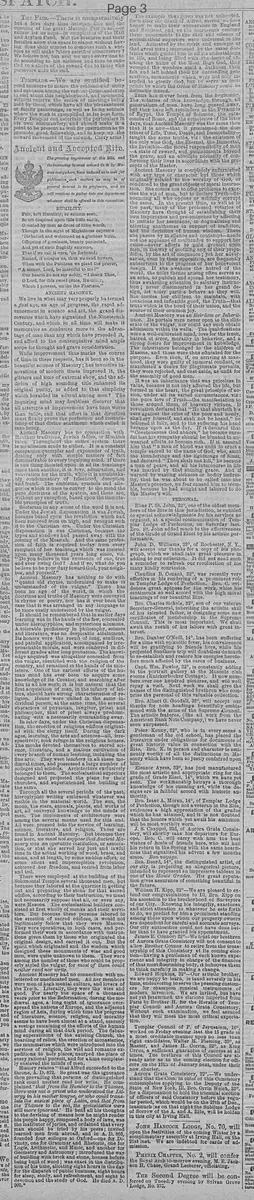
We live in what may very properly be termed a fast age, an age of progress, the rapid advancement in science and art, the grand discoveries which have signalized the Nineteenth Century, and which in all time will make it memorable as conducive more to the advantage of man than any which have preceded it, and afford to the contemplative mind ample scope for thought and grave consideration.
While improvement thus marks the course of time in these respects, has it been so in the beautiful science of Masonry; has inventive innovations of modern times improved it, the glitter and tinsel of external show, and the addition of high sounding title enhanced its original purity, or added to that simplicity which heralded its advent among men? The inquiring mind may doubtless discover that all attempts at improvement have been worse than futile, and that effort in that direction must finally prove the perfection and immutability of that divine sentiment which called it into being.
Ancient Masonry has no connection with Heathen traditions, Jewish fables, or Monkish tales. Throughout the entire system there is no allusion made to either. It is a constant companion exemplar and expounder of truth, dealing only with simple matters of fact demonstrable to every inquiring mind. If there is one thing insisted upon in all its teachings more than another, it is love, admiration, and veneration for the truth, while it is unmistakably condemnatory of falsehood, deception and fraud. The emblems, symbols and allegories which it uses to convey to the mind the pure doctrines of the system, and these are, without any exception, based upon the immutable principles of truth.
Sectarian in any sense of the word it is not. Under the Jewish dispensation it was Jewish because based upon the revelation which had been received from on high, and brought with it to the Christian era. Under the Christian dispensation it was Christian, because the types and shadows had passed away with the coming of the Messiah. And the same profession of faith is required to-day from every recipient of her teachings which was insisted upon many thousand years long since, viz. "Do you believe in the existence of one, true and ever living God? And if so, what do you believe to be your duty toward God, your neighbor, and yourself."
Ancient Masonry has nothing to do with "quaint old rhyme, modernized to make it understanded of the vulgar." There has been no age of the world, in which the doctrines and truths of Masonry were conveyed in rhyme or poetry, nor has it ever been the case that it was arranged in any language to be more easily understood by the vulgar.
It should be remembered that in earlier days learning was in the hands of the few, concealed under hieroglyphics, and mysterious allusions. A tolerable proficiency in philosophy, science and literature, was no despicable attainment. Its honors were the result of long, studious, and painful application, accompanied by irreproachable morals, and were conferred in different grades after long probation. The knowledge acquired was altogether concealed from the vulgar, identified with the religion of the country, and remained in the hands of its ministers. One of the earliest efforts of the human mind has ever been to acquire some knowledge of its Creator, and searching after him in all his work, it is but natural that the first acquisition of man, in the infancy of letters, should have strong characteristics of religion. Hence were united in the same individual person, at the same time, the several characters of physician, lawgiver, priest and philosopher, that of priest always predominating with a necessarily commanding sway.
In later days, under the Christian dispensation, the erection of religious edifices originated with the clergy itself. During the dark ages, learning, the arts and sciences-all, irrespective, took refuge in the religious houses. The monks devoted themselves to sacred science, literature, and a zealous cultivation of every branch of human learning, including the fine arts. They were teachers in all these mediaeval times, and possessed a large number of colleges and schools. Architecture exclusively belonged to them. The ecclesiastical superiors designed and projected the plans for their churches, and superintended the building of the same.
Through all the several periods of the past, hieroglyphic writing embraced whatever was visible in the material world. The sun, the moon, the stars, animals, plants, and works of art, all conveyed knowledge to the minds of men. The implements of architecture were among the several means used for this end. All were pressed into the service of learning, science, literature, and religion. These are found in Ancient Masonry. But because they are here, we must not suppose that Ancient Masonry was an operative institution, or association, or that she served her just and lawful time in the actual working of wood, brass, and stone, and at length, by some sudden effort, or some silent and imperceptible revolution, achieved her freedom, and retired from labor and toil.
There were employed at the building of the Solomonic Temple several thousand men, but because they labored at the quarries in getting out and preparing the stone for that sacred edifice, according to their instruction, we must not necessarily suppose that all, or even any, were Masons. The ecclesiastical builders consisted at first wholly of monks and their servitors. But because these persons labored in the erection of sacred edifices, it would not legitimately follow that they were Masons. They were operatives, in both cases, and performed their work in accordance with instructions given them by those who originated the original design, and carried it out. But the spirit which originated and the wisdom which designed these monuments of wise and good men, were quite unknown to them. They were among the number of those who could be properly styled the vulgar, for most of them could neither read nor write.
Ancient Masonry had no connection with unlettered or uneducated men. All her members were men of high mental culture, and lovers of the Truth. Literally, they were the wise and good. For nearly the space of a thousand years prior to the Reformation, during the mediaeval ages, a long night of ignorance overspread the nations of Europe, and the adjacent region of Asia, during which time the progress of literature, science, religion, and morality seems to have been almost at a stand, scarcely a vestige remaining of the efforts of the human mind during all that dark period. The debasing superstitions of the existing Church, the hoarding of relics, the erection of monasteries, the mummeries which were introduced into the services of religion, the wild and romantic expeditions to holy places, usurped the place of every rational pursuit, and for a time completely enslaved the minds of men.
History relates "that Alfred succeeded to the throne, A. D. 872. So great was the ignorance then prevailing that persons of distinguished rank could neither read nor write. He complained that from the Humber to the Thames, there was not a priest who understood the Liturgy in his mother tongue, or who could translate the easiest piece of Latin, and that from the Thames to the sea, the ecclesiastics were still more ignorant.' He bent all his thoughts to the devising of means how he might render his people happy, composed a body of laws, was the institutor of juries, and ordained that every man should be tried by his peers; invited learned men from abroad, and in A. D. 886, founded four colleges at Oxford-one for Divinity, one for Grammar and Rhetoric, one for Logic, Arithmetic, and Music, and another for Geometry and Astronomy; introduced the way of building with brick and stone, houses before being built of wood; was exact in the distribution of his time, allotting eight hours in the day for the dispatch of public business, eight hours for sleep, study, and refreshment, and eight to devotion and the study of God. He died A. D. 900."
The example thus given was not unheeded. Soon after the death of Alfred, sacred edifices began to make their appearance in England and Scotland, and by the fourteenth century these monuments to the skill and science of ecclesiastical superiors were universal in the land. Animated by the spirit and example of that great man; impressed by the same doctrines which guided him in all his undertakings in life, and being filled with the desire of exalting the name of the Most High God, they wrought the wonders amid a darkness then felt, and left behind them for succeeding generations, monuments which were not only intended to glorify God, but to serve as footprints by which the Order of Masonry could be distinctly traced.
Thus has it ever been from the beginning. The votaries of this knowledge through all generations of men, have long passed away, but they have left reminders in the Pyramids of Egypt, the Temple of Solomon, the catacombs of Rome, and the cemeteries of the later days, that Ancient Masonry was the same then that it is now -that it proclaimed the doctrines of Life, Time, Death, and Immortality-taught the same truths, viz: the existence of the only wise God, the Eternal, the Immortal, the Invisible; the moral responsibility of man -a state of reward, and punishments beyond the grave, and an absolute necessity of conforming their lives in accordance with the precepts of the Master.
Ancient Masonry is completely unfurnished with any type or character but those which originally related to the worship of God, or conduced to the great objects of moral instruction. She comes not to offer problems to exercise the wit of man, but to declare Truth-denouncing all who oppose or willfully corrupt the same. In the present time, as well as in the past, many of the professed votaries of Masonry have thought of establishing their own importance and pre-eminence by affecting to imitate her assurance, in dogmatising and uttering anathemas in support of tradition and the decisions of human wisdom. These she passes by in silence and contempt-needs not the applause of multitudes to support her cause-never affects to gain ground upon men, in the way of soothing any of their prejudices, by the art of eloquence: yet her adversaries, even by their opposition, are frequently subservient to the progress of her benevolent design. If she awakens the hatred of the world, the noise thence arising often serves as an echo, to publish and spread her testimony, thus awakening attention to salutary instruction; never disconcerted in her grand design, let noisy parties behave as they will. She incites her children to maintain, with tenacious and inflexible good, the Truth that truth which is the bond of their union, and the source of their common joy.
Ancient Masonry was an Heirdom or Inheritance. Its portals were never open to the illiterate or the vulgar, nor could any such obtain admission within its walls. The qualifications were a well-cultivated mind, love for the truth, hatred of error, morality in behavior, and a strong desire for improvement in knowledge. The inheritance belonged to the children of Masons, and these were thus educated for the purpose. Even then, if, on arriving at manhood, they were guilty of immoral conduct, or manifested a desire for illegitimate pursuits, they were rejected, and cast aside, as unfit for the assembly of good men.
It was an inheritance that was priceless in value, because it not only affected the life, but formed in the heart, the great principle of action, under all its varied circumstances, viz: the pure love of Truth-the manifestation to those around them, of heavenly virtues. If revelation declared that "He that shutteth his ears against the cries of the poor and needy, shall cry himself, and shall not be heard," he believed it fully, and to the suffering his hand became open as the day. If it declared that "Covetousness God abhors," he became careful lest his sympathy should be blunted in unwearied efforts to become rich. If it assured him that "a man of blood was unfit to erect a temple sacred to the name of God, who, amid the thunderings and the lightnings of Sinai, had declared 'Thou shalt not kill,'" he became a man of peace, and all his intercourse in life was marked by that shining grace. And if warned by wasting sickness or bodily infirmity, that he was about to be called into the Master's presence, no fear caused him to tremble, because he had sought and labored to do the Master's will.
What sub-type of article is it?
What themes does it cover?
What keywords are associated?
What entities or persons were involved?
Where did it happen?
Story Details
Key Persons
Location
Europe, England, Egypt, Rome
Event Date
Mediaeval Ages, A.D. 872 900
Story Details
An essay defending the purity and immutability of Ancient Masonry, emphasizing its basis in truth, morality, and divine principles, disconnected from operative building or vulgar traditions, tracing its history through religious and learned institutions from ancient times to the Christian era.