Thank you for visiting SNEWPapers!
Sign up free
The National Intelligencer And Washington Advertiser
Washington, District Of Columbia
What is this article about?
Ratification of the preliminaries of peace between Britain and France on October 10, 1801, signed October 1 in London. Treaty restores most colonies, evacuates Malta and Egypt, ends hostilities. Public rejoicings in London and Paris; official congratulations to Bonaparte.
Merged-components note: Continuation of the 'Latest Foreign Intelligence' article on the peace preliminaries between Britain and France, with text flowing directly from page 1 to page 2 in sequential reading order.
Clippings
1 of 2
OCR Quality
Full Text
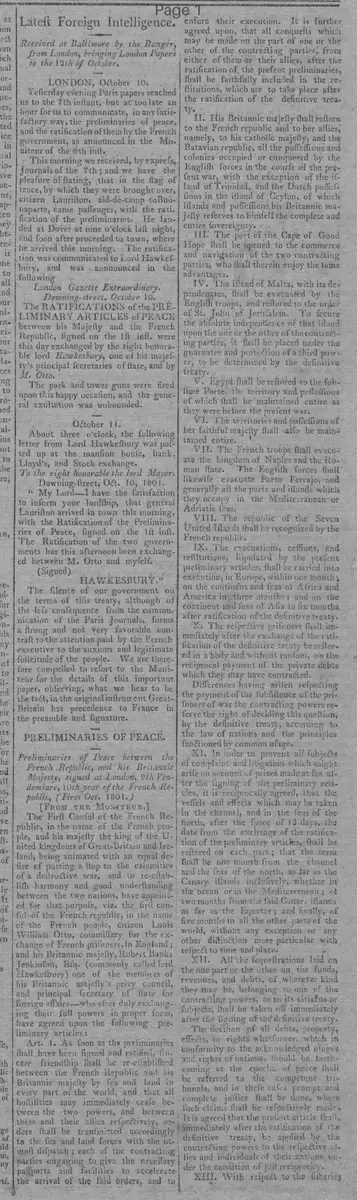
Received at Baltimore by the Ranger from London, bringing London Papers to the 12th of October.
LONDON, October 10.
Yesterday evening Paris papers reached us to the 7th instant, but at too late an hour for us to communicate, in any satisfactory way, the preliminaries of peace, and the ratification of them by the French government, as announced in the Moniteur of the 6th inst. This morning we received, by express, Journals of the 7th: and we have the pleasure of stating, that in the flag of truce, by which they were brought over, citizen Lauriston, aid-de-camp to Bonaparte, came passenger, with the ratification of the preliminaries. He landed at Dover at nine o'clock last night, and soon after proceeded to town, where he arrived this morning. The ratification was communicated to Lord Hawkesbury, and was announced in the following
London Gazette Extraordinary.
Downing-street, October 10.
The RATIFICATIONS of the PRELIMINARY ARTICLES of PEACE between his Majesty and the French Republic, signed on the 1st inst. were this day exchanged by the right honorable lord Hawkesbury, one of his majesty's principal secretaries of state, and by M. Otto.
The park and tower guns were fired upon this happy occasion, and the general exultation was unbounded.
October 11.
About three o'clock, the following letter from Lord Hawkesbury was posted up at the mansion house, bank, Lloyd's, and Stock exchange.
To the right honorable the lord Mayor
Downing-street, Oct. 10, 1801.
My Lord I have the satisfaction to inform your Lordship, that general Lauriston arrived in town this morning, with the Ratification of the Preliminaries of Peace, signed on the 1st inst.
The Ratification of the two governments has this afternoon been exchanged between M. Otto and myself.
(Signed)
HAWKESBURY.
The silence of our government on the terms of this treaty, although of less consequence from the communication of the Paris Journals, forms a strong and not very favorable contrast to the attention paid by the French executive to the anxious and legitimate solicitude of the people. We are therefore compelled to resort to the Moniteur for the details of this important paper, observing, what we hear to be the fact, in the original instrument Great-Britain has precedence to France in the preamble and signature.
PRELIMINARIES OF PEACE.
Preliminaries of Peace between the French Republic, and his Britannic Majesty, signed at London, 9th Vendemiaire, 10th year of the French Republic, (First Oct. 1801.)
[FROM THE MONITEUR.]
The First Consul of the French Republic, in the name of the French people, and his majesty the king of the United Kingdoms of Great-Britain and Ireland, being animated with an equal desire of putting a stop to the calamities of a destructive war, and to re-establish harmony and good understanding between the two nations, have appointed for that purpose, viz. the first consul of the French republic, in the name of the French people, citizen Louis William Otto, commissary for the exchange of French prisoners, in England: and his Britannic majesty, Robert Banks Jenkinson, Esq. (commonly called lord Hawkesbury) one of the members of his Britannic majesty's privy council, and principal secretary of state for foreign affairs—who after duly exchanging their full powers in proper form, have agreed upon the following preliminary articles:
Art. I. As soon as these preliminaries shall have been signed and ratified, sincere friendship shall be re-established between the French Republic and his Britannic majesty by sea and land in every part of the world, and that all hostilities may immediately cease between the two powers, and between them and their allies respectively, orders shall be transmitted accordingly to the sea and land forces with the utmost dispatch; each of the contracting parties engaging to give the necessary passports and facilities to accelerate the arrival of the said orders, and to ensure their execution. It is further agreed upon, that all conquests which may be made on the part of one or the other of the contracting parties, from either of them or their allies, after the ratification of the present preliminaries, shall be faithfully included in the restitutions, which are to take place after the ratification of the definitive treaty.
II. His Britannic majesty shall restore to the French republic and to her allies, namely, to his catholic majesty, and the Batavian republic, all the possessions and colonies occupied or conquered by the English forces in the course of the present war, with the exception of the island of Trinidad, and the Dutch possessions in the island of Ceylon, of which islands and possessions his Britannic majesty reserves to himself the complete and entire sovereignty
III. The port of the Cape of Good Hope shall be opened to the commerce and navigation of the two contracting parties, who shall therein enjoy the same advantages.
IV. The island of Malta, with its dependencies, shall be evacuated by the English troops, and restored to the order of St. John of Jerusalem. To secure the absolute independence of that island upon the one or the other of the contracting parties, it shall be placed under the guarantee and protection of a third power, to be determined by the definitive treaty
V. Egypt shall be restored to the sublime Porte, the territory and possessions of which shall be maintained entire as they were before the present war.
VI. The territories and possessions of her faithful majesty shall also be maintained entire.
VII. The French troops shall evacuate the kingdom of Naples and the Roman state. The English forces shall likewise evacuate Porto Ferrajo, and generally all the ports and islands which they occupy in the Mediterranean of Adriatic seas.
VIII. The republic of the Seven United Islands shall be recognized by the French republic.
IX. The evacuations, cessions, and restitutions, stipulated by the present preliminary articles, shall be carried into execution, in Europe, within one month; on the continent and seas of Africa and America in three months; and on the continent and seas of Asia in six months after ratification of the definitive treaty.
X. The respective prisoners shall immediately after the exchange of the ratification of the definitive treaty be restored in a body and without ransom, on the reciprocal payment of the private debts which they may have contracted. Differences having arisen respecting the payment of the subsistence of the prisoners of war the contracting powers reserve the right of deciding this question, by the definitive treaty, according to the law of nations and the principles sanctioned by common usage.
XI. In order to prevent all subjects of complaint and litigation which might arise on account of prizes made at sea after the signing of the preliminary articles, it is reciprocally agreed, that the vessels and effects which may be taken in the channel, and in the seas of the north, after the space of 12 days, the date from the exchange of the ratification of the preliminary articles, shall be restored on each part: that the term shall be one month from the channel and the seas of the north, as far as the Canary. islands inclusively, whether in the ocean or in the Mediterranean; of two months from the said Canaries, as far as the Equator; and finally, of five months in all the other parts of the world, without any exception or any other distinction more particular with respect to time and place.
XII. All the sequestrations laid on the one part or the other on the funds, revenues, and debts, of whatever kind they may be, belonging to one of the contracting powers, or to its citizens or subjects, shall be taken off immediately after the signing of the definitive treaty. The decision of all debts, property, effects, or rights whatsoever, which in conformity to the acknowledged usages and rights of nations, should be forthcoming at the epoch of peace shall be referred to the competent tribunals, and in these cases prompt and complete justice shall be done, where such claims shall be respectively made It is agreed that the present article shall immediately after the ratification of the definitive treaty, be applied by the contracting powers to the respective allies and individuals of their nations under the condition of just reciprocity.
XIII. With respect to the fisheries
on the coasts of Newfoundland, and the
adjacent islands, and in the gulph of St.
Lawrence, the two powers are agreed to
replace them on the same footing upon
which they were before the present war,
reserving to themselves the right of ma-
king, by the definitive treaty, such ar-
rangements as may appear just and re-
ciprocally useful, in order to place the
fisheries of both nations in the most pro-
per state for the maintenance of peace.
XIV. In all cases of restitution agreed
to by the present treaty, the fortificati-
ons shall be restored in the state in which
they are at the moment of the signing of
the present treaty, and all the fortificati-
ons constructed since the occupation of
them shall remain entire.
It is further agreed, that in all the ca-
ses of concessions stipulated in the pre-
sent treaty, a term of three years, to date
from the ratification of the definitive
peace, shall be allowed to the inhabi-
tants, of whatever description or rank
they may be, to dispose of their property,
acquired or possessed, whether previous
to or during the present war; during
which term of three years they shall be
at full liberty to exercise freely their reli-
gion, and to enjoy their property.
The same privileges are granted in the
restored countries to all those who shall
have made establishments in them of
whatever kind they may be, during the
time that these countries were in poes-
session of Great Britain.
With respect to the other inhabitants
of the restored countries, it is agreed
that none of them shall be prosecuted.
disturbed or molested in their persons or
in their properties, on any pretence what-
ever, on account of their conduct, or po-
litical opinions, or of their attachment to
either of the two powers, or for any oth-
er reason, unless for debts contracted
with respect to individuals, or for acts
subsequent to the definitive treaty.
XV. The present preliminary articles
shall be ratified, and the ratifications ex-
changed, at London, in the space of 15
days at farthest; and immediately after
the ratification, plenipotentiaries shall be
appointed on both sides, who shall repair
to Amiens, in order to proceed to the
arrangement of the definitive treaty, in
concert with the allies of the contracting
Powers.
In witness whereof we the undersigned
plenipotentiaries of the first consul of the
French Republic and his Britannic ma-
jesty, by virtue of our respective full
powers, have signed the present prelim-
inary articles, and have thereto affixed
our seal
Done at London on the 9th Ven-
demiaire, 10th year of the French
Republic—the first day of Octo-
ber, 1801.
(Signed)
OTTO,
HAWKESBURY.
We understand that the marquis Corn-
wallis will proceed in a few days, to
Amiens, to meet the French plenipoten-
tiary, and proceed with all possible dis-
patch to the final arrangement of peace.
The first consul's brother, Joseph Bona-
parte, who signed the treaty of Lunéville.
will probably be appointed plenipotenti-
ary on the part of the French Republic.
It is believed, in the ministerial circles
that the definitive treaty will occupy
but a few weeks. The greatest difficul-
ties will certainly arise from the variety
of considerations to which the discussion
of a fair and satisfactory treaty of com-
merce must give birth.
The rejoicings and illuminations will
be universal throughout the metropolis
this evening.
The French funds, which had fallen
on the 5th, to 52 1-4, rose the following
day upwards of two per cent. The Tiers
Consolides left off on the 6th at 54f. 50c.
When citizen Lauriston, Bonaparte's
aid-de-camp arrived this morning at St.
James's street, the horses of his carriage
were taken out, and he was drawn to his
hotel by the populace, with loud accla-
mations.
LONDON, October 3.
The sensation produced yesterday a-
among the populace was nothing equal to
what might have been expected. The
capture of half a dozen men of war, or
the conquest of a colony, would have
been marked with a stronger demon-
stration of joy. The illumination, so far
from being general, was principally con-
fined to a few streets, the Strand, the
Hay-market, Pall-mall, and Fleet-street.
In the last, the Globe Tavern was light-
ed up at an early hour, with the word
Peace in coloured lamps. This attract-
ed a considerable mob, which filled the
street before the door. It was appre-
hended, that they would immediately set
out on their tour through the whole
town, and enforce a universal illumi-
nation. This induced a few of the bye-
streets to follow the example, but no-
thing more. There were several groups
of people, but no crowd, in the neigh-
bourhood of Temple-bar. The other
streets, even those that were illuminat-
ed, were not more frequented than uu-
sual. St. James's street, Bond-street, and
the west part of the town; east of St.
Paul's, together with Holborn, and the
north part did not illuminate. Several
flags were hoisted in the course of the
day, and the bells of all the churches
were set a ringing
An additional party of the Life-
Guards were ordered yesterday into
town, in case of any riotous proceeding
from the lower order of the people, to
compel the inhabitants to illuminate.
From the London Gazette.
October 13th, 1801.
BY THE KING.
A PROCLAMATION,
Declaring the Cessation of Arms, as
well by Sea as Land, agreed upon be-
tween his Majesty and the French Re-
public, and enjoining the observation
thereof.
GEORGE R.
Whereas preliminaries for restoring
peace between us and the French Repub.
lic were signed at London on the first
of this instant, October, by the pleni-
potentiary of us, and by the plenipoten-
tiary of the French Republic: and
whereas, for the putting an end to the
calamities of war as soon and as far as
may be possible, it hath been agreed be-
tween, us, and the French Republic as
follows; that is to say, that as soon as
the preliminaries shall be signed and ra-
tified, friendship should be established
between us and the French Republic,
by sea and land, in all parts of the
world, and that all hostilities should cease
immediately; and in order to prevent
all causes of complaint and dispute which
might arise on account of prizes which
might be made at sea after the signature
of the preliminary articles, it has been
also reciprocally agreed, that the vessels
and effects which might be taken in the
British Channel and in the North Seas,
after the space of twelve days, to be
computed from the exchange of the ra-
tifications of the preliminary articles,
should be restored on each side; that the
term should be one month from the Bri-
tish Channel and the North Sea as far
as the Canary Islands including, whe-
ther in the Ocean or the Mediterranean;
two months from the said Canary Islands
as far as the Equator; and lastly, five
months in all other parts of the world,
without any exception, or any more par-
ticular description of time or place:
And whereas the ratification of the said
preliminary articles between us and the
French Republic were exchanged by the
respective plenipotentiaries of us, and of
the French Republic, on the 10th day
of this instant October, from which day
the several terms above-mentioned of
twelve days, of one month, of two
months, and of five months, are to be
computed: And whereas it is our royal
will and pleasure that the cessation of
hostilities between us and the French
Republic should be agreeable to the se-
veral epochs fixed between us and the
French Republic. we have thought fit
by and with the advice of our privy
council, to notify the same to all our
loving subjects; and we declare that
our royal will and pleasure is, and we
do hereby strictly charge and command
all our officers both at sea and land, and
all other our subjects whatsoever, to for-
bear all acts of hostility, either by sea
or land, against the French Republic,
and their allies, their vessels or subjects,
from and after the respective times above-
mentioned, and under the penalty of in-
currying our highest displeasure.
Given at our Court at Windsor the
twelfth day of this instant October
in the forty-first year of our reign,
and in the year of our Lord one
thousand eight hundred and one.
GOD SAVE THE KING.
At a court at Windsor, the 12th of Oc-
tober, 1801.
PRESENT,
The king's most excellent majesty in
council.
His majesty in council was this day
pleased to declare and order, that for
the convenience and security of the com-
merce of his loving Subjects during the
cessation of arms notified by his royal
proclamation of this day's date, passes
will be delivered as soon as they can be
interchanged, to such of his subjects as
shall desire the same, for their ships,
goods and merchandizes and effects, they
duly observing the several acts of parlia-
ment which are or may be in force.
W. FAULKNER.
PARIS. 12 Vendemiaire (Oct. 4.)
Yesterday at even in the evening the
signal was given for general rejoicing by
the firing of cannon, at the same instant
from the quay of the Thuilleries, and
esplanade of the Hotel National des In-
valides. The citizens having suddenly
stopped in the streets, and interrogated
each other with regard to the event
which the government thus announced,
went in a body to the theatres, conclu-
ding that the news would, no doubt, be
there notified officially. They were right
in their conjectures. At all the theatres
a note from the minister of the interior,
announcing the signature of prelimina-
ries of peace with England had been read,
and repeated in the midst of the loudest
acclamations. Never did a more lively
enthusiasm appear than at the Comedie
Françoise, the Theatre de Picard, and at
that of Vaudeville. At the latter wit is
accustomed to find an appropriate expres-
sion for sentiment, and on this occasion
a copy of extempore verses was receiv-
ed with the most marked approbation.
When the play was over, the citizens
found the fronts of the theatres, of the
public offices, and of a great many pri-
vate houses, illuminated as on the recur-
rence of our great national festivals. The inhabitants of the districts
in the neighbourhood of the theatres &
the palace of government assembled in
the public walks. At this moment a
numerous train, composed of the com-
missaries of the police of Paris, escorted
by detachments of light infantry and
dragoons, preceded by drums and trum-
pets, and surrounded on all sides by in-
numerable crowds of citizens, traversed
the streets and squares, proclaiming in
the midst of torches the news of the sig-
nature of preliminaries. The windows
were all filled with spectators, the pas-
sages were blocked up, and the streets in-
undated with the crowd pressing forward
to hear the magistrate charged with the
proclamation, and to express their joy
by acclamations. At every halt of the
procession thousands of voices exclaimed
Long live the Republic—Long live Bo-
naparte!
The news reached Malmaison at four
in the afternoon. The strictest orders
were immediately given that it should be
announced at Paris by discharges of ar-
tillery, and that, by means of the Tele-
graphe, it might be transmitted with the
greatest possible rapidity to every part of
the Republic.
13 Vendemiaire (Oct. 5.)
The First Consul on his arrival this day
from Malmaison found, on his arrival,
the primary authorities ready to congra-
tulate him on the happy event of the
preliminaries of peace with England.
The president of the conservative se-
nate, citizen Kellerman, expressed in
an appropriate speech, the sentiments of
the senate. The First Consul, in his re-
ply answered, that the intelligence of an
event calculated to have so mighty an in-
fluence on the happiness of France, had
a just claim to give birth to joy in the
members of the senate, who had ever
shown themselves the protectors of the
principles of liberty and social order.
Citizen Arnout, president of the tribu-
nate, attended by all the members now
in Paris, delivered himself in the follow-
ing terms:
"Citizen Consul,
"The members of the Senate hasten
to unite with the public joy, and to pre-
sent to you their congratulations on the
happy signature of preliminaries of peace
with England. They only anticipate the
acclamations and blessings of the French
people for this inestimable benefit, effec-
ted by an illustrious warrior, and accom-
plished by the first magistrates, who have
proved themselves the pacificators of Eu-
rope."
The First Consul replied, that the
French people who had began to taste
the joys of domestic tranquility, were
not less in want of external peace. He
added, that with pleasure he recognized
in the good choice of the majority of the
tribunate in the election of their presi-
dent, the sentiments of attachment to
the government by which the whole bo-
dy were animated.
A great number of the members of the
legislative body having assembled, citizen
Galignani, the president, addressed the First
Consul in their name, and spoke in the
following manner
"Citizen First Consul,
"The members of the legislative bo-
dy, who have at this time assembled, de-
lay not a moment to unite the expression
of their satisfaction and gratitude to the
congratulations of the Tribunate and the
Senate; to the emotions of public joy
which are displayed in all parts of this
great city, and which will immediately
be diffused over the whole of France, on
the happy intelligence of a general peace.
Behold thus gloriously terminated, this
terrible contest, in which one nation has
triumphed over the efforts of many pow-
ers combined for the destruction of its
liberty, and whose wonderful events
will illustrate the most striking pages of
history. Yes, citizen consul, so many
splendid events, so many traits of genu-
ine heroism, and of sublime devotion to
the cause of patriotism in all its forms.
registered in the records of immortality,
will form the wonder of future ages, as
they have excited the admiration of the
present race of men—While they do
this, they will at the same time confer
the appearance of truth on all the mira-
culous circumstances which history re-
counts of the heroic ages.
"What praises! what expressions of
gratitude can sufficiently express our
sense of the merits of those brave armies
who have conquered peace by such prodi-
gies; and above all to that genius who
has so often led them to victory, and
who has constantly prepared and directed
their success.
"The title of one who has triumphed
over nations, is, without doubt, splen-
did and glorious, but how much more splen-
did and pure is the title of him who has
given peace to the world! The first for-
ever recalls to view, all those painful cir-
cumstances which call forth the groans
of humanity. The second presents only
ideas of prosperity and happiness.
"In preparing by victory, and by as-
suring general pacification, citizen con-
sul, you have done enough it is true, for
celebrity; but we may declare, with
boldness, you have not yet done enough
for the true glory and felicity of France.
Warlike exploits have rendered her the
most powerful, the most considerable na-
tion of the universe—she must become,
by your cares, the most flourishing and
the most happy."
In the answer of the first consul, these
words were remarkable: "The stability
of social organization, principally contri-
buted to the restoration of peace."
The members of the tribunal of cas-
sation being introduced, citizen Maraire,
president, pronounced the following
speech:
"First Consul,
When, at your call, every hope is
re-animated, and by the ascendant which
a government, firm, just, and generous,
gains over its enemies, every hope is rea-
lized; when peace, the object of every
wish, is the fruit of your wisdom; when,
I say, maritime is about to be added to
the blessings of continental peace, the
presage to France of the return of her
prosperity and splendor, as well as the
accomplishment of her high destinies,
this is a homage well due, which every
heart which is alive to the true feeling of
Frenchmen, will hasten to pay you.
"In circumstances so honorable for
you, and so happy for us, the tribunal
of cassation feels the propriety of ap-
proaching, to re-echo the transports of
public joy, and the cries of thankfulness
which on all sides display the sentiments
with which all true citizens are penetrat-
ed.
"Entire devotion to the public inte-
rest, constant zeal for the execution of
the laws, and the maintenance of order.
inviolable fidelity to the government,
intimate and sincere attachment to your
person, ardent wishes (not for your glo-
ry, or what accession can it receive?)
but for your preservation, and for the
continuance of that peace so precious to
the world; such are the sentiments
which all my colleagues partake with
me, whose organ, at this moment, it is
to me so agreeable and so honorable to
appear.
The first consul thanked him for the
sentiments he had expressed in the name
of the tribunal of cassation. He added.
that he had not lost a moment in apprising
the president of the signature of the
preliminaries of peace, well knowing
the pleasure this intelligence would af-
ford, and being desirous at the same
time to give a proof of his special regard
and esteem.
Citizen Berthier, president of the
council of Maritime Prizes, spoke in
these terms:
"Citizen Consul,
"In the midst of the public joy, the
council of maritime prizes approach to
join their congratulations to those of
the public functionaries of state.
"They approach, through me as their
organ, to testify their joy and gratitude
for that peace conquered by the perse-
vering efforts of the French people, and
settled by the wisdom of their govern-
ment. This brilliant epoch, which fixes
the destinies of the republic, will soon
see its prosperity carried to a new pitch
of glory.
"For this great work, citizen consul,
thanks be given to you; the love of a
great nation will constitute the reward of
your paternal solicitude.
"Maritime peace! This blessing,
which penetrates our souls with the most
pleasing emotions, points out to us also
the period of our labours as near at
hand.
"Members of an institution created
for a time of war, we shall soon see, ci-
tizen first consul, those powers cease
with which you were pleased to invest
us, and which, when they become use-
less, complete our happiness.
"With all our wishes we desired an
event so essentially connected with pub-
lic felicity, and each of the members
will esteem himself happy, if in his re-
tirement he can hope that his labours have
obtained your approbation."
The ex-Director Treilhard, vice-presi-
dent of the tribunal of appeal, president
of the chamber of vacations, being in-
troduced along with a deputation of the
tribunal, and presented by the minister
of justice, addressed Bonaparte in the
following short speech:
"Citizen First Consul.
"Victory obtained under the ban-
ners of the republic, peace concluded on
the continent, this conciliation, so much
desired, brought about with our fierce
and eternal rivals; internal administra-
tion restored, civil laws prepared and
matured by long meditation; a criminal
code which is formed in the silence of
a calm and profound discussion; order
restored in the finances, exactness in
the payments; confidence at length re-
stored and a confidence too which is
founded on an opinion of wisdom uni-
ted with strength; these are some of
the things which you have accomplish-
ed within the space of two years.
"Suffer me, Citizen Consul, to pre-
sent the homage of the Tribunal of Ap-
peal, whose organ I now am, and it is
with pleasure that I am now only ex-
pressing the sentiments which I have
long felt in my heart, and which I
formerly publicly declared at a period,
ever most dear to my recollection, the
period when I was member of a Lega-
tion of which you was the Chief."
The Prefect of the department, the
secretary general, the council of the
Prefecture, the council general of the
department, the sub-prefects of the di-
strict of Franciade and Sceaux, the Ma-
yors and Adjuncts of Paris, the coun-
cil general and the Administrative com-
mission of Hospitals, the commissaries
of contributions having met to the
number of a hundred, at the hotel of the
prefecture of the department, set out
on foot. at one o'clock, to the Palace
of the government.
They were presented to the First Con-
sul by the Minister of the Interior. The
prefect of the department, thus expressed
his sentiments:
"Citizen Consul,
"We &c. (as above enumerated)
present to you the wishes and the bene-
dictions, of those who live under our
administration.
"The Preliminaries of Peace with
England have been signed, and the joy
excited by this news was the more live-
ly in proportion to its being more un-
expected; in proportion as the govern-
ment of England had accustomed Eu-
rope less to hope from it a return to pa-
cific views.
"Thus the government, ever unit-
ing force to wisdom, has been able to
inspire at once terror of our arms, and
ambition for our alliance.
"Thus two nations, formed to es-
teem each other, will associate their
efforts with their activity, and their gen-
ius to console the world, which have
distinguished the progress of a disastrous
contest.
"General Consul, the Peace of the
World is your work. Who before you
was truly anxious for its restoration?
Who had dared to hope for it?
"You alone. General Consul, you
alone embracing the true interest of all
nations thought that the obstacles which
opposed their happiness could be over-
come. You have constrained the uni-
verse to say with us the individual, the
greatest of mankind, the most worthy of
esteem and of love, is he who, accus-
tomed to the favours of victory, bends his
whole mind to obtain the title of paci-
cator.
"In this great era, Citizen Consul,
the city of Paris owed you first of all
its homage and its gratitude. Its popu-
lation is immense and necessarily indus-
trious. War has chained down their
activity and suspended their labours:
the arts, the offspring of Peace, will
now give them all the means of properi-
ty. Workshops will be re-opened, com-
merce and industry, free from their tram-
mels, will assume new energy. Good
morals will spring from honest labour,
and hospitals will henceforth be only
places of repose to the aged. From
this period it will be impossible for us
to take a single step in this great city
without meeting some individuals whom
your labours have rendered happy.
"Organs of the people of Paris and
of the department of the Seine, it is by
transmitting to you these expressions
that we best can convey to you an idea
of their sentiments. It is in their name,
and almost in their language, that we
this day address you citizen Consul, at
length repose from your long labours,
enjoy in your reflections all the good
which you have accomplished. May
your life be long and happy, or the ex-
ample of governments, or the glory and
prosperity of the Republic."
Speech delivered by general Mortier,
commanding the first military division—
General Consul,
"General peace, the object of so
many a wish, is at length acquired. To
arrive at this august and brilliant result.
the valour and constancy which the French
people displayed in the great contest,
which is finished, were not sufficient.
There was need of firm and vigorous re-
solutions, which arrive without agita-
tion at their end, and command even
fortune itself. There was need of the
powerful union of the genius which con-
ceives, and the force which executes;
of the knowledge of combats which
commands victory, and of the arts of
governing which turns them to advan-
tage.
"France cherishes, in her chief ma-
gistrate, the immortal benefactor of her
country, warriors, while they partake
these sweet affections, love to behold in
him the illustrious chief, who has so of-
ten led them to glory. Organ of those
who compose the first division, I renew
the expression of that devotion and zeal
which they will never cease to feel for
your person."
Cardinal Caprara, legat a latere arriv-
ed yesterday evening at Paris, about half
after six. His suite consists of four pre-
lates of Rome and two other ecclesias-
tics. The carriages were escorted on
the road by the Gendarmerie. His ex-
cellency alighted at the Hotel de Rome,
which belongs to the archbishop of Co-
rinth; but he is to occupy the Hotel de
Montmorency, in Lille-street.
Prince Dolgorucky has received a sa-
bre enriched with diamonds, worth
50,000 francs, as a present to general
Clarke, from his imperial majesty Paul I.
This is a mark of gratitude to general
Clarke, for the attention he bestowed
upon the arrangements with regard
to the return of the Russian prisoners in-
to their native country.
Said Ainet Effendi, secretary to the
Ottoman ambassador, Hauf Bey his in-
tendant, and Ifet, domestic to Hauf
Bey, have received passports to return
to their own country.
What sub-type of article is it?
What keywords are associated?
What entities or persons were involved?
Where did it happen?
Foreign News Details
Primary Location
London
Event Date
Signed October 1, 1801; Ratified October 10, 1801
Key Persons
Outcome
ratification exchanged; cessation of hostilities; restoration of colonies except trinidad and dutch ceylon; evacuation of malta, egypt, naples; public rejoicings and official congratulations in london and paris.
Event Details
Preliminaries of peace signed in London on October 1, 1801, between France (Otto) and Britain (Hawkesbury). Ratified October 10 by Lauriston delivering French ratification. Treaty articles detail end of war, friendship, restitutions, prisoner exchanges, prize protections, fisheries, and fortifications. Proclamations issued; reactions include illuminations, speeches to Bonaparte from French officials.