Thank you for visiting SNEWPapers!
Sign up free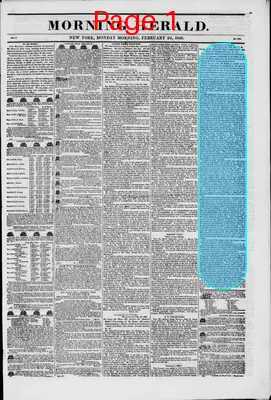
Story
February 24, 1840
Morning Herald
New York, New York County, New York
What is this article about?
In Philadelphia's Criminal Court on February 22, judges quashed indictments against Schuylkill Bank fraud conspirators, citing illegal grand jury formation. Defense used depositions, including from juror Peter Fritz. Attorney General Brooke announces intent to restart proceedings.
Clipping
OCR Quality
95%
Excellent
Full Text
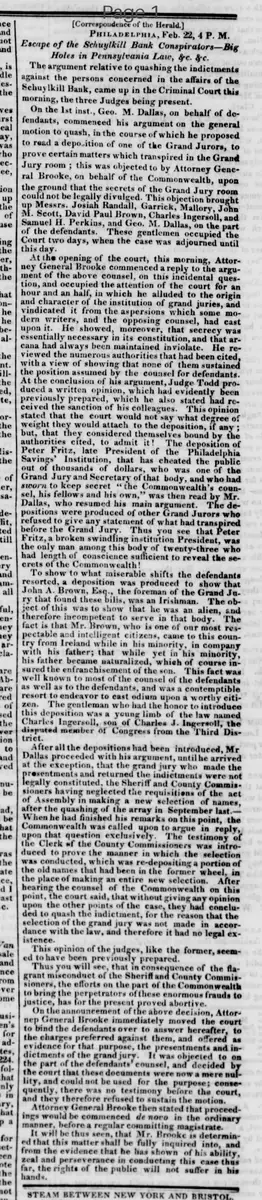
[Correspondence of the Herald.]
Philadelphia, Feb. 22, 4 P. M.
Escape of the Schuylkill Bank Conspirators—Big Holes in Pennsylvania Law, &c. &c.
The argument relative to quashing the indictments against the persons concerned in the affairs of the Schuylkill Bank, came up in the Criminal Court this morning, the three Judges being present.
On the 1st inst., Geo. M. Dallas, on behalf of defendants, commenced his argument on the general motion to quash, in the course of which he proposed to read a deposition of one of the Grand Jurors, to prove certain matters which transpired in the Grand Jury room ; this was objected to by Attorney General Brooke, on behalf of the Commonwealth, upon the ground that the secrets of the Grand Jury room could not be legally divulged. This objection brought up Messrs. Josiah Randall, Garrick, Mallory, John M. Scott, David Paul Brown, Charles Ingersoll, and Samuel H. Perkins, and Geo. M. Dallas, on the part of the defendants. These gentlemen occupied the Court two days, when the case was adjourned until this day.
At the opening of the court, this morning, Attorney General Brooke commenced a reply to the argument of the above counsel, on this incidental question, and occupied the attention of the court for an hour and a half, in which he alluded to the origin and character of the institution of grand juries, and vindicated it from the aspersions which some modern writers, and the opposing counsel, had cast upon it. He showed, moreover, that secrecy was essentially necessary in its constitution, and that arcana had always been maintained inviolate. He reviewed the numerous authorities that had been cited, with a view of showing that none of them sustained the position assumed by the counsel for defendants.
At the conclusion of his argument, Judge Todd produced a written opinion, which had evidently been previously prepared, which he also stated had received the sanction of his colleagues. This opinion stated that the court would not say what degree of weight they would attach to the deposition, if any; but, that they considered themselves bound by the authorities cited, to admit it! The deposition of Peter Fritz, late President of the Philadelphia Savings' Institution, that has cheated the public out of thousands of dollars, who was one of the Grand Jury and Secretary of that body, and who had sworn to keep secret "the Commonwealth's counsel, his fellows and his own," was then read by Mr. Dallas, who resumed his main argument. The depositions were produced of other Grand Jurors who refused to give any statement of what had transpired before the Grand Jury. Thus you see that Peter Fritz, a broken swindling institution President, was the only man among this body of twenty-three who had length of conscience sufficient to reveal the secrets of the Commonwealth!
To show to what miserable shifts the defendants resorted, a deposition was produced to show that John A. Brown, Esq., the foreman of the Grand Jury that found these bills, was an Irishman. The object of this was to show that he was an alien, and therefore incompetent to serve in that body. The fact is that Mr. Brown, who is one of our most respectable and intelligent citizens, came to this country from Ireland while in his minority, in company with his father; that while yet in his minority, his father became naturalized, which of course insured the enfranchisement of the son. This fact was well known to most of the counsel of the defendants as well as to the defendants, and was a contemptible resort to endeavor to cast odium upon a worthy citizen. The gentleman who had the honor to introduce this deposition was a young limb of the law named Charles Ingersoll, son of Charles J. Ingersoll, the disputed member of Congress from the Third District.
After all the depositions had been introduced, Mr Dallas proceeded with his argument, until he arrived at the exception, that the grand jury who made the presentments and returned the indictments were not legally constituted, the Sheriff and County Commissioners having neglected the requisitions of the act of Assembly in making a new selection of names, after the quashing of the array in September last.—
When he had finished his remarks on this point, the Commonwealth was called upon to argue in reply, upon that question exclusively. The testimony of the Clerk of the County Commissioners was introduced to prove the manner in which the selection was conducted, which was re-depositing a portion of the old names that had been in the former wheel, in the place of making an entire new selection. After hearing the counsel of the Commonwealth on this point, the court said, that without giving any opinion upon the other points of the case, they had concluded to quash the indictment, for the reason that the selection of the grand jury was not made in accordance with the law, and therefore it had no legal existence.
This opinion of the judges, like the former, seemed to have been previously prepared.
Thus you will see, that in consequence of the flagrant misconduct of the Sheriff and County Commissioners, the efforts on the part of the Commonwealth to bring the perpetrators of these enormous frauds to justice, has for the present proved abortive.
On the announcement of the above decision, Attorney General Brooke immediately moved the court to bind the defendants over to answer hereafter, to the charges preferred against them, and offered as evidence for that purpose, the presentments and indictments of the grand jury. It was objected to on the part of the defendants' counsel, and decided by the court that these documents were now a mere nullity, and could not be used for the purpose; consequently, there was no testimony before the court, and they therefore refused to sustain the motion.
Attorney General Brooke then stated that proceedings would be commenced de novo in the ordinary manner, before a regular committing magistrate.
It will be thus seen, that Mr. Brooke is determined that this matter shall be fully inquired into, and from the evidence that he has shown of his ability, zeal and perseverance in conducting this case thus far, the rights of the public will not suffer in his hands.
Philadelphia, Feb. 22, 4 P. M.
Escape of the Schuylkill Bank Conspirators—Big Holes in Pennsylvania Law, &c. &c.
The argument relative to quashing the indictments against the persons concerned in the affairs of the Schuylkill Bank, came up in the Criminal Court this morning, the three Judges being present.
On the 1st inst., Geo. M. Dallas, on behalf of defendants, commenced his argument on the general motion to quash, in the course of which he proposed to read a deposition of one of the Grand Jurors, to prove certain matters which transpired in the Grand Jury room ; this was objected to by Attorney General Brooke, on behalf of the Commonwealth, upon the ground that the secrets of the Grand Jury room could not be legally divulged. This objection brought up Messrs. Josiah Randall, Garrick, Mallory, John M. Scott, David Paul Brown, Charles Ingersoll, and Samuel H. Perkins, and Geo. M. Dallas, on the part of the defendants. These gentlemen occupied the Court two days, when the case was adjourned until this day.
At the opening of the court, this morning, Attorney General Brooke commenced a reply to the argument of the above counsel, on this incidental question, and occupied the attention of the court for an hour and a half, in which he alluded to the origin and character of the institution of grand juries, and vindicated it from the aspersions which some modern writers, and the opposing counsel, had cast upon it. He showed, moreover, that secrecy was essentially necessary in its constitution, and that arcana had always been maintained inviolate. He reviewed the numerous authorities that had been cited, with a view of showing that none of them sustained the position assumed by the counsel for defendants.
At the conclusion of his argument, Judge Todd produced a written opinion, which had evidently been previously prepared, which he also stated had received the sanction of his colleagues. This opinion stated that the court would not say what degree of weight they would attach to the deposition, if any; but, that they considered themselves bound by the authorities cited, to admit it! The deposition of Peter Fritz, late President of the Philadelphia Savings' Institution, that has cheated the public out of thousands of dollars, who was one of the Grand Jury and Secretary of that body, and who had sworn to keep secret "the Commonwealth's counsel, his fellows and his own," was then read by Mr. Dallas, who resumed his main argument. The depositions were produced of other Grand Jurors who refused to give any statement of what had transpired before the Grand Jury. Thus you see that Peter Fritz, a broken swindling institution President, was the only man among this body of twenty-three who had length of conscience sufficient to reveal the secrets of the Commonwealth!
To show to what miserable shifts the defendants resorted, a deposition was produced to show that John A. Brown, Esq., the foreman of the Grand Jury that found these bills, was an Irishman. The object of this was to show that he was an alien, and therefore incompetent to serve in that body. The fact is that Mr. Brown, who is one of our most respectable and intelligent citizens, came to this country from Ireland while in his minority, in company with his father; that while yet in his minority, his father became naturalized, which of course insured the enfranchisement of the son. This fact was well known to most of the counsel of the defendants as well as to the defendants, and was a contemptible resort to endeavor to cast odium upon a worthy citizen. The gentleman who had the honor to introduce this deposition was a young limb of the law named Charles Ingersoll, son of Charles J. Ingersoll, the disputed member of Congress from the Third District.
After all the depositions had been introduced, Mr Dallas proceeded with his argument, until he arrived at the exception, that the grand jury who made the presentments and returned the indictments were not legally constituted, the Sheriff and County Commissioners having neglected the requisitions of the act of Assembly in making a new selection of names, after the quashing of the array in September last.—
When he had finished his remarks on this point, the Commonwealth was called upon to argue in reply, upon that question exclusively. The testimony of the Clerk of the County Commissioners was introduced to prove the manner in which the selection was conducted, which was re-depositing a portion of the old names that had been in the former wheel, in the place of making an entire new selection. After hearing the counsel of the Commonwealth on this point, the court said, that without giving any opinion upon the other points of the case, they had concluded to quash the indictment, for the reason that the selection of the grand jury was not made in accordance with the law, and therefore it had no legal existence.
This opinion of the judges, like the former, seemed to have been previously prepared.
Thus you will see, that in consequence of the flagrant misconduct of the Sheriff and County Commissioners, the efforts on the part of the Commonwealth to bring the perpetrators of these enormous frauds to justice, has for the present proved abortive.
On the announcement of the above decision, Attorney General Brooke immediately moved the court to bind the defendants over to answer hereafter, to the charges preferred against them, and offered as evidence for that purpose, the presentments and indictments of the grand jury. It was objected to on the part of the defendants' counsel, and decided by the court that these documents were now a mere nullity, and could not be used for the purpose; consequently, there was no testimony before the court, and they therefore refused to sustain the motion.
Attorney General Brooke then stated that proceedings would be commenced de novo in the ordinary manner, before a regular committing magistrate.
It will be thus seen, that Mr. Brooke is determined that this matter shall be fully inquired into, and from the evidence that he has shown of his ability, zeal and perseverance in conducting this case thus far, the rights of the public will not suffer in his hands.
What sub-type of article is it?
Crime Story
Deception Fraud
Historical Event
What themes does it cover?
Crime Punishment
Deception
Justice
What keywords are associated?
Schuylkill Bank
Conspirators
Grand Jury
Indictments Quashed
Legal Fraud
Court Arguments
What entities or persons were involved?
Geo. M. Dallas
Attorney General Brooke
Peter Fritz
John A. Brown
Charles Ingersoll
Judge Todd
Where did it happen?
Philadelphia
Story Details
Key Persons
Geo. M. Dallas
Attorney General Brooke
Peter Fritz
John A. Brown
Charles Ingersoll
Judge Todd
Location
Philadelphia
Event Date
February 22
Story Details
Arguments in court lead to quashing of indictments against Schuylkill Bank conspirators due to improper grand jury selection by Sheriff and County Commissioners; deposition of grand juror Peter Fritz reveals secrets; Attorney General Brooke plans new proceedings before a magistrate.