Thank you for visiting SNEWPapers!
Sign up free
Letter to Editor
May 28, 1822
The New Hampshire Gazette
Portsmouth, Rockingham County, New Hampshire
What is this article about?
A pseudonymous writer, 'Spirit of '76,' responds to an advocate for establishing a law term and granting courts power to set aside jury verdicts, arguing that such measures contradict American constitutional principles and common sense, favoring jury autonomy over English legal precedents.
Clipping
OCR Quality
98%
Excellent
Full Text
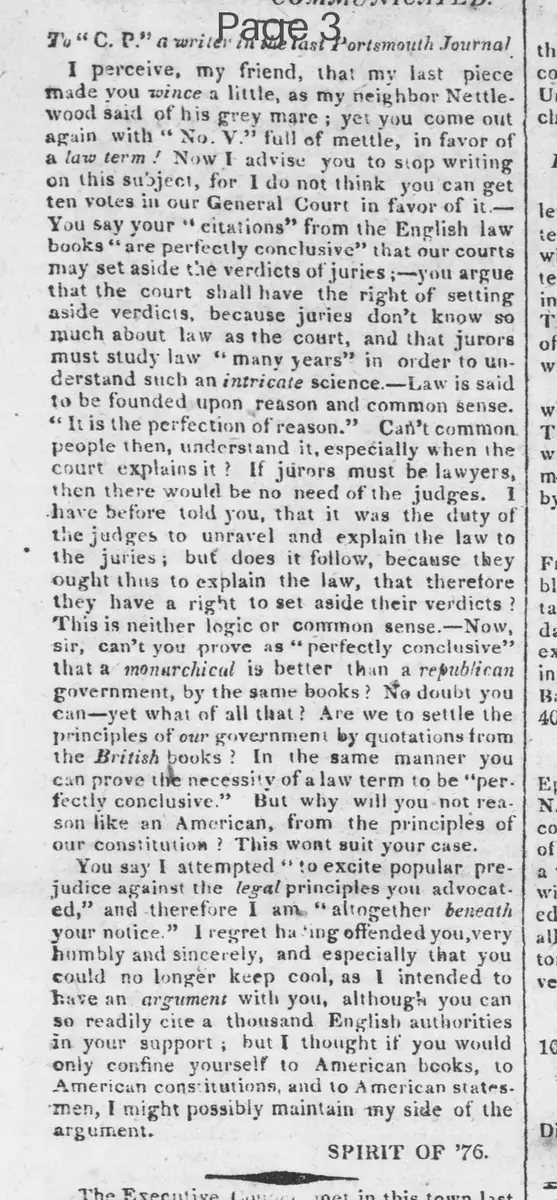
A writer in the last Portsmouth Journal, I perceive, my friend, that my last piece made you wince a little, as my neighbor Nettlewood said of his grey mare; yet you come out again with "No. V." full of mettle, in favor of a law term! Now I advise you to stop writing on this subject, for I do not think you can get ten votes in our General Court in favor of it. You say your "citations" from the English law books "are perfectly conclusive" that our courts may set aside the verdicts of juries;—you argue that the court shall have the right of setting aside verdicts, because juries don't know so much about law as the court, and that jurors must study law "many years" in order to understand such an intricate science.—Law is said to be founded upon reason and common sense. "It is the perfection of reason." Can't common people then, understand it, especially when the court explains it? If jurors must be lawyers, then there would be no need of the judges. I have before told you, that it was the duty of the judges to unravel and explain the law to the juries; but does it follow, because they ought thus to explain the law, that therefore they have a right to set aside their verdicts? This is neither logic or common sense.—Now, sir, can't you prove as "perfectly conclusive" that a monarchical is better than a republican government, by the same books? No doubt you can—yet what of all that? Are we to settle the principles of our government by quotations from the British books? In the same manner you can prove the necessity of a law term to be "perfectly conclusive." But why will you not reason like an American, from the principles of our constitution? This won't suit your case. You say I attempted "to excite popular prejudice against the legal principles you advocated," and therefore I am "altogether beneath your notice." I regret having offended you, very humbly and sincerely, and especially that you could no longer keep cool, as I intended to have an argument with you, although you can so readily cite a thousand English authorities in your support; but I thought if you would only confine yourself to American books, to American constitutions, and to American statesmen, I might possibly maintain my side of the argument.
SPIRIT OF '76.
SPIRIT OF '76.
What sub-type of article is it?
Persuasive
Political
Philosophical
What themes does it cover?
Constitutional Rights
Politics
What keywords are associated?
Law Term
Jury Verdicts
American Constitution
English Law Books
General Court
Common Sense
Republican Government
What entities or persons were involved?
Spirit Of '76.
Letter to Editor Details
Author
Spirit Of '76.
Main Argument
opposes establishing a law term and empowering courts to override jury verdicts, asserting that law is based on reason accessible to common people and that arguments should derive from american constitutional principles, not english legal precedents.
Notable Details
Cites English Law Books As Inconclusive For American Context
References 'Spirit Of '76' Pseudonym Evoking Revolutionary Era
Argues Judges Should Explain Law To Juries Without Overriding Verdicts