Thank you for visiting SNEWPapers!
Sign up free
Watchman Of The South
Richmond, Virginia
What is this article about?
Alfred Moritz Myers, a Prussian Jew trained for the rabbinate, relocates to Liverpool in June 1830, grapples with Talmud doubts, discovers messianic prophecies in Hebrew Bible, studies New Testament amid persecution, and converts to Christianity after six months of spiritual turmoil.
Clipping
OCR Quality
Full Text
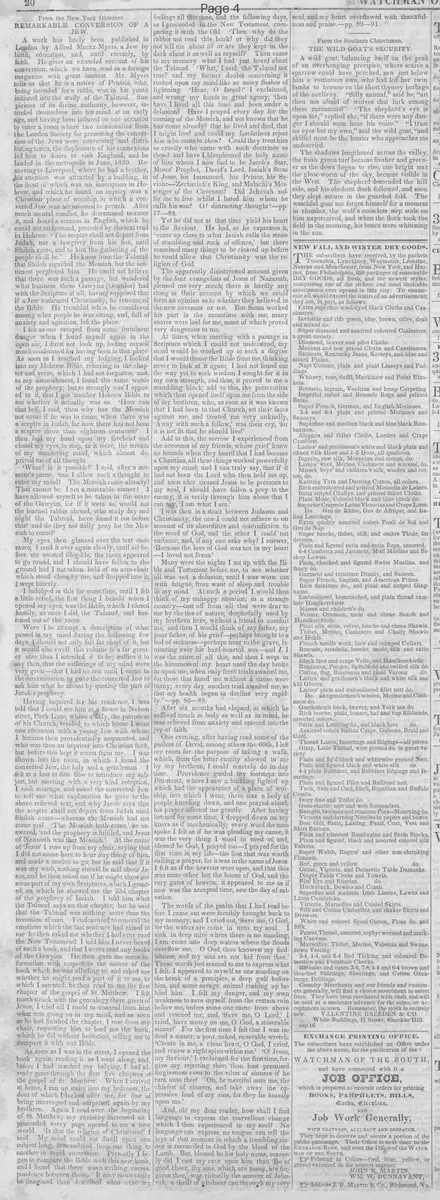
REMARKABLE CONVERSION OF A JEW.
A work has lately been published in London by Alfred Moritz Myers, a Jew by birth, education, and, until recently, by faith. He gives an extended account of his conversion, which we have read in a foreign magazine with great interest. Mr. Myers tells us that he is a native of Prussia, who, being intended for a rabbi, was in his youth initiated into the study of the Talmud. Suspicions of its divine authority, however, intruded themselves into his mind at an early age, and having been induced on one occasion to enter a room where two missionaries from the London Society for promoting the conversion of the Jews were conversing and distributing tracts, the displeasure of his connexions led him to desire to visit England, and he landed in the metropolis in June, 1830. Removing to Liverpool, where he had a brother, his attention was attracted by a building, in the front of which was an inscription in Hebrew, and which he found on inquiry was a Christian place of worship, in which a converted Jew was accustomed to preach. After much mental conflict, he determined to enter it, and heard a sermon in English, which he could not understand, preceded by the text read in Hebrew: "The sceptre shall not depart from Judah, nor a lawgiver from his feet, until Shiloh come, and to him the gathering of the people shall be." He knew from the Talmud that Shiloh signified the Messiah, but the sentiment perplexed him. He could not believe that there was such a passage, but wondered what business these Gawyim (Gentiles) had with the Scripture at all, having supposed that if a Jew embraced Christianity, he renounced the Bible. He trembled when he considered among what people he was sitting, and, full of anxiety and agitation, left the place.
I felt as one escaped from some imminent danger when I found myself again in the open air; I durst not look up, feeling myself much condemned for having been in that place. As soon as I reached my lodging, I looked into my Hebrew Bible, referring to the chapter and verse, which I had not forgotten; and to my astonishment, I found the same words of the prophecy; but so strongly was I opposed to it, that I got another Hebrew Bible to see whether it actually was so. 'How can that be?' I said; then why has the Messiah not come if he was to come, when there was a sceptre in Judah, for now there has not been a sceptre more than eighteen centuries?' I then laid my hand upon my forehead and closed my eyes, to stop, as it were, the stream of my wandering mind, which almost deprived me of all thought.
'What! is it possible?' I said, after a moment's pause, 'can I allow such a thought to enter my mind? The Messiah come already? That cannot be: I am a miserable sinner! I have allowed myself to be taken in the snare of the Gawyim, for if it were so, would not the learned rabbis abroad, who study day and night the Talmud, have found it out before this? and do they not daily pray for the Messiah to come?'
My eyes then glanced over the text once more; I read it over again slowly, until all before me seemed illegible; the room appeared to go round, and I should have fallen to the ground had I not taken hold of an arm-chair which stood close by me, and dropped into it: I wept bitterly.
I indulged in this for some time, until I felt a little relief: the first thing I beheld when I opened my eyes, was the Bible, which I closed hastily, as once I did the Talmud, and hastened out of the room.
Were I to attempt a description of what passed in my mind during the following few days, I should not only fall far short of it, but it would also swell this volume to a far greater size than I intended it to be; suffice it to say then, that the sufferings of my mind were very great—that I had no rest until I came to the determination to go to the converted Jew to ask him what he meant by quoting the part of Jacob's prophecy.
Having inquired for his residence, I was told that I could see him at a house in Nelson street, Park Lane, where a lady, the patroness of his Church, resided: to which house I went one afternoon with a young Jew with whom I became then providentially acquainted, and who was then an inquirer into Christian faith, but before this kept it secret from me. I was shown into the room, in which I found the converted Jew, the lady and a gentleman. I felt at a loss at first how to introduce my subject, but meeting with a very kind reception, I took courage, and asked the converted Jew to tell me what explanation he gave to the above referred text, and why Jacob says that the sceptre shall not depart from Judah until Shiloh come—whereas the Messiah had not come yet? 'The Messiah hath come,' he answered, 'and the prophecy is fulfilled, and Jesus of Nazareth was that Messiah.' At the name of Jesus I rose up from my chair, saying that I did not come here to hear any thing of him, and made a motion to go; but he said that if it was my wish, nothing should be said about Jesus, and he then asked me if he might show me some part of my own Scriptures, which I granted; on which he showed me the 53d chapter of the prophecy of Isaiah. I told him what the Talmud says on that chapter; but he said that the Talmud was nothing more than the invention of man. I endeavored to conceal the emotions which the last sentence had raised in me he then asked me whether I had ever read the New Testament? I told him I never heard of such a book, and that I never read any books of the Gawyim. He then gave me some information with respect to the nature of the book which he was alluding to, and asked me whether he might read a part of it to me, to which I assented: he then read to me the first chapter of the gospel of St. Matthew. I felt much struck with the genealogy there given of Jesus; I tried all I could to conceal from him what was going on in my mind, and as soon as he had finished the chapter, I rose from my chair, requesting him to lend me the book, which he did without hesitation, telling me to compare it with our Bible.
As soon as I was in the street, I opened the book again, reading it as I went along, and before I had reached my lodging, I had already gone through the first five chapters of the gospel of St. Matthew. When I arrived at home, I ran up stairs into my bedroom, the door of which I locked after me, for fear of being interrupted and surprised again by my brethren. Again I read over the beginning of St. Matthew; my curiosity increased as I proceeded; every page opened to me a new world. 'Is that the religion of Christians?' I said. My mind could not dwell upon one subject long; it wandered from one thing to another in rapid succession. Presently I began to compare the Bible with this new book, and I found that there was a striking correspondence between them. It may more easily be imagined than described what were my feelings all this time, and the following days, as I proceeded in the New Testament, comparing it with the Old. 'Then why do the rabbis not read this book? or why did they not tell me about it? or are they kept in the dark about it as well as myself?' Then came to my memory what I had just heard about the Talmud. 'What,' I said, the Talmud not true?' and my former doubts concerning it rushed upon my mind like so many flashes of lightning. 'Hear, O Israel!' I exclaimed, and wrung my hands in great agony; then have I lived all this time and been under a delusion? Have I prayed every day for the coming of the Messiah, and not known that he has come already? that he lived and died, that I might live? and could my forefathers reject him who came to them? Could they treat him so cruelly who came with such doctrines as these? and have I blasphemed the holy name of him whom I now find to be Jacob's Star, Moses' Prophet, David's Lord, Isaiah's Stem of Jesse, his Immanuel, his Prince, his Saviour—Zechariah's King, and Malachi's Messenger of the Covenant? Did Jehovah suffer me to live whilst I hated him whom he calls his son? O! distracting thought!—pp. 77-82.
Yet he did not at that time yield his heart to the Saviour. He had, as he expresses it, "come up close to what Isaiah calls the stone of stumbling and rock of offence," but there remained many things to be cleared up before he could allow that Christianity was the religion of God.
The apparently disinterested account given by the four evangelists of Jesus of Nazareth, pleased me very much; there is hardly any thing in their account by which we could form an opinion as to whether they believed in the new covenant or not. But Satan worked his part in the meantime with me; many snares were laid for me, some of which proved very dangerous to me.
At times, when meeting with a passage in Scripture which I could not understand, my mind would be worked up to such a degree that I would throw the Bible from me, thinking never to look at it again; I had not found out the way yet to seek wisdom I sought for it in my own strength, and thus, it proved to me a stumbling block; add to this, the persecution which then opened itself upon me from the side of my brethren, who, as soon as it was known that I had been to that Church, set their faces against me, and treated me very unkindly, 'Away with such a fellow,' was their cry, 'for it is not fit that he should live!'
Add to this, the sorrow I experienced from the accounts of my friends, whose grief knew no bounds when they heard that I had become a Christian, all these things worked powerfully upon my mind; and I can truly say, that if it had not been the Lord who then held me up, and soon after caused Jesus to be precious to my soul, I should have fallen a prey to the enemy; it is verily through him alone that I can say, 'I am what I am.'
I was then in a strait between Judaism and Christianity: the one I could not adhere to on account of its absurdities and contradiction to the word of God, and the other I could not embrace; and, if any one asks why? I answer 'Because the love of God was not in my heart—I loved not Jesus.'
Many were the nights I sat up with the Bible and Testament before me, to see whether all was not a delusion, until I was worn out with fatigue, from want of sleep and trouble in my mind. At such a period I would then think of my unhappy situation; in a strange country—cast off from all that were dear to me by the ties of nature; despitefully used by my brethren here, without a friend to comfort me; and then I would think of my father, my poor father, of his grief—perhaps brought to a bed of sickness—perhaps near to the grave, lamenting over his hard-hearted son—and I, I was the cause of all this; and then I wept in the bitterness of my heart until the day broke in upon me, when only fresh trials awaited me, for those that hated me without a cause were many; every day another trial awaited me, so that my health began to decline very rapidly.—pp. 86–88.
After six months had elapsed, in which he suffered much in body as well as in mind, he was relieved from anxiety and entered into the joy of faith.
One evening, after having read some of the psalms of David, among others the 69th, I left my room for the purpose of taking a walk, which, from the bitter enmity showed to me by my brethren, I could scarcely do in day time. Providence guided my footsteps into Pitt-street, where I saw a building lighted up which had the appearance of a place of worship, into which I went; there was a body of people kneeling down, and one prayed aloud; his prayer affected me greatly. After having listened for some time, I dropped down on my knees as if mechanically; every word the man spoke I felt as if he was pleading my cause; it was the very thing I stood in need of, and, blessed be God, I prayed too—I prayed for the first time in my life—the first that was worth calling a prayer, for it was in the name of Jesus.
I felt as if the heavens were open, and that this was none other but the house of God, and the very gates of heaven; it appeared to me as if now was the accepted time, now the day of salvation.
The words of the psalm that I had read before I came out were forcibly brought back to my memory, and I cried out, 'Save me, O God, for the waters are come in unto my soul. I sink in deep mire where there is no standing; I am come into deep waters where the floods overflow me. O God, thou knowest my foolishness, and my sins are not hid from thee.'
These words just seemed to me to express what I felt: I appeared to myself as one standing on the brink of a precipice, a deep gulf before him, and some savage animal rushing up behind him. I felt my danger, and my own weakness to save myself from the certain ruin before me, unless some one came from above and rescued me; and, 'Save me, O Lord,' I cried, 'have mercy on me, O God, a miserable sinner!' For the first time I felt that I was indeed a sinner; a poor, naked, miserable wretch. 'Create in me a clean heart, O God,' I cried, 'and renew a right spirit within me.' 'O! Jesus, my Saviour,' I exclaimed for the first time, 'forgive my rejecting thee; thou hast promised forgiveness even to the vilest of sinners if he turn unto thee! Oh, be merciful unto me, the chiefest of sinners, and take away the oppressive load of my sins, for they lie heavily upon me.'
And, oh! my dear reader, how shall I find language to express the marvellous change which I then experienced in my soul? No language can express, no tongue can tell the joys of that moment in which a trembling sinner is reconciled to God by the blood of the Lamb. But, blessed be his holy name, scarcely did I cast my care upon him than 'Be of good cheer, thy sins, which are many, are forgiven thee,' was virtually the answer of Jehovah; a thrill of gladness ran through my very soul, and my heart overflowed with thankfulness and praise.—pp. 89–91.
What sub-type of article is it?
What themes does it cover?
What keywords are associated?
What entities or persons were involved?
Where did it happen?
Story Details
Key Persons
Location
Liverpool, England
Event Date
June 1830 (After Six Months)
Story Details
Alfred Moritz Myers, a Prussian Jew trained as a rabbi, doubts the Talmud early on, moves to England in June 1830, attends a Christian service in Liverpool, discovers messianic prophecies in the Hebrew Bible, studies the New Testament despite initial resistance and persecution from his community, and after six months of mental and physical suffering, experiences a profound conversion during a prayer meeting in Pitt-street.