Thank you for visiting SNEWPapers!
Sign up free
Editorial
January 16, 1819
Richmond Enquirer
Richmond, Richmond County, Virginia
What is this article about?
Editorial critiques the minority protest on General Jackson's unauthorized occupation of Spanish posts in Florida, arguing it violates constitutional authority of Congress over acts of war and territorial detention. Calls for congressional sanction instead of executive overreach.
Clipping
OCR Quality
90%
Excellent
Full Text
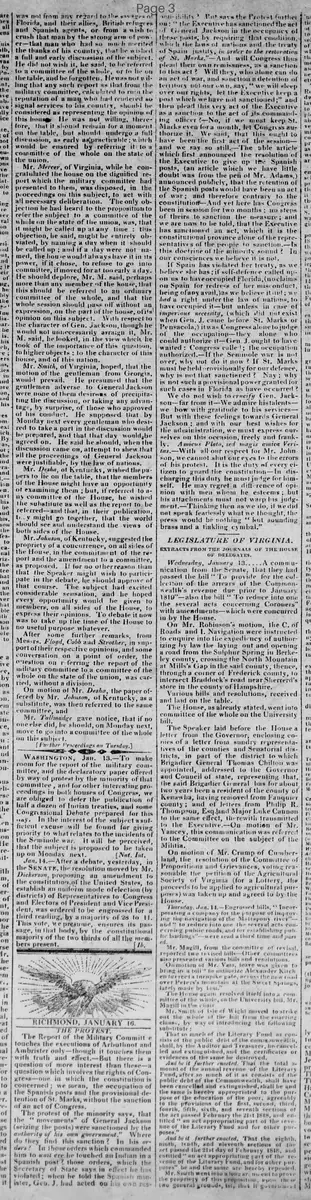
RICHMOND, JANUARY 16.
THE PROTEST.
The Report of the Military Committee touches the executions of Arbuthnot and Ambrister only—though it touches them with truth and effect.—But there is a question of more interest than these—a question which involves the rights of Congress—one in which the constitution is concerned: we mean, the occupation of the Spanish posts and the provisional detention of St. Marks, without the sanction of an act of Congress.
The protest of the minority says, that the "movements" of General Jackson (seizing the posts) were sanctioned by the authority of his own government." Where do they find this sanction? In his orders? In those orders which commanded him to wait ere he touched an Indian in a Spanish post? those orders, which the Secretary of State says in effect he has violated; when he told the Spanish minister, Gen. J. had acted on his own responsibility? But says the Protest for that one: " the Executive has sanctioned the act of General Jackson in the occupancy of those posts; by requiring that condition, which the laws of nations and the treaty of Spain justify, in order to the restoration of St. Marks."
—And will Congress thus plead their own remissness, as a sanction to this act? Will they, who alone can do an act of war, and sanction a detention of territory not our own, say, " we will sleep over our rights, let the Executive keep a post which we have not sanctioned;" and then plead this very act of the Executive as a sanction to the act of its commanding officer? No, if we must keep St. Marks even for a month, let Congress authorize it. We said, that this ought to have been the first act of the session—and we say so still—The able article which first announced the resolution of the Executive to give up the Spanish posts, (an article which we have little doubt was from the pen of Mr. Adams.) announced publicly, that the retention of the Spanish posts would have been an act of war: and therefore contrary to the constitution—And yet here has Congress been in session for two months; no steps of theirs to sanction the measure; and we are now to be told, that the Executive has sanctioned an act, which it is the constitutional province alone of the representatives of the people to sanction.—Is this doctrine of the minority sound? In our consciences we believe it is not.
If Spain has violated her treaty, as we believe she has: if self-defence called upon us to have occupied Florida (no claims on Spain for redress of her misconduct being of any avail,) as we believe it did: we had a right under the law of nations, to have occupied it—but unless in case of imperious necessity, (which did not exist when Gen. J. came before St. Marks or Pensacola,) it was Congress alone to judge of the occupation—they alone "who could authorize it—Gen. J. ought to have waited: Congress called; the occupation authorized.—if the Seminole war is not over, why not do it now? If St. Marks must be held provisionally for our defence, why is not that sanctioned? Nay: why is not such a provisional power granted for such cases in Florida as have occurred?
We do not wish to crucify Gen. Jackson—far from it—We admire his talents—we bow with gratitude to his services—But with these feelings towards General Jackson: and with our best wishes for the administration, we must express ourselves on this occasion, freely and frankly. Amicus Plato, sed magis amica Veritas.—With all our respect for Mr. Johnson, we cannot shut our eyes to the errors of his protest. It is the duty of every citizen to guard the constitution—In discharging this duty he must judge for himself. He may regret a difference of opinion with men whom he esteems; but his attachments must not warp his judgment.—Thinking then as we do, if we did not speak fearlessly what we thought, the press would be nothing " but sounding brass and a tinkling cymbal."
THE PROTEST.
The Report of the Military Committee touches the executions of Arbuthnot and Ambrister only—though it touches them with truth and effect.—But there is a question of more interest than these—a question which involves the rights of Congress—one in which the constitution is concerned: we mean, the occupation of the Spanish posts and the provisional detention of St. Marks, without the sanction of an act of Congress.
The protest of the minority says, that the "movements" of General Jackson (seizing the posts) were sanctioned by the authority of his own government." Where do they find this sanction? In his orders? In those orders which commanded him to wait ere he touched an Indian in a Spanish post? those orders, which the Secretary of State says in effect he has violated; when he told the Spanish minister, Gen. J. had acted on his own responsibility? But says the Protest for that one: " the Executive has sanctioned the act of General Jackson in the occupancy of those posts; by requiring that condition, which the laws of nations and the treaty of Spain justify, in order to the restoration of St. Marks."
—And will Congress thus plead their own remissness, as a sanction to this act? Will they, who alone can do an act of war, and sanction a detention of territory not our own, say, " we will sleep over our rights, let the Executive keep a post which we have not sanctioned;" and then plead this very act of the Executive as a sanction to the act of its commanding officer? No, if we must keep St. Marks even for a month, let Congress authorize it. We said, that this ought to have been the first act of the session—and we say so still—The able article which first announced the resolution of the Executive to give up the Spanish posts, (an article which we have little doubt was from the pen of Mr. Adams.) announced publicly, that the retention of the Spanish posts would have been an act of war: and therefore contrary to the constitution—And yet here has Congress been in session for two months; no steps of theirs to sanction the measure; and we are now to be told, that the Executive has sanctioned an act, which it is the constitutional province alone of the representatives of the people to sanction.—Is this doctrine of the minority sound? In our consciences we believe it is not.
If Spain has violated her treaty, as we believe she has: if self-defence called upon us to have occupied Florida (no claims on Spain for redress of her misconduct being of any avail,) as we believe it did: we had a right under the law of nations, to have occupied it—but unless in case of imperious necessity, (which did not exist when Gen. J. came before St. Marks or Pensacola,) it was Congress alone to judge of the occupation—they alone "who could authorize it—Gen. J. ought to have waited: Congress called; the occupation authorized.—if the Seminole war is not over, why not do it now? If St. Marks must be held provisionally for our defence, why is not that sanctioned? Nay: why is not such a provisional power granted for such cases in Florida as have occurred?
We do not wish to crucify Gen. Jackson—far from it—We admire his talents—we bow with gratitude to his services—But with these feelings towards General Jackson: and with our best wishes for the administration, we must express ourselves on this occasion, freely and frankly. Amicus Plato, sed magis amica Veritas.—With all our respect for Mr. Johnson, we cannot shut our eyes to the errors of his protest. It is the duty of every citizen to guard the constitution—In discharging this duty he must judge for himself. He may regret a difference of opinion with men whom he esteems; but his attachments must not warp his judgment.—Thinking then as we do, if we did not speak fearlessly what we thought, the press would be nothing " but sounding brass and a tinkling cymbal."
What sub-type of article is it?
Constitutional
Foreign Affairs
Military Affairs
What keywords are associated?
Spanish Posts
St Marks
General Jackson
Congressional Authority
Executive Sanction
Florida Occupation
Seminole War
What entities or persons were involved?
General Jackson
Congress
Executive
Mr. Adams
Mr. Johnson
Spain
Editorial Details
Primary Topic
Constitutional Authority Over Occupation Of Spanish Posts In Florida
Stance / Tone
Critical Of Executive Overreach And Minority Protest
Key Figures
General Jackson
Congress
Executive
Mr. Adams
Mr. Johnson
Spain
Key Arguments
Occupation Of Spanish Posts By General Jackson Lacked Congressional Sanction
Executive Cannot Authorize Acts Of War Reserved For Congress
Minority Protest's Claim Of Executive Sanction Is Unsound
Congress Should Authorize Provisional Detention Of St. Marks
General Jackson Violated Orders And Acted On Own Responsibility
Retention Of Posts Would Be An Act Of War Contrary To Constitution