Thank you for visiting SNEWPapers!
Sign up free
Lynchburg Virginian
Lynchburg, Virginia
What is this article about?
A committee appointed by Governor Thomas W. Gilmer investigates the Bank of Virginia in Richmond, uncovering a $544,116 deficit caused by the first teller's embezzlement through suppressed checks from 1838 to 1840. The report details assets, liabilities, and procedural lapses, dated June 13, 1840.
Clipping
OCR Quality
Full Text
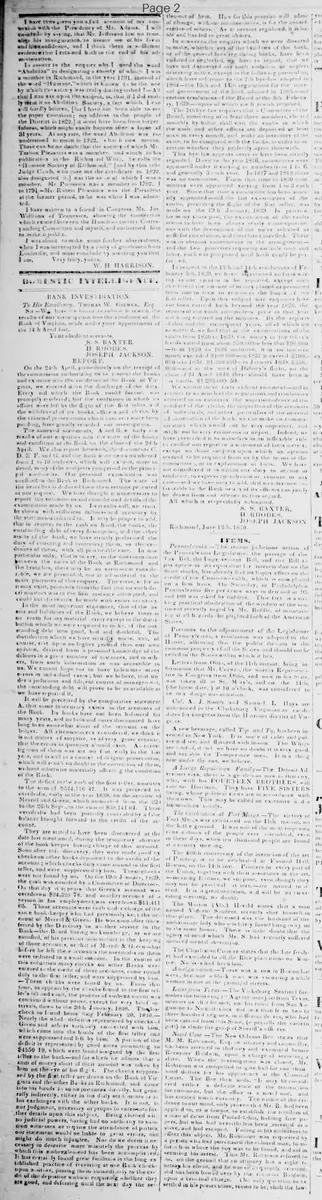
BANK INVESTIGATION.
To His Excellency, Thomas W. Gilmer, Esq.
Sir—We have the honor to submit herewith the results of our investigation into the condition of the Bank of Virginia, made under your appointment of the 14th April last.
Your obedient servants,
S.S. BAXTER,
H. RHODES,
JOSEPH JACKSON.
REPORT.
On the 24th April, immediately on the receipt of the commission authorizing us to inspect the books and examine into the condition of the Bank of Virginia, we entered upon the discharge of the duty. Every aid which the Bank could furnish, was promptly rendered; but the confusion in which its affairs were left by the flight of the first teller, and the withdrawal of its books, &c. and checks, by the criminal prosecutions which have since been pending, have greatly retarded our investigation.
The annexed statements, A and B, embody the results of our enquiries as to the state of the books and condition of the Bank at the close of the 20th April. We also report herewith, the documents C, D, E, F, and G, and the Bank's statements numbered from 1 to 10 inclusive, which will illustrate, more in detail, many of the subjects comprised in the printed statements. Our personal examination was confined to the Bank at Richmond. The state of the branches is deduced from their returns procured at our request. We have thought it unnecessary to report the voluminous and complicated details of the examination made by us. Its results will, we trust, be shown with sufficient fullness and accuracy in the statements referred to. It may be proper to add, that in respect to the cash on hand, the books, the outstanding debt of every description, and the other assets of the bank, we have strictly performed the duty of counting and inspecting them, or the evidences of them, with all practicable care. In one particular only, that is to say, in the discrimination between the notes of the Bank at Richmond and the branches, there may be an error—not considerable, we are persuaded, nor at all material to the main purposes of this enquiry. The error, if any exist, proceeds from the fact that no such discrimination was in the first instance attempted, and could not afterwards be made with entire accuracy.
In the most important statement, that of the assets and liabilities of the Bank, we believe there is no room for any material error except in the distribution which we were required to make, of the outstanding debt into good, bad and doubtful. The distribution which we have actually made, can, of course, rest upon no higher ground than our own opinion, derived from a personal knowledge of the debtors in a great number of instances, and in others, from such information as was accessible to us. We cannot hope not to have fallen into many errors in individual cases; but we believe, that under a judicious and diligent course of management, the outstanding debt will prove to be as available as we have reported it.
It will be perceived by the comparative statement A, that some inaccuracy exists in the accounts of the Bank. Its books have not been balanced for many years, and its bills and notes discounted have long been somewhat short of the account on the ledger. All circumstances considered, we think it is not a matter of surprise, or of very grave censure, that the errors in question should exist. Investigation of them was set on foot early in the last year, and is still in a course of diligent prosecution, which will result, no doubt, in the correction of them, without otherwise materially affecting the condition of the Bank.
The deficit in the cash of the first teller, amounts to the sum of $544,116 47. It was preceded by overdrafts, early in the year 1838, on the account of Merrill and Green, which amounted from the 22d to the 26th Sept., to the sum of $38,141 04. These overdrafts had been partially concealed by a false balance brought forward to the credit of the account.
They are stated to have been discovered at the date last mentioned, during the temporary absence of the book-keeper having charge of that account. Soon after this discovery, they were made good by checks on other banks deposited to the credit of the account; which checks duly came around to the first teller, and were suppressed by him. These checks were not found by us. On the 19th January, 1839, the cash was counted by a Committee of Directors. On that day it appears that Green's account was overdrawn $24,320 78, and another account of a person in his employment was overdrawn $11,411 05. These accounts were both under charge of the same book-keeper who had previously kept the account of Merrill & Green. He was soon after transferred by the Directory to another service in the Bank—the Board having no knowledge, as we are satisfied, of his previous misconduct in the keeping of those accounts, or that of Merrill & Green—but before he left these accounts the overdrafts on them were reduced to a small amount. In the course of this reduction many checks on other Banks were entered to the credit of these accounts, came round duly to the first teller, and were suppressed by him. These checks were found by us. From that time, as appears by the checks found in the first teller's till and vault, the process of embezzlement was continued without pause, except for very brief intervals, down to the 30th January, 1840. The last check so found bears date February 20, 1840. Nearly the whole deficit is represented by checks of Green and others variously connected with him, which came into the hands of the first teller and were suppressed and left by him. A portion of the deficit is represented by good notes amounting to $4550 19, which were found assigned by the first teller to the bank—and for which he admits that a sum of money short of their amount was taken by him on the eve of his flight. The checks suppressed by the first teller are drawn on the Bank of Virginia and the other Banks in Richmond, and came into his hands in some instances directly, but generally indirectly, either in his daily settlements or in his exchanges with the other banks. It is not, in our judgment, necessary or proper to enter into further details upon this subject. Being clothed with no judicial powers, having had no authority to summon witnesses or require the attendance of parties, our statement would be liable to great errors, and might do much injustice. Nor do we deem it necessary so to describe more minutely the process by which this embezzlement has been accomplished. It has certainly found great facilities in the long established practice of receiving at one Bank checks upon another, passing them immediately to the credit of the depositor without enquiring whether they are good, and deferring until the next day the settlement of them.
Upon this practice will admit of change, with such inconvenience, is for the consideration of others. As at present regulated, it is hazardous and has led to great abuses.
In answer to the enquiry which we were directed to make, whether any of the by-laws of the bank, or of the general laws regulating banks, have been violated or neglected, we have to report, that we have not discovered any such violation or neglect deserving notice, except in the following particulars, which have reference to the 13th and 14th regulations for the internal government of the bank, adopted in 1804—the 7th by-law adopted in 1816—a certain resolutions of the Board of the 5th February, 1839—copies of which are herewith returned.
The 7th by-law requires that a committee of the Board, consisting of at least three members, elected monthly by ballot, shall visit the vaults in which the cash and other effects are deposited at least once in every month, and make an inventory of the same, to be compared with the books, in order to ascertain whether they properly agree therewith.
This by-law appears never to have been strictly regarded. Down to the year 1816, committees were appointed under various numbers from 1 to 6, and generally 3 each. In 1817 and 1818 there was no committee. From that time to 1820 committees were appointed varying from 1 to 3 each year. Since that time a Committee has been annually appointed—and the last examination of the vaults, preceding the flight of the first teller, was made on the 19th January, 1839. In practice, for many years past, the examination of the vaults seems to have been almost nearly contemporaneous with the destruction of the notes selected as unfit for circulation, and therefore cancelled. There was an obvious convenience in the arrangement—and the two processes requiring no further time and labor, each was postponed until both could be put off.
In respect to the 13th and 14th resolutions of February 5th, 1839 we have obtained no facts worthy to be reported, except such as relate to the amount of money placed or permitted from time to time to remain in the hands of the second teller. Upon this subject our enquiries have not been carried back beyond the year 1820, the reports of the vault committees prior to that year not being entered on the minutes. By the reports of that and the subsequent years, all of which are so entered, we find that at the examinations of the vaults from 1820 to 1839 the money in the teller's hands varied from about $50,000 to less than $300,000—from 1830 to 1835 inclusive, in no instance much exceeded $100,000—in 1837 it exceeded $700,000—in 1838, $1,200,000—on January 18, 1839 $350,000—and at the time of Dunley's flight, on the close of 21 April 1840 there should have been in hands, $1,203,009 50.
We submit this fact without comment and in reference to some other of the regulations and resolutions referred to as concerns the superintendence of the conduct of the clerks, the inspection of the accounts of individuals, and other particulars of the internal administration of the bank, we can make no communication which would not be very imperfect, and might not be very erroneous or unjust. Indeed, we have prescribed to ourselves as an inflexible rule to confine our report to a statement of facts merely, except on those subjects upon which an opinion seemed to be required from us by the terms of the commission, or an explanation of facts. We have not considered it as within our duty to accuse or vindicate, to express approbation or censure in any case—and we have only to add, that no inference favorable to the Bank or any of its officers can justly be drawn from our silence in this regard.
All which is respectfully submitted.
S.S. BAXTER.
H. RHODES.
JOSEPH JACKSON
Richmond, June 13th, 1840.
What sub-type of article is it?
What keywords are associated?
What entities or persons were involved?
Where did it happen?
Domestic News Details
Primary Location
Richmond
Event Date
June 13, 1840
Key Persons
Outcome
deficit of $544,116.47 due to embezzlement by the first teller; procedural lapses in vault examinations and by-laws.
Event Details
Committee investigates Bank of Virginia following appointment on April 14, 1840, starting work April 24, 1840. Finds embezzlement via suppressed checks from 1838 to 1840, inaccuracies in accounts, and neglect of certain by-laws regarding vault inspections.