Thank you for visiting SNEWPapers!
Sign up free
The New Hampshire Gazette
Portsmouth, Rockingham County, New Hampshire
What is this article about?
Address by Matthew Clarkson to Philadelphia citizens, dated June 3, 1795, republished in Portsmouth in July, calling for collective reform of youth disorders through moral education, family discipline, and civic measures to enhance city order, reputation, and prevent crime.
Merged-components note: This is a continuation of the public address on the better government of youth by Matth. Clarkson, which spans from page 1 to page 4. The content is an opinion piece advocating for reform, fitting the editorial label better than the original 'story'.
Clippings
1 of 2
OCR Quality
Full Text
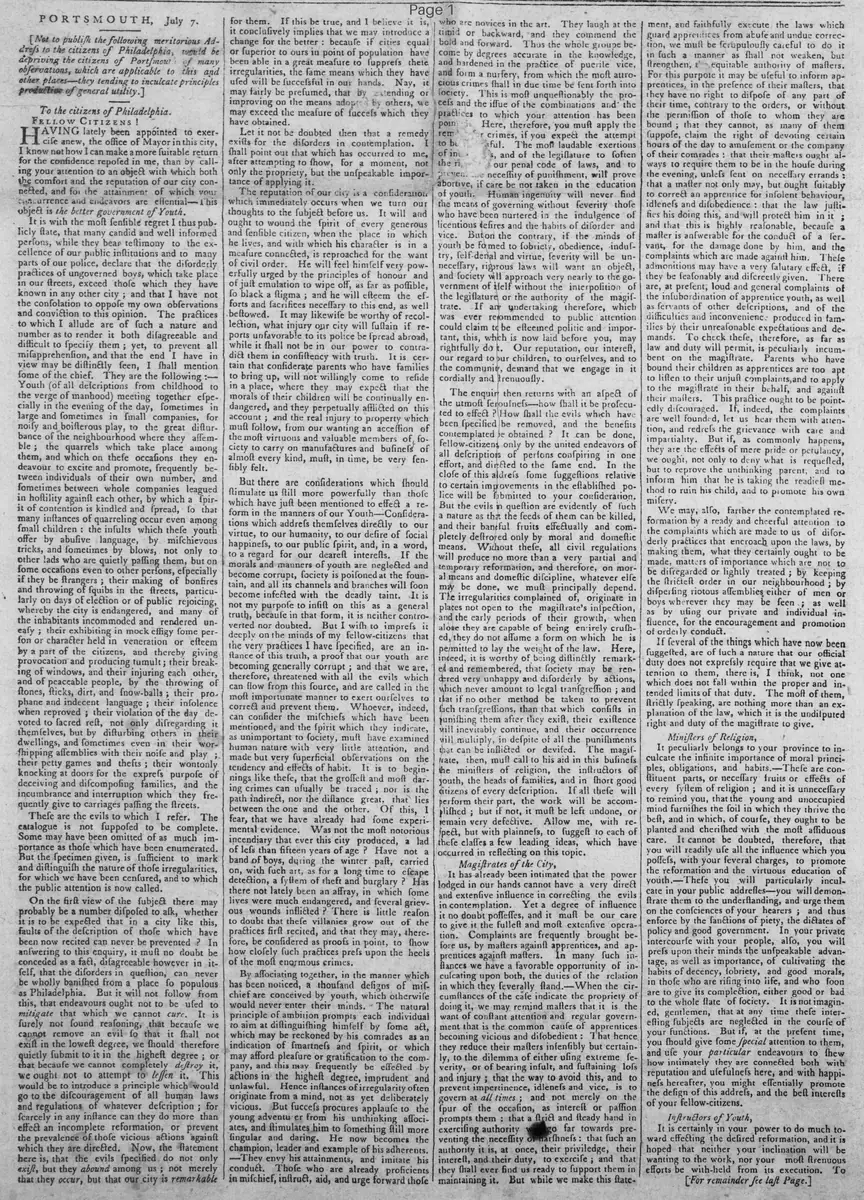
Not to publish the following meritorious Address to the citizens of Philadelphia, would be depriving the citizens of Portsmouth of many observations, which are applicable to this and other places—they tending to inculcate principles productive of general utility.
To the citizens of Philadelphia.
Fellow Citizens!
Having experienced your confidence,
I know not how I can make a more suitable return for the confidence reposed in me, than by calling your attention to an object with which both the comfort and the reputation of our city connected, and for the attainment of which your concurrence and endeavors are essential—this object is the better government of Youth.
It is with the most sensible regret I thus publicly state, that many candid and well informed persons, while they bear testimony to the excellence of our public institutions and to many parts of our police, declare that the disorderly practices of ungoverned boys, which take place in our streets, exceed those which they have known in any other city; and that I have not the consolation to oppose my own observations and conviction to this opinion. The practices to which I allude are of such a nature and number as to render it both disagreeable and difficult to specify them; yet, to prevent all misapprehension, and that the end I have in view may be distinctly seen, I shall mention some of the chief. They are the following:—
Youth (of all descriptions from childhood to the verge of manhood) meeting together especially in the evening of the day, sometimes in large and sometimes in small companies, for noisy and boisterous play, to the great disturbance of the neighbourhood where they assemble; the quarrels which take place among them, and which on these occasions they endeavour to excite and promote, frequently between individuals of their own number, and sometimes between whole companies leagued in hostility against each other, by which a spirit of contention is kindled and spread, so that many instances of quarreling occur even among small children: the insults which these youth offer by abusive language, by mischievous tricks, and sometimes by blows, not only to other lads who are quietly passing them, but on some occasions even to other persons, especially if they be strangers; their making of bonfires and throwing of squibs in the streets, particularly on days of election or of public rejoicing, whereby the city is endangered, and many of the inhabitants incommoded and rendered uneasy; their exhibiting in mock effigy some person or character held in veneration or esteem by a part of the citizens, and thereby giving provocation and producing tumult; their breaking of windows, and their injuring each other, and of peaceable people, by the throwing of stones, sticks, dirt, and snow-balls; their profane and indecent language; their insolence when reproved; their violation of the day devoted to sacred rest, not only disregarding it themselves, but by disturbing others in their dwellings, and sometimes even in their worshipping assemblies with their noise and play; their petty games and thefts; their wantonly knocking at doors for the express purpose of deceiving and discomposing families, and the incumbrance and interruption which they frequently give to carriages passing the streets.
These are the evils to which I refer. The catalogue is not supposed to be complete.
Some may have been omitted of as much importance as those which have been enumerated.
But the specimen given, is sufficient to mark and distinguish the nature of those irregularities, for which we have been censured, and to which the public attention is now called.
On the first view of the subject there may probably be a number disposed to ask, whether it is to be expected that in a city like this, faults of the description of those which have been now recited can never be prevented? In answering to this enquiry, it must no doubt be conceded as a fact, disagreeable however in itself, that the disorders in question, can never be wholly banished from a place so populous as Philadelphia. But it will not follow from this, that endeavours ought not to be used to mitigate that which we cannot cure. It is surely not sound reasoning, that because we cannot remove an evil so that it shall not exist in the lowest degree, we should therefore quietly submit to it in the highest degree; or that because we cannot completely destroy it, we ought not to attempt to lessen it. This would be to introduce a principle which would go to the discouragement of all human laws and regulations of whatever description; for scarcely in any instance can they do more than effect an incomplete reformation, or prevent the prevalence of those vicious actions against which they are directed. Now, the statement here is, that the evils specified do not only exist, but they abound among us; not merely that they occur, but that our city is remarkable for them. If this be true, and I believe it is, it conclusively implies that we may introduce a change for the better: because if cities equal or superior to ours in point of population have been able in a great measure to suppress these irregularities, the same means which they have used will be successful in our hands. Nay, it may fairly be presumed, that by extending or improving on the means adopted by others, we may exceed the measure of success which they have obtained.
Let it not be doubted then that a remedy exists for the disorders in contemplation. I shall point out that which has occurred to me, after attempting to show, for a moment, not only the propriety, but the unspeakable importance of applying it.
The reputation of our city is a consideration which immediately occurs when we turn our thoughts to the subject before us. It will and ought to wound the spirit of every generous and sensible citizen, when the place in which he lives, and with which his character is in a measure connected, is reproached for the want of civil order. He will feel himself very powerfully urged by the principles of honour and of just emulation to wipe off, as far as possible, so black a stigma: and he will esteem the efforts and sacrifices necessary to this end, as well bestowed. It may likewise be worthy of recollection, what injury our city will sustain if reports unfavourable to its police be spread abroad, while it shall not be in our power to contradict them in consistency with truth. It is certain that considerate parents who have families to bring up, will not willingly come to reside in a place, where they may expect that the morals of their children will be continually endangered, and they perpetually afflicted on this account; and the real injury to property which must follow, from our wanting an accession of the most virtuous and valuable members of, society to carry on manufactures and business of almost every kind, must, in time, be very sensibly felt.
But there are considerations which should stimulate us still more powerfully than those which have just been mentioned to effect a reform in the manners of our Youth—Considerations which address themselves directly to our virtue, to our humanity, to our desire of social happiness, to our public spirit, and, in a word, to a regard for our dearest interests. If the morals and manners of youth are neglected and become corrupt, society is poisoned at the fountain, and all its channels and branches will soon become infected with the deadly taint. It is not my purpose to insist on this as a general truth, because in that form, it is neither controverted nor doubted. But I wish to impress it deeply on the minds of my fellow-citizens that the very practices I have specified, are an instance of this truth, a proof that our youth are becoming generally corrupt; and that we are, therefore, threatened with all the evils which can flow from this source, and are called in the most importunate manner to exert ourselves to correct and prevent them. Whoever, indeed, can consider the mischiefs which have been mentioned, and the spirit which they indicate, as unimportant to society, must have examined human nature with very little attention, and made but very superficial observations on the tendency and effects of habit. It is to beginnings like these, that the grossest and most daring crimes can usually be traced; nor is the path indirect, nor the distance great, that lies between the one and the other. Of this, I fear, that we have already had some experimental evidence. Was not the most notorious incendiary that ever this city produced, a lad of less than fifteen years of age? Have not a band of boys, during the winter past, carried on, with such art, as for a long time to escape detection, a system of theft and burglary? Has there not lately been an affray, in which some lives were much endangered, and several grievous wounds inflicted? There is little reason to doubt that these villainies grow out of the practices first recited, and that they may, therefore, be considered as proofs in point, to show how closely such practices press upon the heels of the most enormous crimes.
By associating together, in the manner which has been noticed, a thousand designs of mischief are conceived by youth, which otherwise would never enter their minds.—The natural principle of ambition prompts each individual to aim at distinguishing himself by some act, which may be reckoned by his comrades as an indication of smartness and spirit, or which may afford pleasure or gratification to the company, and this may frequently be effected by actions in the highest degree, imprudent and unlawful. Hence instances of irregularity often originate from a mind, not as yet deliberately vicious. But success procures applause to the young adventurer from his unthinking associates, and stimulates him to something still more singular and daring. He now becomes the champion, leader and example of his adherents.—They envy his attainments, and imitate his conduct. Those who are already proficients in mischief, instruct, aid, and urge forward those who are novices in the art. They laugh at the timid or backward, and they commend the bold and forward. Thus the whole groupe become by degrees accurate in the knowledge, and hardened in the practice of puerile vice, and form a nursery, from which the most atrocious crimes shall in due time be sent forth into society. This is most unquestionably the process and the issue of the combinations and the practices to which your attention has been pointed.
Here, therefore, you must apply the remedy to these crimes, if you expect the attempt to be successful. The most laudable exertions of individuals, and of the legislature to soften the rigour of our penal code of laws, and to prevent the necessity of punishment, will prove abortive, if care be not taken in the education of youth. Human ingenuity will never find the means of governing without severity those who have been nurtured in the indulgence of licentious desires and the habits of disorder and vice. But on the contrary, if the minds of youth be formed to sobriety, obedience, industry, self-denial and virtue, severity will be unnecessary, rigorous laws will want an object, and society will approach very nearly to the government of itself without the interposition of the legislature or the authority of the magistrate. If an undertaking therefore, which was ever recommended to public attention could claim to be esteemed politic and important, this, which is now laid before you, may rightfully do so. Our reputation, our interest, our regard to our children, to ourselves, and to the community, demand that we engage in it cordially and strenuously.
The enquiry then returns with an aspect of the utmost seriousness—how shall it be prosecuted to effect? How shall the evils which have been specified be removed, and the benefits contemplated be obtained? It can be done, fellow-citizens only by the united endeavors of all descriptions of persons conspiring in one effort, and directed to the same end. In the close of this address some suggestions relative to certain improvements in the established police will be submitted to your consideration.
But the evils in question are evidently of such a nature as that the seeds of them can be killed, and their baneful fruits effectually and completely destroyed only by moral and domestic means. Without these, all civil regulations will produce no more than a very partial and temporary reformation, and therefore, on moral means and domestic discipline, whatever else may be done, we must principally depend.
The irregularities complained of, originate in places not open to the magistrate's inspection, and the early periods of their growth, when alone they are capable of being entirely crushed, they do not assume a form on which he is permitted to lay the weight of the law. Here, indeed, it is worthy of being distinctly remarked and remembered, that society may be rendered very unhappy and disorderly by actions, which never amount to legal transgression; and that if no other method be taken to prevent such transgressions, than that which consists in punishing them after they exist, their existence will inevitably continue, and their occurrence will multiply, in despite of all the punishments that can be inflicted or devised. The magistrate, then, must call to his aid in this business the ministers of religion, the instructors of youth, the heads of families, and in short good citizens of every description. If all these will perform their part, the work will be accomplished; but if not, it must be left undone, or remain very defective. Allow me, with respect, but with plainness, to suggest to each of these classes a few leading ideas, which have occurred in reflecting on this topic.
Magistrates of the City,
It has already been intimated that the power lodged in our hands cannot have a very direct and extensive influence in correcting the evils in contemplation. Yet a degree of influence it no doubt possesses, and it must be our care to give it the fullest and most extensive operation. Complaints are frequently brought before us, by masters against apprentices, and apprentices against masters. In many such instances we have a favorable opportunity of inculcating upon both, the duties of the relation in which they severally stand.—When the circumstances of the case indicate the propriety of doing it, we may remind masters that it is the want of constant attention and regular government that is the common cause of apprentices becoming vicious and disobedient: That hence they reduce their masters insensibly but certainly, to the dilemma of either using extreme severity, or of bearing insult, and sustaining loss and injury; that the way to avoid this, and to prevent impertinence, idleness and vice, is to govern at all times; and not merely on the spur of the occasion, as interest or passion prompts them: that a strict and steady hand in exercising authority will go far towards preventing the necessity of harshness: that such an authority it is, at once, their privilege, their interest, and their duty, to exercise; and that they shall ever find us ready to support them in maintaining it. But while we make this statement, and faithfully execute the laws which guard apprentices from abuse and undue correction, we must be scrupulously careful to do it in such a manner as shall not weaken, but strengthen, the equitable authority of masters.
For this purpose it may be useful to inform apprentices, in the presence of their masters, that they have no right to dispose of any part of their time, contrary to the orders, or without the permission of those to whom they are bound; that they cannot, as many of them suppose, claim the right of devoting certain hours of the day to amusement or the company of their comrades: that their masters ought always to require them to be in the house during the evening, unless sent on necessary errands: that a master not only may, but ought suitably to correct an apprentice for insolent behaviour, idleness and disobedience: that the law justifies his doing this, and will protect him in it; and that this is highly reasonable, because a master is answerable for the conduct of a servant, for the damage done by him, and the complaints which are made against him. These admonitions may have a very salutary effect, if they be seasonably and discreetly given. There are, at present, loud and general complaints of the insubordination of apprentice youth, as well as servants of other descriptions, and of the difficulties and inconveniences produced in families by their unreasonable expectations and demands. To check these, therefore, as far as law and duty will permit, is peculiarly incumbent on the magistrate. Parents who have bound their children as apprentices are too apt to listen to their unjust complaints, and to apply to the magistrate in their behalf, and against their masters. This practice ought to be pointedly discouraged. If, indeed, the complaints are well founded, let us hear them with attention, and redress the grievance with care and impartiality. But if, as commonly happens, they are the effects of mere pride or petulancy, we ought, not only to deny what is requested, but to reprove the unthinking parent, and to inform him that he is taking the readiest method to ruin his child, and to promote his own misery.
We may, also, farther the contemplated reformation by a ready and cheerful attention to the complaints which are made to us of disorderly practices that encroach upon the laws, by making them, what they certainly ought to be made, matters of importance which are not to be disregarded or lightly treated; by keeping the strictest order in our neighbourhood; by dispersing riotous assemblies either of men or boys wherever they may be seen; as well as by using our private and individual influence, for the encouragement and promotion of orderly conduct.
If several of the things which have now been suggested, are of such a nature that our official duty does not expressly require that we give attention to them, there is, I think, not one which does not fall within the proper and intended limits of that duty. The most of them, strictly speaking, are nothing more than an explanation of the law, which it is the undisputed right and duty of the magistrate to give.
Ministers of Religion,
It peculiarly belongs to your province to inculcate the infinite importance of moral principles, obligations, and habits.—These are constituent parts, or necessary fruits or effects of every system of religion; and it is unnecessary to remind you, that the young and unoccupied mind furnishes the soil in which they thrive the best, and in which, of course, they ought to be planted and cherished with the most assiduous care. It cannot be doubted, therefore, that you will readily use all the influence which you possess, with your several charges, to promote the reformation and the virtuous education of youth.—These you will particularly inculcate in your public addresses—you will demonstrate them to the understanding, and urge them on the consciences of your hearers; and thus enforce by the sanctions of piety, the dictates of policy and good government. In your private intercourse with your people, also, you will press upon their minds the unspeakable advantage, as well as importance, of cultivating the habits of decency, sobriety, and good morals, in those who are rising into life, and who soon are to give its complexion, either good or bad to the whole state of society. It is not imagined, gentlemen, that at any time these interesting subjects are neglected in the course of your functions. But if, at the present time, you should give some special attention to them, and use your particular endeavours to show how intimately they are connected both with reputation and usefulness here, and with happiness hereafter, you might essentially promote the design of this address, and the best interests of your fellow-citizens.
Instructors of Youth,
It is certainly in your power to do much toward effecting the desired reformation, and it is hoped that neither your inclination will be wanting to the work, nor your most strenuous efforts be with-held from its execution. To improve the knowledge and understanding of your pupils, though a primary and principal part of your trust, is certainly not the whole. To form the hearts and habits of those committed to your care is also your business and should be your concern. If youth, indeed, become attached to vicious pursuits, or contract a fondness for idleness, dissipation, or mischief, all attempts to bring them forward in learning will be attended with little success ; so, that a regard to their behaviour is necessarily connected with their progress in knowledge. Neither is there any reflecting parent or guardian who does not value the morals of his child even more than his literary proficiency. This is remarked, because it seems to be an idea with some teachers, that they have nothing to do with the deportment of their pupils, except while under their own eye and inspection, during the hours of study : and there is reason to believe, that the imbibing of the same opinion by the scholars themselves, sets them free from many salutary restraints which they would otherwise feel, and is one principal cause, in fact, of the disorders which have been stated. It is possible indeed, that there may be a few individuals so unthinking as to wish the teacher would give himself no concern with their children when they are not in his presence ; but by far the greater part would undoubtedly shew double honour and respect to the man who should extend his care and his advice to their whole conduct.
It will therefore be your interest, gentlemen as it is your duty, to lay it down as one of the fundamental rules of your schools, that all unwarrantable behaviour of your pupils, in whatever place, which shall come to your knowledge, shall, in some form or other, be the subject of your animadversion : or if any exceptions be made, let them relate only to such things as you are well assured did pass under the immediate observance of those to whom the children belong.
Your opinion and advice seriously and frequently delivered to youth, who are accustomed, to look up to you as the teachers of wisdom, and to regard your sentiments as the standard of truth and propriety, cannot be devoid of influence ; and if to these be added the rules and administration, of a well devised discipline, the beneficial effects can scarcely fail of becoming speedily and generally visible.
Will you not be able to prevent, in a great measure, the shameful sight of children fighting in the streets, by inspiring them with an abhorrence for it, and by giving suitable correction to all under your care who shall be found engaged in this savage practice ? It admits of no question that you can do much toward putting an end to that noisy and boisterous play, and to those mischievous tricks and diversions which so much prevail, by destroying the false notions which are entertained of these things; by instilling the belief that these are not the evidence of superior understanding or a manly spirit, but of something much the reverse.--that it requires no genius at all to be noisy. quarrelsome and wicked---that the greatest dunce in the school is usually most distinguished for these qualities, and that they lead to disgrace at present, and to infamy and ruin in future. On the other hand you might shew, that an orderly, quiet, peaceable, kind, and obliging disposition and deportment, are the real marks of an excellent spirit, and the sure indication of future respect and distinction. If lessons to this effect--lessons to which I am sensible you are far better qualified than myself to devise and urge--were frequently given in this city, but especially where the larger boys are instructed, the beneficial effects, would certainly be great. The powerful principles of honour and shame, which operate at all times and all places, would be brought over to the side of virtue and order; and those who now pride themselves of being tumultuous, contentious and insolent, might come to regard every thing of this description with contempt and abhorrence. I am aware, indeed, that in every school there will frequently be individuals who will listen to no admonitions, nor fully yield to any restraints, and that this is apt to be a disheartening circumstance to the teacher. But let him remember, that though there is some disappointment, there is still much success. A system judiciously formed, duly persisted in, and discreetly and firmly executed, will never fail to have a powerful and desirable operation on the greater number ; and even those whom it cannot entirely reform it will much circumscribe. This is encouragement abundantly sufficient to counterbalance all disappointment, labor and fatigue, which the instructors of youth may experience in the faithful discharge of their duty.
For how, gentlemen, can you render a more important service to society, or how secure a more lasting and refined pleasure to yourselves, than by recalling from ruin, those who are hastening towards it, and by forming to usefulness and virtue, those in whom are centered, the affection of your fellow-citizens, and the hopes of the community ! On your hearty concurrence, therefore, in attempting to produce a reform in the manners of youth we shall confidently reckon, and to your exertions, we must certainly be much indebted, if the attempt shall ever be successful.
Parents, Guardians, and Masters.
Your interests are the most deeply involved in the proposed undertaking, and your assistance is the most essential in conducting it to a prosperous issue. If you encourage, second, and support the measures recommended to magistrates and teachers, the contemplated object will assuredly be obtained : but, that you esteem these measures rigid or severe--nay, if you only treat them with inattention or neglect, and refuse to contribute your active co-operation to render them effectual, the object will certainly be lost. With you children pass by far the largest portion of their time, and vain will be a speculative lesson, or a few hours of restraint at church or at school, if all the hours which are pent at home be given up to licentious indulgence, or passed in careless inattention to their behaviour. Nothing can follow from this, but that youth shall come to consider their teachers as unreasonable tyrants, to hate both their persons, and their precepts, to despise both their persuasions and restraints, and to esteem a deliverance, and from the whole as a most desirable liberty. But if you enforce at home what is taught them abroad, if you add the weight of your opinion and authority, to that of their professed instructors, if you pursue the same system, and inculcate the same ideas, it is scarcely possible that a favorable, deep, and lasting impression should not be made on minds not yet rendered insensible by age and corruption.-In the beginning of his existence, man is certainly in a high degree, the creature of imitation, authority and example. Such as he is made by these in early life, such he is likely to remain through the whole of it. If these powerful means of forming him be steadily employed, to render him virtuous and useful, they will seldom be found ineffectual for the purpose, but if they direct his course to an opposite point, they will still seldomer fail to precipitate him into vice and misery. These truths repeated, I am aware, till they are trite and hackneyed, are after all, but little regarded. The inattention which they suffer, is the radical cause of all the evils of which we complain. To the want of family instruction, family examples and family government, all the vices of our youth may be traced. This is the real source from which they spring, and it ought to be fairly laid open to the public view, that the importance of stopping it may be perceived, and that our endeavours for the purpose may be rightly applied.
How long shall it be, fellow-citizens, before experience shall convince us that the declaration is founded in wisdom, which says " Train up a child in the way he should go, and when he is old he will not depart from it." Believe it as an incontestable truth, that you will have neither morals nor order in the smaller divisions of society, nor government in the state at large, unless the seeds of all be planted in families, and cherished by domestic education. A defect here is essential.' It is a want of the germinating principle from which the whole after growth must proceed, and of the soil and sunshine, for which no industry or skill can ever furnish or find the substitutes. In short, it leaves the mind destitute of those feelings, and motives to which all laws and public instructions are addressed. on which alone they can operate, and of which they must suppose the possession ;-nay, in consequence of this fatal neglect, principles are imbibed, and habits formed, which are in active open hostility with law and order. On every parent, guardian, and master in this city, therefore, not merely my voice, but the voice of the most sacred duty, the voice of their children's happiness, the voice of this community, and of their God, most loudly' calls, demanding of them that they use their utmost endeavors in forming to the love of sobriety, submission, order, industry, and virtue, the rising generation. It is stated to you as a melancholy fact, that there is a general and deplorable want of care in regard to this interesting concern, and that the vicious practices of youth have, in consequence, become reproachful to the place. Even the few who aim at doing their duty, are defeated in their designs, and discouraged in their attempts, by the prevalence of evil example. Let reformation then be universally attempted. Let every parent, without exception engage with spirit in this business, or consider himself as an enemy to his offspring and to the city. Let every parent watch, restrain, and govern his children. Let every master realize that he is bound to take care of his servants. Let both be more instructed and subjected to wholesome discipline. Let the time of their relaxation be more wisely allowed them. Let that pernicious custom of suffering them to assemble in riotous gangs at the close of the day, be wholly discontinued. Let every master of a family make it an indisputable rule, that his children and apprentices shall be within doors at an early hour of the evening, unless sent for, or detained abroad on necessary business. Let these means be used in concert, and a different aspect will soon appear on the face of our city, and incomparably more happiness will be experienced in our families, and in our own minds.
Citizens in general.--Give your countenance and aid to measures which have been advised.- Use your influence to recommend and carry them into effect. Those who, as common-councilmen, are representatives and legislators of the city, will, it is hoped, be particularly attentive to sanction with their opinion and recommendation, a design, which has for its object the good of their constituents. Their example and exertions in the several parts of the city where they live, will be very influential on the mass of the people. But let every individual, whatever be his rank, character, or employment, feel himself bound to lend a helping hand on the occasion. Nothing but a general sentiment, producing a general and united effort, can render the proposed attempts successful. Let every man therefore feel that it is of importance that he should concur in this business. Individuals make up the community, and the same excuse which serves for one, may be pleaded by all. Let no one, therefore, seek an excuse, but as he has a mind to think, a tongue to speak, and a hand to help, let him cheerfully employ each and all, as occasion shall require in this work of reformation. Let every citizen, whenever he observes youth engaged in quarrels separate and chide them. What spirit must that be which can make a matter of amusement (and yet this happens among us) of seeing children worry and tear each other like furies in human shape ! Do not such persons deserve to be considered as the patrons of robbery and assassination ? The spirit of outrage which originates and is cherished in childish broils, often terminate in these horrid crimes. A young bully is the most promising candidate for murder and the gallows. Tell these truths, fellow-citizens, to the thoughtless children, and let shame and fear save them from destruction. Let the citizens also endeavor to preserve each particular neighborhood in peace, and to drive out of it those riotous hordes of ungoverned boys, who seek to make it the theatre of their unreasonable and unlawful sports. These associations of mischief would soon be completely broken up, if the inhabitants would generally unite in such a practice. Some union of this nature is the object towards which I have been looking, as an improvement in our police.-- Would it not be useful and practicable to appoint certain individuals in each square of the city, who should consider it as their special duty to preserve order, as well as to assist generally in the execution of the laws ? Might not these appointments, by being frequently changed, be kept from becoming excessively burthensome to any ? Would not this regulation, if adopted, prevent the danger which arises from every individual neglecting a concern which belongs to him no more than to others ? Might not influential citizens agree privately among themselves that they would act in the. capacity proposed, for a certain time, and then engage others to take. their places ? Or would it be more expedient that they should be chosen by the inhabitants of the square ? Or would it be still better if they should be recommended by the inhabitants, and appointed by law?
These ideas are proposed in the form of queries, becaUse it is not eay to decide in what me- thod the plan proposed may best be executed. though it is, I think. of unquestionable moment, that, in some way or other, it should be carried into effect. Let it become the subject of your reflections and discussion, and let that method be adopted which shall finally appear to be most advantageous. It might likewise be of so much use, if those who are well affected toward the design oi this whole address, would spend some of their thoughts and time in digesting and bring- ing into operation other means of rendering it successful.
I have now, fellow-citizens, discharged a duty which has for a considerable time occu- pied my most serious attention, and of which every review only served the more to convince me that it was important, and, to me indispens- ible.--Whether my suggestions shall be of any real use to the public, remains with you to de- termine. I have not promised to myself that what I have said will meet the immediate ap- probation of all. It is not impossible but that some will think that I have represented the state of things among us worse than it really is, and that at any rate I ought not to have publis- hed it, out ofa regard both to our interest and our honor. To this I answer, that, with the best means of information, I am not conscious that the representation given is in the least de- gree exaggerated, that it is impossible to conceal the fact, and that if it were not impossible it would be impolitic, when the remedy of the evils complained of must depend on their being known and attended to.-That as things are circumstanced, it is the soundest policy, and will be most both for our interest and our hon- our to shew the world that we are sensible of the evils which exist ; are seriously labouring to correct them ; and that, of consequence, they will speedily be removed.
Some, it is probable, will pronounce the at- tempt recommended chimerical ; some, it may be, will think my address officious ; and some will certainly condemn it, because it censures their conduct, and opposes their inclinations.-- But I cheerfully trust the answer to all such objections, and the discovery of their origin to the good sense of the citizens at large, by which I hope I shall be justified, and the object I have held up to their view be duly apprecia- ted, zealously pursued, and- fully obtained.
MATTH. CLARKSON
Philadelphia, June 3, 1795
What sub-type of article is it?
What keywords are associated?
What entities or persons were involved?
Editorial Details
Primary Topic
Reform Of Disorderly Youth Practices In Philadelphia
Stance / Tone
Urgent Call For Moral, Domestic, And Civic Reform To Curb Youth Misbehavior And Prevent Crime
Key Figures
Key Arguments