Thank you for visiting SNEWPapers!
Sign up free
Literary
January 14, 1811
Portland Gazette, And Maine Advertiser
Portland, Cumberland County, Maine
What is this article about?
Resuming the 'Jethro' series, this essay describes the ideal religious ruler who governs with Christian principles and fear of God, trusting in divine wisdom. It praises George Washington's piety, referencing his farewell address where he prayed for guidance in his administration to benefit America.
Clipping
OCR Quality
95%
Excellent
Full Text
Miscellany.
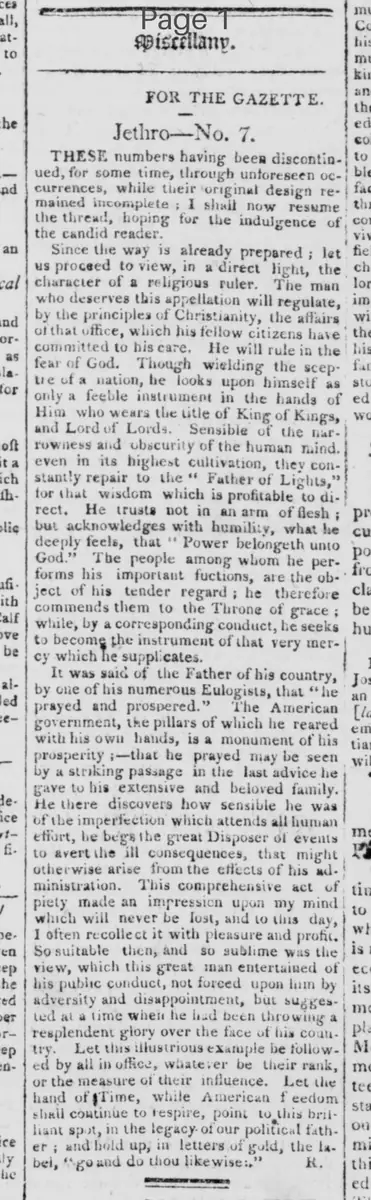
FOR THE GAZETTE.
Jethro-No. 7.
THESE numbers having been discontinued, for some time, through unforeseen occurrences, while their original design remained incomplete; I shall now resume the thread, hoping for the indulgence of the candid reader.
Since the way is already prepared; let us proceed to view, in a direct light, the character of a religious ruler. The man who deserves this appellation will regulate, by the principles of Christianity, the affairs of that office, which his fellow citizens have committed to his care. He will rule in the fear of God. Though wielding the sceptre of a nation, he looks upon himself as only a feeble instrument in the hands of Him who wears the title of King of Kings, and Lord of Lords. Sensible of the narrowness and obscurity of the human mind, even in its highest cultivation, they constantly repair to the "Father of Lights," for that wisdom which is profitable to direct. He trusts not in an arm of flesh; but acknowledges with humility, what he deeply feels, that "Power belongeth unto God." The people among whom he performs his important functions, are the object of his tender regard; he therefore commends them to the Throne of grace; while, by a corresponding conduct, he seeks to become the instrument of that very mercy which he supplicates.
It was said of the Father of his country, by one of his numerous Eulogists, that "he prayed and prospered." The American government, the pillars of which he reared with his own hands, is a monument of his prosperity; -that he prayed may be seen by a striking passage in the last advice he gave to his extensive and beloved family. He there discovers how sensible he was of the imperfection which attends all human effort, he begs the great Disposer of events to avert the ill consequences, that might otherwise arise from the effects of his administration. This comprehensive act of piety made an impression upon my mind which will never be lost, and to this day, I often recollect it with pleasure and profit.
So suitable then, and so sublime was the view, which this great man entertained of his public conduct, not forced upon him by adversity and disappointment, but suggested at a time when he had been throwing a resplendent glory over the face of his country. Let this illustrious example be followed by all in office, whatever be their rank, or the measure of their influence. Let the hand of Time, while American freedom shall continue to respire, point to this brilliant spot, in the legacy of our political father; and hold up, in letters of gold, the label, 'go and do thou likewise.'
R.
FOR THE GAZETTE.
Jethro-No. 7.
THESE numbers having been discontinued, for some time, through unforeseen occurrences, while their original design remained incomplete; I shall now resume the thread, hoping for the indulgence of the candid reader.
Since the way is already prepared; let us proceed to view, in a direct light, the character of a religious ruler. The man who deserves this appellation will regulate, by the principles of Christianity, the affairs of that office, which his fellow citizens have committed to his care. He will rule in the fear of God. Though wielding the sceptre of a nation, he looks upon himself as only a feeble instrument in the hands of Him who wears the title of King of Kings, and Lord of Lords. Sensible of the narrowness and obscurity of the human mind, even in its highest cultivation, they constantly repair to the "Father of Lights," for that wisdom which is profitable to direct. He trusts not in an arm of flesh; but acknowledges with humility, what he deeply feels, that "Power belongeth unto God." The people among whom he performs his important functions, are the object of his tender regard; he therefore commends them to the Throne of grace; while, by a corresponding conduct, he seeks to become the instrument of that very mercy which he supplicates.
It was said of the Father of his country, by one of his numerous Eulogists, that "he prayed and prospered." The American government, the pillars of which he reared with his own hands, is a monument of his prosperity; -that he prayed may be seen by a striking passage in the last advice he gave to his extensive and beloved family. He there discovers how sensible he was of the imperfection which attends all human effort, he begs the great Disposer of events to avert the ill consequences, that might otherwise arise from the effects of his administration. This comprehensive act of piety made an impression upon my mind which will never be lost, and to this day, I often recollect it with pleasure and profit.
So suitable then, and so sublime was the view, which this great man entertained of his public conduct, not forced upon him by adversity and disappointment, but suggested at a time when he had been throwing a resplendent glory over the face of his country. Let this illustrious example be followed by all in office, whatever be their rank, or the measure of their influence. Let the hand of Time, while American freedom shall continue to respire, point to this brilliant spot, in the legacy of our political father; and hold up, in letters of gold, the label, 'go and do thou likewise.'
R.
What sub-type of article is it?
Essay
What themes does it cover?
Religious
Political
Patriotism
What keywords are associated?
Religious Ruler
Christian Principles
George Washington
Piety In Government
American Freedom
Divine Wisdom
What entities or persons were involved?
R.
Literary Details
Title
Jethro No. 7.
Author
R.
Subject
The Character Of A Religious Ruler
Key Lines
He Will Rule In The Fear Of God.
Though Wielding The Sceptre Of A Nation, He Looks Upon Himself As Only A Feeble Instrument In The Hands Of Him Who Wears The Title Of King Of Kings, And Lord Of Lords.
It Was Said Of The Father Of His Country, By One Of His Numerous Eulogists, That "He Prayed And Prospered."
Let This Illustrious Example Be Followed By All In Office, Whatever Be Their Rank, Or The Measure Of Their Influence.