Thank you for visiting SNEWPapers!
Sign up free
The Jeffersonian
Stroudsburg, Monroe County, Pennsylvania
What is this article about?
Article on the ancient history of Chinese pottery, tracing its origins to around 2698 BC, the discovery of porcelain under the Han dynasty (185 BC-85 AD) using kaolin and petuntze, and its impact on European markets from the 16th century onward.
Clipping
OCR Quality
Full Text
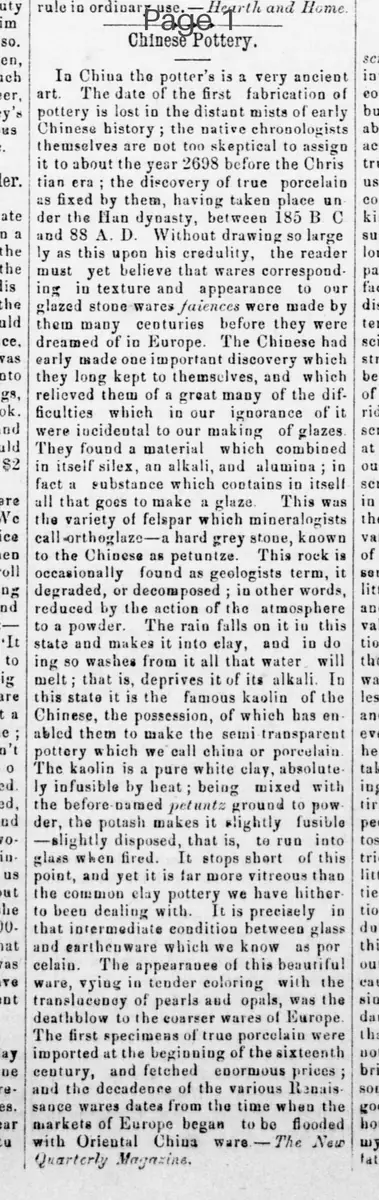
In China the potter's is a very ancient art. The date of the first fabrication of pottery is lost in the distant mists of early Chinese history; the native chronologists themselves are not too skeptical to assign it to about the year 2698 before the Christian era; the discovery of true porcelain as fixed by them, having taken place under the Han dynasty, between 185 B.C. and 85 A.D. Without drawing so largely as this upon his credulity, the reader must yet believe that wares corresponding in texture and appearance to our glazed stone wares faiences were made by them many centuries before they were dreamed of in Europe. The Chinese had early made one important discovery which they long kept to themselves, and which relieved them of a great many of the difficulties which in our ignorance of it were incidental to our making of glazes. They found a material which combined in itself silica, an alkali, and alumina; in fact a substance which contains in itself all that goes to make a glaze. This was the variety of felspar which mineralogists call orthoclase—a hard grey stone, known to the Chinese as petuntze. This rock is occasionally found as geologists term it, degraded, or decomposed: in other words, reduced by the action of the atmosphere to a powder. The rain falls on it in this state and makes it into clay, and in doing so washes from it all that water will melt: that is, deprives it of its alkali. In this state it is the famous kaolin of the Chinese, the possession of which has enabled them to make the semi-transparent pottery which we call china or porcelain. The kaolin is a pure white clay, absolutely infusible by heat; being mixed with the before-named petuntze ground to powder, the potash makes it slightly fusible—slightly disposed, that is, to run into glass when fired. It stops short of this point, and yet it is far more vitreous than the common clay pottery we have hitherto been dealing with. It is precisely in that intermediate condition between glass and earthenware which we know as porcelain. The appearance of this beautiful ware, vying in tender coloring with the translucency of pearls and opals, was the deathblow to the coarser wares of Europe. The first specimens of true porcelain were imported at the beginning of the sixteenth century, and fetched enormous prices; and the decadence of the various Renaissance wares dates from the time when the markets of Europe began to be flooded with Oriental China Ware.—The New Quarterly Magazine.
What sub-type of article is it?
What themes does it cover?
What keywords are associated?
Where did it happen?
Story Details
Location
China
Event Date
About The Year 2698 Before The Christian Era; Under The Han Dynasty, Between 185 B.C. And 85 A.D.; Beginning Of The Sixteenth Century
Story Details
The ancient art of pottery in China dates back to around 2698 BC. True porcelain was discovered under the Han dynasty (185 BC-85 AD) using kaolin and petuntze, enabling semi-transparent ware superior to European pottery. Imports in the 16th century led to the decline of European wares.