Thank you for visiting SNEWPapers!
Sign up free
Literary
June 24, 1785
Fowle's New Hampshire Gazette And General Advertiser
Portsmouth, Rockingham County, New Hampshire
What is this article about?
Excerpt from Wynter's Travels describing the character, regional variations, indolence, customs, diet, religion, and social traits of the Spanish people, critiquing their societal and political conditions under monarchy and Inquisition.
Clipping
OCR Quality
95%
Excellent
Full Text
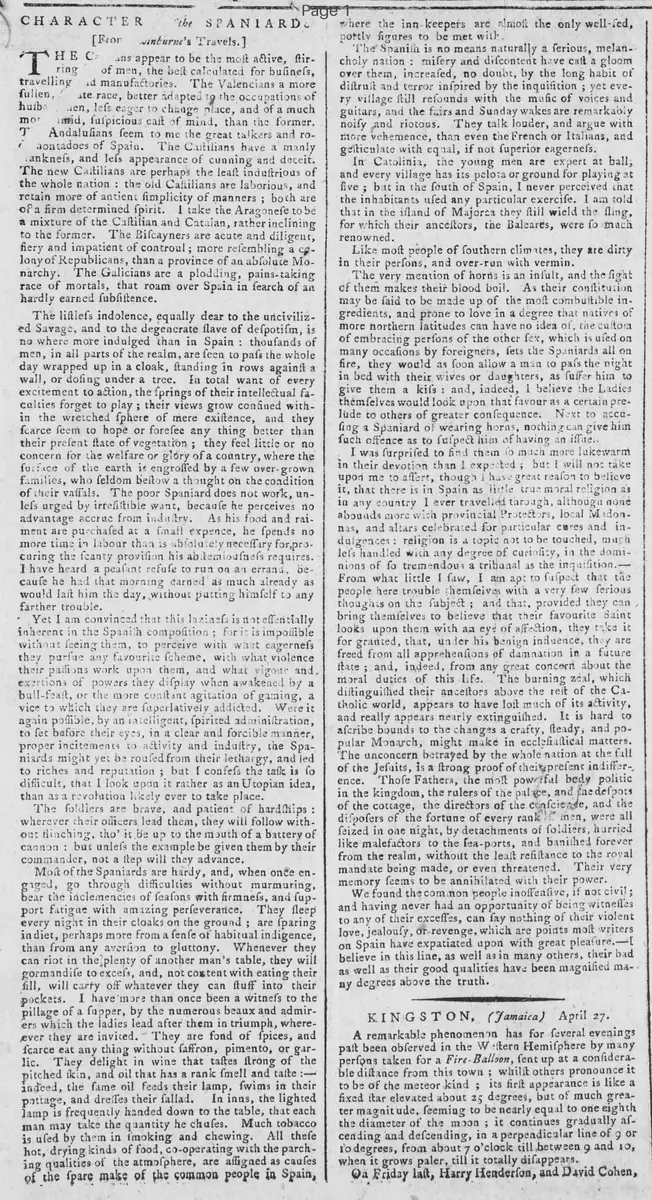
CHARACTER OF THE SPANIARD
[From Wynter's Travels.]
He seems appear to be the most active, stirring of men, the best calculated for business, travelling or manufactories. The Valencians a more sullen, sedate race, better adapted to the occupations of husbandmen, less eager to change place, and of a much more timid, suspicious cast of mind, than the former.
The Andalusians seem to me the great talkers and rodomontades of Spain. The Castilians have a manly frankness, and less appearance of cunning and deceit. The new Castilians are perhaps the least industrious of the whole nation: the old Castilians are laborious, and retain more of ancient simplicity of manners; both are of a firm determined spirit. I take the Aragonese to be a mixture of the Castilian and Catalan, rather inclining to the former. The Biscayners are acute and diligent, fiery and impatient of control; more resembling a colony of Republicans, than a province of an absolute Monarchy. The Galicians are a plodding, pains-taking race of mortals, that roam over Spain in search of an hardly earned subsistence.
The listless indolence, equally dear to the uncivilized Savage, and to the degenerate slave of despotism, is no where more indulged than in Spain: thousands of men, in all parts of the realm, are seen to pass the whole day wrapped up in a cloak, standing in rows against a wall, or dozing under a tree. In total want of every excitement to action, the springs of their intellectual faculties forget to play; their views grow confined within the wretched sphere of mere existence, and they scarce seem to hope or foresee any thing better than their present state of vegetation; they feel little or no concern for the welfare or glory of a country, where the surface of the earth is engrossed by a few over-grown families, who seldom bestow a thought on the condition of their vassals. The poor Spaniard does not work, unless urged by irresistible want, because he perceives no advantage accrue from industry. As his food and raiment are purchased at a small expense, he spends no more time in labour than is absolutely necessary for procuring the scanty provision his abstemiousness requires.
I have heard a peasant refuse to run on an errand, because he had that morning earned as much already as would last him the day, without putting himself to any farther trouble.
Yet I am convinced that this laziness is not essentially inherent in the Spanish composition; for it is impossible without seeing them, to perceive with what eagerness they pursue any favourite scheme, with what violence their passions work upon them, and what vigour and exertions of powers they display when awakened by a bull-feast, or the more constant agitation of gaming, a vice to which they are superlatively addicted. Were it again possible, by an intelligent, spirited administration, to set before their eyes, in a clear and forcible manner, proper incitements to activity and industry, the Spaniards might yet be roused from their lethargy, and led to riches and reputation; but I confess the task is so difficult, that I look upon it rather as an Utopian idea, than as a revolution likely ever to take place.
The soldiers are brave, and patient of hardships: wherever their officers lead them, they will follow without flinching, tho' it be up to the mouth of a battery of cannon: but unless the example be given them by their commander, not a step will they advance.
Most of the Spaniards are hardy, and, when once engaged, go through difficulties without murmuring, bear the inclemencies of seasons with firmness, and support fatigue with amazing perseverance. They sleep every night in their cloaks on the ground; are sparing in diet, perhaps more from a sense of habitual indigence, than from any aversion to gluttony. Whenever they can riot in the plenty of another man's table, they will gormandize to excess, and, not content with eating their fill, will carry off whatever they can stuff into their pockets. I have more than once been a witness to the pillage of a supper, by the numerous beaux and admirers which the ladies lead after them in triumph, wherever they are invited. They are fond of spices, and scarce eat any thing without saffron, pimento, or garlic. They delight in wine that tastes strong of the pitched skin, and oil that has a rank smell and taste: indeed, the same oil feeds their lamp, swims in their pottage, and dresses their salad. In inns, the lighted lamp is frequently handed down to the table, that each man may take the quantity he chooses. Much tobacco is used by them in smoking and chewing. All these hot, drying kinds of food, co-operating with the parching qualities of the atmosphere, are assigned as causes of the spare make of the common people in Spain, where the inn-keepers are almost the only well-fed, portly figures to be met with.
The Spanish is by no means naturally a serious, melancholy nation: misery and discontent have cast a gloom over them, increased, no doubt, by the long habit of distrust and terror inspired by the inquisition; yet every village still resounds with the music of voices and guitars, and the fairs and Sunday wakes are remarkably noisy and riotous. They talk louder, and argue with more vehemence, than even the French or Italians, and gesticulate with equal, if not superior eagerness.
In Catalonia, the young men are expert at ball, and every village has its pelota or ground for playing at it; but in the south of Spain, I never perceived that the inhabitants used any particular exercise. I am told that in the island of Majorca they still wield the sling, for which their ancestors, the Baleares, were so much renowned.
Like most people of southern climates, they are dirty in their persons, and over-run with vermin.
The very mention of horns is an insult, and the sight of them makes their blood boil. As their constitution may be said to be made up of the most combustible ingredients, and prone to love in a degree that natives of more northern latitudes can have no idea of, the custom of embracing persons of the other sex, which is used on many occasions by foreigners, sets the Spaniards all on fire, they would as soon allow a man to pass the night in bed with their wives or daughters, as suffer him to give them a kiss: and, indeed, I believe the ladies themselves would look upon that favour as a certain prelude to others of greater consequence. Next to accusing a Spaniard of wearing horns, nothing can give him such offence as to suspect him of having an issue.
I was surprised to find them so much more lukewarm in their devotion than I expected; but I will not take upon me to assert, though I have great reason to believe it, that there is in Spain as little true moral religion as in any country I ever travelled through, although none abounds more with provincial Protectors, local Madonnas, and altars celebrated for particular cures and indulgences: religion is a topic not to be touched, much less handled with any degree of curiosity, in the dominions of so tremendous a tribunal as the inquisition.
From what little I saw, I am apt to suspect that the people here trouble themselves with a very few serious thoughts on the subject; and that, provided they can bring themselves to believe that their favourite Saint looks upon them with an eye of affection, they take it for granted, that, under his benign influence, they are freed from all apprehensions of damnation in a future state; and, indeed, from any great concern about the moral duties of this life. The burning zeal, which distinguished their ancestors above the rest of the Catholic world, appears to have lost much of its activity, and really appears nearly extinguished. It is hard to ascribe bounds to the changes a crafty, steady, and popular Monarch, might make in ecclesiastical matters.
The unconcern betrayed by the whole nation at the fall of the Jesuits, is a strong proof of their present indifference. Those Fathers, the most powerful body politic in the kingdom, the rulers of the palace, and the despots of the cottage, the directors of the conscience, and the disposers of the fortune of every rank of men, were all seized in one night, by detachments of soldiers, hurried like malefactors to the sea-ports, and banished forever from the realm, without the least resistance to the royal mandate being made, or even threatened. Their very memory seems to be annihilated with their power.
We found the common people inoffensive, if not civil; and having never had an opportunity of being witnesses to any of their excesses, can say nothing of their violent love, jealousy, or revenge, which are points most writers on Spain have expatiated upon with great pleasure. I believe in this line, as well as in many others, their bad as well as their good qualities have been magnified many degrees above the truth.
[From Wynter's Travels.]
He seems appear to be the most active, stirring of men, the best calculated for business, travelling or manufactories. The Valencians a more sullen, sedate race, better adapted to the occupations of husbandmen, less eager to change place, and of a much more timid, suspicious cast of mind, than the former.
The Andalusians seem to me the great talkers and rodomontades of Spain. The Castilians have a manly frankness, and less appearance of cunning and deceit. The new Castilians are perhaps the least industrious of the whole nation: the old Castilians are laborious, and retain more of ancient simplicity of manners; both are of a firm determined spirit. I take the Aragonese to be a mixture of the Castilian and Catalan, rather inclining to the former. The Biscayners are acute and diligent, fiery and impatient of control; more resembling a colony of Republicans, than a province of an absolute Monarchy. The Galicians are a plodding, pains-taking race of mortals, that roam over Spain in search of an hardly earned subsistence.
The listless indolence, equally dear to the uncivilized Savage, and to the degenerate slave of despotism, is no where more indulged than in Spain: thousands of men, in all parts of the realm, are seen to pass the whole day wrapped up in a cloak, standing in rows against a wall, or dozing under a tree. In total want of every excitement to action, the springs of their intellectual faculties forget to play; their views grow confined within the wretched sphere of mere existence, and they scarce seem to hope or foresee any thing better than their present state of vegetation; they feel little or no concern for the welfare or glory of a country, where the surface of the earth is engrossed by a few over-grown families, who seldom bestow a thought on the condition of their vassals. The poor Spaniard does not work, unless urged by irresistible want, because he perceives no advantage accrue from industry. As his food and raiment are purchased at a small expense, he spends no more time in labour than is absolutely necessary for procuring the scanty provision his abstemiousness requires.
I have heard a peasant refuse to run on an errand, because he had that morning earned as much already as would last him the day, without putting himself to any farther trouble.
Yet I am convinced that this laziness is not essentially inherent in the Spanish composition; for it is impossible without seeing them, to perceive with what eagerness they pursue any favourite scheme, with what violence their passions work upon them, and what vigour and exertions of powers they display when awakened by a bull-feast, or the more constant agitation of gaming, a vice to which they are superlatively addicted. Were it again possible, by an intelligent, spirited administration, to set before their eyes, in a clear and forcible manner, proper incitements to activity and industry, the Spaniards might yet be roused from their lethargy, and led to riches and reputation; but I confess the task is so difficult, that I look upon it rather as an Utopian idea, than as a revolution likely ever to take place.
The soldiers are brave, and patient of hardships: wherever their officers lead them, they will follow without flinching, tho' it be up to the mouth of a battery of cannon: but unless the example be given them by their commander, not a step will they advance.
Most of the Spaniards are hardy, and, when once engaged, go through difficulties without murmuring, bear the inclemencies of seasons with firmness, and support fatigue with amazing perseverance. They sleep every night in their cloaks on the ground; are sparing in diet, perhaps more from a sense of habitual indigence, than from any aversion to gluttony. Whenever they can riot in the plenty of another man's table, they will gormandize to excess, and, not content with eating their fill, will carry off whatever they can stuff into their pockets. I have more than once been a witness to the pillage of a supper, by the numerous beaux and admirers which the ladies lead after them in triumph, wherever they are invited. They are fond of spices, and scarce eat any thing without saffron, pimento, or garlic. They delight in wine that tastes strong of the pitched skin, and oil that has a rank smell and taste: indeed, the same oil feeds their lamp, swims in their pottage, and dresses their salad. In inns, the lighted lamp is frequently handed down to the table, that each man may take the quantity he chooses. Much tobacco is used by them in smoking and chewing. All these hot, drying kinds of food, co-operating with the parching qualities of the atmosphere, are assigned as causes of the spare make of the common people in Spain, where the inn-keepers are almost the only well-fed, portly figures to be met with.
The Spanish is by no means naturally a serious, melancholy nation: misery and discontent have cast a gloom over them, increased, no doubt, by the long habit of distrust and terror inspired by the inquisition; yet every village still resounds with the music of voices and guitars, and the fairs and Sunday wakes are remarkably noisy and riotous. They talk louder, and argue with more vehemence, than even the French or Italians, and gesticulate with equal, if not superior eagerness.
In Catalonia, the young men are expert at ball, and every village has its pelota or ground for playing at it; but in the south of Spain, I never perceived that the inhabitants used any particular exercise. I am told that in the island of Majorca they still wield the sling, for which their ancestors, the Baleares, were so much renowned.
Like most people of southern climates, they are dirty in their persons, and over-run with vermin.
The very mention of horns is an insult, and the sight of them makes their blood boil. As their constitution may be said to be made up of the most combustible ingredients, and prone to love in a degree that natives of more northern latitudes can have no idea of, the custom of embracing persons of the other sex, which is used on many occasions by foreigners, sets the Spaniards all on fire, they would as soon allow a man to pass the night in bed with their wives or daughters, as suffer him to give them a kiss: and, indeed, I believe the ladies themselves would look upon that favour as a certain prelude to others of greater consequence. Next to accusing a Spaniard of wearing horns, nothing can give him such offence as to suspect him of having an issue.
I was surprised to find them so much more lukewarm in their devotion than I expected; but I will not take upon me to assert, though I have great reason to believe it, that there is in Spain as little true moral religion as in any country I ever travelled through, although none abounds more with provincial Protectors, local Madonnas, and altars celebrated for particular cures and indulgences: religion is a topic not to be touched, much less handled with any degree of curiosity, in the dominions of so tremendous a tribunal as the inquisition.
From what little I saw, I am apt to suspect that the people here trouble themselves with a very few serious thoughts on the subject; and that, provided they can bring themselves to believe that their favourite Saint looks upon them with an eye of affection, they take it for granted, that, under his benign influence, they are freed from all apprehensions of damnation in a future state; and, indeed, from any great concern about the moral duties of this life. The burning zeal, which distinguished their ancestors above the rest of the Catholic world, appears to have lost much of its activity, and really appears nearly extinguished. It is hard to ascribe bounds to the changes a crafty, steady, and popular Monarch, might make in ecclesiastical matters.
The unconcern betrayed by the whole nation at the fall of the Jesuits, is a strong proof of their present indifference. Those Fathers, the most powerful body politic in the kingdom, the rulers of the palace, and the despots of the cottage, the directors of the conscience, and the disposers of the fortune of every rank of men, were all seized in one night, by detachments of soldiers, hurried like malefactors to the sea-ports, and banished forever from the realm, without the least resistance to the royal mandate being made, or even threatened. Their very memory seems to be annihilated with their power.
We found the common people inoffensive, if not civil; and having never had an opportunity of being witnesses to any of their excesses, can say nothing of their violent love, jealousy, or revenge, which are points most writers on Spain have expatiated upon with great pleasure. I believe in this line, as well as in many others, their bad as well as their good qualities have been magnified many degrees above the truth.
What sub-type of article is it?
Essay
What themes does it cover?
Social Manners
Political
Religious
What keywords are associated?
Spanish Character
Regional Differences
Indolence
Customs
Diet
Religion
Inquisition
Jesuits
What entities or persons were involved?
From Wynter's Travels
Literary Details
Title
Character Of The Spaniard
Author
From Wynter's Travels
Subject
Observations On The Character And Customs Of The Spanish People
Key Lines
The Listless Indolence, Equally Dear To The Uncivilized Savage, And To The Degenerate Slave Of Despotism, Is No Where More Indulged Than In Spain.
Yet I Am Convinced That This Laziness Is Not Essentially Inherent In The Spanish Composition;
The Unconcern Betrayed By The Whole Nation At The Fall Of The Jesuits, Is A Strong Proof Of Their Present Indifference.
I Believe In This Line, As Well As In Many Others, Their Bad As Well As Their Good Qualities Have Been Magnified Many Degrees Above The Truth.