Thank you for visiting SNEWPapers!
Sign up free
The Morning Star And Catholic Messenger
New Orleans, Orleans County, Louisiana
What is this article about?
On July 4, 1876, in Philadelphia, Catholic Total Abstinence Societies held a major parade with 9,000 participants, a pontifical mass, and dedication of a temperance fountain at Centennial grounds, honoring American independence and figures like John Barry.
Clipping
OCR Quality
Full Text
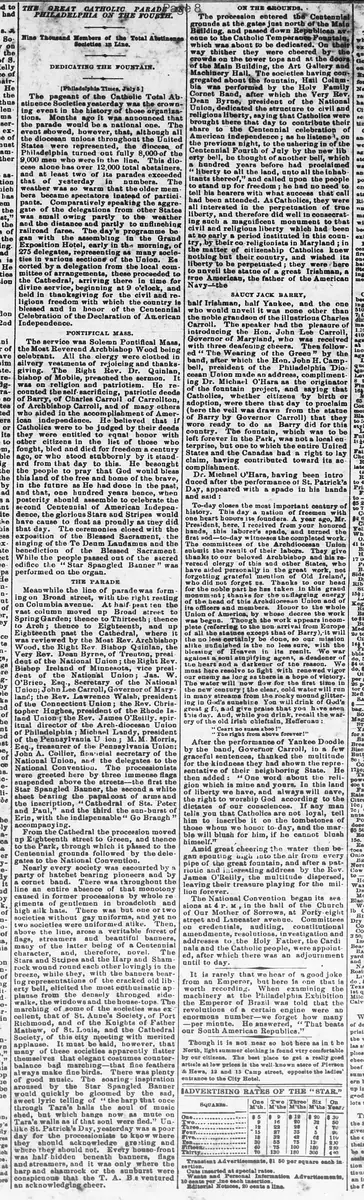
The pageant of the Catholic Total Abstinence Societies yesterday was the crowning event in the history of those organizations. Months ago it was announced that the parade would be a national one. The event showed, however, that, although all the diocesan unions throughout the United States were represented, the diocese of Philadelphia turned out fully 8,000 of the 9,000 men who were in the line. This diocese alone has over 12,000 total abstainers, and at least two of its parades exceeded that of yesterday in numbers. The weather was so warm that the older members became spectators instead of participants. Comparatively speaking the aggregate of the delegations from other States was small owing partly to the weather and the distance and partly to unflinching railroad fares. The day's programme began with the assembling in the Grand Exposition Hotel, early in the morning, of 275 delegates, representing as many societies in various sections of the Union. Escorted by a delegation from the local committee of arrangements, these proceeded to the Cathedral, arriving there in time for divine service, beginning at 9 o'clock, and held in thanksgiving for the civil and religious freedom with which the country is blessed and in honor of the Centennial Celebration of the Declaration of American Independence.
PONTIFICAL MASS.
The service was Solemn Pontifical Mass, the Most Reverend Archbishop Wood being celebrant. All the clergy were clothed in silvery vestments of rejoicing and thanksgiving. The Right Rev. Dr. Quinlan, Bishop of Mobile, preached the sermon. It was on religion and patriotism. He recounted the self-sacrificing, patriotic deeds of Barry, of Charles Carroll of Carrollton, of Archbishop Carroll, and of many others who aided in the accomplishment of American independence. He believed that if Catholics were to be judged by their deeds they were entitled to equal honor with other citizens in the list of those who fought, bled and died for freedom a century ago, or who stood stubbornly by its standard from that day to this. He besought the people to pray that God would bless this land of the free and home of the brave, in the future as He had done in the past, and that, one hundred years hence, when posterity should assemble to celebrate the second Centennial of American Independence, the glorious Stars and Stripes would have cause to float as proudly as they did that day. The ceremonies closed with the exposition of the Blessed Sacrament, the singing of the Te Deum Laudamus and the benediction of the Blessed Sacrament. While the people passed out of the sacred edifice the "Star Spangled Banner" was performed on the organ.
THE PARADE
Meanwhile the line of parade was forming on Broad street, with the right resting on Columbia avenue. At half-past ten the vast column moved up Broad street to Spring Garden; thence to Thirteenth; thence to Arch; thence to Eighteenth, and up Eighteenth past the Cathedral, where it was reviewed by the Most Rev. Archbishop Wood, the Right Rev. Bishop Quinlan, the Very Rev. Dean Byrne, of Trenton, president of the National Union; the Right Rev. Bishop Ireland of Minnesota, vice president of the National Union; Jas. W. O'Brien, Esq., Secretary of the National Union; John Lee Carroll, Governor of Maryland; the Rev. Lawrence Walsh, president of the Connecticut Union; the Rev. Christopher Hughes, president of the Rhode Island Union; the Rev. James O'Reilly, spiritual director of the Arch-diocesan Union of Philadelphia; Michael Landy, president of the Pennsylvania Union; M. M. Morris, Esq., treasurer of the Pennsylvania Union; John A. Collier, financial secretary of the National Union, and the delegates to the National Convention.
The processionists were greeted here by three immense flags suspended above the streets—the first the Star Spangled Banner, the second a white sheet bearing the papal coat of arms and the inscription, "Cathedral of SS. Peter and Paul," and the third the sun-burst of Erin, with the indispensable "Go Bragh" accompanying.
From the Cathedral the procession moved up Eighteenth street to Green, and thence to the Park, through which it passed to the Centennial grounds followed by the delegates to the National Convention.
Nearly every society was escorted by a party of hatchet bearing pioneers and by a cornet band. There was throughout the line an entire absence of that monotony caused in former processions by whole regiments of gentlemen in broadcloth and high silk hats. There was but one or two societies without gay uniforms, and yet no two societies were uniformed alike. Then, above the line, arose a veritable forest of flags, streamers and beautiful banners, many of the latter being of a Centennial character, and, therefore, novel. The Stars and Stripes and the Harp and Shamrock wound round each other lovingly in the breeze, while they, with the banners bearing representations of the cracked old liberty bell, elicited the most enthusiastic applause from the densely thronged sidewalks, the windows and the house-tops. The marching of some of the societies was excellent, that of St. Anne's Society, of Port Richmond, and of the Knights of Father Mathew, of St. Louis, and the Cathedral Society, of this city meeting with merited applause. It must be said, however, that many of these societies apparently flatter themselves that elegant costumes counterbalance bad marching—that fine feathers always make fine birds.
There was plenty of good music. The soaring inspiration aroused by the Star Spangled Banner would quickly be gloomed by the sad, sweet lyric telling of "the harp that once through Tara's halls the soul of music shed, but which hangs now as mute on Tara's walls as if that soul were fled." Unlike St. Patrick's Day, yesterday was a poor day for the processionists to know where they should acknowledge greeting and where they should not. Every house-front was half hidden beneath banners, flags and streamers, and it was only where the harp and shamrock or the sunburst were conspicuous that the T. A. B.'s ventured an acknowledging cheer.
The procession entered the Centennial grounds at the gates just north of the Main Building, and passed down Republican avenue to the Catholic Temperance Fountain, which was about to be dedicated. On their way thither they were cheered by the crowds on the tower tops and at the doors of the Main Building, the Art Gallery and Machinery Hall. The societies having congregated about the fountain, Hail Columbia was performed by the Holy Family Cornet Band, after which the Very Rev. Dean Byrne, president of the National Union, dedicated the structure to civil and religious liberty, saying that Catholics were brought there that day to contribute their share to the Centennial celebration of American independence; as he listened, on the previous night, to the ushering in of the Centennial Fourth of July by the new liberty bell, he thought of another bell, which a hundred years before had proclaimed "liberty to all the land, unto all the inhabitants thereof," and called upon the people to stand up for freedom; he had no need to tell his hearers with what success that call had been attended. As Catholics, they were all interested in the perpetuation of true liberty, and therefore did well in consecrating such a magnificent monument to that civil and religious liberty which had been at so early a period instituted in this country, by their co-religionists in Maryland; in the matter of citizenship Catholics knew nothing but their country, and wished its liberty to be perpetuated; they were here to unveil the statue of a great Irishman, a true American, the father of the American Navy—the
SAUCY JACK BARRY,
half Irishman, half Yankee, and the one who would unveil it was none other than the noble grandson of the illustrious Charles Carroll. The speaker had the pleasure of introducing the Hon. John Lee Carroll, Governor of Maryland, who was received with three deafening cheers. Then followed "The Wearing of the Green" by the band, after which the Hon. John H. Campbell, president of the Philadelphia Diocesan Union made an address, complimenting Dr. Michael O'Hara as the originator of the fountain project, and saying that Catholics, whether citizens by birth or adoption, were there that day to proclaim (here the veil was drawn from the statue of Barry by Governor Carroll) that they were ready to do as Barry did for this country. The fountain, which was to be left forever in the Park, was not a local enterprise, but one to which the entire United States and the Canadas had a right to lay claim, having contributed toward its accomplishment.
Dr. Michael O'Hara, having been introduced after the performance of St. Patrick's Day, appeared with a spade in his hands and said:
To-day closes the most important century of history. This day a nation of freemen with one heart honors its founders. A year ago, Mr. President, here, I received from your honored hands, this laborer's spade, and turned the first sod—to-day witnesses the completed work. The committees of the Archdiocesan Union submit the result of their labors. They give thanks to our beloved Archbishop and his reverend clergy of this and other States, who have aided personally in the great work, not forgetting grateful mention of Old Ireland, who did not forget us. Thanks to our head for the noble part he has taken in this grand monument; thanks for the unflagging energy of the head of this Archdiocesan Union and of its officers and members. Honor to the whole Union of America, by whose decree the work was begun. Though the work appears incomplete (referring to the non-arrival from Europe of all the statues except that of Barry), it will the no less certainly be done, so our mission alike unfinished is the no less sure, with the blessing of Heaven in its result. We war against a soul stupifying agent, a deadener of the heart and a darkener of the reason. We must here resolve to fight with renewed vigor our enemy as long as there is a hope of victory. The water will now flow for the first time in the new century; the clear, cold water will run in many streams from the rocky mound glittering in God's sunshine. You will drink of God's great gift, and give praise that you have seen this day. And, while you drink, recall the war-cry of the old Irish chieftain, Heffernan:
"Ceart no saorsa aboo!"
"The right from above forever!"
After the performance of Yankee Doodle by the band, Governor Carroll, in a few graceful sentences, thanked the multitude for the kindness they had shown the representative of their neighboring State. He then added: "One word about the religion which is mine and yours. In this land of liberty we have, and always will have, the right to worship God according to the dictates of our consciences. If any man tells you that Catholics are not loyal, tell him to inscribe it on the tombstones of those whom we honor to-day, and the marble will blush for him, if he cannot blush himself."
Amid great cheering the water then began spouting high into the air from every pipe of the great fountain, and after a patriotic and interesting address by the Rev. James O'Reilly, the multitude dispersed, leaving their treasure playing for the million forever.
The National Convention began its sessions at 4 P. M., in the hall of the Church of Our Mother of Sorrows, at Forty-eighth street and Lancaster avenue. Committees on credentials, auditing, constitutional amendments, resolutions, investigation and addresses to the Holy Father, the Cardinals and the Catholic people, were appointed, after which there was an adjournment until to-day.
What sub-type of article is it?
What keywords are associated?
What entities or persons were involved?
Where did it happen?
Domestic News Details
Primary Location
Philadelphia
Event Date
July 4, 1876
Key Persons
Outcome
successful parade with 9,000 participants, dedication of catholic temperance fountain, national convention sessions adjourned to next day; no casualties reported.
Event Details
Catholic Total Abstinence Societies held a national parade in Philadelphia with 9,000 participants, primarily from the local diocese. The day included a Solemn Pontifical Mass at the Cathedral with a sermon on religion and patriotism by Bishop Quinlan, a procession reviewed by church and civic leaders, and dedication of a temperance fountain at Centennial grounds featuring unveiling of John Barry statue by Governor Carroll. National Convention began in the afternoon.