Thank you for visiting SNEWPapers!
Sign up free
Editorial
August 17, 1793
National Gazette
Philadelphia, Philadelphia County, Pennsylvania
What is this article about?
An anonymous Republican argues in favor of interpreting the US-France treaty to allow French privateers to fit out in American ports, countering Judge Wilson's opinion and emphasizing alliance obligations and neutrality.
Merged-components note: Continuation of the same editorial piece discussing the treaty with France, split across pages.
Clippings
1 of 2
OCR Quality
95%
Excellent
Full Text
From the (Boston) Independent Chronicle.
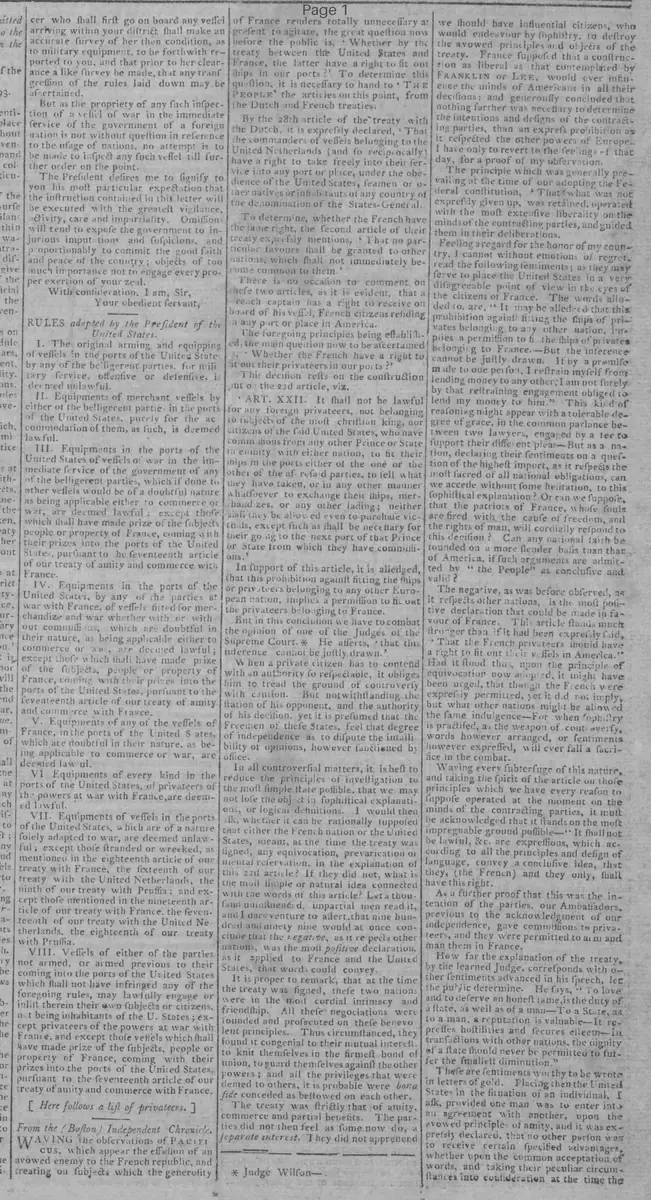
WAVING the observations of PACIFICUS, which appear the effusion of an avowed enemy to the French republic, and treating on subjects which the generosity of France renders totally unnecessary at present to agitate, the great question now before the public is, Whether by the treaty between the United States and France, the latter have a right to fit out ships in our ports? To determine this question, it is necessary to hand to THE PEOPLE the articles on this point, from the Dutch and French treaties.
By the 28th article of the treaty with the Dutch, it is expressly declared, That the commanders of vessels belonging to the United Netherlands (and o reciprocally) have a right to take freely into their service into any port or place, under the obedience of the United States, seamen or other natives or inhabitants of any country of the denomination of the States-General.
To determine, whether the French have the same right, the second article of their treaty expressly mentions, 'That no particular favours shall be granted to other nations, which shall not immediately become common to them.'
There is no occasion to comment on these two articles, as it is evident, that a French captain has a right to receive on board of his vessel, French citizens residing in any port or place in America.
The foregoing principles being established, the main question now to be ascertained, Whether the French have a right to fit out their privateers in our ports?
This decision rests on the construction just of the 22d article, viz.
ART. XXII. It Shall not be lawful for any foreign privateers, not belonging to subjects of the most christian king, nor citizens of the said United States, who have commissions from any other Prince or State in enmity with either nation, to fit their ships in the ports either of the one or the other of the aforesaid parties, to sell what they have taken, or in any other manner whatsoever to exchange their ships, merchandise, or any other lading; neither shall they be allowed even to purchase victuals, except such as shall be necessary for their going to the next port of that Prince or State from which they have commissions.
In support of this article, it is alleged, that this prohibition against fitting the ships or privateers belonging to any other European nation, implies a permission to fit out the privateers belonging to France.
But in this conclusion we have to combat the opinion of one of the Judges of the Supreme Court.* He asserts, that this inference cannot be justly drawn.
When a private citizen has to contend with an authority so respectable, it obliges him to tread the ground of controversy with caution. But notwithstanding the station of his opponent, and the authority of his decision, yet it is presumed that the Freemen of these States, feel that degree of independence as to dispute the infallibility of opinions, however sanctioned by office.
In all controversial matters, it is best to reduce the principles of investigation to the most simple state possible, that we may not lose the object in sophistical explanations, or logical definitions. I would then ask, whether it can be rationally supposed that either the French nation or the United States, meant, at the time the treaty was signed, any equivocation, prevarication or mental reservation, in the explanation of this 22d article? If they did not, what is the most simple or natural idea connected with the words of this article? Let a thousand uninfluenced, impartial men read it, and I dare venture to assert, that nine hundred and ninety nine would at once conclude that the negative, as it respects other nations, was the most positive declaration, as it applied to France and the United States, that word, could convey.
It is proper to remark, that at the time the treaty was signed, these two nations were in the most cordial intimacy and friendship. All these negociations were founded and prosecuted on these benevolent principles. Thus circumstanced, they found it congenial to their mutual interest, to knit themselves in the firmest bond of union, to guard themselves against the other powers; and all the privileges that were denied to others, it is probable were bona fide conceded as bestowed on each other.
The treaty was strictly that of amity, commerce and partial benefits. The parties did not then feel as some now do, a separate interest. They did not apprehend * Judge Wilson—
that we should have influential citizens, who would endeavour by sophistry, to destroy the avowed principles and objects of the treaty. France supposed that a construction as liberal as that contemplated by FRANKLIN or LEE, would ever influence the minds of Americans in all their decisions: and generously concluded that nothing farther was necessary to determine the intentions and designs of the contracting parties, than an express prohibition as it respected the other powers of Europe.
I have only to revert to the feelings of that day, for a proof of my observation.
The principle which was generally prevailing at the time of our adopting the Federal constitution, That 'what was not expressly given up, was retained,' operated with the most extensive liberality on the minds of the contracting parties, and guided them in their deliberations.
Feeling a regard for the honor of my country, I cannot without emotions of regret, read the following sentiments; as they may serve to place the United States in a very disagreeable point of view in the eyes of the citizens of France. The words alluded to, are, "It may be alleged that this prohibition against fitting the ships of privates belonging to any other nation, implies a permission to fit the ships of privates belonging to France.—But the inference cannot be justly drawn. If by a promise made to one person, I restrain myself from lending money to any other, I am not surely by that restraining engagement obliged to lend my money to him." This kind of reasoning might appear with a tolerable degree of grace, in the common parlance between two lawyers, engaged by a fee to support their different pleas—But as a nation, declaring their sentiments on a question of the highest import, as it respects the most sacred of all national obligations, can we accede without some hesitation, to this sophistical explanation? Or can we suppose, that the patriots of France, whose souls are fired with the cause of freedom, and the rights of man, will cordially respond to this decision? Can any national faith be founded on a more slender basis than that of America, if such arguments are admitted by "the People" as conclusive and valid?
The negative, as was before observed, as it respects other nations, is the most positive declaration that could be made in favour of France. This article stands much stronger than if it had been expressly said, "That the French privateers should have a right to fit out their vessels in America."
Had it stood thus upon the principle of equivocation now adopted, it might have been urged, that though the French were expressly permitted, yet it did not imply, but what other nations might be allowed the same indulgence—For when sophistry is practised, as the weapon of controversy, words however arranged, or sentiments however expressed, will ever fall a sacrifice in the combat.
Waving every subterfuge of this nature, and taking the spirit of the article on those principles which we have every reason to suppose operated at the moment on the minds of the contracting parties, it must be acknowledged that it stands on the most impregnable ground possible—"It shall not be lawful, &c." are expressions, which according to all the principles and design of language, convey a conclusive idea, that they, (the French) and they only, shall have this right.
As a further proof that this was the intention of the parties, our Ambassadors, previous to the acknowledgement of our independence, gave commissions to privateers, and they were permitted to arm and man them in France.
How far the explanation of the treaty, by the learned Judge, corresponds with other sentiments advanced in his speech, let the public determine. He says, "To love and to deserve an honest fame, is the duty of a state, as well as of a man. To a State, as to a man, a reputation is valuable—It represses hostilities and secures esteem—In transactions with other nations, the dignity of a state should never be permitted to suffer the smallest diminution."
These are sentiments worthy to be wrote in letters of gold. Placing then the United States in the situation of an individual, I ask, provided one man was to enter into an agreement with another, upon the avowed principle of amity, and it was expressly declared, that no other person was to receive certain specified advantages, whether upon the common acceptation of words, and taking their peculiar circumstances into consideration at the time the
If an agreement was made, it would not be considered by every impartial person, that the parties were exclusively entitled to them?
And should any other explanation be attempted by either party, whether it would be considered as an unfair measure to evade the performance?
If a nation, like a man, has an honest name to secure, why should they not have the same line of conduct to pursue? If reputation is valuable, as it repels hostilities, and secures esteem, why, if we are anxious to keep ourselves out of the present war, and wish to secure the esteem of our allies, should we adopt principles derogatory to our honor; and thereby, according to the judge's own sentiments, provoke other nations to commence hostilities against us?
The foregoing observations arise from the implication that is fairly deducible from the article of treaty. But as the Hon. Judge has not suggested an idea that any law of the United States forbids the French from fitting out privateers in our ports, it is presumed that there is no legislative authority to prevent it. The Hon. Judge must concede to this principle, 'that where no law is, there is no transgression.'
It behooves every person in his station, to decide agreeable to the promulgated laws of the states, as no man has a right to dictate beyond what the law will warrant.
If it is found, that by implication the article will bear the construction now pleaded for, it is the duty of those who are called upon to decide on this question, to request the meeting of Congress, that the principles may be thoroughly investigated by the representatives of the people; and if necessary, such efficient laws enacted, whereby every citizen may know the precise ground on which he stands.
To conclude, no good citizen wishes this country to become a partisan in the present war; but as we are in treaty with the most formidable nation in Europe, let us give it the most fair and liberal construction. Let us be careful, that while we are anxious not to involve ourselves in a war with the other powers, that we do not disaffect our only European ally. Let us not forget their services, while the hand of Britain was heavy on us; but let us remember, that the cause of France is the cause of universal freedom: and on their success depend the future liberties of the United States.
A REPUBLICAN.
WAVING the observations of PACIFICUS, which appear the effusion of an avowed enemy to the French republic, and treating on subjects which the generosity of France renders totally unnecessary at present to agitate, the great question now before the public is, Whether by the treaty between the United States and France, the latter have a right to fit out ships in our ports? To determine this question, it is necessary to hand to THE PEOPLE the articles on this point, from the Dutch and French treaties.
By the 28th article of the treaty with the Dutch, it is expressly declared, That the commanders of vessels belonging to the United Netherlands (and o reciprocally) have a right to take freely into their service into any port or place, under the obedience of the United States, seamen or other natives or inhabitants of any country of the denomination of the States-General.
To determine, whether the French have the same right, the second article of their treaty expressly mentions, 'That no particular favours shall be granted to other nations, which shall not immediately become common to them.'
There is no occasion to comment on these two articles, as it is evident, that a French captain has a right to receive on board of his vessel, French citizens residing in any port or place in America.
The foregoing principles being established, the main question now to be ascertained, Whether the French have a right to fit out their privateers in our ports?
This decision rests on the construction just of the 22d article, viz.
ART. XXII. It Shall not be lawful for any foreign privateers, not belonging to subjects of the most christian king, nor citizens of the said United States, who have commissions from any other Prince or State in enmity with either nation, to fit their ships in the ports either of the one or the other of the aforesaid parties, to sell what they have taken, or in any other manner whatsoever to exchange their ships, merchandise, or any other lading; neither shall they be allowed even to purchase victuals, except such as shall be necessary for their going to the next port of that Prince or State from which they have commissions.
In support of this article, it is alleged, that this prohibition against fitting the ships or privateers belonging to any other European nation, implies a permission to fit out the privateers belonging to France.
But in this conclusion we have to combat the opinion of one of the Judges of the Supreme Court.* He asserts, that this inference cannot be justly drawn.
When a private citizen has to contend with an authority so respectable, it obliges him to tread the ground of controversy with caution. But notwithstanding the station of his opponent, and the authority of his decision, yet it is presumed that the Freemen of these States, feel that degree of independence as to dispute the infallibility of opinions, however sanctioned by office.
In all controversial matters, it is best to reduce the principles of investigation to the most simple state possible, that we may not lose the object in sophistical explanations, or logical definitions. I would then ask, whether it can be rationally supposed that either the French nation or the United States, meant, at the time the treaty was signed, any equivocation, prevarication or mental reservation, in the explanation of this 22d article? If they did not, what is the most simple or natural idea connected with the words of this article? Let a thousand uninfluenced, impartial men read it, and I dare venture to assert, that nine hundred and ninety nine would at once conclude that the negative, as it respects other nations, was the most positive declaration, as it applied to France and the United States, that word, could convey.
It is proper to remark, that at the time the treaty was signed, these two nations were in the most cordial intimacy and friendship. All these negociations were founded and prosecuted on these benevolent principles. Thus circumstanced, they found it congenial to their mutual interest, to knit themselves in the firmest bond of union, to guard themselves against the other powers; and all the privileges that were denied to others, it is probable were bona fide conceded as bestowed on each other.
The treaty was strictly that of amity, commerce and partial benefits. The parties did not then feel as some now do, a separate interest. They did not apprehend * Judge Wilson—
that we should have influential citizens, who would endeavour by sophistry, to destroy the avowed principles and objects of the treaty. France supposed that a construction as liberal as that contemplated by FRANKLIN or LEE, would ever influence the minds of Americans in all their decisions: and generously concluded that nothing farther was necessary to determine the intentions and designs of the contracting parties, than an express prohibition as it respected the other powers of Europe.
I have only to revert to the feelings of that day, for a proof of my observation.
The principle which was generally prevailing at the time of our adopting the Federal constitution, That 'what was not expressly given up, was retained,' operated with the most extensive liberality on the minds of the contracting parties, and guided them in their deliberations.
Feeling a regard for the honor of my country, I cannot without emotions of regret, read the following sentiments; as they may serve to place the United States in a very disagreeable point of view in the eyes of the citizens of France. The words alluded to, are, "It may be alleged that this prohibition against fitting the ships of privates belonging to any other nation, implies a permission to fit the ships of privates belonging to France.—But the inference cannot be justly drawn. If by a promise made to one person, I restrain myself from lending money to any other, I am not surely by that restraining engagement obliged to lend my money to him." This kind of reasoning might appear with a tolerable degree of grace, in the common parlance between two lawyers, engaged by a fee to support their different pleas—But as a nation, declaring their sentiments on a question of the highest import, as it respects the most sacred of all national obligations, can we accede without some hesitation, to this sophistical explanation? Or can we suppose, that the patriots of France, whose souls are fired with the cause of freedom, and the rights of man, will cordially respond to this decision? Can any national faith be founded on a more slender basis than that of America, if such arguments are admitted by "the People" as conclusive and valid?
The negative, as was before observed, as it respects other nations, is the most positive declaration that could be made in favour of France. This article stands much stronger than if it had been expressly said, "That the French privateers should have a right to fit out their vessels in America."
Had it stood thus upon the principle of equivocation now adopted, it might have been urged, that though the French were expressly permitted, yet it did not imply, but what other nations might be allowed the same indulgence—For when sophistry is practised, as the weapon of controversy, words however arranged, or sentiments however expressed, will ever fall a sacrifice in the combat.
Waving every subterfuge of this nature, and taking the spirit of the article on those principles which we have every reason to suppose operated at the moment on the minds of the contracting parties, it must be acknowledged that it stands on the most impregnable ground possible—"It shall not be lawful, &c." are expressions, which according to all the principles and design of language, convey a conclusive idea, that they, (the French) and they only, shall have this right.
As a further proof that this was the intention of the parties, our Ambassadors, previous to the acknowledgement of our independence, gave commissions to privateers, and they were permitted to arm and man them in France.
How far the explanation of the treaty, by the learned Judge, corresponds with other sentiments advanced in his speech, let the public determine. He says, "To love and to deserve an honest fame, is the duty of a state, as well as of a man. To a State, as to a man, a reputation is valuable—It represses hostilities and secures esteem—In transactions with other nations, the dignity of a state should never be permitted to suffer the smallest diminution."
These are sentiments worthy to be wrote in letters of gold. Placing then the United States in the situation of an individual, I ask, provided one man was to enter into an agreement with another, upon the avowed principle of amity, and it was expressly declared, that no other person was to receive certain specified advantages, whether upon the common acceptation of words, and taking their peculiar circumstances into consideration at the time the
If an agreement was made, it would not be considered by every impartial person, that the parties were exclusively entitled to them?
And should any other explanation be attempted by either party, whether it would be considered as an unfair measure to evade the performance?
If a nation, like a man, has an honest name to secure, why should they not have the same line of conduct to pursue? If reputation is valuable, as it repels hostilities, and secures esteem, why, if we are anxious to keep ourselves out of the present war, and wish to secure the esteem of our allies, should we adopt principles derogatory to our honor; and thereby, according to the judge's own sentiments, provoke other nations to commence hostilities against us?
The foregoing observations arise from the implication that is fairly deducible from the article of treaty. But as the Hon. Judge has not suggested an idea that any law of the United States forbids the French from fitting out privateers in our ports, it is presumed that there is no legislative authority to prevent it. The Hon. Judge must concede to this principle, 'that where no law is, there is no transgression.'
It behooves every person in his station, to decide agreeable to the promulgated laws of the states, as no man has a right to dictate beyond what the law will warrant.
If it is found, that by implication the article will bear the construction now pleaded for, it is the duty of those who are called upon to decide on this question, to request the meeting of Congress, that the principles may be thoroughly investigated by the representatives of the people; and if necessary, such efficient laws enacted, whereby every citizen may know the precise ground on which he stands.
To conclude, no good citizen wishes this country to become a partisan in the present war; but as we are in treaty with the most formidable nation in Europe, let us give it the most fair and liberal construction. Let us be careful, that while we are anxious not to involve ourselves in a war with the other powers, that we do not disaffect our only European ally. Let us not forget their services, while the hand of Britain was heavy on us; but let us remember, that the cause of France is the cause of universal freedom: and on their success depend the future liberties of the United States.
A REPUBLICAN.
What sub-type of article is it?
Foreign Affairs
War Or Peace
Legal Reform
What keywords are associated?
French Treaty
Privateers
Neutrality
Judge Wilson
Us France Alliance
Treaty Interpretation
What entities or persons were involved?
France
United States
Judge Wilson
Franklin
Lee
Pacificus
Editorial Details
Primary Topic
Interpretation Of Us France Treaty Allowing French Privateers In Us Ports
Stance / Tone
Pro French Alliance And Liberal Treaty Construction
Key Figures
France
United States
Judge Wilson
Franklin
Lee
Pacificus
Key Arguments
Prohibition On Other Nations Implies Permission For France And Us
Treaty Signed In Amity, No Equivocation Intended
Judge Wilson's Analogy Is Sophistical And Dishonorable
No Us Law Forbids It, Only Treaty Interpretation
Honor Alliance To Maintain Neutrality And Reputation
Call For Congress To Clarify If Needed