Thank you for visiting SNEWPapers!
Sign up free
Editorial
June 23, 1848
Anti Slavery Bugle
New Lisbon, Salem, Columbiana County, Ohio
What is this article about?
Editorial discusses a congressional debate on slavery between Southern representatives Woodward and Bayly, notes evolving Southern attitudes toward open discussion, criticizes slavery as indefensible, and urges anti-slavery voices from slave states to speak out against it.
Clipping
OCR Quality
98%
Excellent
Full Text
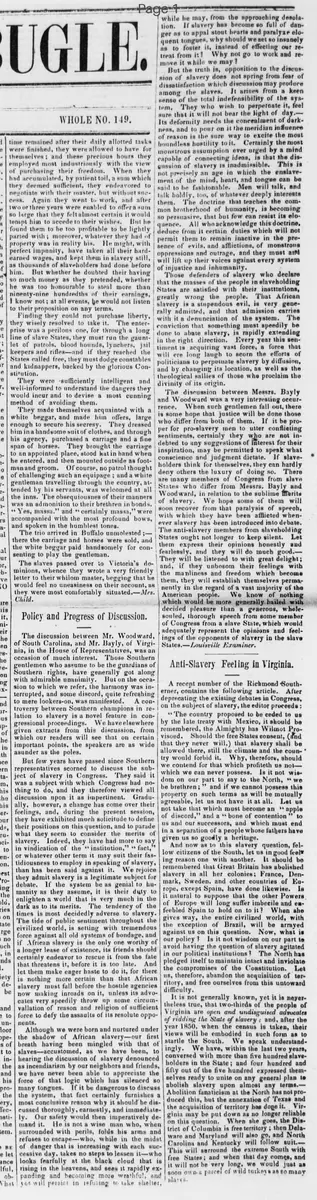
Policy and Progress of Discussion.
The discussion between Mr. Woodward, of South Carolina, and Mr. Bayly, of Virginia, in the House of Representatives, was an occasion of much interest. Those Southern gentlemen who assume to be the guardians of Southern rights, have generally got along with admirable unanimity. But on the occasion to which we refer, the harmony was interrupted, and some discord, quite refreshing to mere lookers-on, was manifested.
A controversy between Southern champions in relation to slavery is a novel feature in congressional proceedings. We have elsewhere given extracts from this discussion, from which our readers will see that on certain important points, the speakers are as wide asunder as the poles.
But few years have passed since Southern representatives scorned to discuss the subject of slavery in Congress. They said it was a subject with which Congress had nothing to do, and they therefore viewed all discussion upon it as impertinent. Gradually, however, a change has come over their feelings, and, during the present session, they have exhibited much solicitude to define their positions on this question, and to parade what they seem to consider the merits of slavery. Indeed, they have had more to say in vindication of the "institution," "fact," or whatever other term it may suit their fastidiousness to employ in speaking of slavery, than has been said against it. We rejoice they admit slavery is a legitimate subject for debate. If the system be as genial to humanity as they assume, it is their duty to enlighten a world that is very much in the dark as to its merits. The tendency of the times is most decidedly adverse to slavery. The tide of public sentiment throughout the civilized world, is setting with tremendous force against all old systems of bondage, and if African slavery is the only one worthy of a longer lease of existence, its friends should certainly endeavor to rescue it from the fate that threatens it, before it is too late. And let them make eager haste to do it, for there is nothing more certain than that African slavery must fall before the hostile agencies now making inroads on it, unless its advocates very speedily throw up some circumvallation of reason and religion of sufficient force to defy the assaults of its resolute opponents.
Although we were born and nurtured under the shadow of African slavery—our first breath having been mingled with that of slaves—accustomed, as we have been, to hearing the discussion of slavery denounced as incendiarism by our neighbors and friends, we have never been able to appreciate the force of that logic which has silenced so many tongues. If it be dangerous to discuss the system, that fact certainly furnishes a most conclusive reason why it should be discussed thoroughly, earnestly, and immediately. Our safety would then imperatively demand it. He is not a wise man who, when surrounded with perils, folds his arms and refuses to escape—who, while in the midst of danger that is increasing with each successive day, takes no steps to lessen it—who looks fearfully at the black cloud that is rising in the heavens, and sees it rapidly expanding and becoming more wrathful, and yet will persist in refusing to take shelter, while he may, from the approaching desolation. If slavery has become so full of danger as to appal stout hearts and paralyze eloquent tongues, why should we act so insanely as to foster it, instead of effecting our retreat from it? Why not go to work and remove it while we may?
But the truth is, opposition to the discussion of slavery does not spring from fear of dissatisfaction which discussion may produce among the slaves. It arises from a keen sense of the total indefensibility of the system. They who wish to perpetuate it, feel sure that it will not bear the light of day.— Its deformity needs the concealment of darkness, and to pour on it the meridian influence of reason is the sure way to excite the most boundless hostility to it. "Certainly the most monstrous assumption ever urged by a mind capable of connecting ideas, is that the discussion of slavery is inadmissible. This is not precisely an age in which the enslavement of the mind, heart, and tongue can be said to be fashionable. Men will talk, and talk boldly, too, of whatever deeply interests them. The doctrine that teaches the common brotherhood of humanity, is becoming so persuasive, that but few can resist its eloquence. All who acknowledge this doctrine deduce from it certain duties which will not permit them to remain inactive in the presence of evils, and afflictions, of monstrous oppressions and outrage, and they must and will lift up their voices against every system of injustice and inhumanity.
Those defenders of slavery who declare that the masses of the people in slaveholding States are satisfied with their institutions, greatly wrong the people. That African slavery is a stupendous evil, is very generally admitted, and that admission carries with it a denunciation of the system. The conviction that something must speedily be done to abate slavery, is rapidly extending in the right direction. Every year this sentiment is acquiring vast force, a force that will ere long laugh to scorn the efforts of politicians to perpetuate slavery by diffusion, and by changing its location, as well as the theological sallies of those who proclaim the divinity of its origin.
The discussion between Messrs. Bayly and Woodward was a very interesting occurrence. When such gentlemen fall out, there is some hope that justice will be done those who differ from both of them. If it be proper for pro-slavery men to utter conflicting sentiments, certainly they who are not indebted to any suggestions of interest for their inspiration, may be permitted to speak what conscience and judgment dictate. If slaveholders think for themselves, they can hardly deny others the luxury of doing so. There are many members of Congress from slave States who differ from Messrs. Bayly and Woodward, in relation to the sublime merits of slavery. We hope some of them will soon recover from that paralysis of speech, with which they have been afflicted whenever slavery has been introduced into debate.
The anti-slavery members from slaveholding States ought not longer to keep silent. Let them express their opinions honestly and fearlessly, and they will do much good.— They will be listened to with great delight; and, if they unbosom their feelings with the manliness and freedom which become them, they will establish themselves permanently in the regard of a vast majority of the American people. We know of nothing which would be more generally hailed with decided pleasure than a generous, whole-souled, thorough speech from some member of Congress from a slave State, which would adequately represent the opinions and feelings of the opponents of slavery in the slave States.—Louisville Examiner.
The discussion between Mr. Woodward, of South Carolina, and Mr. Bayly, of Virginia, in the House of Representatives, was an occasion of much interest. Those Southern gentlemen who assume to be the guardians of Southern rights, have generally got along with admirable unanimity. But on the occasion to which we refer, the harmony was interrupted, and some discord, quite refreshing to mere lookers-on, was manifested.
A controversy between Southern champions in relation to slavery is a novel feature in congressional proceedings. We have elsewhere given extracts from this discussion, from which our readers will see that on certain important points, the speakers are as wide asunder as the poles.
But few years have passed since Southern representatives scorned to discuss the subject of slavery in Congress. They said it was a subject with which Congress had nothing to do, and they therefore viewed all discussion upon it as impertinent. Gradually, however, a change has come over their feelings, and, during the present session, they have exhibited much solicitude to define their positions on this question, and to parade what they seem to consider the merits of slavery. Indeed, they have had more to say in vindication of the "institution," "fact," or whatever other term it may suit their fastidiousness to employ in speaking of slavery, than has been said against it. We rejoice they admit slavery is a legitimate subject for debate. If the system be as genial to humanity as they assume, it is their duty to enlighten a world that is very much in the dark as to its merits. The tendency of the times is most decidedly adverse to slavery. The tide of public sentiment throughout the civilized world, is setting with tremendous force against all old systems of bondage, and if African slavery is the only one worthy of a longer lease of existence, its friends should certainly endeavor to rescue it from the fate that threatens it, before it is too late. And let them make eager haste to do it, for there is nothing more certain than that African slavery must fall before the hostile agencies now making inroads on it, unless its advocates very speedily throw up some circumvallation of reason and religion of sufficient force to defy the assaults of its resolute opponents.
Although we were born and nurtured under the shadow of African slavery—our first breath having been mingled with that of slaves—accustomed, as we have been, to hearing the discussion of slavery denounced as incendiarism by our neighbors and friends, we have never been able to appreciate the force of that logic which has silenced so many tongues. If it be dangerous to discuss the system, that fact certainly furnishes a most conclusive reason why it should be discussed thoroughly, earnestly, and immediately. Our safety would then imperatively demand it. He is not a wise man who, when surrounded with perils, folds his arms and refuses to escape—who, while in the midst of danger that is increasing with each successive day, takes no steps to lessen it—who looks fearfully at the black cloud that is rising in the heavens, and sees it rapidly expanding and becoming more wrathful, and yet will persist in refusing to take shelter, while he may, from the approaching desolation. If slavery has become so full of danger as to appal stout hearts and paralyze eloquent tongues, why should we act so insanely as to foster it, instead of effecting our retreat from it? Why not go to work and remove it while we may?
But the truth is, opposition to the discussion of slavery does not spring from fear of dissatisfaction which discussion may produce among the slaves. It arises from a keen sense of the total indefensibility of the system. They who wish to perpetuate it, feel sure that it will not bear the light of day.— Its deformity needs the concealment of darkness, and to pour on it the meridian influence of reason is the sure way to excite the most boundless hostility to it. "Certainly the most monstrous assumption ever urged by a mind capable of connecting ideas, is that the discussion of slavery is inadmissible. This is not precisely an age in which the enslavement of the mind, heart, and tongue can be said to be fashionable. Men will talk, and talk boldly, too, of whatever deeply interests them. The doctrine that teaches the common brotherhood of humanity, is becoming so persuasive, that but few can resist its eloquence. All who acknowledge this doctrine deduce from it certain duties which will not permit them to remain inactive in the presence of evils, and afflictions, of monstrous oppressions and outrage, and they must and will lift up their voices against every system of injustice and inhumanity.
Those defenders of slavery who declare that the masses of the people in slaveholding States are satisfied with their institutions, greatly wrong the people. That African slavery is a stupendous evil, is very generally admitted, and that admission carries with it a denunciation of the system. The conviction that something must speedily be done to abate slavery, is rapidly extending in the right direction. Every year this sentiment is acquiring vast force, a force that will ere long laugh to scorn the efforts of politicians to perpetuate slavery by diffusion, and by changing its location, as well as the theological sallies of those who proclaim the divinity of its origin.
The discussion between Messrs. Bayly and Woodward was a very interesting occurrence. When such gentlemen fall out, there is some hope that justice will be done those who differ from both of them. If it be proper for pro-slavery men to utter conflicting sentiments, certainly they who are not indebted to any suggestions of interest for their inspiration, may be permitted to speak what conscience and judgment dictate. If slaveholders think for themselves, they can hardly deny others the luxury of doing so. There are many members of Congress from slave States who differ from Messrs. Bayly and Woodward, in relation to the sublime merits of slavery. We hope some of them will soon recover from that paralysis of speech, with which they have been afflicted whenever slavery has been introduced into debate.
The anti-slavery members from slaveholding States ought not longer to keep silent. Let them express their opinions honestly and fearlessly, and they will do much good.— They will be listened to with great delight; and, if they unbosom their feelings with the manliness and freedom which become them, they will establish themselves permanently in the regard of a vast majority of the American people. We know of nothing which would be more generally hailed with decided pleasure than a generous, whole-souled, thorough speech from some member of Congress from a slave State, which would adequately represent the opinions and feelings of the opponents of slavery in the slave States.—Louisville Examiner.
What sub-type of article is it?
Slavery Abolition
What keywords are associated?
Slavery Debate
Congressional Discussion
Southern Representatives
Anti Slavery Advocacy
Abolition Sentiment
What entities or persons were involved?
Mr. Woodward
Mr. Bayly
Southern Representatives
Anti Slavery Members From Slaveholding States
Editorial Details
Primary Topic
Congressional Debate On Slavery Between Southern Representatives
Stance / Tone
Strongly Anti Slavery, Advocating Open Discussion And Opposition
Key Figures
Mr. Woodward
Mr. Bayly
Southern Representatives
Anti Slavery Members From Slaveholding States
Key Arguments
Southern Harmony On Slavery Interrupted By Woodward Bayly Debate
Slavery Now Openly Discussed In Congress, Contrary To Past Scorn
Advocates For Slavery Should Defend It Publicly As World Opposes Bondage
Opposition To Discussion Stems From Indefensibility Of Slavery
Slavery Is A Stupendous Evil Widely Admitted In Slave States
Anti Slavery Members From Slave States Should Speak Fearlessly
Public Sentiment Against Slavery Is Growing Rapidly