Thank you for visiting SNEWPapers!
Sign up free
Letter to Editor
November 1, 1823
Edwardsville Spectator
Edwardsville, Madison County, Illinois
What is this article about?
A series of five letters by Jonathan Freeman to the Illinois Gazette editor, opposing the introduction of slavery into Illinois. He argues it won't alleviate economic scarcity, would disrupt free farmers' lives, and promotes free labor over slave-based agriculture, drawing comparisons to Kentucky and Missouri.
Clipping
OCR Quality
98%
Excellent
Full Text
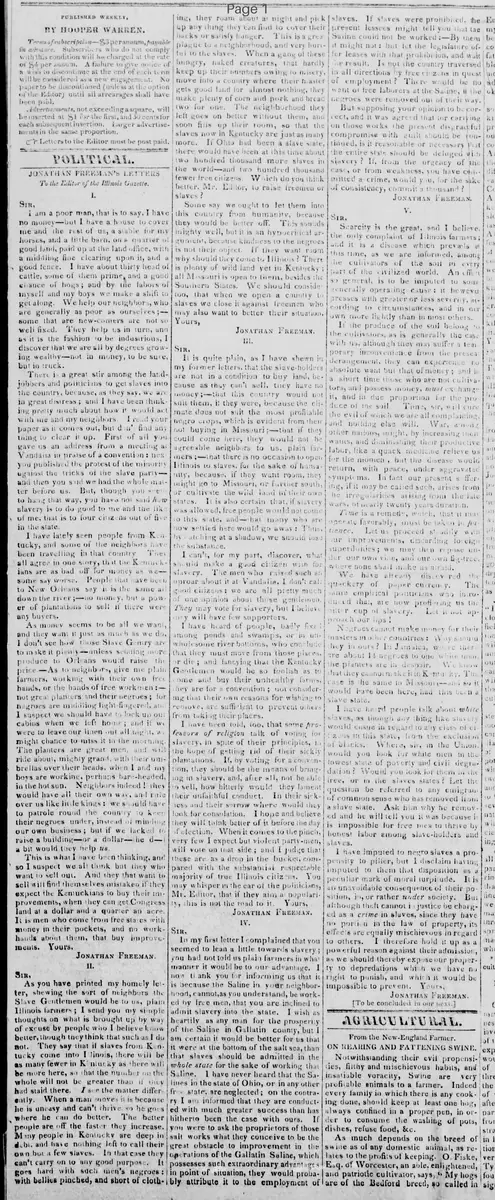
POLITICAL.
JONATHAN FREEMAN'S LETTERS
To the Editor of the Illinois Gazette.
I.
SIR,
I am a poor man, that is to say, I have no money—but I have a house to cover me and the rest of us, a stable for my horses, and a little barn, on a quarter of good land, paid up at the land office, with a middling fine clearing upon it, and a good fence. I have about thirty head of cattle, some of them prime, and a good chance of hogs; and by the labors of myself and my boys we make a shift to get along. We help our neighbors, who are generally as poor as ourselves;—some that are new-comers are not so well fixed. They help us in turn, and as it is the fashion to be industrious, I discover that we are all by degrees growing wealthy—not in money, to be sure, but in truck.
There is great stir among the land-jobbers and politicians to get slaves into the country, because, as they say, we are in great distress; and I have been thinking pretty much about how it would act with me and my neighbors. I read your paper as it comes out, but don't find anything to clear it up. First of all you gave us an address from a meeting at Vandalia in praise of a convention: next you published the protest of the minority against the tricks of the slave party—and then you said we had the whole matter before us. But, though you seem to hang that way, you have not said how slavery is to do good to me and the like of me, that is to four citizens out of five in the state.
I have lately seen people from Kentucky, and some of the neighbors have been travelling in that country. They all agree in one story, that the Kentuckians are as bad off for money as we—some say worse. People that have been to New Orleans say it is the same all down the river;—no money, but a power of plantations to sell if there were any buyers.
As money seems to be all we want, and they want it just as much as we do, I don't see how those Slave Gentry are to make it plenty—unless sending more produce to Orleans would raise the price.—As to neighbors, give me plain farmers, working with their own free hands, or the hands of free workmen:—not great planters and their negroes; for negroes are middling light-fingered, and I suspect we should have to lock up our cabins when we left home; and if we were to leave our linen out all night, we might chance to miss it in the morning.
The planters are great men, and will ride about, mighty grand, with their umbrellas over their heads, when I and my boys are working, perhaps bare-headed, in the hot sun. Neighbors indeed! they would have all their own way, and rule over us like little kings: we should have to patrol round the country to keep their negroes under, instead of minding our own business; but if we lacked to raise a building—or a dollar—the devil a bit would they help us.
This is what I have been thinking, and so I suspect we all think but they who want to sell out. And they that want to sell will find themselves mistaken if they expect the Kentuckians to buy their improvements, when they can get Congress land at a dollar and a quarter an acre.
It is men who come from free states with money in their pockets, and no work-hands about them, that buy improvements.
Yours,
Jonathan Freeman.
II.
SIR,
As you have printed my homely letter, shewing the sort of neighbors the Slave Gentlemen would be to us, plain Illinois farmers; I send you my simple thoughts on what is brought up by way of excuse by people who I believe know better, though they think that such as I do not. They say that if slaves from Kentucky come into Illinois, there will be as many fewer in Kentucky as there will be more here, so that the number on the whole will not be greater than if they had staid there. I see the matter differently. When a man moves it is because he is uneasy and can't thrive, so he goes where he can do better. The better people are off the faster they increase.
Many people in Kentucky are deep in debt, and have nothing left to call their own but a few slaves. In that case they can't carry on to any good purpose. It goes hard with such men's negroes: with bellies pinched, and short of clothing, they roam about at night and pick up anything they can find to cover their backs or satisfy hunger. This is a great plague to a neighborhood, and very hurtful to the slaves. When a gang of these hungry, naked creatures, that hardly keep up their numbers owing to misery, move into a country where their master gets good land for almost nothing, they make plenty of corn and pork and bread two for one. The neighborhood they left goes on better without them, and soon fills up their room, so that the slaves now in Kentucky are just as many more. If Ohio had been a slave state, there would have been at this time about two hundred thousand more slaves in the world and two hundred thousand fewer free citizens. Which do you think better, Mr. Editor, to raise freemen or slaves?
Some say we ought to let them into this country from humanity, because they would be better off. This sounds mighty well, but it is an hypocritical argument, because kindness to the negroes is not their object. If they want room why should they come to Illinois? There is plenty of wild land yet in Kentucky; all Missouri is open to them, besides the Southern States. We should consider too, that when we open a country to slaves we close it against freemen who may also want to better their situation.
Yours,
JONATHAN FREEMAN.
III.
SIR,
It is quite plain, as I have shewn in my former letters, that the slave-holders are not in a condition to buy land, because as they can't sell, they have no money;—that this country would not suit them, if they were, because the climate does not suit the most profitable negro crops, which is evident from their not buying in Missouri;—that if they could come here, they would not be agreeable neighbors to us, plain farmers;—that there is no occasion to open Illinois to slaves, for the sake of humanity, because, if they want room, they might go to Missouri, or further south, or cultivate the wild land in their own states. It is also certain that, if slavery was allowed, free people would not come to this state, and that many who are now settled here would go away: Thus, by catching at a shadow, we should lose the substance.
I can't, for my part, discover, what should make a good citizen wish for slavery. The men who raised such an uproar about it at Vandalia, I don't call good citizens: we are all pretty much of one opinion about those gentlemen. They may vote for slavery, but I believe they will have few supporters.
I have heard of people, badly fixed among ponds and swamps, or in unwholesome river bottoms, who conclude that they must move from those places, or die; and fancying that the Kentucky Gentlemen would be so foolish as to come and buy their unhealthy farms, they are for a convention; not considering that their own reasons for wishing to remove, are sufficient to prevent others from taking their places.
I have been told, too, that some professors of religion talk of voting for slavery, in spite of their principles, in the hope of getting rid of their sickly plantations. If, by voting for a convention, they should be the means of bringing in slavery, and, after all, not be able to sell, how bitterly would they lament their unfaithful conduct. In their sickness and their sorrow where would they look for consolation. I hope and believe they will think better of it before the day of election. When it comes to the pinch, very few I expect but violent party-men, will vote on that side; and I judge that these are as a drop in the bucket, compared with the substantial respectable majority of true Illinois citizens. You may whisper in the ear of the politicians, Mr. Editor, that if they aim at popularity, this is not the road to it.
Yours,
JONATHAN FREEMAN.
IV.
SIR,
In my first letter I complained that you seemed to lean a little towards slavery; you had not told us plain farmers in what manner it would be to our advantage. I now thank you for informing us that it is because the Saline in your neighborhood, cannot, as you understand, be worked by free men, that you are inclined to admit slavery into the state. I wish as heartily as any man for the prosperity of the Saline in Gallatin county, but I am certain it would be better for us that it were at the bottom of the salt sea, than that slaves should be admitted in the whole state for the sake of working that Saline. I have never heard that the Salines in the state of Ohio, or in any other free state, are neglected; on the contrary I am informed that they are conducted with much greater success than has hitherto been the case with ours. If you were to ask the proprietors of those salt works what they conceive to be the great obstacle to improvement in the operations of the Gallatin Saline, which possesses such extraordinary advantages in point of situation, they would probably attribute it to the employment of slaves. If slaves were prohibited, the present lessees might tell you that the Saline could not be worked:—By them it might not: but let the legislature offer leases with that prohibition, and wait the result. Is not the country traversed in all directions by free citizens in quest of employment? There would be no want of free laborers at the Saline, if the negroes were removed out of their way.
But supposing your opinion to be correct, and it was agreed that for carrying on those works the present disgraceful compromise with guilt should be continued, is it reasonable or necessary that the entire state should be deluged with slavery? If, from the urgency of the case, or from weakness, you have committed a crime, would you, for the sake of consistency, commit a thousand?
JONATHAN FREEMAN.
V.
SIR,
Scarcity is the great, and I believe, the only complaint of Illinois farmers; and it is a disease which prevails at this time, as we are informed, among the cultivators of the soil in every part of the civilized world. And if so general, is to be imputed to some generally operating cause: not however which presses with greater or less severity, according to circumstances, and in our own more lightly than in most others.
If the produce of the soil belong to the cultivators, as is generally the case with us, although they may suffer a temporary inconvenience from the present derangement, they can experience no absolute want but that of money; and in a short time those who are not cultivators, and possess money, must exchange it, and in due proportion for the produce of the soil. Time, sir, will cure the evil of which we are all complaining, and nothing else will. War, among other nations, might, by increasing their wants, and diminishing their productive labor, like a quack medicine relieve us for the moment, but the disease would return, with peace, under aggravated symptoms. In fact our present suffering, if it may be called such, arises from the irregularities arising from the late wars, of nearly twenty years duration.
Time is a remedy, which, that it may operate favorably, must be taken in full measure. Let us proceed steadily with our improvements, discarding foreign absurdities; we may then repose under our own vine, and our own fig-tree, where none shall make us afraid.
We have already discovered the quackery of paper currency. The same empirical politicians who introduced that, are now proffering us the bitter cup of slavery. Let it not approach our lips!
Negroes cannot make money for their masters in more countries: Why should they in ours? In Jamaica, where there are about 11 negroes to one white man, the planters are in despair. We know that they cannot make it in Kentucky. The case is the same in Missouri—and so it would have been here, had this been a slave state.
I have heard people talk about white slaves, as though anything like slavery would ensue in regard to any class of citizens in this state, from the exclusion of blacks. Where, sir, in the Union, would you look for white men in the lowest state of poverty and civil degradation? Would you look for them in the free, or in the slave states? Let the question be referred to any emigrant of common sense who has removed from a slave state. Ask him why he removed and he will tell you it was because it is impossible for free men to thrive by honest labor among slave-holders and slaves.
I have imputed to negro slaves a propensity to pilfer, but I disclaim having imputed to them that disposition as a peculiar mark of moral turpitude. It is an unavoidable consequence of their position, in, or rather under society. But although theft cannot in justice be charged as a crime in slaves, since they have no portion in the law of property, its effects are equally mischievous in regard to others. I therefore hold it up as a powerful reason against their admission, as we should thereby expose our property to depredations which we have no right to punish, and which it would be impossible to prevent.
Yours,
JONATHAN FREEMAN.
[To be concluded in our next.]
JONATHAN FREEMAN'S LETTERS
To the Editor of the Illinois Gazette.
I.
SIR,
I am a poor man, that is to say, I have no money—but I have a house to cover me and the rest of us, a stable for my horses, and a little barn, on a quarter of good land, paid up at the land office, with a middling fine clearing upon it, and a good fence. I have about thirty head of cattle, some of them prime, and a good chance of hogs; and by the labors of myself and my boys we make a shift to get along. We help our neighbors, who are generally as poor as ourselves;—some that are new-comers are not so well fixed. They help us in turn, and as it is the fashion to be industrious, I discover that we are all by degrees growing wealthy—not in money, to be sure, but in truck.
There is great stir among the land-jobbers and politicians to get slaves into the country, because, as they say, we are in great distress; and I have been thinking pretty much about how it would act with me and my neighbors. I read your paper as it comes out, but don't find anything to clear it up. First of all you gave us an address from a meeting at Vandalia in praise of a convention: next you published the protest of the minority against the tricks of the slave party—and then you said we had the whole matter before us. But, though you seem to hang that way, you have not said how slavery is to do good to me and the like of me, that is to four citizens out of five in the state.
I have lately seen people from Kentucky, and some of the neighbors have been travelling in that country. They all agree in one story, that the Kentuckians are as bad off for money as we—some say worse. People that have been to New Orleans say it is the same all down the river;—no money, but a power of plantations to sell if there were any buyers.
As money seems to be all we want, and they want it just as much as we do, I don't see how those Slave Gentry are to make it plenty—unless sending more produce to Orleans would raise the price.—As to neighbors, give me plain farmers, working with their own free hands, or the hands of free workmen:—not great planters and their negroes; for negroes are middling light-fingered, and I suspect we should have to lock up our cabins when we left home; and if we were to leave our linen out all night, we might chance to miss it in the morning.
The planters are great men, and will ride about, mighty grand, with their umbrellas over their heads, when I and my boys are working, perhaps bare-headed, in the hot sun. Neighbors indeed! they would have all their own way, and rule over us like little kings: we should have to patrol round the country to keep their negroes under, instead of minding our own business; but if we lacked to raise a building—or a dollar—the devil a bit would they help us.
This is what I have been thinking, and so I suspect we all think but they who want to sell out. And they that want to sell will find themselves mistaken if they expect the Kentuckians to buy their improvements, when they can get Congress land at a dollar and a quarter an acre.
It is men who come from free states with money in their pockets, and no work-hands about them, that buy improvements.
Yours,
Jonathan Freeman.
II.
SIR,
As you have printed my homely letter, shewing the sort of neighbors the Slave Gentlemen would be to us, plain Illinois farmers; I send you my simple thoughts on what is brought up by way of excuse by people who I believe know better, though they think that such as I do not. They say that if slaves from Kentucky come into Illinois, there will be as many fewer in Kentucky as there will be more here, so that the number on the whole will not be greater than if they had staid there. I see the matter differently. When a man moves it is because he is uneasy and can't thrive, so he goes where he can do better. The better people are off the faster they increase.
Many people in Kentucky are deep in debt, and have nothing left to call their own but a few slaves. In that case they can't carry on to any good purpose. It goes hard with such men's negroes: with bellies pinched, and short of clothing, they roam about at night and pick up anything they can find to cover their backs or satisfy hunger. This is a great plague to a neighborhood, and very hurtful to the slaves. When a gang of these hungry, naked creatures, that hardly keep up their numbers owing to misery, move into a country where their master gets good land for almost nothing, they make plenty of corn and pork and bread two for one. The neighborhood they left goes on better without them, and soon fills up their room, so that the slaves now in Kentucky are just as many more. If Ohio had been a slave state, there would have been at this time about two hundred thousand more slaves in the world and two hundred thousand fewer free citizens. Which do you think better, Mr. Editor, to raise freemen or slaves?
Some say we ought to let them into this country from humanity, because they would be better off. This sounds mighty well, but it is an hypocritical argument, because kindness to the negroes is not their object. If they want room why should they come to Illinois? There is plenty of wild land yet in Kentucky; all Missouri is open to them, besides the Southern States. We should consider too, that when we open a country to slaves we close it against freemen who may also want to better their situation.
Yours,
JONATHAN FREEMAN.
III.
SIR,
It is quite plain, as I have shewn in my former letters, that the slave-holders are not in a condition to buy land, because as they can't sell, they have no money;—that this country would not suit them, if they were, because the climate does not suit the most profitable negro crops, which is evident from their not buying in Missouri;—that if they could come here, they would not be agreeable neighbors to us, plain farmers;—that there is no occasion to open Illinois to slaves, for the sake of humanity, because, if they want room, they might go to Missouri, or further south, or cultivate the wild land in their own states. It is also certain that, if slavery was allowed, free people would not come to this state, and that many who are now settled here would go away: Thus, by catching at a shadow, we should lose the substance.
I can't, for my part, discover, what should make a good citizen wish for slavery. The men who raised such an uproar about it at Vandalia, I don't call good citizens: we are all pretty much of one opinion about those gentlemen. They may vote for slavery, but I believe they will have few supporters.
I have heard of people, badly fixed among ponds and swamps, or in unwholesome river bottoms, who conclude that they must move from those places, or die; and fancying that the Kentucky Gentlemen would be so foolish as to come and buy their unhealthy farms, they are for a convention; not considering that their own reasons for wishing to remove, are sufficient to prevent others from taking their places.
I have been told, too, that some professors of religion talk of voting for slavery, in spite of their principles, in the hope of getting rid of their sickly plantations. If, by voting for a convention, they should be the means of bringing in slavery, and, after all, not be able to sell, how bitterly would they lament their unfaithful conduct. In their sickness and their sorrow where would they look for consolation. I hope and believe they will think better of it before the day of election. When it comes to the pinch, very few I expect but violent party-men, will vote on that side; and I judge that these are as a drop in the bucket, compared with the substantial respectable majority of true Illinois citizens. You may whisper in the ear of the politicians, Mr. Editor, that if they aim at popularity, this is not the road to it.
Yours,
JONATHAN FREEMAN.
IV.
SIR,
In my first letter I complained that you seemed to lean a little towards slavery; you had not told us plain farmers in what manner it would be to our advantage. I now thank you for informing us that it is because the Saline in your neighborhood, cannot, as you understand, be worked by free men, that you are inclined to admit slavery into the state. I wish as heartily as any man for the prosperity of the Saline in Gallatin county, but I am certain it would be better for us that it were at the bottom of the salt sea, than that slaves should be admitted in the whole state for the sake of working that Saline. I have never heard that the Salines in the state of Ohio, or in any other free state, are neglected; on the contrary I am informed that they are conducted with much greater success than has hitherto been the case with ours. If you were to ask the proprietors of those salt works what they conceive to be the great obstacle to improvement in the operations of the Gallatin Saline, which possesses such extraordinary advantages in point of situation, they would probably attribute it to the employment of slaves. If slaves were prohibited, the present lessees might tell you that the Saline could not be worked:—By them it might not: but let the legislature offer leases with that prohibition, and wait the result. Is not the country traversed in all directions by free citizens in quest of employment? There would be no want of free laborers at the Saline, if the negroes were removed out of their way.
But supposing your opinion to be correct, and it was agreed that for carrying on those works the present disgraceful compromise with guilt should be continued, is it reasonable or necessary that the entire state should be deluged with slavery? If, from the urgency of the case, or from weakness, you have committed a crime, would you, for the sake of consistency, commit a thousand?
JONATHAN FREEMAN.
V.
SIR,
Scarcity is the great, and I believe, the only complaint of Illinois farmers; and it is a disease which prevails at this time, as we are informed, among the cultivators of the soil in every part of the civilized world. And if so general, is to be imputed to some generally operating cause: not however which presses with greater or less severity, according to circumstances, and in our own more lightly than in most others.
If the produce of the soil belong to the cultivators, as is generally the case with us, although they may suffer a temporary inconvenience from the present derangement, they can experience no absolute want but that of money; and in a short time those who are not cultivators, and possess money, must exchange it, and in due proportion for the produce of the soil. Time, sir, will cure the evil of which we are all complaining, and nothing else will. War, among other nations, might, by increasing their wants, and diminishing their productive labor, like a quack medicine relieve us for the moment, but the disease would return, with peace, under aggravated symptoms. In fact our present suffering, if it may be called such, arises from the irregularities arising from the late wars, of nearly twenty years duration.
Time is a remedy, which, that it may operate favorably, must be taken in full measure. Let us proceed steadily with our improvements, discarding foreign absurdities; we may then repose under our own vine, and our own fig-tree, where none shall make us afraid.
We have already discovered the quackery of paper currency. The same empirical politicians who introduced that, are now proffering us the bitter cup of slavery. Let it not approach our lips!
Negroes cannot make money for their masters in more countries: Why should they in ours? In Jamaica, where there are about 11 negroes to one white man, the planters are in despair. We know that they cannot make it in Kentucky. The case is the same in Missouri—and so it would have been here, had this been a slave state.
I have heard people talk about white slaves, as though anything like slavery would ensue in regard to any class of citizens in this state, from the exclusion of blacks. Where, sir, in the Union, would you look for white men in the lowest state of poverty and civil degradation? Would you look for them in the free, or in the slave states? Let the question be referred to any emigrant of common sense who has removed from a slave state. Ask him why he removed and he will tell you it was because it is impossible for free men to thrive by honest labor among slave-holders and slaves.
I have imputed to negro slaves a propensity to pilfer, but I disclaim having imputed to them that disposition as a peculiar mark of moral turpitude. It is an unavoidable consequence of their position, in, or rather under society. But although theft cannot in justice be charged as a crime in slaves, since they have no portion in the law of property, its effects are equally mischievous in regard to others. I therefore hold it up as a powerful reason against their admission, as we should thereby expose our property to depredations which we have no right to punish, and which it would be impossible to prevent.
Yours,
JONATHAN FREEMAN.
[To be concluded in our next.]
What sub-type of article is it?
Persuasive
Political
Ethical Moral
What themes does it cover?
Slavery Abolition
Politics
Economic Policy
What keywords are associated?
Slavery Opposition
Illinois Farmers
Free Labor
Economic Scarcity
Slaveholders Neighbors
Vandalia Convention
Gallatin Saline
What entities or persons were involved?
Jonathan Freeman
Editor Of The Illinois Gazette
Letter to Editor Details
Author
Jonathan Freeman
Recipient
Editor Of The Illinois Gazette
Main Argument
slavery should not be introduced into illinois as it will not solve economic scarcity, will harm free farmers by creating unequal neighbors and security issues, and free labor is superior for prosperity and moral reasons.
Notable Details
References Vandalia Convention And Protest
Comparisons To Kentucky, Missouri, Ohio, Jamaica
Discussion Of Gallatin Saline And Free Vs Slave Labor
Critique Of Pro Slavery Arguments On Humanity And Economy