Thank you for visiting SNEWPapers!
Sign up free
Story
February 20, 1956
The Lincoln Times
Lincolnton, Lincoln County, North Carolina
What is this article about?
Jim Andersen, State College extension forestry specialist, advises timber owners to prioritize fair deals, buyer reputation, and written contracts to ensure sustainable logging practices beyond just price.
Clipping
OCR Quality
98%
Excellent
Full Text
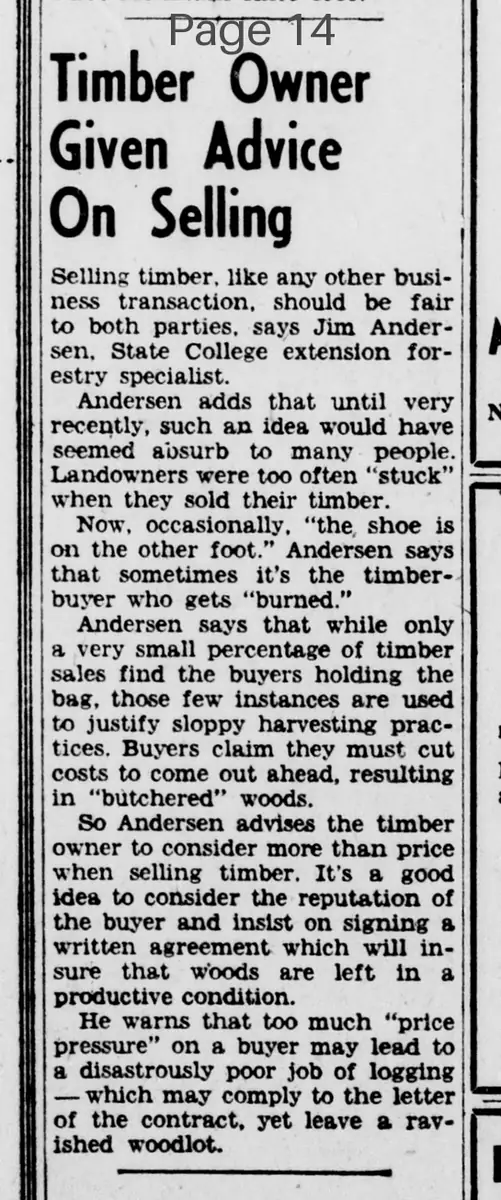
Timber Owner Given Advice On Selling
Selling timber, like any other business transaction, should be fair to both parties, says Jim Andersen, State College extension forestry specialist.
Andersen adds that until very recently, such an idea would have seemed absurd to many people. Landowners were too often "stuck" when they sold their timber.
Now, occasionally, "the shoe is on the other foot." Andersen says that sometimes it's the timber-buyer who gets "burned."
Andersen says that while only a very small percentage of timber sales find the buyers holding the bag, those few instances are used to justify sloppy harvesting practices. Buyers claim they must cut costs to come out ahead, resulting in "butchered" woods.
So Andersen advises the timber owner to consider more than price when selling timber. It's a good idea to consider the reputation of the buyer and insist on signing a written agreement which will insure that woods are left in a productive condition.
He warns that too much "price pressure" on a buyer may lead to a disastrously poor job of logging -- which may comply to the letter of the contract, yet leave a ravaged woodlot.
Selling timber, like any other business transaction, should be fair to both parties, says Jim Andersen, State College extension forestry specialist.
Andersen adds that until very recently, such an idea would have seemed absurd to many people. Landowners were too often "stuck" when they sold their timber.
Now, occasionally, "the shoe is on the other foot." Andersen says that sometimes it's the timber-buyer who gets "burned."
Andersen says that while only a very small percentage of timber sales find the buyers holding the bag, those few instances are used to justify sloppy harvesting practices. Buyers claim they must cut costs to come out ahead, resulting in "butchered" woods.
So Andersen advises the timber owner to consider more than price when selling timber. It's a good idea to consider the reputation of the buyer and insist on signing a written agreement which will insure that woods are left in a productive condition.
He warns that too much "price pressure" on a buyer may lead to a disastrously poor job of logging -- which may comply to the letter of the contract, yet leave a ravaged woodlot.
What sub-type of article is it?
Advisory Article
What keywords are associated?
Timber Sales
Forestry Advice
Sustainable Harvesting
Buyer Reputation
Written Agreements
What entities or persons were involved?
Jim Andersen
Where did it happen?
State College
Story Details
Key Persons
Jim Andersen
Location
State College
Story Details
Jim Andersen advises timber owners to ensure fair sales, consider buyer reputation, use written agreements for productive woods, and avoid excessive price pressure to prevent poor logging.