Thank you for visiting SNEWPapers!
Sign up free
The Virginia Gazette
Richmond, Williamsburg, Richmond County, Virginia
What is this article about?
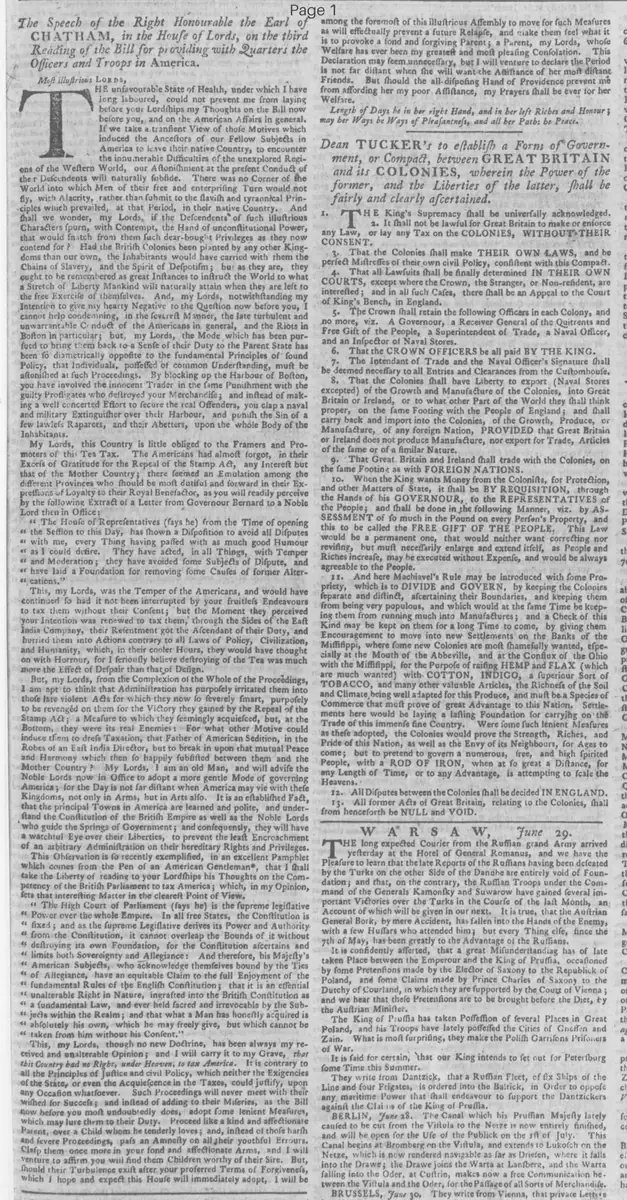
The Earl of Chatham delivers a speech in the House of Lords opposing a bill to quarter British troops in America, criticizing taxation without consent, the Boston Tea Party response, and urging reconciliation with the colonies as a parent to a child.
Merged-components note: The image in reading order 1 overlaps spatially with the story in reading order 2 and appears to be an illustration accompanying the Earl of Chatham's speech, forming a single logical component.
Clipping
OCR Quality
Full Text
Most illustrious Lords,
The unfavourable State of Health, under which I have long laboured, could not prevent me from laying before your Lordships my Thoughts on the Bill now before you, and on the American Affairs in general.
If we take a transient View of those Motives which induced the Ancestors of our Fellow Subjects in America to leave their native Country, to encounter the innumerable Difficulties of the unexplored Regions of the Western World, our Astonishment at the present Conduct of the Descendants will naturally subside. There was no Corner of the World into which Men of their free and enterprising Turn would not fly, with Alacrity, rather than Submit to the slavish and tyrannical Principles which prevailed, at that Period, in their native Country. And shall we wonder, my Lords, if the Descendants of such illustrious Characters spurn, with Contempt, the Hand of unconstitutional Power, that would snatch from them such dear-bought Privileges as they now contend for? Had the British Colonies been planted by any other Kingdoms than our own, the Inhabitants would have carried with them the Chains of Slavery, and the Spirit of Despotism; but as they are, they ought to be remembered as great Instances to instruct the World to what a Stretch of Liberty Mankind will naturally attain when they are left to the free Exercise of themselves. And, my Lords, notwithstanding my Intention to give my hearty Negative to the Question now before you, I cannot help condemning, in the severest Manner, the late turbulent and unwarrantable Conduct of the Americans in general, and the Riots in Boston in particular; but, my Lords, the Mode which has been pursued to bring them back to a Sense of their Duty to the Parent State has been so diametrically opposite to the fundamental Principles of sound Policy, that Individuals, possessed of common Understanding, must be astonished at such Proceedings. By blocking up the Harbour of Boston, you have involved the innocent Trader in the same Punishment with the guilty Profligates who destroyed your Merchandize; and instead of making a well concerted Effort to secure the real Offenders, you clap a naval and military Extinguisher over their Harbour, and punish the Sin of a few lawless Raparees, and their Abetters, upon the whole Body of the Inhabitants.
My Lords, this Country is little obliged to the Framers and Promoters of this Tea Tax. The Americans had almost forgot, in their Excess of Gratitude for the Repeal of the Stamp Act, any Interest but that of the Mother Country; there seemed an Emulation among the different Provinces who should be most dutiful and forward in their Expressions of Loyalty to their Royal Benefactor, as you will readily perceive by the following Extract of a Letter from Governor Bernard to a Noble Lord then in Office:
"The House of Representatives (says he) from the Time of opening the Session to this Day, has shown a Disposition to avoid all Disputes with me, every Thing having passed with as much good Humour as I could desire. They have acted, in all Things, with Temper and Moderation; they have avoided some Subjects of Dispute, and have laid a Foundation for removing some Causes of former Altercations."
This, my Lords, was the Temper of the Americans, and would have continued so had it not been interrupted by your fruitless Endeavours to tax them without their Consent; but the Moment they perceived your Intention was renewed to tax them, through the Sides of the East India Company, their Resentment got the Ascendant of their Duty, and hurried them into Actions contrary to all Laws of Policy, Civilization, and Humanity, which, in their cooler Hours, they would have thought on with Horror, for I seriously believe destroying of the Tea was much more the Effect of Despair than that of Design.
But, my Lords, from the Complexion of the Whole of the Proceedings, I am apt to think that Administration has purposely irritated them into those late violent Acts for which they now so severely smart, purposely to be revenged on them for the Victory they gained by the Repeal of the Stamp Act; a Measure to which they seemingly acquiesced, but, at the Bottom, they were its real Enemies: For what other Motive could induce them to dress Taxation, that Father of American Sedition, in the Robes of an East India Director, but to break in upon that mutual Peace and Harmony which then so happily subsisted between them and the Mother Country? My Lords, I am an old Man, and will advise the Noble Lords now in Office to adopt a more gentle Mode of governing America; for the Day is not far distant when America may vie with these Kingdoms, not only in Arms, but in Arts also. It is an established Fact, that the principal Towns in America are learned and polite, and understand the Constitution of the British Empire as well as the Noble Lords who guide the Springs of Government; and consequently, they will have a watchful Eye over their Liberties, to prevent the least Encroachment of an arbitrary Administration on their hereditary Rights and Privileges.
This Observation is so recently exemplified, in an excellent Pamphlet which comes from the Pen of an American Gentleman*, that I shall take the Liberty of reading to your Lordships his Thoughts on the Competency of the British Parliament to tax America; which, in my Opinion, sets that interesting Matter in the clearest Point of View.
"The High Court of Parliament (says he) is the supreme legislative Power over the whole Empire. In all free States, the Constitution is fixed; and as the supreme Legislative derives its Power and Authority from the Constitution, it cannot overleap the Bounds of it without destroying its own Foundation, for the Constitution ascertains and limits both Sovereignty and Allegiance: And therefore, his Majesty's American Subjects, who acknowledge themselves bound by the Ties of Allegiance, have an equitable Claim to the full Enjoyment of the fundamental Rules of the English Constitution; that it is an essential unalterable Right in Nature, ingrafted into the British Constitution as a fundamental Law, and ever held sacred and irrevocable by the Subjects within the Realm; and that what a Man has honestly acquired is absolutely his own, which he may freely give, but which cannot be taken from him without his Consent."
This, my Lords, though no new Doctrine, has been always my received and unalterable Opinion; and I will carry it to my Grave, that this Country had no Right, under Heaven, to tax America. It is contrary to all the Principles of Justice and civil Policy, which neither the Exigencies of the State, or even the Acquiescence in the Taxes, could justify, upon any Occasion whatsoever. Such Proceedings will never meet with their wished for Success; and instead of adding to their Miseries, as the Bill now before you most undoubtedly does, adopt some lenient Measures, which may lure them to their Duty. Proceed like a kind and affectionate Parent, over a Child whom he tenderly loves; and, instead of those harsh and severe Proceedings, pass an Amnesty on all their youthful Errors. Clap them once more in your fond and affectionate Arms, and I will venture to affirm you will find them Children worthy of their Sire. But, should their Turbulence exist after your proffered Terms of Forgiveness, which I hope and expect this House will immediately adopt, I will be among the foremost of this illustrious Assembly to move for such Measures as will effectually prevent a future Relapse, and make them feel what it is to provoke a fond and forgiving Parent; a Parent, my Lords, whose Welfare has ever been my greatest and most pleasing Consolation. This Declaration may seem unnecessary, but I will venture to declare the Period is not far distant when she will want the Assistance of her most distant Friends. But should the all-disposing Hand of Providence prevent me from affording her my poor Assistance, my Prayers shall be ever for her Welfare.
Length of Days be in her right Hand, and in her left Riches and Honours. May her Ways be Ways of Pleasantness, and all her Paths be Peace.
What sub-type of article is it?
What themes does it cover?
What keywords are associated?
What entities or persons were involved?
Where did it happen?
Story Details
Key Persons
Location
House Of Lords
Story Details
The Earl of Chatham opposes the quartering bill, condemns American riots but criticizes British taxation and harsh measures like the Boston Port Act, quotes a letter and pamphlet on constitutional rights, urges reconciliation and amnesty treating America as a child of Britain.