Thank you for visiting SNEWPapers!
Sign up free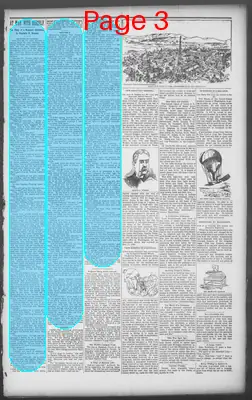
Literary
January 18, 1894
Phillipsburg Herald
Phillipsburg, Phillips County, Kansas
What is this article about?
In this excerpt from Charlotte M. Braeme's novel 'At War with Herself,' Captain Paul Flemyng learns he has lost his claim to the Charnleigh peerage and fortune to a young heiress, Leonie. He maintains composure and interacts romantically with Etheldreda 'Ethel' Dacre in Malta, while Leonie adjusts to her new status in England, yearning for intellectual stimulation and dismissing marriage.
Clipping
OCR Quality
95%
Excellent
Full Text
AT WAR WITH HERSELF.
The Story of a Woman's Atonement,
by Charlotte M. Braeme.
CHAPTER LX—Continued.
Then they sat for some minutes in silence, Major St. John amusing himself by throwing small stones from the rock into the sea, Captain Flemyng looking with a far-off, dreamy gaze at the heaving waters and the sapphire sky. Suddenly Major St. John broke the silence that seemed to have enfolded them.
"General Sir Huntley Dacre understands how to give a good ball. I never remember a better entertainment in Malta than that of last night."
Paul Flemyng made no reply, the subject evidently did not interest him.
"How beautiful la belle Etheldreda grows! I admired her exceedingly last evening."
"She is a lovely girl," said Paul, rousing himself; "it seems a pity that youth and beauty like hers should be buried here."
"The General is sure to return to England, and when he does that young lady will create a furor. If I, for instance, had any idea of asking her to marry me, I should do so at once." And Major St. John looked curiously at the calm, handsome face.
"That would doubtless prove a wise precaution," said the Captain, carelessly; "I am not a great believer in the felicity of either love or marriage."
"Then you are no soldier," was the quick reply; "next to glory, a soldier values love."
"It may be that I have had no actual experience," laughed Paul Flemyng.
"I have imagined to myself a kind of ideal woman, but I have never met any one like her."
"That's all very well. I prefer the real myself," returned the Major, dryly. "I should have imagined, for example, that la belle Ethel was infinitely superior to any ideal that you or I could imagine."
"She is a beautiful girl."
"She is more than that," remarked the Major. "I can read passion, genius, fire, power, in her face. Do you know," questioned he, abruptly, "I fancied there was some little tenderness between you and Miss Dacre?"
"I never care to discuss such matters," said Paul, calmly.
"That is to say, you will not boast of good fortune."
"I have none to boast of, and if I had there is honor in love, I suppose, as well as in warfare."
"We all noticed Miss Dacre's bouquet of white rosebuds," continued Major St. John, "and we could not help seeing that when you left the ball-room you carried one of them in your coat."
"There is nothing in that. Miss Dacre gave it to me because I admired them."
"Young ladies do not give rosebuds for nothing," said the Major laughing. "I consider it a most suspicious circumstance."
To this Captain Flemyng made no reply.
"You will call at the General's some time to-day?" said Major St. John.
"Yes. I told my servant to follow me here first with the papers and letters from the mail."
"Then you will not tell me anything about Miss Dacre, Paul?"
"I have nothing to tell, except that I think her very beautiful, and of an amiable disposition. How nicely she speaks to her father and how kind she is to every one! Ah, here comes the letters!"
There were several letters and papers. Captain Flemyng gave the papers to his friend, while he read the closely written pages of his English correspondence. He came at length to a blue official-looking envelope, and Major St. John, instead of reading the news, looked at him while he opened it.
The letter was of great moment to the young soldier. It was to tell him whether he was Lord Charnleigh, of Crown Leighton, a peer of the realm, with a vast fortune at his command; or whether he was to remain Captain Flemyng, with nothing save his undaunted bravery and his noble heart. Yet his hands did not tremble as he broke the seal, his face neither flushed nor grew pale with emotion—he was calm and collected; and the Major, a brave man himself, did silent homage to his comrade's self-command. Paul Flemyng read the letter through, then laid it aside, and calmly opened the rest. Nothing could be gathered from his face—there was neither great elation nor disappointment in it.
"What news?" asked the Major, curiously, unable to bear the suspense any longer.
"I was just going to tell you. For a lawyer's letter, this is really romantic. The true heir is found, and, to use a Hibernicism, she is an heiress. There will be no Earl of Charnleigh, but a countess. It is quite a romance. Even Mr. Clements seems touched by it; he says there is not the least doubt as to perfect legality of the young lady's claims. The court has passed judgment in her favor. No will can be found, and she is the nearest of kin. He adds that she is young, exceedingly lovely, and has led a most retired life."
"Who was she?" asked the major.
"That he does not say: but, to give her her full title, she is now Leonie, Countess of Charnleigh and Baroness Fieldsaye."
"What a position for a young girl!" exclaimed the Major. "I cannot help wishing, Paul, that the great prize had been yours."
"I resign it cheerfully," he returned. "I should have liked it, but it is hers, and I would not take it from her if I could, Heaven knows. She is welcome to it. See—I part with my hopes as easily as I part with this." And Captain Paul Flemyng, as he spoke, tore a piece of paper into shreds and threw them away.
"You are a hero. If I had just lost a peerage, I should be in a most un-Christian frame of mind with the whole world. I can admire your heroism, but cannot imitate it. Do you know what I should do if I were in your place, mon brave sabreur?"
"No; I cannot even guess."
"I should get leave of absence, go home to England, woo, win, and marry the countess."
"All young ladies are not so willing to be married," said Captain Flemyng. "But I must go now, Major; it is time I paid my visit to the General. Will you accompany me?"
"No, I feel that I should be de trop. I shall see you this evening."
And the two, without more words, parted after the fashion of Englishmen, although Major St. John had such warm affection for his friend that he could have wept like a woman over his disappointment.
CHAPTER X.
Meanwhile Captain Paul Flemyng walked on. He would not admit that he was disappointed; he said to himself that a soldier must bear the buffets of fortune as he bears the blows of the enemy, without flinching. As he walked on beneath the sapphire sky, the sun pouring down golden floods of light upon him, he thought much of the lovely young countess who was now mistress of Crown Leighton. He repeated her name to himself.
"Leonie," he said. "The face that goes with the name should be bright, fair and dainty. I wonder what the richest countess is like. Only 18, and one of the richest heiresses in England, she should have some one to take care of her."
Not until he reached the General's handsome house did Captain Flemyng cease to dwell upon such thoughts; then he was roused from his dreams of far-off England, and returned to the every-day practical duties of life.
General Dacre was not at home, but Miss Dacre was, and the young soldier followed the servant into the drawing room. She was not there, but through the long French windows he saw the gleam of her dress in the balcony. Even as he crossed the room he thought to himself what a perfect picture was before him. The golden sunlight came brokenly through the cool green vine-leaves; the light iron balcony was one mass of blooming flowers, and the lovely girl in their midst looked like their queen. Tall luscious roses twined round the slender pillars, and purple passion-flowers lay at her feet.
"A flower among flowers," he said laughingly. "I called to thank you for one of the happiest evenings I have ever spent, Miss Dacre."
"You owe me little gratitude, Captain Flemyng; the ball was papa's idea, not mine. Will you come out here on to the balcony? It is so much pleasanter than in the warm room. I think July is a month that tries one's temper severely."
"I do not think you have any temper to try," he remarked, pushing back the roses while he found a place by her side.
She looked at him with flashing eyes.
"You are mistaken, Captain Flemyng. A man's idea of feminine excellence is always inanity. Now, do believe me a woman without a temper would be simply insipid and unbearable."
He laughed at her earnest, vehement words.
"You must allow one thing—even if she has a little spice of temper, she must not show it."
"I shall not agree even to that," she replied. "What would tire any one more than a continual diet of sugar?"
He smiled to himself, wondering if the young Countess in far-off England was of the same opinion, and she, looking up at him suddenly, caught the smile. He had not noticed that while she spoke to him her beautiful face turned shyly away; he never saw how the white hands trembled and the dark eyes dropped, so he did not read their secret. He was blind to all these signs that would have been so well understood by a man of greater vanity. She caught the smile, and hastened to change the subject.
"Captain Flemyng," she said, "I wonder if I may ask you a question?"
"You will do me honor," he replied.
"I know the English mail was in to-day, and—pray, pardon me—I heard papa talking about you to my aunt. Shall you think me very inquisitive if I ask you whether the Charnleigh case is settled?"
Looking at her lovely face, and the clear, true eyes bent so kindly upon him, the impulse came to him to tell her the whole truth. She listened, even as he read his letters, with a calm face: but when his story was ended, there was little of calm in the flushed face and trembling lips.
"Then you have lost entirely," she said; "there is no chance for you?"
"None at all," he answered: "the affair is finally settled."
"And you knew that only two hours since, when the mail came in?"
"I received my letters and learned my fate then," he replied.
"Yet, with that knowledge, you could come here calmly to fulfill a trifling social duty, and never once mention what must have lain heavily on your heart!"
"I assure you," he explained, earnestly, "that since I have stood in this balcony until you asked me about it, I have never given it one thought."
She was to be forgiven if she misunderstood him; her lovely face flushed and her eyes dropped with a glad, happy look which she did not seek to repress.
So the sweet, fragrant sunshiny hours passed while the two conversed among the flowers. To the young girl those hours seemed stolen from paradise, they were so full of happiness; they flew like golden moments; she could hardly realize that they were ended when Captain Flemyng said that he must go.
He held the little white hand in his for one minute, then he was gone; and to the girl it seemed as if all the sunshine, the fragrance, and the beauty had gone with him. He had been standing with one hand lying lightly on the iron railing; when he was gone, she stooped down and kissed the place where his hand had lain, and then a hot blush burned her face.
"I would I were a queen," she said, "that I might give him all the riches that would be mine. I wish I had the largest fortune ever given to woman that I might share it with him."
CHAPTER XI.
Captain Paul Flemyng never spoke of his disappointment; he had not mentioned his expectations, but every one knew from the papers what they were. But one feeling was general, and that was universal admiration of the coolness, the courage, the grace with which he bore what to most men would have seemed an almost unbearable disappointment. No one admired his cool, calm courage more than Ethel Dacre.
"If ever we go to London," she said to Captain Flemyng, one day, "I shall hope to see your beautiful young countess. Have you ever seen her yourself?"
"No," he replied; "to tell you a still more startling truth, I do not know of her existence. I shall not be sorry when leave of absence comes, so that I may go home; then I shall see her."
"You will be sure to like her very much," said Ethel, with a sigh.
"She is the head of the family; I must look up to her as 'chieftainess' of a great race."
He did not understand the wistful look she gave him.
"You will think her very beautiful, without doubt, Captain Flemyng."
"Lawyers are given neither to romance nor to exaggeration, and Mr. Clements tells me she is lovely."
"You will be sure to think her the very nicest girl you ever saw."
He looked up with an amused smile.
"I cannot tell, Miss Dacre: I will let you know if the matter interests you."
"Of course it interests me," she replied, turning away with something like faint envy of the young countess.
Yet he did not understand—granite itself was not colder or harder, not more insensible than he.
Meanwhile Leonie, Countess of Charnleigh, was learning to fulfill all the duties of her station.
Crown Leighton had in former times been justly celebrated for its magnificent hospitalities. Lady Charnleigh was very anxious to resume them.
"Imagine a fete in these grounds!" she said, with the ardor of one of whom all such things were new. "Imagine colored lamps amid these trees, fountains scattering silver spray high in the perfumed air, and music floating over the trees and flowers—ladies in jewels bright as the stars in the sky! Oh, Lady Fanshawe, do let us have one fete!"
"Not until you have been presented, my dear Lady Charnleigh. I know what is due to your position and rank. There can be no objection to a few quiet parties, but your first public appearance must be at the court of her Most Gracious Majesty."
She had been to a very few quiet evening parties, and Lady Fanshawe had invited some young people to Crown Leighton, but Lady Charnleigh did not care for these dull entertainments.
"I am so tired of seeing young ladies in white muslin," she said one day, with a sigh; "they all sing, and play, and dance, and talk in low voices about the last new fashions. Auntie"—for by that name "my lady" chose to designate her guardian—"tell me, does not the mind require food as well as the body?"
"Most assuredly, Leonie."
"Then my mind is starving. I thought people talked so cleverly—they do in books. No one ever says anything trite or stupid there. I want food for my mind, and I cannot find it in the society of these white-robed young ladies."
One day in April she entered the drawing-room where Lady Fanshawe awaited her.
"Oh, auntie," she cried, "I wish it were May! You said we should go to London in May; I am counting the hours."
"You are to be presented in May, Leonie," returned the elder lady; "so we must decide soon upon your court dress. Of course you will wear the Charnleigh diamonds."
There came to the young girl, who had been reared in the midst of poverty and privation, a kind of wonder as to whether this was all a dream—whether she would wake up suddenly and laugh at her own folly. Lady Fanshawe looked at the brilliant face.
"Leonie," she said, suddenly, "you ought to marry well—you are sure to marry well."
A low ripple of laughter came from Lady Charnleigh, as she looked up with the frank, sweet smile that characterized her.
"Marry!" she said; "why, what can marriage give me?"
Lady Fanshawe made no reply.
"I have wealth," continued the girl, "jewels, rank—what more does life require to make it happy?"
"You will find out some day—that is, if you are of the same nature as other girls. I am not romantic, nor do I teach romance, but at your age I should have thought that love would take precedence of all."
"Perhaps it might if I knew anything at all about it; but Miss Templeton did not allow such a thing to be mentioned. Any young lady found guilty of receiving a love letter would have been severely punished."
"Miss Templeton acted rightly," said Lady Fanshawe; "girls at school have no business to think of such a thing."
"Of course," continued Leonie, with an air of charming candor, "we were allowed to talk as much as we liked about money; so that I understand that better than love."
But in the eyes of Leonie, Lady Charnleigh, as she spoke, there was something that belied her words.
TO BE CONTINUED.
The Story of a Woman's Atonement,
by Charlotte M. Braeme.
CHAPTER LX—Continued.
Then they sat for some minutes in silence, Major St. John amusing himself by throwing small stones from the rock into the sea, Captain Flemyng looking with a far-off, dreamy gaze at the heaving waters and the sapphire sky. Suddenly Major St. John broke the silence that seemed to have enfolded them.
"General Sir Huntley Dacre understands how to give a good ball. I never remember a better entertainment in Malta than that of last night."
Paul Flemyng made no reply, the subject evidently did not interest him.
"How beautiful la belle Etheldreda grows! I admired her exceedingly last evening."
"She is a lovely girl," said Paul, rousing himself; "it seems a pity that youth and beauty like hers should be buried here."
"The General is sure to return to England, and when he does that young lady will create a furor. If I, for instance, had any idea of asking her to marry me, I should do so at once." And Major St. John looked curiously at the calm, handsome face.
"That would doubtless prove a wise precaution," said the Captain, carelessly; "I am not a great believer in the felicity of either love or marriage."
"Then you are no soldier," was the quick reply; "next to glory, a soldier values love."
"It may be that I have had no actual experience," laughed Paul Flemyng.
"I have imagined to myself a kind of ideal woman, but I have never met any one like her."
"That's all very well. I prefer the real myself," returned the Major, dryly. "I should have imagined, for example, that la belle Ethel was infinitely superior to any ideal that you or I could imagine."
"She is a beautiful girl."
"She is more than that," remarked the Major. "I can read passion, genius, fire, power, in her face. Do you know," questioned he, abruptly, "I fancied there was some little tenderness between you and Miss Dacre?"
"I never care to discuss such matters," said Paul, calmly.
"That is to say, you will not boast of good fortune."
"I have none to boast of, and if I had there is honor in love, I suppose, as well as in warfare."
"We all noticed Miss Dacre's bouquet of white rosebuds," continued Major St. John, "and we could not help seeing that when you left the ball-room you carried one of them in your coat."
"There is nothing in that. Miss Dacre gave it to me because I admired them."
"Young ladies do not give rosebuds for nothing," said the Major laughing. "I consider it a most suspicious circumstance."
To this Captain Flemyng made no reply.
"You will call at the General's some time to-day?" said Major St. John.
"Yes. I told my servant to follow me here first with the papers and letters from the mail."
"Then you will not tell me anything about Miss Dacre, Paul?"
"I have nothing to tell, except that I think her very beautiful, and of an amiable disposition. How nicely she speaks to her father and how kind she is to every one! Ah, here comes the letters!"
There were several letters and papers. Captain Flemyng gave the papers to his friend, while he read the closely written pages of his English correspondence. He came at length to a blue official-looking envelope, and Major St. John, instead of reading the news, looked at him while he opened it.
The letter was of great moment to the young soldier. It was to tell him whether he was Lord Charnleigh, of Crown Leighton, a peer of the realm, with a vast fortune at his command; or whether he was to remain Captain Flemyng, with nothing save his undaunted bravery and his noble heart. Yet his hands did not tremble as he broke the seal, his face neither flushed nor grew pale with emotion—he was calm and collected; and the Major, a brave man himself, did silent homage to his comrade's self-command. Paul Flemyng read the letter through, then laid it aside, and calmly opened the rest. Nothing could be gathered from his face—there was neither great elation nor disappointment in it.
"What news?" asked the Major, curiously, unable to bear the suspense any longer.
"I was just going to tell you. For a lawyer's letter, this is really romantic. The true heir is found, and, to use a Hibernicism, she is an heiress. There will be no Earl of Charnleigh, but a countess. It is quite a romance. Even Mr. Clements seems touched by it; he says there is not the least doubt as to perfect legality of the young lady's claims. The court has passed judgment in her favor. No will can be found, and she is the nearest of kin. He adds that she is young, exceedingly lovely, and has led a most retired life."
"Who was she?" asked the major.
"That he does not say: but, to give her her full title, she is now Leonie, Countess of Charnleigh and Baroness Fieldsaye."
"What a position for a young girl!" exclaimed the Major. "I cannot help wishing, Paul, that the great prize had been yours."
"I resign it cheerfully," he returned. "I should have liked it, but it is hers, and I would not take it from her if I could, Heaven knows. She is welcome to it. See—I part with my hopes as easily as I part with this." And Captain Paul Flemyng, as he spoke, tore a piece of paper into shreds and threw them away.
"You are a hero. If I had just lost a peerage, I should be in a most un-Christian frame of mind with the whole world. I can admire your heroism, but cannot imitate it. Do you know what I should do if I were in your place, mon brave sabreur?"
"No; I cannot even guess."
"I should get leave of absence, go home to England, woo, win, and marry the countess."
"All young ladies are not so willing to be married," said Captain Flemyng. "But I must go now, Major; it is time I paid my visit to the General. Will you accompany me?"
"No, I feel that I should be de trop. I shall see you this evening."
And the two, without more words, parted after the fashion of Englishmen, although Major St. John had such warm affection for his friend that he could have wept like a woman over his disappointment.
CHAPTER X.
Meanwhile Captain Paul Flemyng walked on. He would not admit that he was disappointed; he said to himself that a soldier must bear the buffets of fortune as he bears the blows of the enemy, without flinching. As he walked on beneath the sapphire sky, the sun pouring down golden floods of light upon him, he thought much of the lovely young countess who was now mistress of Crown Leighton. He repeated her name to himself.
"Leonie," he said. "The face that goes with the name should be bright, fair and dainty. I wonder what the richest countess is like. Only 18, and one of the richest heiresses in England, she should have some one to take care of her."
Not until he reached the General's handsome house did Captain Flemyng cease to dwell upon such thoughts; then he was roused from his dreams of far-off England, and returned to the every-day practical duties of life.
General Dacre was not at home, but Miss Dacre was, and the young soldier followed the servant into the drawing room. She was not there, but through the long French windows he saw the gleam of her dress in the balcony. Even as he crossed the room he thought to himself what a perfect picture was before him. The golden sunlight came brokenly through the cool green vine-leaves; the light iron balcony was one mass of blooming flowers, and the lovely girl in their midst looked like their queen. Tall luscious roses twined round the slender pillars, and purple passion-flowers lay at her feet.
"A flower among flowers," he said laughingly. "I called to thank you for one of the happiest evenings I have ever spent, Miss Dacre."
"You owe me little gratitude, Captain Flemyng; the ball was papa's idea, not mine. Will you come out here on to the balcony? It is so much pleasanter than in the warm room. I think July is a month that tries one's temper severely."
"I do not think you have any temper to try," he remarked, pushing back the roses while he found a place by her side.
She looked at him with flashing eyes.
"You are mistaken, Captain Flemyng. A man's idea of feminine excellence is always inanity. Now, do believe me a woman without a temper would be simply insipid and unbearable."
He laughed at her earnest, vehement words.
"You must allow one thing—even if she has a little spice of temper, she must not show it."
"I shall not agree even to that," she replied. "What would tire any one more than a continual diet of sugar?"
He smiled to himself, wondering if the young Countess in far-off England was of the same opinion, and she, looking up at him suddenly, caught the smile. He had not noticed that while she spoke to him her beautiful face turned shyly away; he never saw how the white hands trembled and the dark eyes dropped, so he did not read their secret. He was blind to all these signs that would have been so well understood by a man of greater vanity. She caught the smile, and hastened to change the subject.
"Captain Flemyng," she said, "I wonder if I may ask you a question?"
"You will do me honor," he replied.
"I know the English mail was in to-day, and—pray, pardon me—I heard papa talking about you to my aunt. Shall you think me very inquisitive if I ask you whether the Charnleigh case is settled?"
Looking at her lovely face, and the clear, true eyes bent so kindly upon him, the impulse came to him to tell her the whole truth. She listened, even as he read his letters, with a calm face: but when his story was ended, there was little of calm in the flushed face and trembling lips.
"Then you have lost entirely," she said; "there is no chance for you?"
"None at all," he answered: "the affair is finally settled."
"And you knew that only two hours since, when the mail came in?"
"I received my letters and learned my fate then," he replied.
"Yet, with that knowledge, you could come here calmly to fulfill a trifling social duty, and never once mention what must have lain heavily on your heart!"
"I assure you," he explained, earnestly, "that since I have stood in this balcony until you asked me about it, I have never given it one thought."
She was to be forgiven if she misunderstood him; her lovely face flushed and her eyes dropped with a glad, happy look which she did not seek to repress.
So the sweet, fragrant sunshiny hours passed while the two conversed among the flowers. To the young girl those hours seemed stolen from paradise, they were so full of happiness; they flew like golden moments; she could hardly realize that they were ended when Captain Flemyng said that he must go.
He held the little white hand in his for one minute, then he was gone; and to the girl it seemed as if all the sunshine, the fragrance, and the beauty had gone with him. He had been standing with one hand lying lightly on the iron railing; when he was gone, she stooped down and kissed the place where his hand had lain, and then a hot blush burned her face.
"I would I were a queen," she said, "that I might give him all the riches that would be mine. I wish I had the largest fortune ever given to woman that I might share it with him."
CHAPTER XI.
Captain Paul Flemyng never spoke of his disappointment; he had not mentioned his expectations, but every one knew from the papers what they were. But one feeling was general, and that was universal admiration of the coolness, the courage, the grace with which he bore what to most men would have seemed an almost unbearable disappointment. No one admired his cool, calm courage more than Ethel Dacre.
"If ever we go to London," she said to Captain Flemyng, one day, "I shall hope to see your beautiful young countess. Have you ever seen her yourself?"
"No," he replied; "to tell you a still more startling truth, I do not know of her existence. I shall not be sorry when leave of absence comes, so that I may go home; then I shall see her."
"You will be sure to like her very much," said Ethel, with a sigh.
"She is the head of the family; I must look up to her as 'chieftainess' of a great race."
He did not understand the wistful look she gave him.
"You will think her very beautiful, without doubt, Captain Flemyng."
"Lawyers are given neither to romance nor to exaggeration, and Mr. Clements tells me she is lovely."
"You will be sure to think her the very nicest girl you ever saw."
He looked up with an amused smile.
"I cannot tell, Miss Dacre: I will let you know if the matter interests you."
"Of course it interests me," she replied, turning away with something like faint envy of the young countess.
Yet he did not understand—granite itself was not colder or harder, not more insensible than he.
Meanwhile Leonie, Countess of Charnleigh, was learning to fulfill all the duties of her station.
Crown Leighton had in former times been justly celebrated for its magnificent hospitalities. Lady Charnleigh was very anxious to resume them.
"Imagine a fete in these grounds!" she said, with the ardor of one of whom all such things were new. "Imagine colored lamps amid these trees, fountains scattering silver spray high in the perfumed air, and music floating over the trees and flowers—ladies in jewels bright as the stars in the sky! Oh, Lady Fanshawe, do let us have one fete!"
"Not until you have been presented, my dear Lady Charnleigh. I know what is due to your position and rank. There can be no objection to a few quiet parties, but your first public appearance must be at the court of her Most Gracious Majesty."
She had been to a very few quiet evening parties, and Lady Fanshawe had invited some young people to Crown Leighton, but Lady Charnleigh did not care for these dull entertainments.
"I am so tired of seeing young ladies in white muslin," she said one day, with a sigh; "they all sing, and play, and dance, and talk in low voices about the last new fashions. Auntie"—for by that name "my lady" chose to designate her guardian—"tell me, does not the mind require food as well as the body?"
"Most assuredly, Leonie."
"Then my mind is starving. I thought people talked so cleverly—they do in books. No one ever says anything trite or stupid there. I want food for my mind, and I cannot find it in the society of these white-robed young ladies."
One day in April she entered the drawing-room where Lady Fanshawe awaited her.
"Oh, auntie," she cried, "I wish it were May! You said we should go to London in May; I am counting the hours."
"You are to be presented in May, Leonie," returned the elder lady; "so we must decide soon upon your court dress. Of course you will wear the Charnleigh diamonds."
There came to the young girl, who had been reared in the midst of poverty and privation, a kind of wonder as to whether this was all a dream—whether she would wake up suddenly and laugh at her own folly. Lady Fanshawe looked at the brilliant face.
"Leonie," she said, suddenly, "you ought to marry well—you are sure to marry well."
A low ripple of laughter came from Lady Charnleigh, as she looked up with the frank, sweet smile that characterized her.
"Marry!" she said; "why, what can marriage give me?"
Lady Fanshawe made no reply.
"I have wealth," continued the girl, "jewels, rank—what more does life require to make it happy?"
"You will find out some day—that is, if you are of the same nature as other girls. I am not romantic, nor do I teach romance, but at your age I should have thought that love would take precedence of all."
"Perhaps it might if I knew anything at all about it; but Miss Templeton did not allow such a thing to be mentioned. Any young lady found guilty of receiving a love letter would have been severely punished."
"Miss Templeton acted rightly," said Lady Fanshawe; "girls at school have no business to think of such a thing."
"Of course," continued Leonie, with an air of charming candor, "we were allowed to talk as much as we liked about money; so that I understand that better than love."
But in the eyes of Leonie, Lady Charnleigh, as she spoke, there was something that belied her words.
TO BE CONTINUED.
What sub-type of article is it?
Prose Fiction
What themes does it cover?
Love Romance
Social Manners
What keywords are associated?
Romance
Inheritance
Peerage
Military Life
Malta
Countess
Disappointment
Courtship
What entities or persons were involved?
By Charlotte M. Braeme
Literary Details
Title
At War With Herself. The Story Of A Woman's Atonement
Author
By Charlotte M. Braeme
Key Lines
"I Resign It Cheerfully," He Returned. "I Should Have Liked It, But It Is Hers, And I Would Not Take It From Her If I Could, Heaven Knows. She Is Welcome To It."
"I Would I Were A Queen," She Said, "That I Might Give Him All The Riches That Would Be Mine. I Wish I Had The Largest Fortune Ever Given To Woman That I Might Share It With Him."
"Marry!" She Said; "Why, What Can Marriage Give Me?"
"I Have Wealth," Continued The Girl, "Jewels, Rank—What More Does Life Require To Make It Happy?"