Thank you for visiting SNEWPapers!
Sign up free
Editorial
October 10, 1771
The Virginia Gazette
Richmond, Williamsburg, Richmond County, Virginia
What is this article about?
An anonymous Church of England advocate argues for establishing an American Episcopate in Virginia to provide order, discipline, and religious liberty to the clergy, criticizing opposition from some clergy and the House of Burgesses in 1771, and refuting fears of episcopal tyranny.
Merged-components note: These two components form a single continuous editorial article on the American Episcopate, split across columns on page 1.
Clipping
OCR Quality
95%
Excellent
Full Text
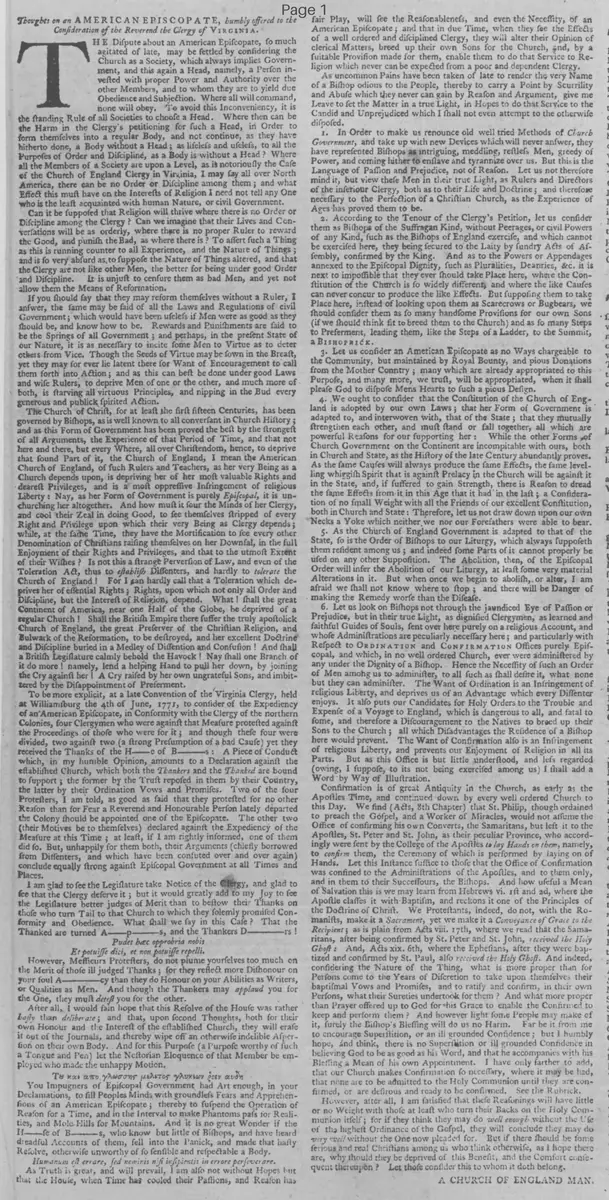
THOUGHTS on an AMERICAN EPISCOPATE, humbly offered to the Consideration of the Reverend the Clergy of VIRGINIA.
THE Dispute about an American Episcopate, so much agitated of late, may be settled by considering the Church as a Society, which always implies Government, and this again a Head, namely, a Person invested with proper Power and Authority over the other Members, and to whom they are to yield due Obedience and Subjection. Where all will command, none will obey. To avoid this Inconveniency, it is the standing Rule of all Societies to choose a Head. Where then can be the Harm in the Clergy's petitioning for such a Head, in Order to form themselves into a regular Body, and not continue, as they have hitherto done, a Body without a Head; as lifeless and useless, to all the Purposes of Order and Discipline, as a Body is without a Head? Where all the Members of a Society are upon a Level, as is notoriously the Case of the Church of England Clergy in Virginia, I may say all over North America, there can be no Order or Discipline among them; and what Effect this must have on the Interests of Religion I need not tell any One who is the least acquainted with human Nature, or civil Government.
Can it be supposed that Religion will thrive where there is no Order or Discipline among the Clergy? Can we imagine that their Lives and Conversations will be as orderly, where there is no proper Ruler to reward the Good, and punish the Bad, as where there is? To assert such a Thing is this is running counter to all Experience, and the Nature of Things; and is so very absurd as, to suppose the Nature of Things altered, and that the Clergy are not like other Men, the better for being under good Order and Discipline. It is unjust to censure them as bad Men, and yet not allow them the Means of Reformation.
If you should say that they may reform themselves without a Ruler, I answer, the same may be said of all the Laws and Regulations of civil Government; which would have been useless if Men were as good as they should be, and know how to be. Rewards and Punishments are said to be the Springs of all Government; and perhaps, in the present State of our Nature, it is as necessary to incite some Men to Virtue as to deter others from Vice. Though the Seeds of Virtue may be sown in the Breast, yet they may for ever lie latent there for Want of Encouragement to call them forth into Action; and as this can best be done under good Laws and wise Rulers, to deprive Men of one or the other, and much more of both, is starving all virtuous Principles, and nipping in the Bud every generous and publick spirited Action.
The Church of Christ, for at least the first fifteen Centuries, has been governed by Bishops, as is well known to all conversant in Church History; and as this Form of Government has been proved the best by the strongest of all Arguments, the Experience of that Period of Time, and that not here and there, but every Where, all over Christendom, hence, to deprive that sound Part of it, the Church of England, I mean the American Church of England, of such Rulers and Teachers, as her very Being as a Church depends upon, is depriving her of her most valuable Rights and dearest Privileges, and is a most oppressive Infringement of religious Liberty: Nay, as her Form of Government is purely Episcopal, it is unchurching her altogether. And how must it affect the Minds of her Clergy, and cool their Zeal in doing Good, to see themselves stripped of every Right and Privilege upon which their very Being as Clergy depends; while, at the same Time, they have the Mortification to see every other Denomination of Christians raising themselves on her Downfal, in the full Enjoyment of their Rights and Privileges, and that to the utmost Extent of their Wishes? Is not this a strange Perversion of Law, and even of the Toleration Act, thus to establish Dissenters, and hardly to tolerate the Church of England! For I can hardly call that a Toleration which deprives her of essential Rights; Rights, upon which not only all Order and Discipline, but the Interest of Religion, depend. What! shall the great Continent of America, near one Half of the Globe, be deprived of a regular Church! Shall the British Empire there suffer the truly apostolick Church of England, the great Preserver of the Christian Religion, and Bulwark of the Reformation, to be destroyed, and her excellent Doctrine and Discipline buried in a Medley of Dissension and Confusion! And shall a British Legislature calmly behold the Havock! Nay shall one Branch of it do more! namely, lend a helping Hand to pull her down, by joining the Cry against her! A Cry raised by her own ungrateful Sons, and imbittered by the Disappointment of Preferment.
To be more explicit, at a late Convention of the Virginia Clergy, held at Williamsburg the 4th of June, 1771, to consider of the Expediency of an American Episcopate, in Conformity with the Clergy of the northern Colonies, four Clergymen who were against that Measure protested against the Proceedings of those who were for it; and though these four were divided, two against two (a strong Presumption of a bad Cause) yet they received the Thanks of the House of B-s: A Piece of Conduct which, in my humble Opinion, amounts to a Declaration against the established Church, which both the Thankers and the Thanked are bound to support; the former by the Trust reposed in them by their Country, the latter by their Ordination Vows and Promises. Two of the four Protesters, I am told, as good as said that they protested for no other Reason than for Fear a Reverend and Honourable Person lately departed the Colony should be appointed one of the Episcopate. The other two (their Motives be to themselves) declared against the Expediency of the Measure at this Time; at least, if I am rightly informed, one of them did so. But, unhappily for them both, their Arguments (chiefly borrowed from Dissenters, and which have been confuted over and over again) conclude equally strong against Episcopal Government at all Times and Places.
I am glad to see the Legislature take Notice of the Clergy, and glad to see that the Clergy deserve it; but it would greatly add to my Joy to see the Legislature better judges of Merit than to bestow their Thanks on those who turn Tail to that Church to which they solemnly promised Conformity and Obedience. What shall we say in this Case? That the Thanked are turned Aps, and the Thankers D-rs!
Pudet hæc opprobria nobis Et potuisse dici, et non potuisse repelli.
However, Messieurs Protesters, do not plume yourselves too much on the Merit of those ill judged Thanks; for they reflect more Dishonour on your Folly than they do Honour on your Abilities as Writers, or Qualities as Men. And though the Thankers may applaud you for the One, they must detest you for the other.
After all, I would fain hope that this Resolve of the House was rather hasty than deliberate; and that, upon second Thoughts, both for their own Honour and the Interest of the established Church, they will erase it out of the Journals, and thereby wipe off an otherwise indelible Aspersion on their own Body. And for this Purpose (a Purpose worthy of such a Tongue and Pen) let the Nestorian Eloquence of that Member be employed who made the unhappy Motion.
[Greek text, possibly a quote]
You Impugners of Episcopal Government had Art enough, in your Declamations, to fill Peoples Minds with groundless Fears and Apprehensions of an American Episcopate; thereby to suspend the Operation of Reason for a Time, and in the Interval to make Phantoms pass for Realities, and Mole Hills for Mountains. And it is no great Wonder if the House of B-s, who know but little of Bishops, and have heard dreadful Accounts of them, fell into the Panic, and made that hasty Resolve, otherwise unworthy of so sensible and respectable a Body.
Humanum est errare, sed nemini nisi inscientis in errore perseverare.
As Truth is great, and will prevail, I am also not without Hopes but that the House, when Time has cooled their Passions, and Reason has
fair Play, will see the Reasonableness, and even the Necessity, of an American Episcopate; and that in due Time, when they see the Effects of a well ordered and disciplined Clergy, they will alter their Opinion of clerical Matters, breed up their own Sons for the Church, and, by a suitable Provision made for them, enable them to do that Service to Religion which never can be expected from a poor and dependent Clergy.
As uncommon Pains have been taken of late to render the very Name of a Bishop odious to the People, thereby to carry a Point by Scurrility and Abuse which they never can gain by Reason and Argument, give me Leave to set the Matter in a true Light, in Hopes to do that Service to the Candid and Unprejudiced which I shall not even attempt to the otherwise disposed.
I. In Order to make us renounce old well tried Methods of Church Government, and take up with new Devices which will never answer, they have represented Bishops as intriguing, meddling, restless Men, greedy of Power, and coming hither to enslave and tyrannize over us. But this is the Language of Passion and Prejudice, not of Reason. Let us not therefore mind it, but view these Men in their true Light, as Rulers and Directors of the inferior Clergy, both as to their Life and Doctrine; and therefore necessary to the Perfection of a Christian Church, as the Experience of Ages has proved them to be.
2. According to the Tenour of the Clergy's Petition, let us consider them as Bishops of the Suffragan Kind, without Peerages, or civil Powers of any Kind, such as the Bishops of England exercise, and which cannot be exercised here, they being secured to the Laity by sundry Acts of Assembly, confirmed by the King. And as to the Powers or Appendages annexed to the Episcopal Dignity, such as Pluralities, Deanries, &c. it is next to impossible that they ever should take Place here, where the Constitution of the Church is so widely different, and where the like Causes can never concur to produce the like Effects. But supposing them to take Place here, instead of looking upon them as Scarecrows or Bugbears, we should consider them as so many handsome Provisions for our own Sons (if we should think fit to breed them to the Church) and as so many Steps to Preferment, leading them, like the Steps of a Ladder, to the Summit, a BISHOPRICK.
3. Let us consider an American Episcopate as no Ways chargeable to the Community, but maintained by Royal Bounty, and pious Donations from the Mother Country; many which are already appropriated to this Purpose, and many more, we trust, will be appropriated, when it shall please God to dispose Mens Hearts to such a pious Design.
4. We ought to consider that the Constitution of the Church of England is adopted by our own Laws; that her Form of Government is adapted to, and interwoven with, that of the State; that they mutually strengthen each other, and must stand or fall together, all which are powerful Reasons for our supporting her: While the other Forms of Church Government on the Continent are incompatible with ours, both in Church and State, as the History of the late Century abundantly proves. As the same Causes will always produce the same Effects, the same levelling whiggish Spirit that is against Prelacy in the Church will be against it in the State, and, if suffered to gain Strength, there is Reason to dread the same Effects from it in this Age that it had in the last; a Consideration of no small Weight with all the Friends of our excellent Constitution, both in Church and State: Therefore, let us not draw down upon our own Necks a Yoke which neither we nor our Forefathers were able to bear.
5. As the Church of England Government is adapted to that of the State, so is the Order of Bishops to our Liturgy, which always supposeth them resident among us; and indeed some Parts of it cannot properly be used on any other Supposition. The Abolition, then, of the Episcopal Order will infer the Abolition of our Liturgy, at least some very material Alterations in it. But when once we begin to abolish, or alter, I am afraid we shall not know where to stop; and there will be Danger of making the Remedy worse than the Disease.
6. Let us look on Bishops not through the jaundiced Eye of Passion or Prejudice, but in their true Light, as dignified Clergymen, as learned and faithful Guides of Souls, sent over here purely on a religious Account, and whose Administrations are peculiarly necessary here; and particularly with Respect to Ordination and Confirmation Offices purely Episcopal, and which, in no well ordered Church, ever were administered by any under the Dignity of a Bishop. Hence the Necessity of such an Order of Men among us to administer, to all such as shall desire it, what none but they can administer. The Want of Ordination is an Infringement of religious Liberty, and deprives us of an Advantage which every Dissenter enjoys. It also puts our Candidates for Holy Orders to the Trouble and Expense of a Voyage to England, which is dangerous to all, and fatal to some, and therefore a Discouragement to the Natives to breed up their Sons to the Church; all which Disadvantages the Residence of a Bishop here would prevent. The Want of Confirmation also is an Infringement of religious Liberty, and prevents our Enjoyment of Religion in all its Parts. But as this Office is but little understood, and less regarded (owing, I suppose, to its not being exercised among us) I shall add a Word by Way of Illustration.
Confirmation is of great Antiquity in the Church, as early as the Apostles Time, and continued down by every well ordered Church to this Day. We find (Acts, 8th Chapter) that St. Philip, though ordained to preach the Gospel, and a Worker of Miracles, would not assume the Office of confirming his Own Converts, the Samaritans, but left it to the Apostles, St. Peter and St. John, as their peculiar Province, who accordingly were sent by the College of the Apostles to lay Hands on them, namely, to confirm them, the Ceremony of which is performed by laying on of Hands. Let this Instance suffice to show that the Office of Confirmation was confined to the Administrations of the Apostles, and to them only, and in them to their Successors, the Bishops. And how useful a Mean of Salvation this is we may learn from Hebrews vi. 1st and 2d, where the Apostle classes it with Baptism, and reckons it one of the Principles of the Doctrine of Christ. We Protestants, indeed, do not, with the Romanists, make it a Sacrament, yet we make it a Conveyance of Grace to the Recipient; as is plain from Acts viii. 17th, where we read that the Samaritans, after being confirmed by St. Peter and St. John, received the Holy Ghost: And, Acts xix. 6th, where the Ephesians, after they were baptized and confirmed by St. Paul, also received the Holy Ghost. And indeed, considering the Nature of the Thing, what is more proper than for Persons come to the Years of Discretion to take upon themselves their baptismal Vows and Promises, and to ratify and confirm, in their own Persons, what their Sureties undertook for them? And what more proper than Prayer offered up to God for his Grace to enable the Confirmed to keep and perform them? And however light some People may make of it, surely the Bishop's Blessing will do us no Harm. Far be it from me to encourage Superstition, or an ill grounded Confidence; but I humbly hope, and think, there is no Superstition or ill grounded Confidence in believing God to be as good as his Word, and that he accompanies with his Blessing a Mean of his own Appointment. I have only farther to add, that our Church makes Confirmation so necessary, where it may be had, that none are to be admitted to the Holy Communion until they are confirmed, or are desirous and ready to be confirmed. See the Rubrick.
However, after all, I am satisfied that these Reasonings will have little or no Weight with those at least who turn their Backs on the Holy Communion itself; for if they think they may do well enough without the Use of the highest Ordinance of the Gospel, they will conclude they may do very well without the One now pleaded for. But if there should be some serious and real Christians among us who think otherwise, as I hope there are, why should they be deprived of this Benefit, and the Comfort consequent thereupon? Let those consider this to whom it doth belong.
A CHURCH OF ENGLAND MAN.
THE Dispute about an American Episcopate, so much agitated of late, may be settled by considering the Church as a Society, which always implies Government, and this again a Head, namely, a Person invested with proper Power and Authority over the other Members, and to whom they are to yield due Obedience and Subjection. Where all will command, none will obey. To avoid this Inconveniency, it is the standing Rule of all Societies to choose a Head. Where then can be the Harm in the Clergy's petitioning for such a Head, in Order to form themselves into a regular Body, and not continue, as they have hitherto done, a Body without a Head; as lifeless and useless, to all the Purposes of Order and Discipline, as a Body is without a Head? Where all the Members of a Society are upon a Level, as is notoriously the Case of the Church of England Clergy in Virginia, I may say all over North America, there can be no Order or Discipline among them; and what Effect this must have on the Interests of Religion I need not tell any One who is the least acquainted with human Nature, or civil Government.
Can it be supposed that Religion will thrive where there is no Order or Discipline among the Clergy? Can we imagine that their Lives and Conversations will be as orderly, where there is no proper Ruler to reward the Good, and punish the Bad, as where there is? To assert such a Thing is this is running counter to all Experience, and the Nature of Things; and is so very absurd as, to suppose the Nature of Things altered, and that the Clergy are not like other Men, the better for being under good Order and Discipline. It is unjust to censure them as bad Men, and yet not allow them the Means of Reformation.
If you should say that they may reform themselves without a Ruler, I answer, the same may be said of all the Laws and Regulations of civil Government; which would have been useless if Men were as good as they should be, and know how to be. Rewards and Punishments are said to be the Springs of all Government; and perhaps, in the present State of our Nature, it is as necessary to incite some Men to Virtue as to deter others from Vice. Though the Seeds of Virtue may be sown in the Breast, yet they may for ever lie latent there for Want of Encouragement to call them forth into Action; and as this can best be done under good Laws and wise Rulers, to deprive Men of one or the other, and much more of both, is starving all virtuous Principles, and nipping in the Bud every generous and publick spirited Action.
The Church of Christ, for at least the first fifteen Centuries, has been governed by Bishops, as is well known to all conversant in Church History; and as this Form of Government has been proved the best by the strongest of all Arguments, the Experience of that Period of Time, and that not here and there, but every Where, all over Christendom, hence, to deprive that sound Part of it, the Church of England, I mean the American Church of England, of such Rulers and Teachers, as her very Being as a Church depends upon, is depriving her of her most valuable Rights and dearest Privileges, and is a most oppressive Infringement of religious Liberty: Nay, as her Form of Government is purely Episcopal, it is unchurching her altogether. And how must it affect the Minds of her Clergy, and cool their Zeal in doing Good, to see themselves stripped of every Right and Privilege upon which their very Being as Clergy depends; while, at the same Time, they have the Mortification to see every other Denomination of Christians raising themselves on her Downfal, in the full Enjoyment of their Rights and Privileges, and that to the utmost Extent of their Wishes? Is not this a strange Perversion of Law, and even of the Toleration Act, thus to establish Dissenters, and hardly to tolerate the Church of England! For I can hardly call that a Toleration which deprives her of essential Rights; Rights, upon which not only all Order and Discipline, but the Interest of Religion, depend. What! shall the great Continent of America, near one Half of the Globe, be deprived of a regular Church! Shall the British Empire there suffer the truly apostolick Church of England, the great Preserver of the Christian Religion, and Bulwark of the Reformation, to be destroyed, and her excellent Doctrine and Discipline buried in a Medley of Dissension and Confusion! And shall a British Legislature calmly behold the Havock! Nay shall one Branch of it do more! namely, lend a helping Hand to pull her down, by joining the Cry against her! A Cry raised by her own ungrateful Sons, and imbittered by the Disappointment of Preferment.
To be more explicit, at a late Convention of the Virginia Clergy, held at Williamsburg the 4th of June, 1771, to consider of the Expediency of an American Episcopate, in Conformity with the Clergy of the northern Colonies, four Clergymen who were against that Measure protested against the Proceedings of those who were for it; and though these four were divided, two against two (a strong Presumption of a bad Cause) yet they received the Thanks of the House of B-s: A Piece of Conduct which, in my humble Opinion, amounts to a Declaration against the established Church, which both the Thankers and the Thanked are bound to support; the former by the Trust reposed in them by their Country, the latter by their Ordination Vows and Promises. Two of the four Protesters, I am told, as good as said that they protested for no other Reason than for Fear a Reverend and Honourable Person lately departed the Colony should be appointed one of the Episcopate. The other two (their Motives be to themselves) declared against the Expediency of the Measure at this Time; at least, if I am rightly informed, one of them did so. But, unhappily for them both, their Arguments (chiefly borrowed from Dissenters, and which have been confuted over and over again) conclude equally strong against Episcopal Government at all Times and Places.
I am glad to see the Legislature take Notice of the Clergy, and glad to see that the Clergy deserve it; but it would greatly add to my Joy to see the Legislature better judges of Merit than to bestow their Thanks on those who turn Tail to that Church to which they solemnly promised Conformity and Obedience. What shall we say in this Case? That the Thanked are turned Aps, and the Thankers D-rs!
Pudet hæc opprobria nobis Et potuisse dici, et non potuisse repelli.
However, Messieurs Protesters, do not plume yourselves too much on the Merit of those ill judged Thanks; for they reflect more Dishonour on your Folly than they do Honour on your Abilities as Writers, or Qualities as Men. And though the Thankers may applaud you for the One, they must detest you for the other.
After all, I would fain hope that this Resolve of the House was rather hasty than deliberate; and that, upon second Thoughts, both for their own Honour and the Interest of the established Church, they will erase it out of the Journals, and thereby wipe off an otherwise indelible Aspersion on their own Body. And for this Purpose (a Purpose worthy of such a Tongue and Pen) let the Nestorian Eloquence of that Member be employed who made the unhappy Motion.
[Greek text, possibly a quote]
You Impugners of Episcopal Government had Art enough, in your Declamations, to fill Peoples Minds with groundless Fears and Apprehensions of an American Episcopate; thereby to suspend the Operation of Reason for a Time, and in the Interval to make Phantoms pass for Realities, and Mole Hills for Mountains. And it is no great Wonder if the House of B-s, who know but little of Bishops, and have heard dreadful Accounts of them, fell into the Panic, and made that hasty Resolve, otherwise unworthy of so sensible and respectable a Body.
Humanum est errare, sed nemini nisi inscientis in errore perseverare.
As Truth is great, and will prevail, I am also not without Hopes but that the House, when Time has cooled their Passions, and Reason has
fair Play, will see the Reasonableness, and even the Necessity, of an American Episcopate; and that in due Time, when they see the Effects of a well ordered and disciplined Clergy, they will alter their Opinion of clerical Matters, breed up their own Sons for the Church, and, by a suitable Provision made for them, enable them to do that Service to Religion which never can be expected from a poor and dependent Clergy.
As uncommon Pains have been taken of late to render the very Name of a Bishop odious to the People, thereby to carry a Point by Scurrility and Abuse which they never can gain by Reason and Argument, give me Leave to set the Matter in a true Light, in Hopes to do that Service to the Candid and Unprejudiced which I shall not even attempt to the otherwise disposed.
I. In Order to make us renounce old well tried Methods of Church Government, and take up with new Devices which will never answer, they have represented Bishops as intriguing, meddling, restless Men, greedy of Power, and coming hither to enslave and tyrannize over us. But this is the Language of Passion and Prejudice, not of Reason. Let us not therefore mind it, but view these Men in their true Light, as Rulers and Directors of the inferior Clergy, both as to their Life and Doctrine; and therefore necessary to the Perfection of a Christian Church, as the Experience of Ages has proved them to be.
2. According to the Tenour of the Clergy's Petition, let us consider them as Bishops of the Suffragan Kind, without Peerages, or civil Powers of any Kind, such as the Bishops of England exercise, and which cannot be exercised here, they being secured to the Laity by sundry Acts of Assembly, confirmed by the King. And as to the Powers or Appendages annexed to the Episcopal Dignity, such as Pluralities, Deanries, &c. it is next to impossible that they ever should take Place here, where the Constitution of the Church is so widely different, and where the like Causes can never concur to produce the like Effects. But supposing them to take Place here, instead of looking upon them as Scarecrows or Bugbears, we should consider them as so many handsome Provisions for our own Sons (if we should think fit to breed them to the Church) and as so many Steps to Preferment, leading them, like the Steps of a Ladder, to the Summit, a BISHOPRICK.
3. Let us consider an American Episcopate as no Ways chargeable to the Community, but maintained by Royal Bounty, and pious Donations from the Mother Country; many which are already appropriated to this Purpose, and many more, we trust, will be appropriated, when it shall please God to dispose Mens Hearts to such a pious Design.
4. We ought to consider that the Constitution of the Church of England is adopted by our own Laws; that her Form of Government is adapted to, and interwoven with, that of the State; that they mutually strengthen each other, and must stand or fall together, all which are powerful Reasons for our supporting her: While the other Forms of Church Government on the Continent are incompatible with ours, both in Church and State, as the History of the late Century abundantly proves. As the same Causes will always produce the same Effects, the same levelling whiggish Spirit that is against Prelacy in the Church will be against it in the State, and, if suffered to gain Strength, there is Reason to dread the same Effects from it in this Age that it had in the last; a Consideration of no small Weight with all the Friends of our excellent Constitution, both in Church and State: Therefore, let us not draw down upon our own Necks a Yoke which neither we nor our Forefathers were able to bear.
5. As the Church of England Government is adapted to that of the State, so is the Order of Bishops to our Liturgy, which always supposeth them resident among us; and indeed some Parts of it cannot properly be used on any other Supposition. The Abolition, then, of the Episcopal Order will infer the Abolition of our Liturgy, at least some very material Alterations in it. But when once we begin to abolish, or alter, I am afraid we shall not know where to stop; and there will be Danger of making the Remedy worse than the Disease.
6. Let us look on Bishops not through the jaundiced Eye of Passion or Prejudice, but in their true Light, as dignified Clergymen, as learned and faithful Guides of Souls, sent over here purely on a religious Account, and whose Administrations are peculiarly necessary here; and particularly with Respect to Ordination and Confirmation Offices purely Episcopal, and which, in no well ordered Church, ever were administered by any under the Dignity of a Bishop. Hence the Necessity of such an Order of Men among us to administer, to all such as shall desire it, what none but they can administer. The Want of Ordination is an Infringement of religious Liberty, and deprives us of an Advantage which every Dissenter enjoys. It also puts our Candidates for Holy Orders to the Trouble and Expense of a Voyage to England, which is dangerous to all, and fatal to some, and therefore a Discouragement to the Natives to breed up their Sons to the Church; all which Disadvantages the Residence of a Bishop here would prevent. The Want of Confirmation also is an Infringement of religious Liberty, and prevents our Enjoyment of Religion in all its Parts. But as this Office is but little understood, and less regarded (owing, I suppose, to its not being exercised among us) I shall add a Word by Way of Illustration.
Confirmation is of great Antiquity in the Church, as early as the Apostles Time, and continued down by every well ordered Church to this Day. We find (Acts, 8th Chapter) that St. Philip, though ordained to preach the Gospel, and a Worker of Miracles, would not assume the Office of confirming his Own Converts, the Samaritans, but left it to the Apostles, St. Peter and St. John, as their peculiar Province, who accordingly were sent by the College of the Apostles to lay Hands on them, namely, to confirm them, the Ceremony of which is performed by laying on of Hands. Let this Instance suffice to show that the Office of Confirmation was confined to the Administrations of the Apostles, and to them only, and in them to their Successors, the Bishops. And how useful a Mean of Salvation this is we may learn from Hebrews vi. 1st and 2d, where the Apostle classes it with Baptism, and reckons it one of the Principles of the Doctrine of Christ. We Protestants, indeed, do not, with the Romanists, make it a Sacrament, yet we make it a Conveyance of Grace to the Recipient; as is plain from Acts viii. 17th, where we read that the Samaritans, after being confirmed by St. Peter and St. John, received the Holy Ghost: And, Acts xix. 6th, where the Ephesians, after they were baptized and confirmed by St. Paul, also received the Holy Ghost. And indeed, considering the Nature of the Thing, what is more proper than for Persons come to the Years of Discretion to take upon themselves their baptismal Vows and Promises, and to ratify and confirm, in their own Persons, what their Sureties undertook for them? And what more proper than Prayer offered up to God for his Grace to enable the Confirmed to keep and perform them? And however light some People may make of it, surely the Bishop's Blessing will do us no Harm. Far be it from me to encourage Superstition, or an ill grounded Confidence; but I humbly hope, and think, there is no Superstition or ill grounded Confidence in believing God to be as good as his Word, and that he accompanies with his Blessing a Mean of his own Appointment. I have only farther to add, that our Church makes Confirmation so necessary, where it may be had, that none are to be admitted to the Holy Communion until they are confirmed, or are desirous and ready to be confirmed. See the Rubrick.
However, after all, I am satisfied that these Reasonings will have little or no Weight with those at least who turn their Backs on the Holy Communion itself; for if they think they may do well enough without the Use of the highest Ordinance of the Gospel, they will conclude they may do very well without the One now pleaded for. But if there should be some serious and real Christians among us who think otherwise, as I hope there are, why should they be deprived of this Benefit, and the Comfort consequent thereupon? Let those consider this to whom it doth belong.
A CHURCH OF ENGLAND MAN.
What sub-type of article is it?
Moral Or Religious
Constitutional
What keywords are associated?
American Episcopate
Church Of England
Virginia Clergy
Religious Liberty
Episcopal Government
Ordination
Confirmation
House Of Burgesses
What entities or persons were involved?
Virginia Clergy
House Of Burgesses
Church Of England
Dissenters
Bishops
Editorial Details
Primary Topic
Advocacy For An American Episcopate
Stance / Tone
Strongly Supportive Of Episcopal Church Government
Key Figures
Virginia Clergy
House Of Burgesses
Church Of England
Dissenters
Bishops
Key Arguments
Church Requires A Head For Order And Discipline
Episcopate Essential For Religious Liberty And Church Integrity
Opposition From Four Virginia Clergymen In 1771 Misguided
Bishops Not Tyrannical But Necessary Rulers Without Civil Power
American Episcopate Funded By Royal Bounty, Not Local Taxes
Episcopal Government Aligns With State Constitution
Ordination And Confirmation Require Resident Bishops
Historical And Biblical Precedent For Bishops