Thank you for visiting SNEWPapers!
Sign up free
Literary
May 28, 1799
The New Hampshire Gazette
Portsmouth, Rockingham County, New Hampshire
What is this article about?
An essay advising young men on entering life: persevere in one profession, avoid pride and resentment until wealthy, and don't try to please everyone. Illustrated with fables of a tailor vs. conjurer, a proud goose, and a painter seeking universal approval.
Clipping
OCR Quality
98%
Excellent
Full Text
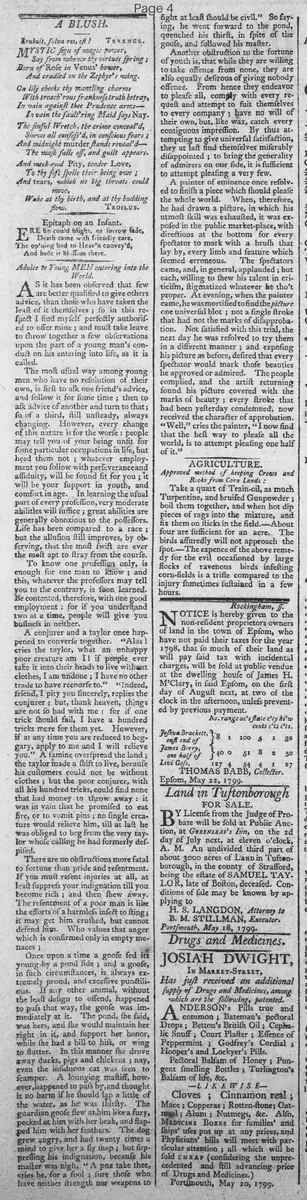
Advice to Young Men entering into the World.
As it has been observed that few are better qualified to give others advice, than those who have taken the least of it themselves: so in this respect I find myself perfectly authorized to offer mine; and must take leave to throw together a few observations upon the part of a young man's conduct on his entering into life, as it is called.
The most usual way among young men who have no resolution of their own, is first to ask one friend's advice, and follow it for some time; then to ask advice of another and turn to that; so of a third, still unsteady, always changing. However, every change of this nature is for the worse: people may tell you of your being unfit for some particular occupations in life, but heed them not; whatever employment you follow with perseverance and assiduity, will be found fit for you; it will be your support in youth, and comfort in age. In learning the usual part of every profession, very moderate abilities will suffice; great abilities are generally obnoxious to the possessors.
Life has been compared to a race; but the allusion still improves, by observing, that the most swift are ever the most apt to stray from the course.
To know one profession only, is enough for one man to know; and this, whatever the professors may tell you to the contrary, is soon learned. Be contented, therefore, with one good employment: for if you understand two at a time, people will give you business in neither.
A conjurer and a taylor once happened to converse together. "Alas! cries the taylor, what an unhappy poor creature am I! if people ever take it into their heads to live without clothes, I am undone; I have no other trade to have recourse to." "Indeed, friend, I pity you sincerely, replies the conjurer; but, thank heaven, things are not so bad with me: for if one trick should fail, I have a hundred tricks more for them yet. However, if at any time you are reduced to beggary, apply to me and I will relieve you." A famine overspread the land: the taylor made a shift to live, because his customers could not be without clothes; but the poor conjurer, with all his hundred tricks, could find none that had money to throw away: it was in vain that he promised to eat fire, or to vomit pins; no single creature would relieve him, till at last he was obliged to beg from the very taylor whose calling he had formerly despised.
There are no obstructions more fatal to fortune than pride and resentment. If you must resent injuries at all, at least suppress your indignation till you become rich; and then show away. The resentment of a poor man is like the efforts of a harmless insect to sting; it may get him crushed, but cannot defend him. Who values that anger which is confirmed only in empty menaces;
Once upon a time a goose fed its young by a pond side; and a goose, in such circumstances, is always extremely proud, and excessive punctilious. If any other animal, without the least design to offend, happened to pass that way, the goose was immediately at it. The pond, she said, was hers, and she would maintain her right in it, and support her honor, while she had a bill to his, or wing to flutter. In this manner she drove away ducks, pigs and chickens; nay, even the insidious cat was seen to scamper. A lounging mastiff, however, happened to pass by, and thought it no harm if he should lap a little of the water, as he was thirsty. The guardian goose flew at him like a fury, pecked at him with her beak, and flapped him with her feathers. The dog grew angry, and had twenty times a mind to give her a fly nap; but suppressing his indignation, because his master was nigh, "A pox take thee, cries he, for a fool; sure those who have neither strength nor weapons to fight at least should be civil." So saying, he went forward to the pond, quenched his thirst, in spite of the goose, and followed his master.
Another obstruction to the fortune of youth is, that while they are willing to take offence from none, they are also equally desirous of giving nobody offence. From hence they endeavor to please all, comply with every request and attempt to suit themselves to every company; have no will of their own, but, like wax, catch every contiguous impression. By thus attempting to give universal satisfaction, they at last find themselves miserably disappointed; to bring the generality of admirers on our side, it is sufficient to attempt pleasing a very few.
A painter of eminence once resolved to finish a piece which should please the whole world. When, therefore, he had drawn a picture, in which his utmost skill was exhausted, it was exposed in the public market-place, with directions at the bottom for every spectator to mark with a brush that lay by, every limb and feature which seemed erroneous. The spectators came, and, in general, applauded; but each, willing to show his talent in criticism, stigmatized whatever he thought proper. At evening, when the painter came, he was mortified to find the picture one universal blot; not a single stroke that had not the marks of disapprobation. Not satisfied with this trial, the next day he was resolved to try them in a different manner; and exposing his picture as before, desired that every spectator would mark those beauties he approved or admired. The people complied, and the artist returning found his picture covered with the marks of beauty; every stroke that had been yesterday condemned, now received the character of approbation. "Well," cries the painter, "I now find that the best way to please all the world, is to attempt pleasing one half of it."
As it has been observed that few are better qualified to give others advice, than those who have taken the least of it themselves: so in this respect I find myself perfectly authorized to offer mine; and must take leave to throw together a few observations upon the part of a young man's conduct on his entering into life, as it is called.
The most usual way among young men who have no resolution of their own, is first to ask one friend's advice, and follow it for some time; then to ask advice of another and turn to that; so of a third, still unsteady, always changing. However, every change of this nature is for the worse: people may tell you of your being unfit for some particular occupations in life, but heed them not; whatever employment you follow with perseverance and assiduity, will be found fit for you; it will be your support in youth, and comfort in age. In learning the usual part of every profession, very moderate abilities will suffice; great abilities are generally obnoxious to the possessors.
Life has been compared to a race; but the allusion still improves, by observing, that the most swift are ever the most apt to stray from the course.
To know one profession only, is enough for one man to know; and this, whatever the professors may tell you to the contrary, is soon learned. Be contented, therefore, with one good employment: for if you understand two at a time, people will give you business in neither.
A conjurer and a taylor once happened to converse together. "Alas! cries the taylor, what an unhappy poor creature am I! if people ever take it into their heads to live without clothes, I am undone; I have no other trade to have recourse to." "Indeed, friend, I pity you sincerely, replies the conjurer; but, thank heaven, things are not so bad with me: for if one trick should fail, I have a hundred tricks more for them yet. However, if at any time you are reduced to beggary, apply to me and I will relieve you." A famine overspread the land: the taylor made a shift to live, because his customers could not be without clothes; but the poor conjurer, with all his hundred tricks, could find none that had money to throw away: it was in vain that he promised to eat fire, or to vomit pins; no single creature would relieve him, till at last he was obliged to beg from the very taylor whose calling he had formerly despised.
There are no obstructions more fatal to fortune than pride and resentment. If you must resent injuries at all, at least suppress your indignation till you become rich; and then show away. The resentment of a poor man is like the efforts of a harmless insect to sting; it may get him crushed, but cannot defend him. Who values that anger which is confirmed only in empty menaces;
Once upon a time a goose fed its young by a pond side; and a goose, in such circumstances, is always extremely proud, and excessive punctilious. If any other animal, without the least design to offend, happened to pass that way, the goose was immediately at it. The pond, she said, was hers, and she would maintain her right in it, and support her honor, while she had a bill to his, or wing to flutter. In this manner she drove away ducks, pigs and chickens; nay, even the insidious cat was seen to scamper. A lounging mastiff, however, happened to pass by, and thought it no harm if he should lap a little of the water, as he was thirsty. The guardian goose flew at him like a fury, pecked at him with her beak, and flapped him with her feathers. The dog grew angry, and had twenty times a mind to give her a fly nap; but suppressing his indignation, because his master was nigh, "A pox take thee, cries he, for a fool; sure those who have neither strength nor weapons to fight at least should be civil." So saying, he went forward to the pond, quenched his thirst, in spite of the goose, and followed his master.
Another obstruction to the fortune of youth is, that while they are willing to take offence from none, they are also equally desirous of giving nobody offence. From hence they endeavor to please all, comply with every request and attempt to suit themselves to every company; have no will of their own, but, like wax, catch every contiguous impression. By thus attempting to give universal satisfaction, they at last find themselves miserably disappointed; to bring the generality of admirers on our side, it is sufficient to attempt pleasing a very few.
A painter of eminence once resolved to finish a piece which should please the whole world. When, therefore, he had drawn a picture, in which his utmost skill was exhausted, it was exposed in the public market-place, with directions at the bottom for every spectator to mark with a brush that lay by, every limb and feature which seemed erroneous. The spectators came, and, in general, applauded; but each, willing to show his talent in criticism, stigmatized whatever he thought proper. At evening, when the painter came, he was mortified to find the picture one universal blot; not a single stroke that had not the marks of disapprobation. Not satisfied with this trial, the next day he was resolved to try them in a different manner; and exposing his picture as before, desired that every spectator would mark those beauties he approved or admired. The people complied, and the artist returning found his picture covered with the marks of beauty; every stroke that had been yesterday condemned, now received the character of approbation. "Well," cries the painter, "I now find that the best way to please all the world, is to attempt pleasing one half of it."
What sub-type of article is it?
Essay
Fable
Satire
What themes does it cover?
Moral Virtue
Social Manners
What keywords are associated?
Advice To Youth
Perseverance
Pride
Resentment
Pleasing Others
Moral Fables
Conduct In Life
Literary Details
Title
Advice To Young Men Entering Into The World.
Subject
Conduct On Entering Into Life
Key Lines
Whatever Employment You Follow With Perseverance And Assiduity, Will Be Found Fit For You; It Will Be Your Support In Youth, And Comfort In Age.
There Are No Obstructions More Fatal To Fortune Than Pride And Resentment.
The Best Way To Please All The World, Is To Attempt Pleasing One Half Of It.