Thank you for visiting SNEWPapers!
Sign up free
Editorial
May 25, 1803
The Recorder
Richmond, Virginia
What is this article about?
This editorial, addressed to Charles Lee, critiques the judiciary's claimed power to declare congressional acts unconstitutional, referencing Callender's trial and Marbury v. Madison. It argues this undermines legislative authority and the Constitution's balance of powers.
Clipping
OCR Quality
92%
Excellent
Full Text
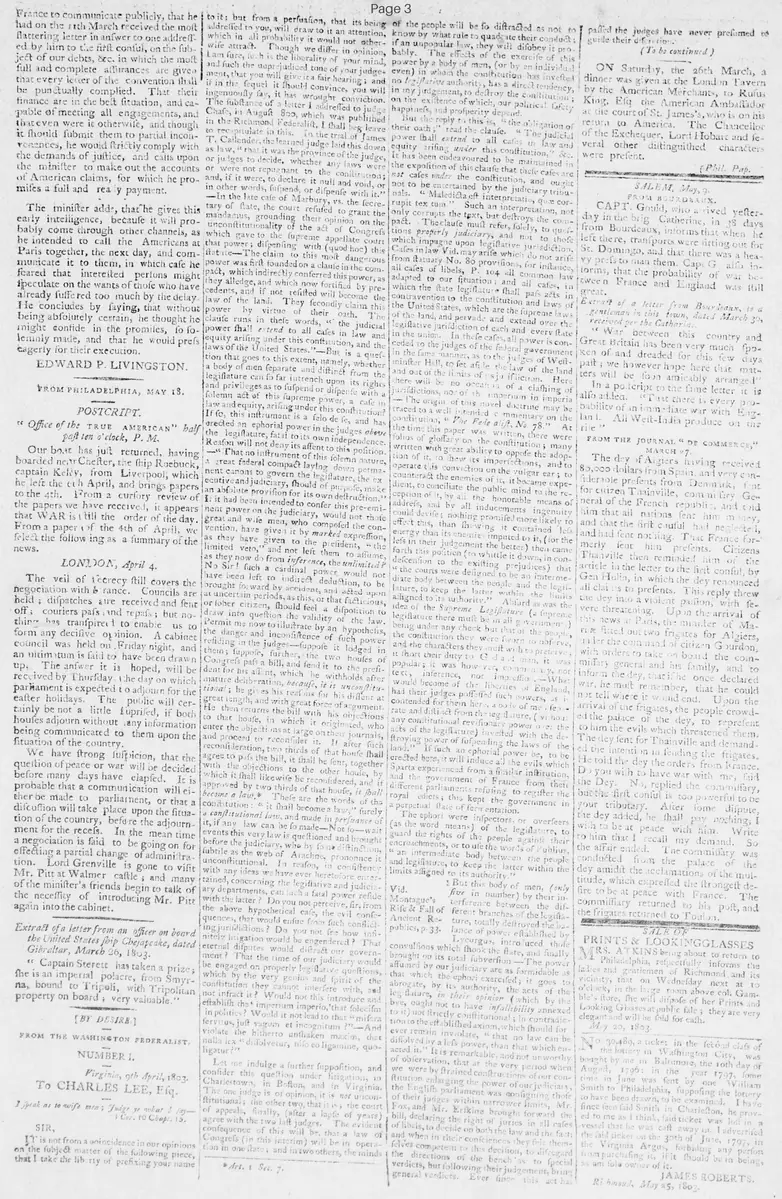
[BY DESIRE]
FROM THE WASHINGTON FEDERALIST.
NUMBER I.
Virginia, 9th April, 1803.
To CHARLES LEE, Esq.
I speak as to wise men; Judge ye what I say. 1 Cor. 10th Chap: 15.
SIR,
It is not from a coincidence in our opinions on the subject matter of the following piece, that I take the liberty of prefixing your name to it; but from a persuasion, that its being addressed to you, will draw to it an attention, which in all probability it would not otherwise attract. Though we differ in opinion I am sure, to his the liberality of your mind, and such the unprejudiced tone of your judgement, that you will give it a fair hearing; and if in the sequel it should convince, you will ingenuously say, it has wrought conviction.
The substance of a letter I addressed to judge Chase, in August 1800, which was published in the Richmond Federalist, I shall beg leave to recapitulate in this. In the trial of James T. Callender, the learned judge laid this down as law, "that it was the province of the judge, or judges to decide, whether any laws were or were not repugnant to the constitution; and, if it were, to declare it null and void, or in other words, suspend, or dispense with it."
In the late case of Marbury, vs. the secretary of state, the court refused to grant the mandamus, grounding their opinion on the unconstitutionality of the act of Congress which gave to the supreme appellate court that power; dispensing with (quod hoc) this statute--The claim to this most dangerous power was first founded on a clause in the compact, which indirectly conferred this power, as they allege, and which now fortified by precedents, and if not resisted will become the law of the land. They secondly claim this power by virtue of their oath. The clause runs in these words, "the judicial power shall extend to all cases in law and equity arising under this constitution, the laws of the United States."--But is a question that goes to this extent, namely, whether a body of men separate and distinct from the legislature can so far intrench upon its rights and privileges as to suspend or dispense with a solemn act of this supreme power, a case in law and equity, arising under this constitution? If so, this instrument is a felo de se, and has erected an ephorial power in the judges above the legislature, fatal to its own independence. Reason will not deny its assent to this position. "That no instrument of this solemn nature, a great federal compact laying down permanent canons to govern the legislature, the executive and judiciary, should of purpose, make an absolute provision for its own destruction."
It it had been intended to confer this pre-eminent power on the judiciary, would not those great and wise men, who composed the convention, have given it by marked expression, as they have given to the president, "the limited veto," and not left them to assume, as they now do from inference, the unlimited? No Sir! such a cardinal power would not have been left to indirect deduction, to be brought forward by accident, and acted upon at uncertain periods, as this, or that factious, or sober citizen, should feel a disposition to draw into question the validity of the law.
Permit me now to illustrate by an hypothesis, the danger and inconsistency of such power residing in the judges-suppose it lodged in thein: suppose, further, the two houses of Congress pass a bill, and send it to the president for his assent. which he withholds after mature deliberation, because, it is unconstitutional: he gives his reasons for his dissent at great length, and with great force of argument. He then returns the bill with his objections to that house, in which it originated, who enter the objections at large on their journals, and proceed to reconsider it. If after such reconsideration, two thirds of that house shall agree to pass the bill, it shall be sent, together with the objections to the other house, by which it shall likewise be reconsidered, and if approved by two thirds of that house, it shall become a law.* These are the words of the constitution : "it shall become a law," surely a constitutional law, and made in pursuance of it, if any law can be so made--Not so-wait events this very law is questioned and brought before the judiciary. where by some distinction. subtle as the web of Arachne, pronounce it unconstitutional. In reason, in consistency with any ideas we have ever heretofore entertained, concerning the legislative and judicin-ary departments, can such a fatal power reside with the latter ? Do you not perceive, sir, from the above hypothetical case, the evil conse-quences, that would ensue from such conflicting jurisdictions? Do you not see how infi-nitely litigation would be engendered? That eternal disputes would distract our govern-ment ? That the time of our judiciary would be engaged on properly legislative questions, which by the very genius and spirit of the constitution they cannot interfere with, and not infract it? Would not this introduce and establish the 'imperium in imperio,' that solecism in politics? Would it not lead to that "mifera servitus, just vagum et incognitum?"-And violate the hitherto unshaken maxim, that nulla lex "dissolvetur, nisi co ligamine, quo-ligatur?"
Let me indulge a further supposition, and consider this question under litigation,, in Charlestown, in Boston, and in Virginia. The one judge is of opinion, it is not unconstitutional; the other two, that it is, the court of appeals, fully, (after a lapse of years) agree with the two last judges. The evident consequence of this will be, that a law of Congress (in this interim) will be in opera-tion in one state, and in two others, the minds of the people will be so distracted as not to know by what rule to quadrate their conduct : if an unpopular law, they will disobey it probably. The effects of the exercise of this power by a body of men, (or by an individual even) in whom the constitution has invested no legislative authority, has a direct tendency, in my judgement, to destroy the constitution; on the existence of which, our political safety, happiness, and prosperity depend.
But the reply to this is, " the obligation of their oath ;" read the clause. " The judicial power shall extend to all cases in law and equity arising under this constitution," &c. It has been endeavoured to be maintained in the exposition of this clause that these cases are not cases under the constitution, and ought not to be entertained by the judiciary tribu-nals. « Maledicta est interpretatio, qur cor-rupit textum " Such an interpretation, not only corrupts the text, but destroys the com-pact. The clause must refer, solely, to ques-tions properly judiciary, and not to those which impugn upon legislative jurisdiction,
Cases in law Vid. may arise which do not arise from statutory No. 80 provisions, for instance, all cases of libels, P. 104 all common law adapted to our situation; and all cases, in which the state legislature shall pass acts in contravention to the constitution and laws of the United States, which are the supreme laws of the land, and pervade- and extend over the legislative jurisdiction of each and every state in the union. In these cases, all power is con-ceded to the judges of the federal government in the same manner, as to the judges of West-minster Hall, to set aside the law of the land and out of the limits of jurisdiction. Here here will be no occasion of a clashing of jurifdictions, nor of the imperium in imperio -- The origin of this novel doctrine may be traced to a well intended commentary on the constitution, " The Federalist, No 78." At the time this paper was written, there were folios of glossary on the constitution; many written with great ability to oppose the adop-tion of it, to shew its imperfections. and to operate this conviction on the vulgar ear; to counteract the enemies of it, it became expe-dient, to conciliate the public mind to the re-ception of it, by all the honorable means of address, and by all inducements ingenuity could devise; nothing promised more likely to effect this, than shewing it contained less energy than its enemies imputed to it, (for the less in their judgement the better) then came forth this position (to whittle it down, in con-descension to the existing prejudices) that " the courts were designed to be an interme-diate body between the people and the legis-lature, to keep the latter within the limits aligned to its authority." Absurd as was the idea of the Supreme Legislature (a supreme legislature there must be in all government) being under any check but that of the people, the Constitution they were sworn to observe, and the characters they must wish to preserve, it short their duty to God and man, it was popular; it was however, common a y, not text, inference, not imposthume. -What would become of the- liberties of England, had their judges possessed such powers, as contended for them here , a body of men , separate and distinct from the legislature, (without any constitutional revisionary power over the acts of the legislature) invested with the de-stroying power of suspending the laws of the land."" If such an ephorial power be, to be erected here, it will induce all the evils which Sparta experienced from a similar institution, and the government of France from their different parliaments refusing to register the royal edicts; this kept the government in a perpetual state of fermentation.
The ephors were inspectors, or overseers (as the word means) of the legislature, to guard the rights of the people against their encroachments, or to use the words of Publius, " an intermediate body between the people and legislature, to keep the latter within the limits assigned to its authority."
: But this body of men, (only five in number) by their in-terference between the dif- Vid. Montague's Rife & Fall of different branches of the legislature, totally destroyed the ba- lance of power established by Lycurgus, introduced those convulfions which shook the state, and finally brought on its total subversion --The power assumed by our judiciary are as formidable as that which the ephori exercised; it goes to abrogate, by its authority, the acts" of the legillature, in their opinion (which by the bye, ought not to have infallibility annexed to it) not strictly constitutional; in contradic-tion to the established axiom, which should for ever remain inviolate, " that no law can be diffolved by a less power, than that which en-acted it."It is remarkable, and not unworthy of observation, that at the very period when we were by strained constructions of our con-stitution enlarging the power of our judiciary, the English parliament was consigning those of their judges within narrower limits, Mr. Fox, and Mr. Erskine brought forward the bill, declaring the right of juries in all cases of libels, to decide on both the law and the fact; and when in their consciences they felt them-selves competent to this decision, to disregard the directions of the bench as to special verdicts, but following their judgement, bring general verdicts. Ever since this act has paffed the judges have never presumed to gurde their d'fenetio'.
(To be continued)
FROM THE WASHINGTON FEDERALIST.
NUMBER I.
Virginia, 9th April, 1803.
To CHARLES LEE, Esq.
I speak as to wise men; Judge ye what I say. 1 Cor. 10th Chap: 15.
SIR,
It is not from a coincidence in our opinions on the subject matter of the following piece, that I take the liberty of prefixing your name to it; but from a persuasion, that its being addressed to you, will draw to it an attention, which in all probability it would not otherwise attract. Though we differ in opinion I am sure, to his the liberality of your mind, and such the unprejudiced tone of your judgement, that you will give it a fair hearing; and if in the sequel it should convince, you will ingenuously say, it has wrought conviction.
The substance of a letter I addressed to judge Chase, in August 1800, which was published in the Richmond Federalist, I shall beg leave to recapitulate in this. In the trial of James T. Callender, the learned judge laid this down as law, "that it was the province of the judge, or judges to decide, whether any laws were or were not repugnant to the constitution; and, if it were, to declare it null and void, or in other words, suspend, or dispense with it."
In the late case of Marbury, vs. the secretary of state, the court refused to grant the mandamus, grounding their opinion on the unconstitutionality of the act of Congress which gave to the supreme appellate court that power; dispensing with (quod hoc) this statute--The claim to this most dangerous power was first founded on a clause in the compact, which indirectly conferred this power, as they allege, and which now fortified by precedents, and if not resisted will become the law of the land. They secondly claim this power by virtue of their oath. The clause runs in these words, "the judicial power shall extend to all cases in law and equity arising under this constitution, the laws of the United States."--But is a question that goes to this extent, namely, whether a body of men separate and distinct from the legislature can so far intrench upon its rights and privileges as to suspend or dispense with a solemn act of this supreme power, a case in law and equity, arising under this constitution? If so, this instrument is a felo de se, and has erected an ephorial power in the judges above the legislature, fatal to its own independence. Reason will not deny its assent to this position. "That no instrument of this solemn nature, a great federal compact laying down permanent canons to govern the legislature, the executive and judiciary, should of purpose, make an absolute provision for its own destruction."
It it had been intended to confer this pre-eminent power on the judiciary, would not those great and wise men, who composed the convention, have given it by marked expression, as they have given to the president, "the limited veto," and not left them to assume, as they now do from inference, the unlimited? No Sir! such a cardinal power would not have been left to indirect deduction, to be brought forward by accident, and acted upon at uncertain periods, as this, or that factious, or sober citizen, should feel a disposition to draw into question the validity of the law.
Permit me now to illustrate by an hypothesis, the danger and inconsistency of such power residing in the judges-suppose it lodged in thein: suppose, further, the two houses of Congress pass a bill, and send it to the president for his assent. which he withholds after mature deliberation, because, it is unconstitutional: he gives his reasons for his dissent at great length, and with great force of argument. He then returns the bill with his objections to that house, in which it originated, who enter the objections at large on their journals, and proceed to reconsider it. If after such reconsideration, two thirds of that house shall agree to pass the bill, it shall be sent, together with the objections to the other house, by which it shall likewise be reconsidered, and if approved by two thirds of that house, it shall become a law.* These are the words of the constitution : "it shall become a law," surely a constitutional law, and made in pursuance of it, if any law can be so made--Not so-wait events this very law is questioned and brought before the judiciary. where by some distinction. subtle as the web of Arachne, pronounce it unconstitutional. In reason, in consistency with any ideas we have ever heretofore entertained, concerning the legislative and judicin-ary departments, can such a fatal power reside with the latter ? Do you not perceive, sir, from the above hypothetical case, the evil conse-quences, that would ensue from such conflicting jurisdictions? Do you not see how infi-nitely litigation would be engendered? That eternal disputes would distract our govern-ment ? That the time of our judiciary would be engaged on properly legislative questions, which by the very genius and spirit of the constitution they cannot interfere with, and not infract it? Would not this introduce and establish the 'imperium in imperio,' that solecism in politics? Would it not lead to that "mifera servitus, just vagum et incognitum?"-And violate the hitherto unshaken maxim, that nulla lex "dissolvetur, nisi co ligamine, quo-ligatur?"
Let me indulge a further supposition, and consider this question under litigation,, in Charlestown, in Boston, and in Virginia. The one judge is of opinion, it is not unconstitutional; the other two, that it is, the court of appeals, fully, (after a lapse of years) agree with the two last judges. The evident consequence of this will be, that a law of Congress (in this interim) will be in opera-tion in one state, and in two others, the minds of the people will be so distracted as not to know by what rule to quadrate their conduct : if an unpopular law, they will disobey it probably. The effects of the exercise of this power by a body of men, (or by an individual even) in whom the constitution has invested no legislative authority, has a direct tendency, in my judgement, to destroy the constitution; on the existence of which, our political safety, happiness, and prosperity depend.
But the reply to this is, " the obligation of their oath ;" read the clause. " The judicial power shall extend to all cases in law and equity arising under this constitution," &c. It has been endeavoured to be maintained in the exposition of this clause that these cases are not cases under the constitution, and ought not to be entertained by the judiciary tribu-nals. « Maledicta est interpretatio, qur cor-rupit textum " Such an interpretation, not only corrupts the text, but destroys the com-pact. The clause must refer, solely, to ques-tions properly judiciary, and not to those which impugn upon legislative jurisdiction,
Cases in law Vid. may arise which do not arise from statutory No. 80 provisions, for instance, all cases of libels, P. 104 all common law adapted to our situation; and all cases, in which the state legislature shall pass acts in contravention to the constitution and laws of the United States, which are the supreme laws of the land, and pervade- and extend over the legislative jurisdiction of each and every state in the union. In these cases, all power is con-ceded to the judges of the federal government in the same manner, as to the judges of West-minster Hall, to set aside the law of the land and out of the limits of jurisdiction. Here here will be no occasion of a clashing of jurifdictions, nor of the imperium in imperio -- The origin of this novel doctrine may be traced to a well intended commentary on the constitution, " The Federalist, No 78." At the time this paper was written, there were folios of glossary on the constitution; many written with great ability to oppose the adop-tion of it, to shew its imperfections. and to operate this conviction on the vulgar ear; to counteract the enemies of it, it became expe-dient, to conciliate the public mind to the re-ception of it, by all the honorable means of address, and by all inducements ingenuity could devise; nothing promised more likely to effect this, than shewing it contained less energy than its enemies imputed to it, (for the less in their judgement the better) then came forth this position (to whittle it down, in con-descension to the existing prejudices) that " the courts were designed to be an interme-diate body between the people and the legis-lature, to keep the latter within the limits aligned to its authority." Absurd as was the idea of the Supreme Legislature (a supreme legislature there must be in all government) being under any check but that of the people, the Constitution they were sworn to observe, and the characters they must wish to preserve, it short their duty to God and man, it was popular; it was however, common a y, not text, inference, not imposthume. -What would become of the- liberties of England, had their judges possessed such powers, as contended for them here , a body of men , separate and distinct from the legislature, (without any constitutional revisionary power over the acts of the legislature) invested with the de-stroying power of suspending the laws of the land."" If such an ephorial power be, to be erected here, it will induce all the evils which Sparta experienced from a similar institution, and the government of France from their different parliaments refusing to register the royal edicts; this kept the government in a perpetual state of fermentation.
The ephors were inspectors, or overseers (as the word means) of the legislature, to guard the rights of the people against their encroachments, or to use the words of Publius, " an intermediate body between the people and legislature, to keep the latter within the limits assigned to its authority."
: But this body of men, (only five in number) by their in-terference between the dif- Vid. Montague's Rife & Fall of different branches of the legislature, totally destroyed the ba- lance of power established by Lycurgus, introduced those convulfions which shook the state, and finally brought on its total subversion --The power assumed by our judiciary are as formidable as that which the ephori exercised; it goes to abrogate, by its authority, the acts" of the legillature, in their opinion (which by the bye, ought not to have infallibility annexed to it) not strictly constitutional; in contradic-tion to the established axiom, which should for ever remain inviolate, " that no law can be diffolved by a less power, than that which en-acted it."It is remarkable, and not unworthy of observation, that at the very period when we were by strained constructions of our con-stitution enlarging the power of our judiciary, the English parliament was consigning those of their judges within narrower limits, Mr. Fox, and Mr. Erskine brought forward the bill, declaring the right of juries in all cases of libels, to decide on both the law and the fact; and when in their consciences they felt them-selves competent to this decision, to disregard the directions of the bench as to special verdicts, but following their judgement, bring general verdicts. Ever since this act has paffed the judges have never presumed to gurde their d'fenetio'.
(To be continued)
What sub-type of article is it?
Constitutional
Legal Reform
What keywords are associated?
Judicial Review
Constitutional Power
Separation Of Powers
Marbury Madison
Callender Trial
Ephoral Power
Federalist 78
What entities or persons were involved?
Charles Lee
Judge Chase
James T. Callender
Marbury V. Secretary Of State
Supreme Court
Congress
President
Editorial Details
Primary Topic
Opposition To Judicial Power To Declare Laws Unconstitutional
Stance / Tone
Strongly Critical Of Judicial Overreach
Key Figures
Charles Lee
Judge Chase
James T. Callender
Marbury V. Secretary Of State
Supreme Court
Congress
President
Key Arguments
Judges Should Not Decide Constitutionality Of Laws Or Declare Them Null And Void
Judicial Power To Nullify Statutes Undermines Legislative Authority
Constitution Does Not Explicitly Grant Judiciary Power To Suspend Laws
Hypothetical Veto Override By Congress Could Still Be Overturned By Courts, Leading To Conflict
Such Power Creates Imperium In Imperio And Endless Litigation
Oath Does Not Extend To Questioning Legislative Acts
Doctrine Originates From Federalist No. 78 To Appease Critics
Historical Parallels To Ephors In Sparta And French Parliaments Show Dangers