Thank you for visiting SNEWPapers!
Sign up free
St. Cloud Democrat
Saint Cloud, Stearns County, Minnesota
What is this article about?
In 1859, the St. Cloud Democrat promotes the town of St. Cloud, MN, as a thriving settlement at the Mississippi's head of navigation, with fertile lands, abundant natural resources, German farmers, educational opportunities, and recovery from grasshopper damage, attracting settlers.
Clipping
OCR Quality
Full Text
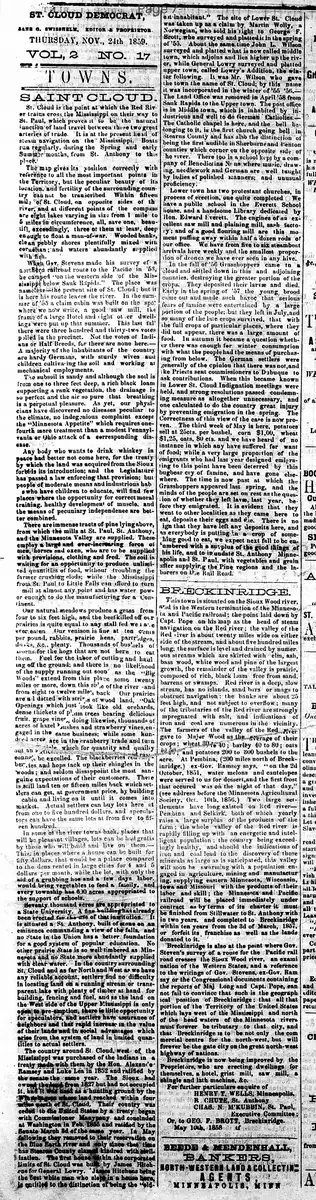
Saml. Q. Swisher, Proprietor.
THURSDAY, NOV. 24th 1859
VOL. 2 NO. 17
TOWNS
SAINT CLOUD
St. Cloud is the point at which the Red River trains cross the Mississippi on their way to St. Paul, which proves it to be the natural junction of land travel between these two great arteries of trade. It is at the present head of steam navigation on the Mississippi. Boats run regularly during the Spring and early Summer months, from St. Anthony to this place.
The map gives its position correctly with reference to all the most important points in the Territory, but the peculiar beauty of its location and fertility of the surrounding country can not be transcribed. Within fifteen miles of St. Cloud, on opposite sides of the river, and at different points of the compass are eight lakes varying in size from 1 mile to 5 miles in circumference, all, save one, beautiful, exceedingly, three of them at least, deep enough to float a man-of-war. Wooded banks, clean pebbly shores plentifully mixed with cornelian; and waters abundantly supplied with fish.
When Gov. Stevens made his survey of northern railroad route to the Pacific in '53, he camped on the western side of the Mississippi below Sauk Rapids. The place was nameless the present site of St. Cloud; but it is here his route leaves the river. In the summer of '55 a claim cabin was built on the spot where we now write, a good saw mill, the frame of a large Hotel and eight other dwellings were put up that summer. This last fall there were three hundred and thirty-two votes polled in the precinct. Not the votes of Indians or Half Breeds, for there are none here.
A majority of the inhabitants of the country are hardy Germans, with sturdy wives and children cultivating the soil and working at mechanical employments.
The subsoil is sandy and although the soil is from one to three feet deep, a rich black loam supporting a rank vegetation, the drainage is so perfect and the air so pure that breathing is a perpetual pleasure. As yet, our physicians have discovered no diseases peculiar to the climate, no indigenous complaint except the "Minnesota Appetite" which requires one fourth more treatment than a modest Pennsylvania or Ohio attack of a corresponding disease.
Any body who wants to drink whiskey in peace had better not come here, for the treaty by which the land was acquired from the Sioux forbids its introduction; and the Legislature has passed a law enforcing that provision; but people of moderate means and industrious habits who have children to educate, will find few places where the opportunity for correct moral training, healthy development of muscle, and the means of pecuniary independence are better combined.
There are immense tracts of pine lying above, from which the mills at St. Paul, St. Anthony, and the Minnesota Valley are supplied. These employ a large and ever-increasing force of men, horses and oxen, who are to be supplied with provisions, clothing and feed. The soil is waiting for an opportunity to produce unlimited quantities of food, without troubling the farmer crushing clods; while the Mississippi from St. Paul to Little Falls can afford to turn mill at almost any point and has water power enough to do the manufacturing for a Continent.
Our natural meadows produce a grass from four to six feet high, and the beef killed off our prairies is quite equal to any stall fed we have ever eaten for venison is not at ten cents per pound, rabbits, prairie hens, partridges, ducks, &c., plenty. Thousands of bushels of corn for the hogs that are not here to eat them. Fuel for the labor of cutting and hauling off the ground; and there is no likelihood of the supply running out soon as the "Big Woods" extend from this place some twenty miles or more, down this side of the river and from eight to twelve miles back Our prairies are all dotted with strips of wood land, Oak Openings which just look like old orchards, dense thickets of plum trees bearing delicious fruit. grape vine, doing likewise, thousands of acres of hazel bushes and strawberry vines, engaged in the same business; while some hundred acres are in the cranberry trade and furnish which for quantity and quality out an ice.
Berries and hops tack up their shingles in the woods; and seldom disappoint the most sanguine expectations of their customers. There is still land ten or fifteen miles back which settlers can get, at government price, by building cabin and living on it until it comes into market. Actual settlers can buy lots here at from one to five hundred dollars, and speculators can have the same lots at from five to fifteen hundred.
In some of the river towns back, places that will be pleasant villages, lots can be had gratis by those who will build and live on them. This, in places where a house can be built for fifty dollars, that would be a palace compared to the dens rented in large cities for 4 and 5 dollars per month, while the lot, with only the aid of a grubbing hoe and a few days labor, would bring vegetables to feed a family, and every township has 630 acres appropriated to the support of schools.
Seventy thousand acres are appropriated to a State University. A fine building has already been erected for the use of that institution. It is situated at St. Anthony, built of stone on an eminence commanding a view of the falls, and no State in the Union has a better foundation for a good system of popular education. No other prairie State is so well-timbered as Minnesota and no State more abundantly supplied with clear water. In the country surrounding St. Cloud and as far North and West as we have any reliable account, settlers find no difficulty in locating land on a running stream or transparent lake with plenty of timber at hand for building, fencing and fuel, and as the land on the West side of the Upper Mississippi is only open to pre-emption, there is little opportunity for speculators, and settlers have assurance of neighbors and that rapid increase in the value of their lands and in social advantages which arise from the system of land in limited quantities to actual settlers.
The country around St. Cloud, west of the Mississippi was purchased of the Indians in treaty made with them by the Hon. Alexander Ramsey and Luke Lea in 1851 and ratified by the Government the same year. The Sioux had owned their grant since 1827, but had not occupied it, had no village or fixed hunting ground by the bank of St Cloud, Their country was ceded to the United States by a treaty bearing with Commissioner Manypenny and concluded at Washington in Feb. 1855 and ratified by the Senate March 23d the year. Many were moved to their reservation.
Stearns County and kindred with civilization within the corporate limits of St. Cloud was built by James Hitchens for General Lowry. J. Hitchens being the first white men who stop in the hot Gutco Jot Sostinmionorbe.
e. it inhabitant. Tho site of Lower St. Cloud was taken up as a claim by Martin Wolly, a Norwegian, who sold his right to Georg F. Brott, who surveyed and platted it in the spring of '55. About the same time John L. Wilson surveyed and platted what is now called middle town, which adjoins and lies higher up the river, while General Lowry surveyed and platted upper town, called Lowry's Addition, the winter following. It was Mr. Wilson who gave the town the name of St. Cloud; by this time it was incorporated in the winter of '55-6.
The Land Office was removed in April '58 from Sauk Rapids to the Upper town. The post office is in Middle town, which is inhabited by industrious and well to do German Catholics. The Catholic chapel is here; and the bell belonging to it, is the first church going bell in Stearns County and has also the distinction of being the first audible in Sherburne and Benton counties which corner on the opposite side of the river. There too is a school kept by a company of Benedictine Nuns where music, drawing, needlework and German are well taught by ladies of polished manners; and unusual proficiency.
Lower town has two protestant churches, in process of erection, one quite completed We have a public school in the Everett School house, and a handsome Library dedicated by Hon. Edward Everett. The engines of an excellent saw mill and planing mill, sash factory: and of a good Flour mill are this moment puffing away within half a dozen rods of our office. We have from five to six steamboat arrivals here weekly and the smallest proportion of drones we have ever seen in any hive.
In the fall of '56 Grasshoppers came in a cloud and settled down in this and adjoining counties, destroying the greater portion of the crops. They deposited their larvae and died. Early in the spring of '57 the young brood came out and made such havoc that serious fears of famine were entertained by a large portion of the people: but they left in July, and so many of the late crops survived, that with the full crops of particular places, where they did not appear, there was a large amount of food. In autumn it became a question whether there was enough for winter consumption with what the people had the means of purchasing from below. The German settlers were generally of the opinion that there was not, and the Priests sent commissioners to Dubuque to ask contributions. When this became known in Lower St. Cloud Indignation meetings were held, and strong resolutions passed condemning measure as altogether unnecessary, and one calculated to do the country great injury by preventing emigration in the spring. The correctness of this view of the case is now proven. The third week of May is here, potatoes sell at 25cts. per bushel, corn $1.00, wheat $1.25, oats 80 cts. and we have heard of no instance in which any have suffered, for want of food; while a very large proportion of the emigrants who had last year designed emigrating to this point have been deterred by this bugbear cry of famine, and have gone elsewhere. The time is now past at which the Grasshoppers appeared last spring, and the minds of the people are set at rest as the question of whether they left larvae, last year, before they emigrated. It is evidently that they went to other localities as they came here to eat, deposit their eggs and die. There is no sign that they have left any deposits here, and as everybody is putting in a crop of something good to eat, we expect next fall to be encumbered with a surplus of the good things of this life, and to inundate St. Anthony Minneapolis and St. Paul, with vegetables and grain after supplying the Pine regions and the laborers on the Rail Road.
What sub-type of article is it?
What themes does it cover?
What keywords are associated?
What entities or persons were involved?
Where did it happen?
Story Details
Key Persons
Location
St. Cloud, Minnesota
Event Date
1851 1859
Story Details
Article describes St. Cloud's position as a trade junction on the Mississippi River, its natural beauty with lakes and fertile soil, settlement history starting in 1855 with claim cabins and mills, German inhabitants, prohibition of whiskey, abundant resources like pine, grass, game, and berries, land availability, educational institutions, and recovery from 1856-1857 grasshopper plague without famine.