Thank you for visiting SNEWPapers!
Sign up free
Editorial
May 10, 1855
Belmont Chronicle
Saint Clairsville, Belmont County, Ohio
What is this article about?
The editorial praises the independent and essential nature of farming, quoting Cicero and Virgil, contrasting its reliability with commercial uncertainties, and highlighting the farmer's skill in overcoming challenges for a bountiful harvest.
Clipping
OCR Quality
98%
Excellent
Full Text
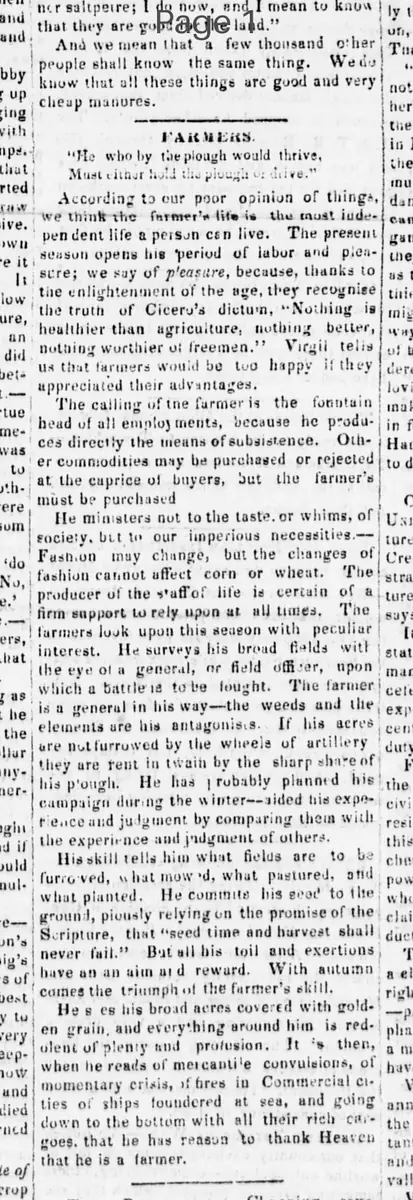
FARMERS.
"He who by the plough would thrive,
Must either hold the plough or drive."
According to our poor opinion of things, we think the farmer's life is the most independent life a person can live. The present season opens his period of labor and pleasure; we say of pleasure, because, thanks to the enlightenment of the age, they recognise the truth of Cicero's dictum, "Nothing is healthier than agriculture, nothing better, nothing worthier of freemen." Virgil tells us that farmers would be too happy if they appreciated their advantages.
The calling of the farmer is the fountain head of all employments, because he produces directly the means of subsistence. Other commodities may be purchased or rejected at the caprice of buyers, but the farmer's must be purchased
He ministers not to the taste or whims of society, but to our imperious necessities. Fashion may change, but the changes of fashion cannot affect corn or wheat. The producer of the staff of life is certain of a firm support to rely upon at all times. The farmers look upon this season with peculiar interest. He surveys his broad fields with the eye of a general, or field officer, upon which a battle is to be fought. The farmer is a general in his way--the weeds and the elements are his antagonists. If his acres are not furrowed by the wheels of artillery they are rent in twain by the sharp share of his plough. He has probably planned his campaign during the winter--guided his experience and judgment by comparing them with the experience and judgment of others.
His skill tells him what fields are to be furrowed, what mowed, what pastured, and what planted. He commits his seed to the ground, piously relying on the promise of the Scripture, that "seed time and harvest shall never fail." But all his toil and exertions have an end and reward. With autumn comes the triumph of the farmer's skill.
He sees his broad acres covered with golden grain, and everything around him is redolent of plenty and profusion. It is then, when he reads of mercantile convulsions, of monetary crisis, of fires in Commercial cities of ships foundered at sea, and going down to the bottom with all their rich cargoes, that he has reason to thank Heaven that he is a farmer.
"He who by the plough would thrive,
Must either hold the plough or drive."
According to our poor opinion of things, we think the farmer's life is the most independent life a person can live. The present season opens his period of labor and pleasure; we say of pleasure, because, thanks to the enlightenment of the age, they recognise the truth of Cicero's dictum, "Nothing is healthier than agriculture, nothing better, nothing worthier of freemen." Virgil tells us that farmers would be too happy if they appreciated their advantages.
The calling of the farmer is the fountain head of all employments, because he produces directly the means of subsistence. Other commodities may be purchased or rejected at the caprice of buyers, but the farmer's must be purchased
He ministers not to the taste or whims of society, but to our imperious necessities. Fashion may change, but the changes of fashion cannot affect corn or wheat. The producer of the staff of life is certain of a firm support to rely upon at all times. The farmers look upon this season with peculiar interest. He surveys his broad fields with the eye of a general, or field officer, upon which a battle is to be fought. The farmer is a general in his way--the weeds and the elements are his antagonists. If his acres are not furrowed by the wheels of artillery they are rent in twain by the sharp share of his plough. He has probably planned his campaign during the winter--guided his experience and judgment by comparing them with the experience and judgment of others.
His skill tells him what fields are to be furrowed, what mowed, what pastured, and what planted. He commits his seed to the ground, piously relying on the promise of the Scripture, that "seed time and harvest shall never fail." But all his toil and exertions have an end and reward. With autumn comes the triumph of the farmer's skill.
He sees his broad acres covered with golden grain, and everything around him is redolent of plenty and profusion. It is then, when he reads of mercantile convulsions, of monetary crisis, of fires in Commercial cities of ships foundered at sea, and going down to the bottom with all their rich cargoes, that he has reason to thank Heaven that he is a farmer.
What sub-type of article is it?
Agriculture
What keywords are associated?
Farmers
Agriculture
Independence
Rural Life
Harvest
Plough
Subsistence
Plenty
What entities or persons were involved?
Cicero
Virgil
Editorial Details
Primary Topic
Virtues Of The Farmer's Life
Stance / Tone
Laudatory And Supportive
Key Figures
Cicero
Virgil
Key Arguments
Farmer's Life Is Most Independent
Agriculture Is Healthiest And Worthiest Of Freemen
Farmer Produces Means Of Subsistence Essential To Necessities
Farmer's Produce Unaffected By Fashion Changes
Farmer Certain Of Firm Support
Farmer's Skill Leads To Triumph In Harvest