Thank you for visiting SNEWPapers!
Sign up free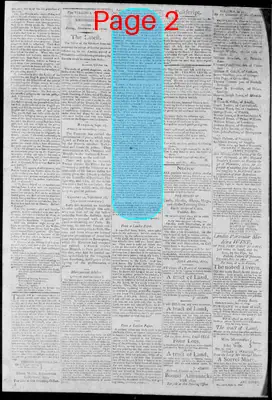
Editorial
November 21, 1800
Virginia Argus
Richmond, Virginia
What is this article about?
An editorial critiques the destructive political ill will in America that divides society, harms reputations, and equates virtue with party affiliation. It urges citizens to prioritize national good over partisan hatred, emphasizing that virtue transcends political differences and true patriotism lies in cooperative pursuits for the common welfare.
Clipping
OCR Quality
98%
Excellent
Full Text
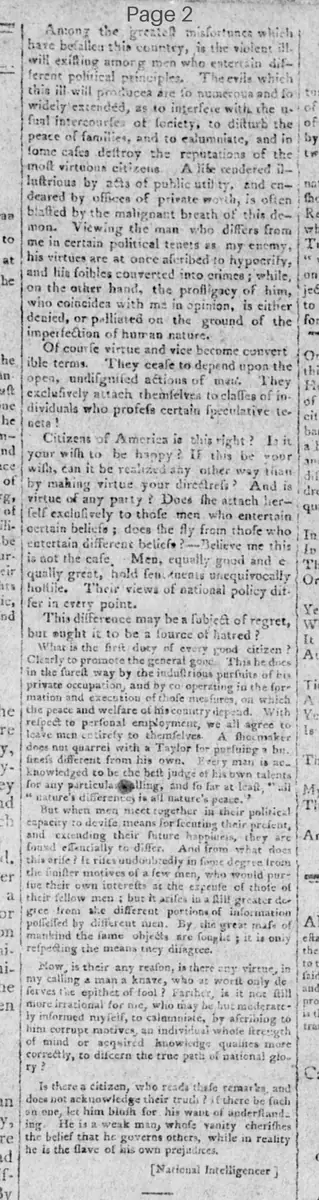
Among the greatest misfortunes which have befallen this country, is the violent ill will existing among men who entertain different political principles. The evils which this ill will produces are so numerous and so widely extended, as to interfere with the usual intercourses of society, to disturb the peace of families, and to calumniate, and in some cases destroy the reputations of the most virtuous citizens. A life rendered illustrious by acts of public utility, and endeared by offices of private worth, is often blasted by the malignant breath of this demon. Viewing the man who differs from me in certain political tenets as my enemy, his virtues are at once ascribed to hypocrisy, and his foibles converted into crimes; while, on the other hand, the profligacy of him, who coincides with me in opinion, is either denied, or palliated on the ground of the imperfection of human nature. Of course virtue and vice become convertible terms. They cease to depend upon the open, undisguised actions of men. They exclusively attach themselves to classes of individuals who profess certain speculative tenets.
Citizens of America is this right? Is it your wish to be happy? If this be your wish, can it be realized any other way than by making virtue your director? And is virtue of any party? Does the attach herself exclusively to those men who entertain certain beliefs; does she fly from those who entertain different beliefs?--Believe me this is not the case. Men, equally good and equally great, hold sentiments unequivocally hostile. Their views of national policy differ in every point.
This difference may be a subject of regret, but ought it to be a source of hatred?
What is the first duty of every good citizen? Clearly to promote the general good. This he does in the greatest way by the industrious pursuits of his private occupation, and by co-operating in the formation and execution of those measures, on which the peace and welfare of his country depend. With respect to personal employment, we all agree to leave men entirely to themselves. A shoemaker does not quarrel with a Taylor for pursuing a business different from his own. Every man is acknowledged to be the best judge of his own talents or any particular calling, and so far at least. "Nature's difference is all nature's peace."
But when men meet together in their political capacity to devise means of securing their present, and extending their future happiness, they are found essentially to differ. And from what arises this? It rises undoubtedly in some degree from the sinister motives of a few men, who would pursue their own interests at the expense of those of their fellow men; but it arises in a still greater degree from the different portions of information possessed by different men. By the great mass of mankind the same objects are ought; it is only respecting the means they disagree.
Now, is there any reason, is there any virtue, in my calling a man a knave, who at worst only deserves the epithet of fool? Farther, is it not still more irrational for me, who may be but moderately informed myself, to calumniate, by ascribing to him corrupt motives, an individual whose strength of mind or acquired knowledge qualifies more correctly, to discern the true path of national glory?
Is there a citizen, who reads these remarks, and does not acknowledge their truth? If there be such an one, let him blush for his want of understanding. He is a weak man, whose vanity cherishes the belief that he governs others, while in reality he is the slave of his own prejudices.
[National Intelligencer]
Citizens of America is this right? Is it your wish to be happy? If this be your wish, can it be realized any other way than by making virtue your director? And is virtue of any party? Does the attach herself exclusively to those men who entertain certain beliefs; does she fly from those who entertain different beliefs?--Believe me this is not the case. Men, equally good and equally great, hold sentiments unequivocally hostile. Their views of national policy differ in every point.
This difference may be a subject of regret, but ought it to be a source of hatred?
What is the first duty of every good citizen? Clearly to promote the general good. This he does in the greatest way by the industrious pursuits of his private occupation, and by co-operating in the formation and execution of those measures, on which the peace and welfare of his country depend. With respect to personal employment, we all agree to leave men entirely to themselves. A shoemaker does not quarrel with a Taylor for pursuing a business different from his own. Every man is acknowledged to be the best judge of his own talents or any particular calling, and so far at least. "Nature's difference is all nature's peace."
But when men meet together in their political capacity to devise means of securing their present, and extending their future happiness, they are found essentially to differ. And from what arises this? It rises undoubtedly in some degree from the sinister motives of a few men, who would pursue their own interests at the expense of those of their fellow men; but it arises in a still greater degree from the different portions of information possessed by different men. By the great mass of mankind the same objects are ought; it is only respecting the means they disagree.
Now, is there any reason, is there any virtue, in my calling a man a knave, who at worst only deserves the epithet of fool? Farther, is it not still more irrational for me, who may be but moderately informed myself, to calumniate, by ascribing to him corrupt motives, an individual whose strength of mind or acquired knowledge qualifies more correctly, to discern the true path of national glory?
Is there a citizen, who reads these remarks, and does not acknowledge their truth? If there be such an one, let him blush for his want of understanding. He is a weak man, whose vanity cherishes the belief that he governs others, while in reality he is the slave of his own prejudices.
[National Intelligencer]
What sub-type of article is it?
Partisan Politics
Moral Or Religious
Social Reform
What keywords are associated?
Political Ill Will
Partisan Hatred
National Unity
Virtue In Politics
Citizen Duty
Political Differences
What entities or persons were involved?
Citizens Of America
Editorial Details
Primary Topic
Critique Of Political Ill Will And Call For Unity Through Virtue
Stance / Tone
Moral Exhortation Against Partisan Hatred
Key Figures
Citizens Of America
Key Arguments
Political Differences Should Not Breed Hatred Or Destroy Reputations
Virtue Is Not Exclusive To Any Political Party
Good Citizens Promote The General Good Regardless Of Differing Views
Disagreements Arise From Varying Information, Not Necessarily Sinister Motives
Calumniating Others Based On Political Tenets Is Irrational And Unvirtuous