Thank you for visiting SNEWPapers!
Sign up free
Editorial
July 18, 1815
Daily National Intelligencer
Washington, District Of Columbia
What is this article about?
An editorial harshly criticizes the inaugural issue of 'The North American Review' as a vehicle for the Essex Junto's narrow, unpatriotic, and sectarian views, mocking its promoters and vowing ongoing satirical scrutiny to expose their follies.
Clipping
OCR Quality
98%
Excellent
Full Text
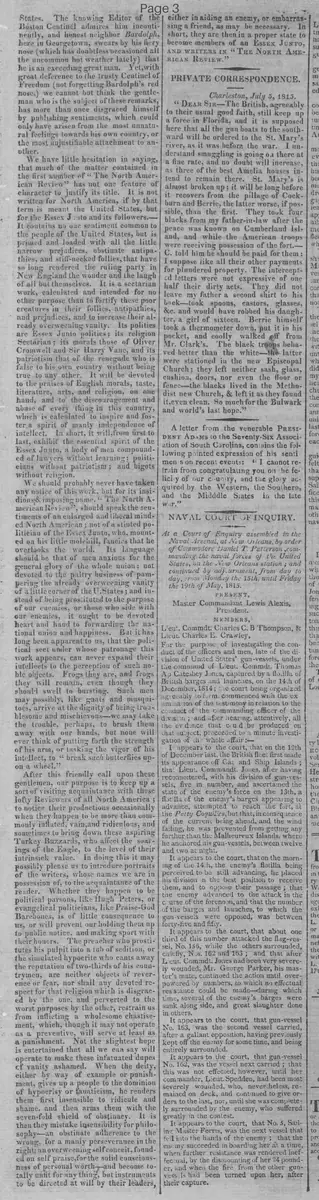
States. The knowing Editor of the Boston Centinel admires him incontinently, and honest neighbor Bardolph, here in Georgetown, swears by his fiery nose (which has doubtless occasioned all the uncommon hot weather lately) that he is an exceeding great man. Yet, with great deference to the trusty Centinel of Freedom (not forgetting Bardolph's red nose) we cannot but think the gentleman who is the subject of these remarks, has more than once disgraced himself by publishing sentiments, which could only have arisen from the most unnatural feelings towards his own country, or the most unjustifiable attachment to another.
We have little hesitation in saying, that much of the matter contained in the first number of "The North American Review" has not one feature of character to justify its title. It is not written for North America, if by that term is meant the United States, but for the Essex Junto and its followers. It contains no one sentiment common to the people of the United States, but is primed and loaded with all the little narrow prejudices, obstinate antipathies, and stiff-necked follies, that have so long rendered the ruling party in New England the wonder and the laugh of all but themselves. It is a sectarian work, calculated and intended for no other purpose than to fortify these poor creatures in their follies, antipathies, and prejudices, and to increase their already overweening vanity. Its politics are Essex Junto politics; its religion sectarian; its morals those of Oliver Cromwell and Sir Harry Vane, and its patriotism that of the renegade who is false to his own country without being true to any other. It will be devoted to the praises of English morals, taste, literature, arts, and religion, on one hand, and to the discouragement and abuse of every thing in this country, which is calculated to inspire and foster a spirit of manly independence of intellect. In short, it will, from first to last, exhibit the essential spirit of the Essex Junto, a body of men compounded of lawyers without learning; politicians without patriotism; and bigots without religion.
We should probably never have taken any notice of this work, but for its insiduous & imposing name. "The North American Review" should speak the sentiments of an enlarged and liberal minded North American: not of a stinted politician of the Essex Junto, who, mounted on his little molehill, fancies that he overlooks the world. Its language should be that of men anxious for the general glory of the whole union: not devoted to the paltry business of pampering the already overweening vanity of a little corner of the U. States; and instead of being prostituted to the purpose of our enemies, or those who side with our enemies, it ought to be devoted heart and hand to forwarding the national union and happiness. But it has long been apparent to us, that the political sect under whose patronage this work appears, can never expand their intellects to the perception of such noble objects. Frogs they are, and frogs they will remain, even though they should swell to bursting. Such men may possibly, like gnats and musquitoes, arrive at the dignity of being troublesome and mischievous—we may take the trouble, perhaps, to brush them away with our hands, but none will ever think of putting forth the strength of his arm, or tasking the vigor of his intellect, to "break such butterflies upon a wheel."
After this friendly call upon these gentlemen, our purpose is to keep up a sort of visiting acquaintance with these lofty Reviewers of all North America; to notice their productions occasionally when they happen to be more than commonly inflated, vain, and ridiculous, and sometimes to bring down these aspiring Turkey Buzzards, who affect the soarings of the Eagle, to the level of their intrinsick value. In doing this it may possibly please us to introduce portraits of the writers, whose names we are in possession of, to the acquaintance of the reader. Whether they happen to be political parsons, like Hugh Peters, or evangelical politicians, like Praise-God Barebones, is of little consequence to us, or will prevent our holding them up to public notice, and making sport with their honors. The preacher who prostitutes his pulpit into a tub of sedition, or the simulated hypocrite who cant away the reputation of two-thirds of his countrymen, are neither objects of reverence or fear, nor shall any devoted respect for that religion which is disgraced by the one, and perverted to the worst purposes by the other, restrain us from inflicting a wholesome chastisement, which, though it may not operate as a preventive, will serve at least as a punishment. Not the slightest hope is entertained that all we can say will operate to make these infatuated dupes of vanity ashamed. When the deity, either by way of example or punishment, gives up a people to the dominion of hypocrisy or fanaticism, he renders them first insensible to ridicule and shame, and then arms them with the seven-fold shield of obstinacy. It is then they mistake insensibility or philosophy—an obstinate adherence to the wrong, for a manly perseverance in the right; an overweening selfconceit, founded on self praise, for the solid consciousness of personal worth—and become totally unfit for any thing, but instruments to be directed at will by their leaders, either in aiding an enemy, or embarrasing a friend, as may be necessary. In short, they are then in a proper state to become members of an Essex Junto, AND WRITERS IN "The NORTH AMERICAN REVIEW".
We have little hesitation in saying, that much of the matter contained in the first number of "The North American Review" has not one feature of character to justify its title. It is not written for North America, if by that term is meant the United States, but for the Essex Junto and its followers. It contains no one sentiment common to the people of the United States, but is primed and loaded with all the little narrow prejudices, obstinate antipathies, and stiff-necked follies, that have so long rendered the ruling party in New England the wonder and the laugh of all but themselves. It is a sectarian work, calculated and intended for no other purpose than to fortify these poor creatures in their follies, antipathies, and prejudices, and to increase their already overweening vanity. Its politics are Essex Junto politics; its religion sectarian; its morals those of Oliver Cromwell and Sir Harry Vane, and its patriotism that of the renegade who is false to his own country without being true to any other. It will be devoted to the praises of English morals, taste, literature, arts, and religion, on one hand, and to the discouragement and abuse of every thing in this country, which is calculated to inspire and foster a spirit of manly independence of intellect. In short, it will, from first to last, exhibit the essential spirit of the Essex Junto, a body of men compounded of lawyers without learning; politicians without patriotism; and bigots without religion.
We should probably never have taken any notice of this work, but for its insiduous & imposing name. "The North American Review" should speak the sentiments of an enlarged and liberal minded North American: not of a stinted politician of the Essex Junto, who, mounted on his little molehill, fancies that he overlooks the world. Its language should be that of men anxious for the general glory of the whole union: not devoted to the paltry business of pampering the already overweening vanity of a little corner of the U. States; and instead of being prostituted to the purpose of our enemies, or those who side with our enemies, it ought to be devoted heart and hand to forwarding the national union and happiness. But it has long been apparent to us, that the political sect under whose patronage this work appears, can never expand their intellects to the perception of such noble objects. Frogs they are, and frogs they will remain, even though they should swell to bursting. Such men may possibly, like gnats and musquitoes, arrive at the dignity of being troublesome and mischievous—we may take the trouble, perhaps, to brush them away with our hands, but none will ever think of putting forth the strength of his arm, or tasking the vigor of his intellect, to "break such butterflies upon a wheel."
After this friendly call upon these gentlemen, our purpose is to keep up a sort of visiting acquaintance with these lofty Reviewers of all North America; to notice their productions occasionally when they happen to be more than commonly inflated, vain, and ridiculous, and sometimes to bring down these aspiring Turkey Buzzards, who affect the soarings of the Eagle, to the level of their intrinsick value. In doing this it may possibly please us to introduce portraits of the writers, whose names we are in possession of, to the acquaintance of the reader. Whether they happen to be political parsons, like Hugh Peters, or evangelical politicians, like Praise-God Barebones, is of little consequence to us, or will prevent our holding them up to public notice, and making sport with their honors. The preacher who prostitutes his pulpit into a tub of sedition, or the simulated hypocrite who cant away the reputation of two-thirds of his countrymen, are neither objects of reverence or fear, nor shall any devoted respect for that religion which is disgraced by the one, and perverted to the worst purposes by the other, restrain us from inflicting a wholesome chastisement, which, though it may not operate as a preventive, will serve at least as a punishment. Not the slightest hope is entertained that all we can say will operate to make these infatuated dupes of vanity ashamed. When the deity, either by way of example or punishment, gives up a people to the dominion of hypocrisy or fanaticism, he renders them first insensible to ridicule and shame, and then arms them with the seven-fold shield of obstinacy. It is then they mistake insensibility or philosophy—an obstinate adherence to the wrong, for a manly perseverance in the right; an overweening selfconceit, founded on self praise, for the solid consciousness of personal worth—and become totally unfit for any thing, but instruments to be directed at will by their leaders, either in aiding an enemy, or embarrasing a friend, as may be necessary. In short, they are then in a proper state to become members of an Essex Junto, AND WRITERS IN "The NORTH AMERICAN REVIEW".
What sub-type of article is it?
Partisan Politics
Satire
Moral Or Religious
What keywords are associated?
Essex Junto
North American Review
Partisan Criticism
New England Faction
Political Satire
Sectarianism
American Patriotism
What entities or persons were involved?
Essex Junto
The North American Review
Boston Centinel
Bardolph
Oliver Cromwell
Sir Harry Vane
Hugh Peters
Praise God Barebones
Editorial Details
Primary Topic
Critique Of The North American Review And The Essex Junto
Stance / Tone
Strongly Critical And Mocking
Key Figures
Essex Junto
The North American Review
Boston Centinel
Bardolph
Oliver Cromwell
Sir Harry Vane
Hugh Peters
Praise God Barebones
Key Arguments
The North American Review Promotes Essex Junto Prejudices And Antipathies, Not Sentiments Of The United States
It Is Sectarian, Fortifying Follies And Vanity Of New England Ruling Party
Its Politics Are Unpatriotic, Praising England While Abusing American Independence
The Review Should Represent Liberal North American Views, Not Narrow Sectionalism
Essex Junto Members Are Lawyers Without Learning, Politicians Without Patriotism, Bigots Without Religion
The Author Will Continue To Mock And Chastise The Review's Writers
Such Fanatics Are Insensible To Ridicule And Serve As Tools For Enemies