Thank you for visiting SNEWPapers!
Sign up free
Gazette Of The United States
Philadelphia, Philadelphia County, Pennsylvania
What is this article about?
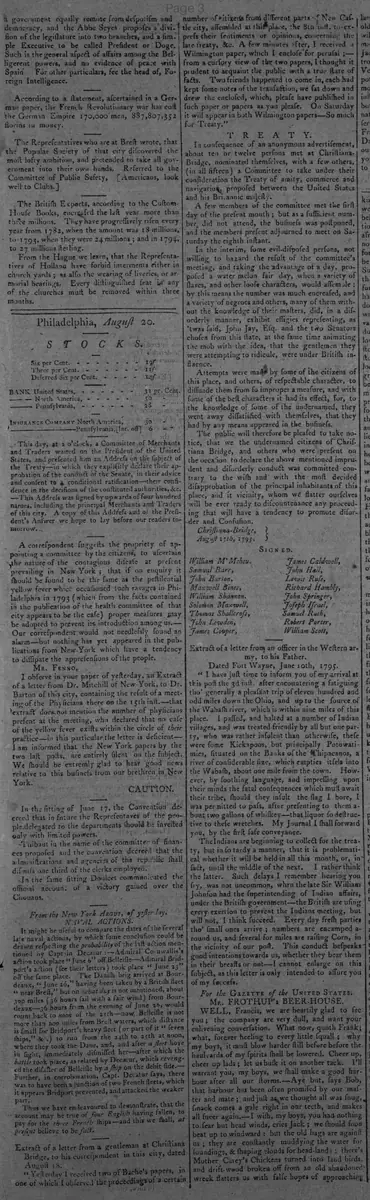
Residents of Christiana Bridge disavow a disorderly protest against the Jay Treaty on August 8, 1795, involving effigies of John Jay and Delaware senators, organized by a small committee but joined by slaves and others, contrary to the wishes of principal inhabitants.
Clipping
OCR Quality
Full Text
Bridge, to his correspondent in this city, dated
August 18.
" Yesterday I received two of Bache's papers, in
one of which I observed the proceedings of a certain
number of citizens from different parts of New Castle
city, assembled at this place, the 8th inst. to express
their sentiments or opinions, concerning the
late treaty, &c. A few minutes after, I received a
Wilmington paper, which I enclose for perusal ;-
from a cursory view of the two papers, I thought it
prudent to acquaint the public with a true state of
facts. Two friends happened to come in, each had
kept some notes of the transaction, we sat down and
drew the enclosed, which, please have published in
such paper or papers as you please. On Saturday
it will appear in both Wilmington papers—So much
for Treaty."
TREATY.
In consequence of an anonymous advertisement,
about ten or twelve persons met at Christiana-
Bridge, nominated themselves, with a few others,
(in all fifteen) a Committee to take under their
consideration the Treaty of amity, commerce and
navigation, proposed between the United States
and his Britannic majesty.
A few members of the committee met the first
day of the present month; but as a sufficient number
did not attend, the business was postponed,
and the members present adjourned to meet on Saturday
the eighth instant.
In the interim, some evil-disposed persons, not
willing to hazard the result of the committee's
meeting, and taking the advantage of a day, proposed
a water melon fair day, when a variety of
slaves, and other loose characters, would assemble :
by this means the number was much increased, and
a variety of negroes and others, many of them without
the knowledge of their masters, did, in a disorderly
manner, exhibit effigies representing, as
'twas said, John Jay, Esq. and the two Senators
chosen from this state, at the same time animating
the mob with the idea, that the gentlemen they
were attempting to ridicule, were under British influence.
Attempts were made by some of the citizens of
this place, and others, of respectable character, to
dissuade them from so improper a measure, and with
some of the best characters it had its effect, for, to
the knowledge of some of the undernamed, they
went away dissatisfied with themselves, that they
had by any means appeared in the business.
The public will therefore be pleased to take notice,
that we the undernamed citizens of Christiana
Bridge, and others who were present on
the occasion to declare the above mentioned imprudent
and disorderly conduct was committed contrary
to the wish and with the most decided
disapprobation of the principal inhabitants of this
place, and its vicinity, whom we flatter ourselves
will be ever ready to discountenance any proceeding
that will have a tendency to promote disorder
and Confusion.
Christiana-Bridge,
August 17th, 1795.
Signed.
William M'Keen.
James Caldwell,
Samuel Barr,
John Hall,
John Burton,
Lewis Rue,
Maxwell Bines,
Richard Hambley,
William Shannon.
John Springer,
Solomon Maxwell,
Joseph Israel,
Thomas Shallcross,
Samuel Ruth,
John Lewden,
Robert Porter,
James Couper,
William Scott.
What sub-type of article is it?
What keywords are associated?
What entities or persons were involved?
Where did it happen?
Domestic News Details
Primary Location
Christiana Bridge
Event Date
August 8, 1795
Key Persons
Outcome
disorderly conduct disavowed by principal inhabitants; some participants left dissatisfied.
Event Details
A committee of fifteen met to discuss the Treaty of amity, commerce and navigation between the United States and Britain, but the gathering was disrupted by evil-disposed persons who increased numbers with slaves and loose characters on a watermelon fair day, leading to exhibition of effigies of John Jay and Delaware senators, accused of British influence; respectable citizens attempted to dissuade the mob.