Thank you for visiting SNEWPapers!
Sign up free
Literary
December 14, 1890
The Cheyenne Daily Leader
Cheyenne, Laramie County, Wyoming
What is this article about?
Article describes English-inspired designs for American home furnishings, including fig leaf-shaped chair cushions in silk, alternative slumber rolls, nested pillows for couches, and simple screens with floral panels. Signed by ExxA Morret Tyng.
Clipping
OCR Quality
95%
Excellent
Full Text
English Comfort for American Homes.
From London, we have a new design for chair backs or saddlebags.
The two cushions formerly made in shape of modest squares, laced together with narrow ribbon across the top, and garnished with tiny tassels about the edges, set astride the back of a wicker rocking chair or straight back reception chair, have been displaced by cushions in the shape of a large conventionalized fig leaf. The cushion has four points and an indentation in the center of the top. It is well to buy an ordinary pillow of feathers or down for a couple of dollars, which affords ample stuffing for the two cushions.
Cut the shape of the leaf as indicated in the sketch out of stout unbleached muslin. These forms are then duplicated in India or China silk. Green is the most effective color to be used, and in two shades, the darker tone for the upper side of the cushion and the lighter shade for the lower side, suggestive of the lighter lining of a natural leaf.
The edges and veins are outlined in silk cord of the lighter shade of silk, as the veining in a real leaf is generally lighter than the surface. The two points of both cushions at either side of the indentation for the stem are then fastened together. At one side is set a rosette made of a ruche of silk in the two shades and tied through the center with rich green ribbon. The cushion is then in readiness to be placed upon the chair's back, to which it lends both comfort and ornament. Since the feathers are of most expense, it is well to suggest a slumber roll worked with dainty silk to be left seven inches longer than the cushion, cut diagonally across the ends and lined with plush. A girdle of ribbon is then tied from end to end to hang it on the chair's back. The jaunty ends display the rich plush lining, and you have practically the same result as the saddlebag with half the labor and cost.
A nest of cushions is almost a necessary appointment in a drawing room or library of today. Piled at the side of a low, broad couch, covered with a Bagdad rug—which, luxuriant as it sounds, is the cheapest covering, since beside the slight expense of the rug it does away with upholstery—are these cushions, tastily covered in infinite variety. They may be incased in the rarest stuffs of the orient or in the cheap, durable manufactures of our American mills.
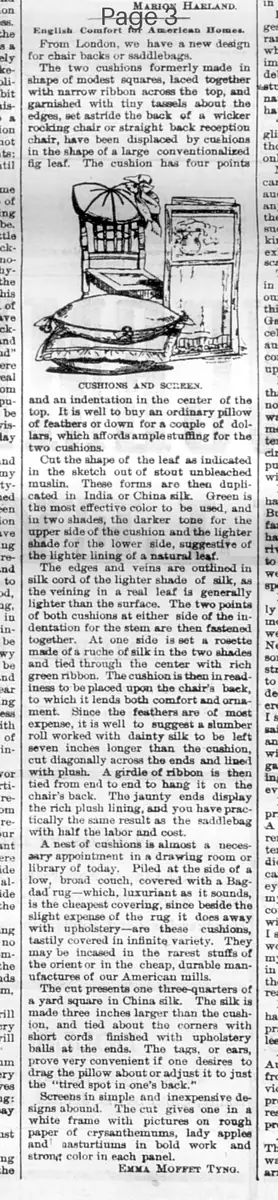
The cut presents one three-quarters of a yard square in China silk. The silk is made three inches larger than the cushion, and tied about the corners with short cords finished with upholstery balls at the ends. The tags, or ears, prove very convenient if one desires to drag the pillow about or adjust it to just the "tired spot in one's back."
Screens in simple and inexpensive designs abound. The cut gives one in a white frame with pictures on rough paper of chrysanthemums, lady apples and nasturtiums in bold work and strong color in each panel.
ExxA, Morret Tyng.
From London, we have a new design for chair backs or saddlebags.
The two cushions formerly made in shape of modest squares, laced together with narrow ribbon across the top, and garnished with tiny tassels about the edges, set astride the back of a wicker rocking chair or straight back reception chair, have been displaced by cushions in the shape of a large conventionalized fig leaf. The cushion has four points and an indentation in the center of the top. It is well to buy an ordinary pillow of feathers or down for a couple of dollars, which affords ample stuffing for the two cushions.
Cut the shape of the leaf as indicated in the sketch out of stout unbleached muslin. These forms are then duplicated in India or China silk. Green is the most effective color to be used, and in two shades, the darker tone for the upper side of the cushion and the lighter shade for the lower side, suggestive of the lighter lining of a natural leaf.
The edges and veins are outlined in silk cord of the lighter shade of silk, as the veining in a real leaf is generally lighter than the surface. The two points of both cushions at either side of the indentation for the stem are then fastened together. At one side is set a rosette made of a ruche of silk in the two shades and tied through the center with rich green ribbon. The cushion is then in readiness to be placed upon the chair's back, to which it lends both comfort and ornament. Since the feathers are of most expense, it is well to suggest a slumber roll worked with dainty silk to be left seven inches longer than the cushion, cut diagonally across the ends and lined with plush. A girdle of ribbon is then tied from end to end to hang it on the chair's back. The jaunty ends display the rich plush lining, and you have practically the same result as the saddlebag with half the labor and cost.
A nest of cushions is almost a necessary appointment in a drawing room or library of today. Piled at the side of a low, broad couch, covered with a Bagdad rug—which, luxuriant as it sounds, is the cheapest covering, since beside the slight expense of the rug it does away with upholstery—are these cushions, tastily covered in infinite variety. They may be incased in the rarest stuffs of the orient or in the cheap, durable manufactures of our American mills.
The cut presents one three-quarters of a yard square in China silk. The silk is made three inches larger than the cushion, and tied about the corners with short cords finished with upholstery balls at the ends. The tags, or ears, prove very convenient if one desires to drag the pillow about or adjust it to just the "tired spot in one's back."
Screens in simple and inexpensive designs abound. The cut gives one in a white frame with pictures on rough paper of chrysanthemums, lady apples and nasturtiums in bold work and strong color in each panel.
ExxA, Morret Tyng.
What sub-type of article is it?
Essay
What themes does it cover?
Social Manners
What keywords are associated?
Chair Cushions
Fig Leaf Design
Silk Pillows
Home Decor
English Style
American Homes
What entities or persons were involved?
Exxa, Morret Tyng.
Literary Details
Title
English Comfort For American Homes.
Author
Exxa, Morret Tyng.
Subject
Designs For Chair Cushions And Home Furnishings
Form / Style
Instructional Prose On Interior Design