Thank you for visiting SNEWPapers!
Sign up free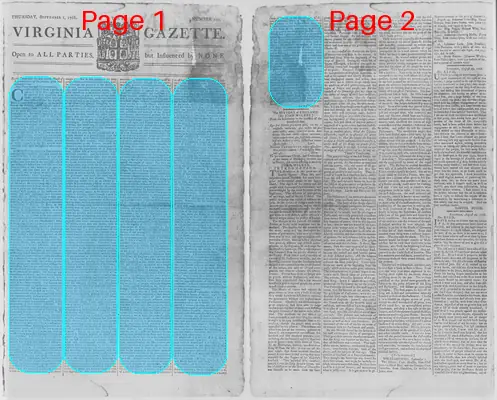
The Virginia Gazette
Williamsburg, Virginia
What is this article about?
An American writer praises the Massachusetts Bay House of Representatives for refusing to rescind a resolution endorsing a circular letter protesting recent Parliamentary acts, viewing it as a defense of colonial constitutional rights against arbitrary taxation and misrepresentation to the British sovereign.
Merged-components note: This is a continuation of the same letter to the editor across pages, as the text flows directly from one component to the next.
Clippings
1 of 2
OCR Quality
Full Text
of Representatives of the province of the
Massachusetts Bay.
Dear Friends and Countrymen,
COMPLIMENTS from a person on this side, to be sure ought not to
be received with equal joy with those, which not many years ago
were bestowed upon his Majesty's brave subjects in these colonies, on the other
side of the Atlantic, whilst engaged against a
common enemy; because possibly they may
not be quite so animating from a brother as
from a parent: Yet when a behaviour greatly
in support of the noble cause of liberty, so
constitutionally established as it has ever been,
becomes a general topic of conversation, and
may one day be of great and national concern,
it seems to be a duty incumbent on every pa-
triotic breast, to express its grateful and un-
feigned approbation of it: permit me there-
fore, an American, to tender to you the cor-
dial respect of many a heart feeling friend for
liberty, on account of your judicious, as well
as decent conduct, in the late attacks made
(through you) upon the rights of all the colo-
nies.
In the midst of my concern at some arbitrary
and oppressive measures extended against the
town of Boston, I was pleased to read that
the news writers could confidently assure the
public, that such part of the oppression which
had unhappily fallen from some officers of his
Majesty's ship of war, would not be again at-
tempted, and that some part of what had
happened, was in a great measure the effect
of a real mistake; I say I was pleased to read
this, because the excuse assigned is consistent
with the general behaviour of the Gentlemen
of the navy; for I have long observed, that
however they may in their course of life, be,
from a particular destination, accustomed to
contend with enemies on the boisterous ele-
ment, yet their retirement into harbours,
works such an effectual change in their con-
duct, with respect to their friends and fellow
subjects, as to make them the most agreeable
companions of society. In short, as the
Viscount d'Ortez said to Charles the IX of
France, in the protestant massacre, they are
too brave citizens and soldiers to the country
they live in, to descend to be the cowardly
executioners of the countrymen they live with.
But how great was my astonishment! when
looking eagerly into the next weekly impor-
tation of northern news, (to see what further
lengths the little lordlings bestablished
amongst you had carried their injudicious ef-
forts) to find a new matter agitated, of the
most oppressing and intimidating nature. A
requisition communicated to your then Ho-
nourable House, that you should rescind the
resolution of a former Assembly, that gave
rise to a circular letter from the Speaker of
their House, on the subject of uniformly re-
presenting against some late acts of Parliament.
—I could not upon reading it (with submission
to a certain E—p, as well as a certain
Ex-cy) but think, that as that circular
letter which gave occasion to that message for
rescinding, had (as you well reason) been to
all intents and purposes executed, and indeed
in the hands of the public, the message was
something out of time: and that things would,
in the eyes of the dispassionate world, have
worn a much better face, if under such a situ-
ation it had been omitted. For suppose not
only the famous 61, but the truly memorable
and patriotic 92, had each man with his pen
contributed his blot to such an erasure, from
the menace with which that requisition was at
last communicated, such an action would have
argued nothing less in any people, than a con-
fession of rashness or inconsiderateness, in the
proceeding of that former Assembly. But
perhaps whilst that notable misrepresenter was
(as he artfully insinuates out of friendship, by
his keeping back part of the E-I of H—h's
letter) endeavouring to raise in you, the merit
of compliance without menace, he was him-
self studying his own merit, rather than that
of the business with which he was instructed;
for with submission, menacing is but a bad way
to convict error, and must for ever argue an
arbitrariness in the power menacing, tending
to effect some purpose not properly within the
rules of justice. It seems then no random con-
clusion, that this reserved hint of intimidation,
had its rise in some first scheme of misrepre-
sentation, calculated perhaps solely to counte-
nance that slavery, to which an original mad
projector, a few years ago, intended to reduce
the subjects of Great Britain; though begin-
ning only by degrees with those in America.
So that if you, Gentlemen, had been trapped
by him, the purpose of depriving the colonists
of those constitutional rights of representation,
in instances of taxation (most essential to the
liberties of the subject in the British empire)
would in some imaginations have gone swim-
mingly on. But in this, perhaps every dirty
artist would have found himself much mistaken;
for although the province of the Massachu-
setts-Bay, has in every instance of its conduct,
since these oppressive measures began, been
justly respectable in the cause of liberty; yet
give me leave to hint to every curious blade
who increases his fortune, or elevates his title,
by the baseness of his projects, that there are
Americans greatly struggling in the
cause of liberty, to save their constitution from
being overturned; and it is hardly a doubt,
whether any man once blessed with the enjoy-
inent of freedom, would not rather seal his
liberty with his own blood, than give (either
with his tongue or pen) the least instance of
betraying it. If one such unfeeling fellow can
be found, that would not, he must deserve to
be doomed to—pottage all his life, the ancient
price of a bartered birth-right.
It must for ever be the unhappiness of a
people situated at a great distance from the
seat of empire, to be liable to every misrepre-
sentation of their conduct, when things are
communicated to the T—e, because the
channel to that sacred place, running general-
ly through the departments of ill designing
men, seldom fails of being muddied, to suit
their base purposes. And from hence, with-
out instancing particular facts, may we date
our present misfortunes. Otherwise no doubt
we should sensibly feel our most gracious So-
vereign active to preserve the liberties as well
of his faithful subjects in America, as of those
that surround his palace; therefore it seems
prudent as well as dutiful, to endeavour that
our grievances may reach the royal ear by
some course out of that channel. Without
considering myself then as an adviser to a
people so penetratingly prudent as you Gen-
tlemen seem to be, I must wish that the circular
letter occasioning the measure above hinted at,
could genuinely appear in the several public
papers in America, where (though I may be
mistaken) I must say I have not as yet seen it:
so—as our worthy countrymen in Maryland
seem to think, in their late decent and spirited
address, it is something doubtful whether any
genuine copy of that letter was really trans-
mitted home. I own I had a manuscript of it
under my perusal, and I then thought (if ever
I was capable of digesting any thing so as to
discover how properly it suited its intended
purpose) that letter intimated, to the several
Assemblies, every duty and loyalty, both to
the person and government of our most graci-
ous Sovereign: a strict attachment to our
mother country; and as to the supreme 5oo, it
was my humble opinion then, the respect paid
to them consideratis considerandis (abundance
of arbitrary severity) that there exceeded in ex-
pressions of subordination. Therefore I can-
not think that any impudent commentary upon
that letter, for the sake of misrepresenting its
apparent address, and only evident purpose,
could have been so bare faced, without some
vile interpolation or alteration; and as these
are things generally within the arts of ill de-
sign, perhaps the printing of that letter will
sufficiently evince the baseness of the attempt.
Without some such solution, it seems to be
difficult to reconcile with the express purpose
of the letter, the construction given to it as
tending to create unwarrantable combinations,
to excite an unjustifiable opposition to the con-
stitutional authority of Parliament, and to re-
vive the unhappy divisions and distractions
which have operated so prejudicially to Great-
Britain and the colonies. The misrepre-
senting the resolutions of the former House,
as a factious measure, pushing through a thin
House, a reconsideration of what a full Asem-
bly had rejected (which I see makes a part of
its baseness) would, I own, upon a presupposi-
tion of its being strictly true, justly induce the
appellation of a very unfair proceeding; but
with respect to the letter itself, being the thing
effected by that resolution: no genuine copy
of it could have drawn forth such a construc-
tion: for although the resolution had been un-
fairly obtained, yet the letter in consequence
of it, preserving in every part of it a truly de-
cent, and really fair method of obtaining re-
dress, certainly could not have been so con-
demned. For if we are not (through the
channel so strongly implied, as almost to be
prescribed, and firmly secured to the subject)
by the bill of rights, in a decent, dutiful,
loyal and constitutional address, offered
without tumult or disorder, to lay our com-
plaints before the throne; in what manner can
the Sovereign ever be acquainted with the
grievances of his people; or the people relieved
by him from such grievances? Shall we sup-
pose it impossible in nature for a Sovereign to
be misinformed or ill advised! Or do the ideas
of sovereignty convey a perfect acquaintance
with every circumstance of distress within the
realm? Or lastly, are we to be satisfied with
the impossibility, that every supremacy assu-
med over us, should exert its power with in-
justice and severity, because we are experi-
mentally, as well as cordially convinced, that
our most glorious Prince will not, does not,
nay cannot deign to oppress us; and from
thence by a pusillanimity not consistent with
British freedom, attend our dying liberties to
such graves, which the arbitrary disposers of
them shall assign, without complaint?-
Many are the sandbanks which have
been thrown up against us in that channel,
once opened to the subject by the bill of rights,
that palladium and bulwark of the English
constitution; countenanced perhaps by that
late bill which I have frequently heard appella-
ted the bill of might; a pretty constant oppo-
nent to all right, and framed very presump-
tively through a vile misrepresentation, that
these hitherto most useful colonies to their
mother country, are now attempting to shake
off their dependence and subordination: For
if we look into a certain memorable P-st,
we shall find how active a Gentleman by name,
had been to mislead the P into measures
destructive of the liberties of the colonists, by
his being there made the standard expositor
of American intentions: And no doubt such a
dignified pander to ministerial oppression, had his
confederates to transmit to his designing princi-
pal, every bold assertion, as apparently against
truth, as that of the American intentions was
against the reason of things: For who can
dispassionately say, that any colonist by writing,
speaking, or action, ever discovered any other
design, than that of securing his right of con-
stitutional representation, in the taxations for
revenues in support of the empire: by which
means the Representative, whilst he is engaged
in the burdensome task, may not only be ac-
quainted with the abilities of his constituents;
be answerable for his conduct in taxing at some
subsequent election for Representatives; but
by a weight equally laid on his own property,
might feel with sensibility in what manner he
had loaded that of others. If the endeavour-
ing to preserve such a right can be fairly deem-
ed the throwing off a due subordination, a
struggling against a dependency on the mother
country, and what not, it may be answered,
there can be no freedom under such a kind of
supremacy: for no such supremacy can be
submitted to, but by abject slaves.—I have
read in a printed speech against the suspending
and dispensing prerogative, in the long dispute
as to the legality of the late embargo on the
exportation of wheat; intended no doubt
as an answer to all that had been advanced in
favour of the prerogative, wherein a certain
bl-e ri-n N—n, is much complimented
for his prophecy on the repeal of the stamp-
act, "that it would be a means of importing
rebellion from America;" and I cannot but say
it is greatly to be wished, that the supremacy
now assumed, exclusive of the Representatives
of the people in this part of the realm, may
not, when once established, import an abject
slavery into the kingdom; and that even from
America. I do not know but the effects of
such a prophecy as this, will be more severely
felt, and occasion a sacrifice of more English
blood, when justified by its completion, than
any indulgence shewn to America, struggling
only to preserve its constitutional liberty, ever
can be. I would here ask that n-le prophet,
as well as the straining speech maker upon his
prophecy, if they have never heard of the ri-
sing or rioting of people within the kingdom
at home, against forestallers, &c. before the
struggles of the Americans against the st-p
a-t? It seems then as if these Americans,
instead of being the importers of such behavi-
our, were rather copiers of their mother
country, in extraordinary instances where
they could not get their grievances redressed;
why then did they make that an exotic, which
seems to be the growth of every free country?
For I think I may be bold to advance from his-
torical observations, that the desire of inde-
pendency is not so much the cause of a disor-
derly behaviour in a people, as the disorderly
instances of severity in government are; of
course every rising in the populace is rather
the effect of impatience in suffering, than of any
other motive; but perhaps the subjects in
America are of a different species of beings,
and no more entitled to the same rank in crea-
tion, than it seems they are to the same justice
with the subjects in England. This prophecy
then, notwithstanding the bl-t-n pro-
phet's repetition of it, and the speech maker's
compliment upon it, seems to have been as
little to the purpose in the dispute upon the
extraordinary exertion of the prerogative, as
it was when prophesied on the repeal of the
stamp-act. I would not be here thought con-
demning any endeavour to restrain an uncon-
stitutional exertion of prerogative, when I
mention this dispute on the embargo affair:
for although liberty, in Britain, is a Goddess
of a most benign and invigorating disposition
to all her votaries, yet from an observed deli-
cacy in her constitution, every instance of noxious
air, however seriously opened, certainly
weakens her active powers too much to be over-
looked: But what I would be understood to
mean is, that this Goddess is liable to be much
more endangered, by the vapours that rise from
taxation without representation, than she is or
can be from loyalty chiefly to preserve what sight
to the whole realm: therefore it would be
most prudent in those who wish (as they pre-
tend) the Goddess should continue in her
healthy existence, not to suffer in any instance
a perfect door to stand ajar, that might let in
those destructive vapours upon her, and that
at a time perhaps when her constitution may
not be quite so vigorous as she seems to be at
present. Necessity indeed is a pretty general
excuse for all arbitrary and unconstitutional
measures; but how comes it with that speech
maker, to be more justifiable in this uncon-
stitutional arbitrariness extended against the
Americans, than it was in that exercised in
behalf of a people in danger of suffering for
want of bread, as was the case at home?
Certainly if necessity was ever a justification in
any instance, it ought rather to be allowed in
favour of a starving people; especially where
hardly any thing but such an exertion of pre-
rogative could so instantaneously relieve; and
perhaps no method less expensive could have
been then fallen upon, than such an exertion:
which was very far from being the case in the
necessities of government, so often urged
against the Americans, when they were de-
prived of their constitutional rights of repre-
sentation; for I beg leave to assert that the
necessities of government have been, and can
be as well, and much cheaper supplied, by
the old methods of raising money in the colo-
nies, by their constitutional Assemblies, as
they ever can be, by this new mode of taxati-
on assumed at home. Rebellion then seems to
be the language of the most tyrannical temper,
whenever it is used against the struggles of a
people, stimulated by the horror of being
greatly enslaved.
It is with much pleasure that I read, that
even in the days of arbitrary power, whilst the
freedom of the land was in danger of being
over run, under the shelter of an unlimited
prerogative, no kind of difference was then
made between the rights and conditions of the
subjects in the colonies. and those in England:
as was particularly adjudged in a case agitated
against a Governor of Barbados: where not
even a R—l instruction could aid his inti-mage-
ment of the constitutional rights of the people
in that island: and I was silently led to wish,
that the remembrance of former times might
influence the actions of the present day; for
certainly if the rights of the people are to be
secured against the weight of a Sc. + r, the
subjects themselves can hardly with justice
think of such an infringement by the weight of
a Mae. A Roman General looking
upon the bust of a virtuous ancestor, confesses
himself animated to a glorious emulation; but
a modern H, an E-, a L, a G
&c. can behold pictures not older than the
days of Charles the I, of the noble efforts of
such names, against the enslaving schemes of
tyranny and oppression, and become so regard-
less of their virtues, as to satisfy themselves
with being studious in the monopoly of property,
and the aggrandizement of one part of the
realm only; just as if equity could dictate, or
prudence countenance, the least partial sacrifice
of it in the other parts.
This business of rescinding, erasing, &c.
resolutions in favour of liberty, made by the
several Assemblies in the colonies, I find has
been much agitated at home. One such attempt
was endeavoured (as it is said) to make it a
part of a certain repealing act; and we see it
expressly managed as one of the interrogatories
put to Doctor Franklin. Now to what other
purpose could such a measure be intended, than
that of blotting out all traces to posterity,
should they unhappily be born under slavery,
that their ancestors did every thing that their
weak situation could admit of, to support and
maintain their rights to freedom? Does not
then even such a measure of rescinding, ar-
gue and imply a conviction, that every exer-
cise of such a supremacy, is rather founded in
the mightiness of power to effect it, than in
any constitutional right they can have over a
poor helpless American? And had you, my
dear countrymen, or any other colony, thus
meanly submitted their necks to the yoke, no
doubt all the other Assemblies would by some
such mode (of confirming right by the power
they have to enforce it) have been left with-
out a common lasting record. to those
that should be born after them. of their spi-
rited conduct, on such overbearing occasions.
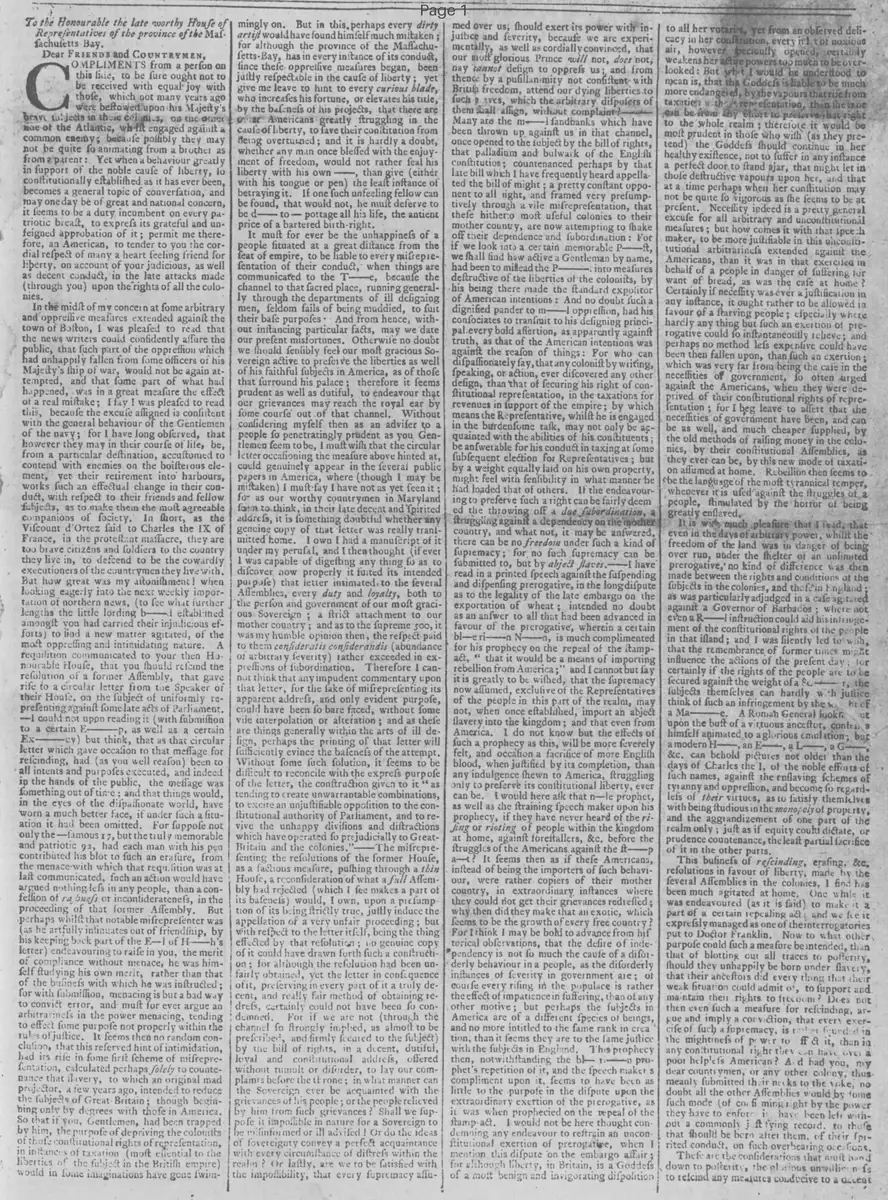
These are the considerations that must hand
down to posterity, the glorious unwillingness
to rescind any measures coercive to a recant
claim of liberty, in the patriotic resolves of the late Honourable House of Representatives of the province of the Massachusetts Bay: and I doubt not but they will be as much recorded in the songs of the Americans, as ever the year 69 was in the songs of the Druids. Whilst such a prudence, as well as firmness in behaviour continues, I cannot think the schemes of any Excellency need to be dreaded (no not of his Excellency the —) in the cause of liberty: for certainly the wisdom of Heaven will direct the immutability of right, even into the very bosom that is seemingly devoted to destroy it. Our mother country, when she comes to discover the espies to that natural union, which ought to subsist between herself and her children, will confess and atone for her late severities, by the most tender indulgencies; especially whilst powerful and suspicious wars are brooding abroad. I have often employed my thoughts upon the subject of freedom; but never with more satisfaction to myself, than when I am recommending love, duty, and obedience to our Sovereign: an intimate connection, with a respectable dependence on, and a filial subordination to, our mother country, in all matters neither mediately nor immediately tending to the destruction of freedom, and patriotic esteem: and when I speak with the voice of truth, as well as reason, I will hope no one will misconstrue the sincere and honest approbation of
An AMERICAN.
What sub-type of article is it?
What themes does it cover?
What keywords are associated?
What entities or persons were involved?
Letter to Editor Details
Author
An American
Recipient
The Honourable The Late Worthy House Of Representatives Of The Province Of The Massachusetts Bay
Main Argument
the letter praises the house for refusing to rescind their resolution supporting the circular letter protesting parliamentary acts, arguing that such a demand is arbitrary, based on misrepresentation, and threatens colonial rights to representation in taxation and petitioning the throne without fear.
Notable Details
- references viscount d'ortez and charles ix on the st. bartholomew's day massacre
- cites circular letter from massachusetts speaker against late acts of parliament
- defends right to address the sovereign via bill of rights
- criticizes prophecy of rebellion from stamp-act repeal
- mentions interrogation of doctor franklin
- alludes to year 69 in druid songs