Thank you for visiting SNEWPapers!
Sign up free
Story
September 30, 1853
The Belmont Chronicle, And Farmers, Mechanics And Manufacturers Advocate
Saint Clairsville, Belmont County, Ohio
What is this article about?
Article from Cleveland Herald accuses I. H. Barney, Democratic candidate for School Commissioner, of duplicity: admitting role in Dayton Convention for Andrews but withdrawing, promising not to run, yet yielding to party pressure to oppose Andrews and run himself.
Clipping
OCR Quality
98%
Excellent
Full Text
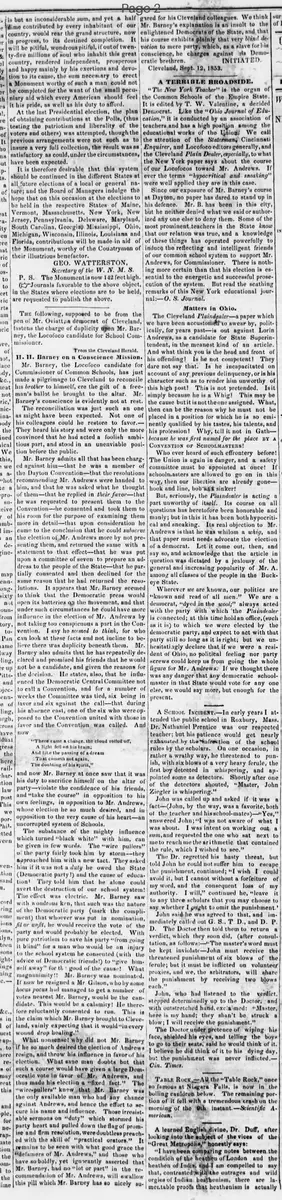
The following, supposed to be from the pen of Mr. Oviatt, a democrat of Cleveland, fastens the charge of duplicity upon Mr. Barney, the Locofoco candidate for School Commissioner.
From the Cleveland Herald.
I. H. Barney on a Conscience Mission.
Mr. Barney, the Locofoco candidate for Commissioner of Common Schools, has just made a pilgrimage to Cleveland to reconcile his brother to himself, ere the gift of a freeman's ballot be brought to the altar. Mr. Barney's conscience is evidently not at rest. The reconciliation was just such an one as might have been expected. Not one of his colleagues could he restore to favor.—They heard his story and were only the more convinced that he had acted a foolish ambitious part, and stood in an unenviable position before the public.
Mr. Barney admits all that has been charged against him—that he was a member of the Dayton Convention—that the resolutions recommending Mr. Andrews were handed to him, and that he was asked what he thought of them—that he replied in their favor—that he was requested to present them to the Convention—he consented and took them to his room for the purpose of examining them more in detail—that upon consideration he came to the conclusion that he could subserve the election of Mr. Andrews more by not presenting them, and returned the same with a statement to that effect—that he was put upon a committee of seven to prepare an address to the people of the State—that he partially consented and then declined for the same reason that he had returned the resolutions. It appears that Mr. Barney seemed to think that the Democratic press would open its batteries on the movement, and that under such circumstances he could have more influence in the election of Mr. Andrews by not taking too conspicuous a part in the Convention. I say he seemed to think, for who can look at these facts and not incline to believe there was duplicity beneath them. Mr. Barney also admits that he has repeatedly declared and promised his friends that he would not be a candidate, and given the reasons for the decision. He states, also, that he influenced the Democratic Central Committee not to call a Convention, and for a number of weeks the Committee was tied, six being in favor and six against the call—that during his absence east, one of the six who were opposed to the Convention united with those in favor and the Convention was called. And now
"There came a change, the cloud rolled off,
A light fell on his brain;
And like the passing of a dream
That cometh not again,
The doubting of his spirit,"
and now Mr. Barney at once saw that it was his duty to sacrifice himself on the altar of party—violate the confidence of his friends, and "take the course" in opposition to his own feelings, in opposition to Mr. Andrews, whose election he so much desired, and in opposition to the very cause of his heart—an uncorrupted system of Schools.
The substance of the mighty influence which turned "black white" with him, can be given in few words. The "wire pullers" of the party fairly took him by storm—they approached him with a new tact. They asked him if it was not a duty he owed the State (Democratic party?) and the cause of education? They told him that he alone could avert the destruction of our school system! The effect was electric. Mr. Barney saw with wondrous ken, that such was the nature of the Democratic party (mark the compliment) that whoever was put in nomination, fit or unfit, he would receive the vote of the party and would probably be elected. With pure patriotism to save his party "from going it blind" for a man who would be an injury to the school system he consented (with the advice of Democratic friends!) to "give himself away" for the good of the cause! What magnanimity!! Mr. Barney was nominated.
If now he resigned a Mr. Gilson, who by some hocus pocus had managed to get a number of votes nearest Mr. Barney, would be the candidate. This would be a calamity! He therefore reluctantly consented to run. This is the claim which Mr. Barney brought to Cleveland, vainly expecting that it would "in every wound drop healing."
What nonsense! why did not Mr. Barney if he so much desired the election of Andrews resign, and throw his influence in favor of his election. What sane man doubts but that such a course would have given a large Democratic vote in favor of Mr. Andrews, and thus made his election a "fixed fact." The "wire-pullers" knew that Mr. Barney was the only available man who had any chance against Andrews, and hence the effort to secure his name and influence. Those irresistible sermons on "duty" which stormed his party heart and pulled down the flag of promise and firm resolution, were doubtless preached with the skill of "practical orators." It remains to be seen with what good grace the "defamers of Mr. Andrews," and those who have so boldly, yet ignorantly asserted that Mr. Barney, had no "lot or part" in the recommendation of Mr. Andrews, will swallow this pill which Mr. Barney has so nicely sugared for his Cleveland colleagues. We think Mr. Barney's explanation is an insult to the enlightened Democrats of the State, and that his course exhibits plainly that very blind devotion to mere party, which, as a salve for his conscience, he charges against his Democratic brethren.
From the Cleveland Herald.
I. H. Barney on a Conscience Mission.
Mr. Barney, the Locofoco candidate for Commissioner of Common Schools, has just made a pilgrimage to Cleveland to reconcile his brother to himself, ere the gift of a freeman's ballot be brought to the altar. Mr. Barney's conscience is evidently not at rest. The reconciliation was just such an one as might have been expected. Not one of his colleagues could he restore to favor.—They heard his story and were only the more convinced that he had acted a foolish ambitious part, and stood in an unenviable position before the public.
Mr. Barney admits all that has been charged against him—that he was a member of the Dayton Convention—that the resolutions recommending Mr. Andrews were handed to him, and that he was asked what he thought of them—that he replied in their favor—that he was requested to present them to the Convention—he consented and took them to his room for the purpose of examining them more in detail—that upon consideration he came to the conclusion that he could subserve the election of Mr. Andrews more by not presenting them, and returned the same with a statement to that effect—that he was put upon a committee of seven to prepare an address to the people of the State—that he partially consented and then declined for the same reason that he had returned the resolutions. It appears that Mr. Barney seemed to think that the Democratic press would open its batteries on the movement, and that under such circumstances he could have more influence in the election of Mr. Andrews by not taking too conspicuous a part in the Convention. I say he seemed to think, for who can look at these facts and not incline to believe there was duplicity beneath them. Mr. Barney also admits that he has repeatedly declared and promised his friends that he would not be a candidate, and given the reasons for the decision. He states, also, that he influenced the Democratic Central Committee not to call a Convention, and for a number of weeks the Committee was tied, six being in favor and six against the call—that during his absence east, one of the six who were opposed to the Convention united with those in favor and the Convention was called. And now
"There came a change, the cloud rolled off,
A light fell on his brain;
And like the passing of a dream
That cometh not again,
The doubting of his spirit,"
and now Mr. Barney at once saw that it was his duty to sacrifice himself on the altar of party—violate the confidence of his friends, and "take the course" in opposition to his own feelings, in opposition to Mr. Andrews, whose election he so much desired, and in opposition to the very cause of his heart—an uncorrupted system of Schools.
The substance of the mighty influence which turned "black white" with him, can be given in few words. The "wire pullers" of the party fairly took him by storm—they approached him with a new tact. They asked him if it was not a duty he owed the State (Democratic party?) and the cause of education? They told him that he alone could avert the destruction of our school system! The effect was electric. Mr. Barney saw with wondrous ken, that such was the nature of the Democratic party (mark the compliment) that whoever was put in nomination, fit or unfit, he would receive the vote of the party and would probably be elected. With pure patriotism to save his party "from going it blind" for a man who would be an injury to the school system he consented (with the advice of Democratic friends!) to "give himself away" for the good of the cause! What magnanimity!! Mr. Barney was nominated.
If now he resigned a Mr. Gilson, who by some hocus pocus had managed to get a number of votes nearest Mr. Barney, would be the candidate. This would be a calamity! He therefore reluctantly consented to run. This is the claim which Mr. Barney brought to Cleveland, vainly expecting that it would "in every wound drop healing."
What nonsense! why did not Mr. Barney if he so much desired the election of Andrews resign, and throw his influence in favor of his election. What sane man doubts but that such a course would have given a large Democratic vote in favor of Mr. Andrews, and thus made his election a "fixed fact." The "wire-pullers" knew that Mr. Barney was the only available man who had any chance against Andrews, and hence the effort to secure his name and influence. Those irresistible sermons on "duty" which stormed his party heart and pulled down the flag of promise and firm resolution, were doubtless preached with the skill of "practical orators." It remains to be seen with what good grace the "defamers of Mr. Andrews," and those who have so boldly, yet ignorantly asserted that Mr. Barney, had no "lot or part" in the recommendation of Mr. Andrews, will swallow this pill which Mr. Barney has so nicely sugared for his Cleveland colleagues. We think Mr. Barney's explanation is an insult to the enlightened Democrats of the State, and that his course exhibits plainly that very blind devotion to mere party, which, as a salve for his conscience, he charges against his Democratic brethren.
What sub-type of article is it?
Deception Fraud
Biography
What themes does it cover?
Deception
Betrayal
What keywords are associated?
Political Duplicity
School Commissioner
Democratic Convention
Cleveland Herald
Locofoco Candidate
What entities or persons were involved?
Mr. Oviatt
I. H. Barney
Mr. Andrews
Mr. Gilson
Where did it happen?
Cleveland, Dayton
Story Details
Key Persons
Mr. Oviatt
I. H. Barney
Mr. Andrews
Mr. Gilson
Location
Cleveland, Dayton
Story Details
I. H. Barney, Locofoco candidate for School Commissioner, admits involvement in Dayton Convention supporting Andrews but withdrew to avoid scrutiny; promised not to run but was persuaded by party leaders to become candidate against Andrews to protect school system, seen as duplicitous.