Thank you for visiting SNEWPapers!
Sign up free
The Liberator
Boston, Suffolk County, Massachusetts
What is this article about?
An address to U.S. Congress advocating for the abolition of slavery, emphasizing racial equality, the benefits of amalgamation, and referencing Jefferson's views on emancipation and Native American rights. Argues against colonization and for gradual manumission to preserve national harmony.
Merged-components note: These two components form the complete 'ADDRESS TO MEMBERS OF CONGRESS' editorial piece, with text continuing seamlessly across pages.
Clippings
1 of 2
OCR Quality
Full Text
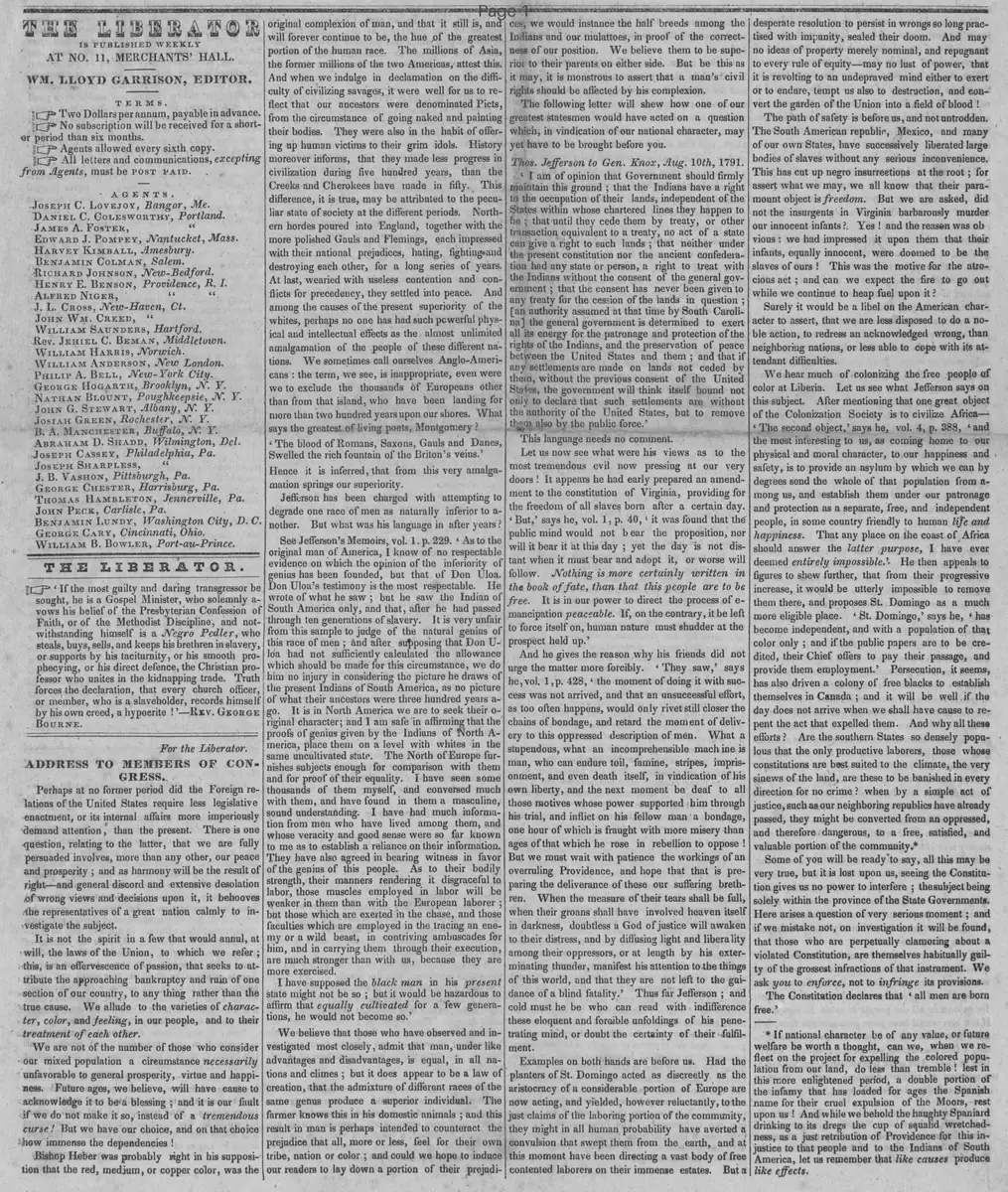
ADDRESS TO MEMBERS OF CONGRESS.
Perhaps at no former period did the Foreign relations of the United States require less legislative enactment, or its internal affairs more imperiously demand attention, than the present. There is one question, relating to the latter, that we are fully persuaded involves, more than any other, our peace and prosperity; and as harmony will be the result of right--and general discord and extensive desolation of wrong views and decisions upon it, it behooves the representatives of a great nation calmly to investigate the subject.
It is not the spirit in a few that would annul, at will, the laws of the Union, to which we refer; this, is an effervescence of passion, that seeks to attribute the approaching bankruptcy and ruin of one section of our country, to any thing rather than the true cause. We allude to the varieties of character, color, and feeling, in our people, and to their treatment of each other.
We are not of the number of those who consider our mixed population a circumstance necessarily unfavorable to general prosperity, virtue and happiness. Future ages, we believe, will have cause to acknowledge it to be a blessing; and it is our fault if we do not make it so, instead of a tremendous curse! But we have our choice, and on that choice how immense the dependencies!
Bishop Heber was probably right in his supposition that the red, medium, or copper color, was the original complexion of man, and that it still is, and will forever continue to be, the hue of the greatest portion of the human race. The millions of Asia, the former millions of the two Americas, attest this. And when we indulge in declamation on the difficulty of civilizing savages, it were well for us to reflect that our ancestors were denominated Picts, from the circumstance of going naked and painting their bodies. They were also in the habit of offering up human victims to their grim idols. History moreover informs, that they made less progress in civilization during five hundred years, than the Creeks and Cherokees have made in fifty. This difference, it is true, may be attributed to the peculiar state of society at the different periods. Northern hordes poured into England, together with the more polished Gauls and Flemings, each impressed with their national prejudices, hating, fighting and destroying each other, for a long series of years. At last, wearied with useless contention and conflicts for precedency, they settled into peace. And among the causes of the present superiority of the whites, perhaps no one has had such powerful physical and intellectual effects as the almost unlimited amalgamation of the people of these different nations. We sometimes call ourselves Anglo-Americans: the term, we see, is inappropriate, even were we to exclude the thousands of Europeans other than from that island, who have been landing for more than two hundred years upon our shores. What says the greatest of living poets, Montgomery?
The blood of Romans, Saxons, Gauls and Danes,
Swelled the rich fountain of the Briton's veins.
Hence it is inferred, that from this very amalgamation springs our superiority.
Jefferson has been charged with attempting to degrade one race of men as naturally inferior to another. But what was his language in after years? See Jefferson's Memoirs, vol. 1. p. 229. As to the original man of America, I know of no respectable evidence on which the opinion of the inferiority of genius has been founded, but that of Don Uloa. Don Uloa's testimony is the most respectable. He wrote of what he saw; but he saw the Indian of South America only, and that, after he had passed through ten generations of slavery. It is very unfair from this sample to judge of the natural genius of this race of men; and after supposing that Don Uloa had not sufficiently calculated the allowance which should be made for this circumstance, we do him no injury in considering the picture he draws of the present Indians of South America, as no picture of what their ancestors were three hundred years ago. It is in North America we are to seek their original character; and I am safe in affirming that the proofs of genius given by the Indians of North America, place them on a level with whites in the same uncultivated state. The North of Europe furnishes subjects enough for comparison with them and for proof of their equality. I have seen some thousands of them myself, and conversed much with them, and have found in them a masculine, sound understanding. I have had much information from men who have lived among them, and whose veracity and good sense were so far known to me as to establish a reliance on their information. They have also agreed in bearing witness in favor of the genius of this people. As to their bodily strength, their manners rendering it disgraceful to labor, those muscles employed in labor will be weaker in them than with the European laborer: but those which are exerted in the chase, and those faculties which are employed in the tracing an enemy or a wild beast, in contriving ambuscades for him, and in carrying them through their execution, are much stronger than with us, because they are more exercised.
I have supposed the black man in his present state might not be so; but it would be hazardous to affirm that equally cultivated for a few generations, he would not become so.
We believe that those who have observed and investigated most closely, admit that man, under like advantages and disadvantages, is equal, in all nations and climes; but it does appear to be a law of creation, that the admixture of different races of the same genus produce a superior individual. The farmer knows this in his domestic animals; and this result in man is perhaps intended to counteract the prejudice that all, more or less, feel for their own tribe, nation or color; and could we hope to induce our readers to lay down a portion of their prejudices, we would instance the half breeds among the Indians and our mulattoes, in proof of the correctness of our position. We believe them to be superior to their parents on either side. But be this as it may, it is monstrous to assert that a man's civil rights should be affected by his complexion.
The following letter will shew how one of our greatest statesmen would have acted on a question which, in vindication of our national character, may yet have to be brought before you.
Thos. Jefferson to Gen. Knox, Aug. 10th, 1791.
I am of opinion that Government should firmly maintain this ground; that the Indians have a right to the occupation of their lands, independent of the States within whose chartered lines they happen to be; that until they cede them by treaty, or other transaction equivalent to a treaty, no act of a state can give a right to such lands; that neither under the present constitution nor the ancient confederation had any state or person, a right to treat with the Indians without the consent of the general government; that the consent has never been given to any treaty for the cession of the lands in question; [an authority assumed at that time by South Carolina] the general government is determined to exert all its energy for the patronage and protection of the rights of the Indians, and the preservation of peace between the United States and them; and that if any settlements are made on lands not ceded by them, without the previous consent of the United States, the government will think itself bound not only to declare that such settlements are without the authority of the United States, but to remove them also by the public force.
This language needs no comment.
Let us now see what were his views as to the most tremendous evil now pressing at our very doors! It appears he had early prepared an amendment to the constitution of Virginia, providing for the freedom of all slaves born after a certain day. But, says he, vol. 1, p. 40, it was found that the public mind would not bear the proposition, nor will it bear it at this day; yet the day is not distant when it must bear and adopt it, or worse will follow. Nothing is more certainly written in the book of fate, than that this people are to be free. It is in our power to direct the process of emancipation peaceable. If, on the contrary, it be left to force itself on, human nature must shudder at the prospect held up. And he gives the reason why his friends did not urge the matter more forcibly. They saw, says he, vol. 1, p. 428, the moment of doing it with success was not arrived, and that an unsuccessful effort, as too often happens, would only rivet still closer the chains of bondage, and retard the moment of delivery to this oppressed description of men. What a stupendous, what an incomprehensible machine is man, who can endure toil, famine, stripes, imprisonment, and even death itself, in vindication of his own liberty, and the next moment be deaf to all those motives whose power supported him through his trial, and inflict on his fellow man a bondage, one hour of which is fraught with more misery than ages of that which he rose in rebellion to oppose! But we must wait with patience the workings of an overruling Providence, and hope that that is preparing the deliverance of these our suffering brethren. When the measure of their tears shall be full, when their groans shall have involved heaven itself in darkness, doubtless a God of justice will awaken to their distress, and by diffusing light and liberality among their oppressors, or at length by his exterminating thunder, manifest his attention to the things of this world, and that they are not left to the guidance of a blind fatality. Thus far Jefferson; and cold must he be who can read with indifference these eloquent and forcible unfoldings of his penetrating mind, or doubt the certainty of their fulfilment.
Examples on both hands are before us. Had the planters of St. Domingo acted as discreetly as the aristocracy of a considerable portion of Europe are now acting, and yielded, however reluctantly, to the just claims of the laboring portion of the community, they might in all human probability have averted a convulsion that swept them from the earth, and at this moment have been directing a vast body of free contented laborers on their immense estates. But a desperate resolution to persist in wrongs so long practised with impunity, sealed their doom. And may no ideas of property merely nominal, and repugnant to every rule of equity--may no lust of power, that it is revolting to an undepraved mind either to exert or to endure, tempt us also to destruction, and convert the garden of the Union into a field of blood!
The path of safety is before us, and not untrodden. The South American republic, Mexico, and many of our own States, have successively liberated large bodies of slaves without any serious inconvenience. This has cut up negro insurrections at the root; for assert what we may, we all know that their paramount object is freedom. But we are asked, did not the insurgents in Virginia barbarously murder our innocent infants? Yes! and the reason was obvious: we had impressed it upon them that their infants, equally innocent, were doomed to be the slaves of ours! This was the motive for the atrocious act; and can we expect the fire to go out while we continue to heap fuel upon it?
Surely it would be a libel on the American character to assert, that we are less disposed to do a noble action, to redress an acknowledged wrong, than neighboring nations, or less able to cope with its attendant difficulties.
We hear much of colonizing the free people of color at Liberia. Let us see what Jefferson says on this subject. After mentioning that one great object of the Colonization Society is to civilize Africa--The second object, says he, vol. 4, p. 388, and the most interesting to us, as coming home to our physical and moral character, to our happiness and safety, is to provide an asylum by which we can by degrees send the whole of that population from among us, and establish them under our patronage and protection as a separate, free, and independent people, in some country friendly to human life and happiness. That any place on the coast of Africa should answer the latter purpose, I have ever deemed entirely impossible. He then appeals to figures to shew further, that from their progressive increase, it would be utterly impossible to remove them there, and proposes St. Domingo as a much more eligible place. St. Domingo, says he, has become independent, and with a population of that color only; and if the public papers are to be credited, their Chief offers to pay their passage, and provide them employment. Persecution, it seems, has also driven a colony of free blacks to establish themselves in Canada; and it will be well if the day does not arrive when we shall have cause to repent the act that expelled them. And why all these efforts? Are the southern States so densely populous that the only productive laborers, those whose constitutions are best suited to the climate, the very sinews of the land, are these to be banished in every direction for no crime? when by a simple act of justice, such as our neighboring republics have already passed, they might be converted from an oppressed, and therefore dangerous, to a free, satisfied, and valuable portion of the community.
Some of you will be ready to say, all this may be very true, but it is lost upon us, seeing the Constitution gives us no power to interfere; the subject being solely within the province of the State Governments. Here arises a question of very serious moment; and if we mistake not, on investigation it will be found, that those who are perpetually clamoring about a violated Constitution, are themselves habitually guilty of the grossest infractions of that instrument. We ask you to enforce, not to infringe its provisions.
The Constitution declares that 'all men are born free.'
* If national character be of any value, or future welfare be worth a thought, can we, when we reflect on the project for expelling the colored population from our land, do less than tremble! lest in this more enlightened period, a double portion of the infamy that has loaded for ages the Spanish name for their cruel expulsion of the Moors, rest upon us! And while we behold the haughty Spaniard drinking to its dregs the cup of squalid wretchedness, as a just retribution of Providence for this injustice to that people and to the Indians of South America, let us remember that like causes produce like effects.
The slaveholder declares that many are born slaves. The former proclaims all equal. The latter asserts that the minority has in some States a right to buy and sell the majority like beasts of burden. The constitution guarantees to each state a republican form of government. Now can any combination of men sanctioning injustice like this, be a republic?
It is true Jefferson says, in speaking of the states, vol. 2, p. 63, 'The southern ones at this time are aristocratic in their dispositions, and that this spirit should grow and extend itself, is within the natural order of things.' And is it not in the natural order of things that every good citizen should seek to check it?
Can it be, while we and half the people of Europe raise our voices in behalf of the Greeks, Poles, and others in aid of their efforts for freedom, that we have no right to lisp a syllable for two millions of our own native born Americans groaning under a tenfold more oppressive thraldom?
The colored inhabitants of these United States, including both slave and free, have about reached the number of our whole population at the period of the revolution.* Now from the present aspect of affairs, slavery will soon receive its death blow in the whole Archipelago of the West Indies, and it will be well to reflect whether after that event, it will be possible to keep our own slaves in subjection.
Why not make a virtue of necessity, and rather than reluctantly follow, gloriously lead? There is safety in the latter, incalculable peril in the former!
Those who will protest most loudly against your intervention peacefully to remove this enormity, will not hesitate to call upon you to sacrifice thousands of lives and millions of money, to aid them to crush in others the spirit of freedom that animates themselves. Indeed, the troops of the United States garrison, at this moment, the slave arsenals of the south, at the expense of the nation; and the consequence of this revolting service may be read in the unheard of desertions from the army, reported by the late Secretary at War.
There is another matter connected with this subject, it behooves you carefully to examine. Treaties have been formed with foreign powers, reciprocally granting certain privileges to their subjects and our citizens. Now England, France, Denmark, &c. have recently declared their free colored subjects entitled to equal privileges with any other. These in the pursuit of their lawful callings, on arriving in southern ports will be liable by the laws of those states to be seized, imprisoned and sold into slavery, simply on account of their complexion! Will this be submitted to? Have we a better and more valid right to make slaves of their subjects than they have to impress ours? And are the United States to be involved in a contest with foreign powers on this account?
Many of our own States have also invested this description of inhabitants with the rights of citizenship; a number of these our citizens have been seized while engaged in their lawful concerns in the southern states, and without any allegation of crime, sold into interminable slavery, regardless of the Constitution, which guarantees the citizens of each State an equality of rights. Nor is this all: our respectable free white citizens, while travelling in the southern states, have been insulted and disgracefully maltreated for merely expressing their disapprobation of slavery. These things have produced a painful state of public feeling; if persisted in, may yet sever our bond of union. On whom but you shall the people of the United States call to break the chains that now bind the Missionaries in the dungeons of Georgia? Can it be that Justice has fled our Halls of Legislation, and found shelter only in the cabin of the red man and the hut of the slave? Surely your united wisdom will devise some way to neutralize these various elements of discord and confusion.
Ex-President Monroe declared in the late Virginian convention his conviction that the question of slavery was of too great magnitude for the State Legislatures without the aid of the General Government. You can solemnly proffer that aid, which, if refused, would authorize you to protest against being called upon to waste the blood and treasure of the nation in seeking to perpetuate a system that all admit to be wrong, and which must ultimately bring down ruin on those who persist in it.
We conceive it utterly impossible that the plan of Colonization can ever afford the desired relief. What would have been said, had the British Government, at the time of the revolution, entertained a project for colonizing all our people in some foreign land? If the idea would have been preposterous then, is it more practicable for us now to remove, in like manner, a like number of our people, equally unwilling to go? And were it practicable, yet viewed as a question of political economy, such a measure would assuredly desolate the south, and annihilate, at a blow, its political influence, and almost its very existence. Deplorable as is the state of things, it does not require a remedy so absolutely desperate.
Lafayette frequently expressed his abhorrence of slavery, declaring that it was a dark spot on the face of the nation, that could not always exist; but the longer it exists, the more alarming the evil becomes. Jefferson says, that in twenty-five years from the date of one of his letters, their number will amount to six millions, and one million of these fighting men,' vol. 4, p. 388. With these facts and prospects before us, is it possible to believe that tranquillity, for any length of time, can be preserved without abolishing personal bondage, and granting something like an equality of rights to all our people? It is thus, and thus only, that the planters can retain their large estates in safety; and their superior intelligence, under a liberal and just system, might long enable them to direct the great mass of labor more safely at least, and we believe more profitably, than heretofore. Wealth and intelligence would still, as in other parts of the earth, give power. Open but the door for the elevation of the laboring classes, as their talents, industry and good conduct enable them to rise, and they will be satisfied.
Gradual manumission will unquestionably be continued while slavery exists; but it is insufficient, and we apprehend more dangerous than immediate universal emancipation, because it makes those retained more dissatisfied with their situation. A planter, on this account, dreads to employ a free black, and thus makes him a kind of persecuted outlaw. The treatment that this class receive, is a grievance that cries loudly for redress. We know individuals who employ free colored people in agricultural pursuits, and from patriotic motives sit at the same table with them; and we are assured that, with proper treatment, they have proved as sober, industrious, docile and valuable hands, as any they have ever employed. But they own no slaves.
This line of conduct, though not essential, is, we are persuaded, among the best that could be adopted. It is, however, of essential importance, that we all, and more especially every statesman, labor to eradicate the prejudice that still so lamentably separates us; for until we emancipate our own minds from this thraldom, we shall continue to be unjust. Could we succeed in this great work, the harmony of the whole community would be at once restored, and this vast continent become universally, as it has hitherto partially been, the asylum of the human race.
In closing this address, allow me to assume the name of one of the most enlightened and benevolent of the human race now living, though not a white man.
RAMMOHUN ROY.
* Jefferson states the number of slaves in the U. S. in 1785, to have been 700,000, giving a total of two millions six hundred and thirty-nine thousand three hundred inhabitants of every condition in the United States-see vol. 1, p. 424.
4
What sub-type of article is it?
What keywords are associated?
What entities or persons were involved?
Editorial Details
Primary Topic
Advocacy For Emancipation And Racial Equality In The United States
Stance / Tone
Strongly Pro Emancipation And Anti Slavery, Urging Congressional Intervention
Key Figures
Key Arguments