Thank you for visiting SNEWPapers!
Sign up free
The Arizona Sentinel
Yuma, Arizona City, Yuma County, Arizona
What is this article about?
Report of Gen. O. O. Howard's speech in Arizona City on the 8th inst., advocating the new peace policy for civilizing Indians through honest agents, reservations, and protection, emphasizing moral sentiment and rejection of extermination.
Merged-components note: Continuation of Gen. O. O. Howard's speech across pages 1 and 2, sequential reading order and coherent text flow.
Clippings
1 of 2
OCR Quality
Full Text
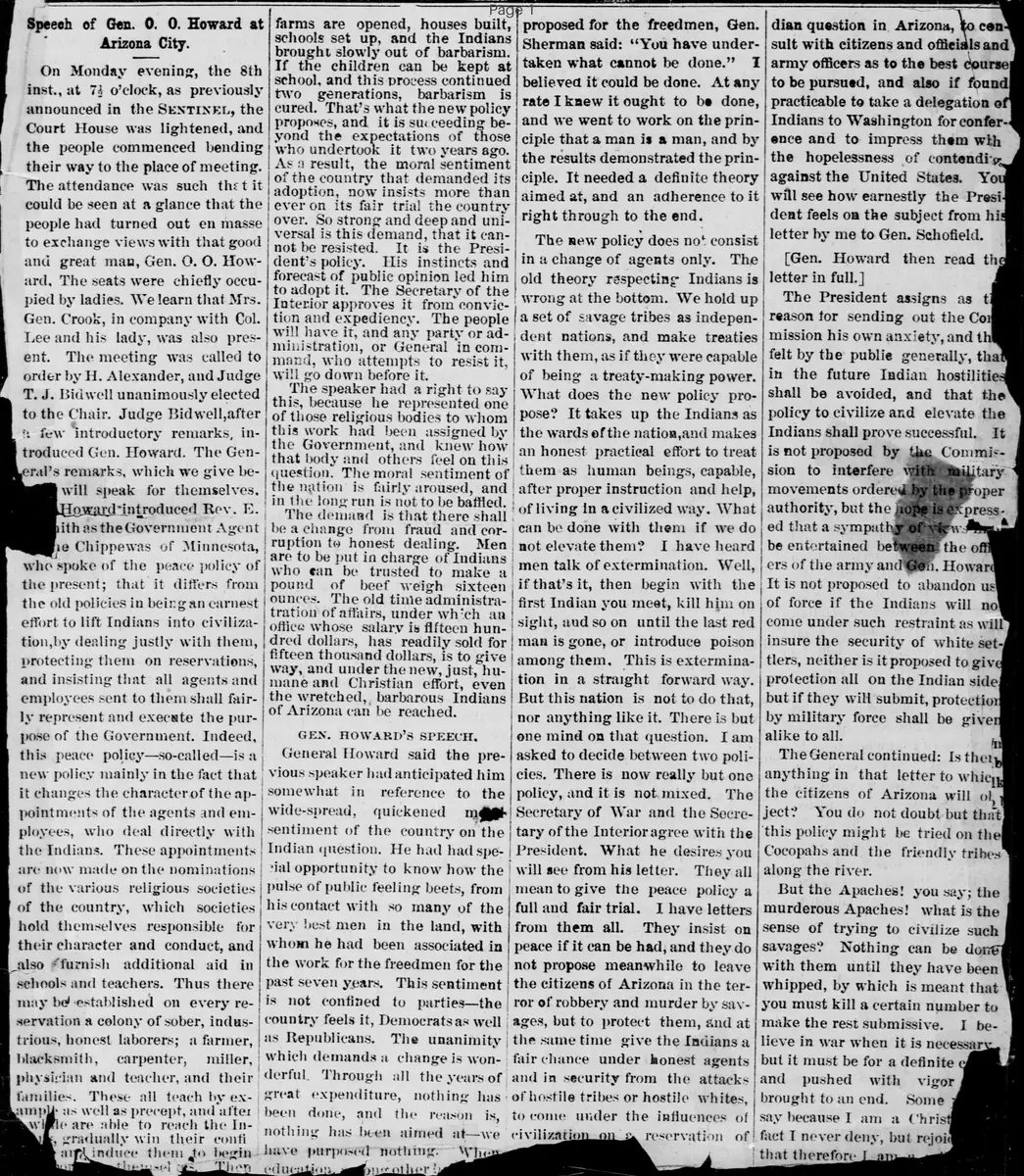
On Monday evening, the 8th inst., at 7 o'clock, as previously announced in the SENTINEL, the Court House was lighted, and the people commenced wending their way to the place of meeting. The attendance was such that it could be seen at a glance that the people had turned out en masse to exchange views with that good and great man, Gen. O. O. Howard. The seats were chiefly occupied by ladies. We learn that Mrs. Gen. Crook, in company with Col. Lee and his lady, was also present. The meeting was called to order by H. Alexander, and Judge T. J. Bidwell unanimously elected to the Chair. Judge Bidwell, after a few introductory remarks, introduced Gen. Howard. The General's remarks, which we give below, will speak for themselves.
Howard introduced Rev. E. Smith as the Government Agent for the Chippewas of Minnesota, who spoke of the peace policy of the present; that it differs from the old policies in being an earnest effort to lift Indians into civilization, by dealing justly with them, protecting them on reservations, and insisting that all agents and employees sent to them shall fairly represent and execute the purpose of the Government. Indeed, this peace policy—so-called—is a new policy mainly in the fact that it changes the character of the appointments of the agents and employees, who deal directly with the Indians. These appointments are now made on the nominations of the various religious societies of the country, which societies hold themselves responsible for their character and conduct, and also furnish additional aid in schools and teachers. Thus there may be established on every reservation a colony of sober, industrious, honest laborers; a farmer, blacksmith, carpenter, miller, physician and teacher, and their families. These all teach by example as well as precept, and after while we are able to reach the Indians, gradually win their confidence, induce them to begin farms are opened, houses built schools set up, and the Indians brought slowly out of barbarism. If the children can be kept at school, and this process continued two generations, barbarism is cured. That's what the new policy proposes, and it is succeeding beyond the expectations of those who undertook it two years ago.
As a result, the moral sentiment of the country that demanded its adoption, now insists more than ever on its fair trial the country over. So strong and deep and universal is this demand, that it cannot be resisted. It is the President's policy. His instincts and forecast of public opinion led him to adopt it. The Secretary of the Interior approves it from conviction and expediency. The people will have it, and any party or administration, or General in command, who attempts to resist it, will go down before it.
The speaker had a right to say this, because he represented one of those religious bodies to whom this work had been assigned by the Government, and knew how that body and others feel on this question. The moral sentiment of the nation is fairly aroused, and in the long run is not to be baffled. The demand is that there shall be a change from fraud and corruption to honest dealing. Men are to be put in charge of Indians who can be trusted to make a pound of beef weigh sixteen ounces. The old time administration of affairs, under which an office whose salary is fifteen hundred dollars, has readily sold for fifteen thousand dollars, is to give way, and under the new, just, humane and Christian effort, even the wretched, barbarous Indians of Arizona can be reached.
GEN. HOWARD'S SPEECH.
General Howard said the previous speaker had anticipated him somewhat in reference to the wide-spread, quickened moral sentiment of the country on the Indian question. He had had special opportunity to know how the pulse of public feeling beats, from his contact with so many of the very best men in the land, with whom he had been associated in the work for the freedmen for the past seven years. This sentiment is not confined to parties—the country feels it, Democrats as well as Republicans.
The unanimity which demands a change is wonderful. Through all the years of great expenditure, nothing has been done, and the reason is, nothing has been aimed at—we have purposed nothing. When it was proposed for the freedmen, Gen. Sherman said: "You have undertaken what cannot be done." I believed it could be done. At any rate I knew it ought to be done, and we went to work on the principle that a man is a man, and by the results demonstrated the principle. It needed a definite theory aimed at, and an adherence to it right through to the end.
The new policy does not consist in a change of agents only. The old theory respecting Indians is wrong at the bottom. We hold up a set of savage tribes as independent nations, and make treaties with them, as if they were capable of being a treaty-making power. What does the new policy propose? It takes up the Indians as the wards of the nation, and makes an honest practical effort to treat them as human beings, capable, after proper instruction and help, of living in a civilized way. What can be done with them if we do not elevate them? I have heard men talk of extermination. Well, if that's it, then begin with the first Indian you meet, kill him on sight, and so on until the last red man is gone, or introduce poison among them. This is extermination in a straightforward way. But this nation is not to do that, nor anything like it. There is but one mind on that question. I am asked to decide between two policies. There is now really but one policy, and it is not mixed. The Secretary of War and the Secretary of the Interior agree with the President. What he desires you will see from his letter. They all mean to give the peace policy a full and fair trial. I have letters from them all. They insist on peace if it can be had, and they do not propose meanwhile to leave the citizens of Arizona in the terror of robbery and murder by savages, but to protect them, and at the same time give the Indians a fair chance under honest agents and in security from the attacks of hostile tribes or hostile whites, to come under the influences of civilization on a reservation.
[Gen. Howard then read the letter in full.]
The President assigns as the reason for sending out the Commission his own anxiety, and the felt by the public generally, that in the future Indian hostilities shall be avoided, and that the policy to civilize and elevate the Indians shall prove successful. It is not proposed by the Commission to interfere with military movements ordered by the proper authority, but the hope is expressed that a sympathy of views be entertained between the officers of the army and Gen. Howard. It is not proposed to abandon use of force if the Indians will not come under such restraint as will insure the security of white settlers, neither is it proposed to give protection all on the Indian side, but if they will submit, protection by military force shall be given alike to all.
The General continued: Is there anything in that letter to which the citizens of Arizona will object? You do not doubt but that this policy might be tried on the Cocopahs and the friendly tribes along the river. But the Apaches! you say; the murderous Apaches! what is the sense of trying to civilize such savages? Nothing can be done with them until they have been whipped, by which is meant that you must kill a certain number to make the rest submissive. I believe in war when it is necessary but it must be for a definite cause and pushed with vigor brought to an end. Some say because I am a Christian—fact I never deny, but rejoice that therefore I am
to pat everybody on the back. I could not be more misunderstood. At a meeting held in Washington in the interests of universal peace, just as I was leaving for this coast. they insisted on my speaking. I told them I believed in peace, but only the peace that carried security and justice. For that kind of peace I will fight any time when it is necessary. So I believe now.-[Cheers.] But in all things we will not forget that we are men, civilized men, not savages; that we seek peace and not war. If at any time during rebellion a flag of truce had been sent into our lines. would we have tried hard to agree and stop blood-shed? So I say now. Or when it is war, but peace at first moment possible, and when we fight, it should be only civilized war. Why. I have heard Indian children, taken captive, have been thrown out of a wagon while moving and shot as they struck the ground. How can I believe it? That cannot be done by civilized men. The white people of Arizona cannot be savages. You have Anglo-Saxon blood in your veins. You may have been a long time out in this rough country, but I am sure you have not forgotten home and education to learn barbarism of the savages that fight you. We do not need to turn savages to conquer fifteen hundred Indian warriors. Let the nation see what ought to be done, and it will be done in the proper way. We can have troops enough to begin at one corner of your Territory and run a skirmish line straight across. plow down your whole length, bringing out every crawling, sneaking savage; but we must see it is necessary--must be united about it. At present the people and the Government insist on a trial of the peace policy. Let us put these Indians on reservations and have force enough to keep them and protect them there. I am prepared to recommend the bringing at once of five thousand additional troops, if required, to enforce the peace policy on this basis. Come, then, gentlemen, give us let us have peace in Arizona your country will be safe; your mineral resources will be developed; emigrants will flow in. and the day of prosperity will dawn-not in- are always necessary. The work is slow but it will come along. I wish Agent Smith had told you what even a year of honest, patient work has done for the Indians in Minnesota. You know they were cunning. drunkenness, & bitterness. murder and all violence held sway among the Sandwich Islanders. There seemed to be no hope, but at last the right men and right methods carried. The whole country was upheaved and revolutionized. When our army crossed over on the Helena Island, off South Carolina. we found the most degraded negroes of this country. They were among the last who had been imported from Africa. When I saw them--so low. so degraded-I said, "what can be done for them or with them?" But two teachers from Massachusetts--two Christian women-already on the ground, had settled the question. The children could learn--were learning like other children. That will lift up and save any people, only press it hard enough and strong enough, and do not confine your teaching to the school-room merely, but give it to every department of life. Vileness and disease, and death and every vice of idleness and barbarism are to be cured. Of course it will take time and patience. A little Indian orphan boy, picked up by Gen. Sheridan after one of those horrible massacres, in which Indians take their turn of vengeance, was brought to Washington. They did not know what else to do with him, so they turned him over to the Freedmen's Bureau. He was a savage, thorough-bred, with all the ferocity ever ascribed to his race. For a while I was troubled about him. He did not civilize. Everybody that met him seemed delighted to punch and poke him to see his fierceness and draw the savage fire. A thousand years of that education would not have saved him. At last a Christian mother took him into her home. washed him, clothed him and treated him for all the world as if he were her own boy. That did it. In one year the boy was transformed. He goes to school with my own son, and is getting ahead of him in his studies. To change his life and habits we needed to change his surroundings. So for all barbarous people. Change their circumstances. It is practicable--only have a will-to cure these Indian difficulties. This is my belief. Settle them peaceably war if we must.
What sub-type of article is it?
What themes does it cover?
What keywords are associated?
What entities or persons were involved?
Where did it happen?
Story Details
Key Persons
Location
Arizona City, Court House
Event Date
Monday Evening, The 8th Inst.
Story Details
Gen. Howard delivers a speech promoting the new peace policy for Indians, involving religious societies appointing honest agents to civilize tribes on reservations, supported by the President and moral sentiment, rejecting extermination and advocating protection for settlers while offering Indians a chance at civilization.