Thank you for visiting SNEWPapers!
Sign up free
Domestic News
May 11, 1786
Fowle's New Hampshire Gazette And General Advertiser
Portsmouth, Rockingham County, New Hampshire
What is this article about?
On March 23, the Committee on Agriculture voted to publish an abstract of a letter to the Bath Agricultural Society advocating potato cultivation as superior food for the poor and cattle, soil improver, and profitable crop, with detailed planting and care methods.
Clipping
OCR Quality
98%
Excellent
Full Text
Agriculture.
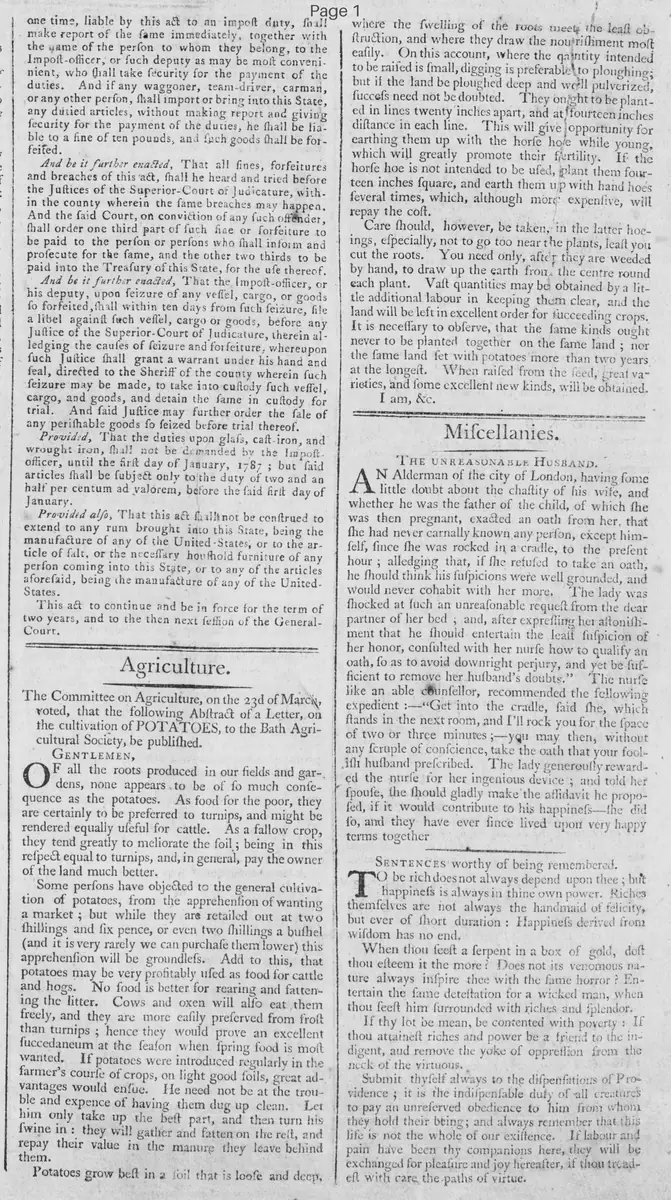
The Committee on Agriculture, on the 23d of March, voted, that the following Abstract of a Letter, on the cultivation of POTATOES, to the Bath Agricultural Society, be published.
GENTLEMEN,
Of all the roots produced in our fields and gardens, none appears to be of so much consequence as the potatoes. As food for the poor, they are certainly to be preferred to turnips, and might be rendered equally useful for cattle. As a fallow crop, they tend greatly to meliorate the soil; being in this respect equal to turnips, and, in general, pay the owner of the land much better.
Some persons have objected to the general cultivation of potatoes, from the apprehension of wanting a market; but while they are retailed out at two shillings and six pence, or even two shillings a bushel (and it is very rarely we can purchase them lower) this apprehension will be groundless. Add to this, that potatoes may be very profitably used as food for cattle and hogs. No food is better for rearing and fattening the litter. Cows and oxen will also eat them freely, and they are more easily preserved from frost than turnips; hence they would prove an excellent succedaneum at the season when spring food is most wanted. If potatoes were introduced regularly in the farmer's course of crops, on light good soils, great advantages would ensue. He need not be at the trouble and expense of having them dug up clean. Let him only take up the best part, and then turn his swine in: they will gather and fatten on the rest, and repay their value in the manure they leave behind them.
Potatoes grow best in a soil that is loose and deep, where the swelling of the roots meet the least obstruction, and where they draw the nourishment most easily. On this account, where the quantity intended to be raised is small, digging is preferable to ploughing: but if the land be ploughed deep and well pulverized, success need not be doubted. They ought to be planted in lines twenty inches apart, and at fourteen inches distance in each line. This will give opportunity for earthing them up with the horse hoe while young, which will greatly promote their fertility. If the horse hoe is not intended to be used, plant them fourteen inches square, and earth them up with hand hoes several times, which, although more expensive, will repay the cost.
Care should, however, be taken, in the latter hoeings, especially, not to go too near the plants, lest you cut the roots. You need only, after they are weeded by hand, to draw up the earth from the centre round each plant. Vast quantities may be obtained by a little additional labour in keeping them clear, and the land will be left in excellent order for succeeding crops.
It is necessary to observe, that the same kinds ought never to be planted together on the same land; nor the same land set with potatoes more than two years at the longest. When raised from the seed, great varieties, and some excellent new kinds, will be obtained.
I am, &c.
The Committee on Agriculture, on the 23d of March, voted, that the following Abstract of a Letter, on the cultivation of POTATOES, to the Bath Agricultural Society, be published.
GENTLEMEN,
Of all the roots produced in our fields and gardens, none appears to be of so much consequence as the potatoes. As food for the poor, they are certainly to be preferred to turnips, and might be rendered equally useful for cattle. As a fallow crop, they tend greatly to meliorate the soil; being in this respect equal to turnips, and, in general, pay the owner of the land much better.
Some persons have objected to the general cultivation of potatoes, from the apprehension of wanting a market; but while they are retailed out at two shillings and six pence, or even two shillings a bushel (and it is very rarely we can purchase them lower) this apprehension will be groundless. Add to this, that potatoes may be very profitably used as food for cattle and hogs. No food is better for rearing and fattening the litter. Cows and oxen will also eat them freely, and they are more easily preserved from frost than turnips; hence they would prove an excellent succedaneum at the season when spring food is most wanted. If potatoes were introduced regularly in the farmer's course of crops, on light good soils, great advantages would ensue. He need not be at the trouble and expense of having them dug up clean. Let him only take up the best part, and then turn his swine in: they will gather and fatten on the rest, and repay their value in the manure they leave behind them.
Potatoes grow best in a soil that is loose and deep, where the swelling of the roots meet the least obstruction, and where they draw the nourishment most easily. On this account, where the quantity intended to be raised is small, digging is preferable to ploughing: but if the land be ploughed deep and well pulverized, success need not be doubted. They ought to be planted in lines twenty inches apart, and at fourteen inches distance in each line. This will give opportunity for earthing them up with the horse hoe while young, which will greatly promote their fertility. If the horse hoe is not intended to be used, plant them fourteen inches square, and earth them up with hand hoes several times, which, although more expensive, will repay the cost.
Care should, however, be taken, in the latter hoeings, especially, not to go too near the plants, lest you cut the roots. You need only, after they are weeded by hand, to draw up the earth from the centre round each plant. Vast quantities may be obtained by a little additional labour in keeping them clear, and the land will be left in excellent order for succeeding crops.
It is necessary to observe, that the same kinds ought never to be planted together on the same land; nor the same land set with potatoes more than two years at the longest. When raised from the seed, great varieties, and some excellent new kinds, will be obtained.
I am, &c.
What sub-type of article is it?
Agriculture
What keywords are associated?
Potato Cultivation
Agriculture
Farming Advice
Cattle Feed
Soil Improvement
Bath Agricultural Society
Domestic News Details
Event Date
23d Of March
Event Details
The Committee on Agriculture voted to publish an abstract of a letter to the Bath Agricultural Society on potato cultivation, highlighting its benefits as food for the poor and livestock, soil improvement, market viability, and methods for planting, hoeing, and rotation to maximize yield and soil health.