Thank you for visiting SNEWPapers!
Sign up free
Story
April 2, 1918
The Interior Journal
Stanford, Lincoln County, Kentucky
What is this article about?
Corporal Henry C. Davis writes from Camp Taylor, KY, on March 30, sharing camp life facts, reassuring mothers about soldiers' safety compared to past wars, highlighting low mortality rates, moral benefits of service, and amenities available to troops during WWI mobilization.
Clipping
OCR Quality
98%
Excellent
Full Text
FACTS ABOUT CAMP TAYLOR
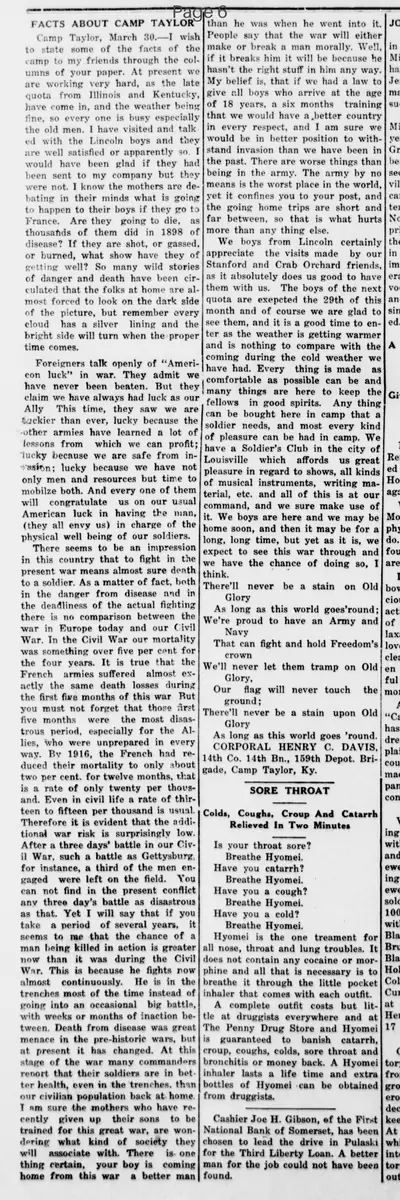
Camp Taylor, March 30.—I wish to state some of the facts of the camp to my friends through the columns of your paper. At present we are working very hard, as the late quota from Illinois and Kentucky have come in, and the weather being fine, so every one is busy especially the old men. I have visited and talked with the Lincoln boys and they are well satisfied or apparently so. I would have been glad if they had been sent to my company but they were not. I know the mothers are debating in their minds what is going to happen to their boys if they go to France. Are they going to die, as thousands of them did in 1898 of disease? If they are shot, or gassed, or burned, what show have they of getting well? So many wild stories of danger and death have been circulated that the folks at home are almost forced to look on the dark side of the picture, but remember every cloud has a silver lining and the bright side will turn when the proper time comes.
Foreigners talk openly of "American luck" in war. They admit we have never been beaten. But they claim we have always had luck as our Ally. This time, they say we are duckier than ever, lucky because the other armies have learned a lot of lessons from which we can profit; lucky because we are safe from invasion; lucky because we have not only men and resources but time to mobilize both. And every one of them will congratulate us on our usual American luck in having the man, (they all envy us) in charge of the physical well being of our soldiers.
There seems to be an impression in this country that to fight in the present war means almost sure death to a soldier. As a matter of fact, both in the danger from disease and in the deadliness of the actual fighting there is no comparison between the war in Europe today and our Civil War. In the Civil War our mortality was something over five per cent for the four years. It is true that the French armies suffered almost exactly the same death losses during the first five months of this war. But you must not forget that those first five months were the most disastrous period, especially for the Allies, who were unprepared in every way. By 1916, the French had reduced their mortality to only about two per cent. for twelve months, that is a rate of only twenty per thousand. Even in civil life a rate of thirteen to fifteen per thousand is usual. Therefore it is evident that the additional war risk is surprisingly low.
After a three days' battle in our Civil War, such a battle as Gettysburg, for instance, a third of the men engaged were left on the field. You can not find in the present conflict any three day's battle as disastrous as that. Yet I will say that if you take a period of several years, it seems to me that the chance of a man being killed in action is greater now than it was during the Civil War. This is because he fights now almost continuously. He is in the trenches most of the time instead of going into an occasional big battle, with weeks or months of inaction between. Death from disease was great menace in the pre-historic wars, but at present it has changed. At this stage of the war many commanders report that their soldiers are in better health, even in the trenches, than our civilian population back at home.
I am sure the mothers who have recently given up their sons to be trained for this great war, are wondering what kind of society they will associate with. There is one thing certain, your boy is coming home from this war a better man than he was when he went into it. People say that the war will either make or break a man morally. Well, if it breaks him it will be because he hasn't the right stuff in him any way. My belief is, that if we had a law to give all boys who arrive at the age of 18 years, a six months training that we would have a better country in every respect, and I am sure we would be in better position to withstand invasion than we have been in the past. There are worse things than being in the army. The army by no means is the worst place in the world, yet it confines you to your post, and the going home trips are short and far between, so that is what hurts more than any thing else.
We boys from Lincoln certainly appreciate the visits made by our Stanford and Crab Orchard friends, as it absolutely does us good to have them with us. The boys of the next quota are expected the 29th of this month and of course we are glad to see them, and it is a good time to enter as the weather is getting warmer and is nothing to compare with the coming during the cold weather we have had. Every thing is made as comfortable as possible can be and many things are here to keep the fellows in good spirits. Any thing can be bought here in camp that a soldier needs, and most every kind of pleasure can be had in camp. We have a Soldier's Club in the city of Louisville which affords us great pleasure in regard to shows, all kinds of musical instruments, writing material, etc. and all of this is at our command, and we sure make use of it. We boys are here and we may be home soon, and then it may be for a long, long time, but yet as it is, we expect to see this war through and we have the chance of doing so, I think.
There'll never be a stain on Old Glory
As long as this world goes 'round;
We're proud to have an Army and Navy
That can fight and hold Freedom's crown
We'll never let them tramp on Old Glory,
Our flag will never touch the ground;
There'll never be a stain upon Old Glory
As long as this world goes 'round.
CORPORAL HENRY C. DAVIS,
14th Co. 14th Bn., 159th Depot Brigade, Camp Taylor, Ky.
Camp Taylor, March 30.—I wish to state some of the facts of the camp to my friends through the columns of your paper. At present we are working very hard, as the late quota from Illinois and Kentucky have come in, and the weather being fine, so every one is busy especially the old men. I have visited and talked with the Lincoln boys and they are well satisfied or apparently so. I would have been glad if they had been sent to my company but they were not. I know the mothers are debating in their minds what is going to happen to their boys if they go to France. Are they going to die, as thousands of them did in 1898 of disease? If they are shot, or gassed, or burned, what show have they of getting well? So many wild stories of danger and death have been circulated that the folks at home are almost forced to look on the dark side of the picture, but remember every cloud has a silver lining and the bright side will turn when the proper time comes.
Foreigners talk openly of "American luck" in war. They admit we have never been beaten. But they claim we have always had luck as our Ally. This time, they say we are duckier than ever, lucky because the other armies have learned a lot of lessons from which we can profit; lucky because we are safe from invasion; lucky because we have not only men and resources but time to mobilize both. And every one of them will congratulate us on our usual American luck in having the man, (they all envy us) in charge of the physical well being of our soldiers.
There seems to be an impression in this country that to fight in the present war means almost sure death to a soldier. As a matter of fact, both in the danger from disease and in the deadliness of the actual fighting there is no comparison between the war in Europe today and our Civil War. In the Civil War our mortality was something over five per cent for the four years. It is true that the French armies suffered almost exactly the same death losses during the first five months of this war. But you must not forget that those first five months were the most disastrous period, especially for the Allies, who were unprepared in every way. By 1916, the French had reduced their mortality to only about two per cent. for twelve months, that is a rate of only twenty per thousand. Even in civil life a rate of thirteen to fifteen per thousand is usual. Therefore it is evident that the additional war risk is surprisingly low.
After a three days' battle in our Civil War, such a battle as Gettysburg, for instance, a third of the men engaged were left on the field. You can not find in the present conflict any three day's battle as disastrous as that. Yet I will say that if you take a period of several years, it seems to me that the chance of a man being killed in action is greater now than it was during the Civil War. This is because he fights now almost continuously. He is in the trenches most of the time instead of going into an occasional big battle, with weeks or months of inaction between. Death from disease was great menace in the pre-historic wars, but at present it has changed. At this stage of the war many commanders report that their soldiers are in better health, even in the trenches, than our civilian population back at home.
I am sure the mothers who have recently given up their sons to be trained for this great war, are wondering what kind of society they will associate with. There is one thing certain, your boy is coming home from this war a better man than he was when he went into it. People say that the war will either make or break a man morally. Well, if it breaks him it will be because he hasn't the right stuff in him any way. My belief is, that if we had a law to give all boys who arrive at the age of 18 years, a six months training that we would have a better country in every respect, and I am sure we would be in better position to withstand invasion than we have been in the past. There are worse things than being in the army. The army by no means is the worst place in the world, yet it confines you to your post, and the going home trips are short and far between, so that is what hurts more than any thing else.
We boys from Lincoln certainly appreciate the visits made by our Stanford and Crab Orchard friends, as it absolutely does us good to have them with us. The boys of the next quota are expected the 29th of this month and of course we are glad to see them, and it is a good time to enter as the weather is getting warmer and is nothing to compare with the coming during the cold weather we have had. Every thing is made as comfortable as possible can be and many things are here to keep the fellows in good spirits. Any thing can be bought here in camp that a soldier needs, and most every kind of pleasure can be had in camp. We have a Soldier's Club in the city of Louisville which affords us great pleasure in regard to shows, all kinds of musical instruments, writing material, etc. and all of this is at our command, and we sure make use of it. We boys are here and we may be home soon, and then it may be for a long, long time, but yet as it is, we expect to see this war through and we have the chance of doing so, I think.
There'll never be a stain on Old Glory
As long as this world goes 'round;
We're proud to have an Army and Navy
That can fight and hold Freedom's crown
We'll never let them tramp on Old Glory,
Our flag will never touch the ground;
There'll never be a stain upon Old Glory
As long as this world goes 'round.
CORPORAL HENRY C. DAVIS,
14th Co. 14th Bn., 159th Depot Brigade, Camp Taylor, Ky.
What sub-type of article is it?
Biography
Historical Event
What themes does it cover?
Moral Virtue
Survival
Triumph
What keywords are associated?
Camp Taylor
Wwi Mobilization
Soldier Morale
War Mortality
American Luck
Moral Improvement
What entities or persons were involved?
Henry C. Davis
Lincoln Boys
Where did it happen?
Camp Taylor, Ky.
Story Details
Key Persons
Henry C. Davis
Lincoln Boys
Location
Camp Taylor, Ky.
Event Date
March 30
Story Details
Corporal Davis shares camp experiences, reassures families on low war risks compared to Civil War, highlights moral benefits of service, and describes amenities and high spirits among troops awaiting deployment.