Thank you for visiting SNEWPapers!
Sign up free
The Daily Herald
New Haven, New Haven County, Connecticut
What is this article about?
Announcement of the death of Chief Justice John Marshall in Philadelphia, including a biographical sketch of his birth in Virginia in 1755, Revolutionary War service, political and legal career, appointment as Chief Justice in 1801, and praise for his principled life and constitutional legacy.
Clipping
OCR Quality
Full Text
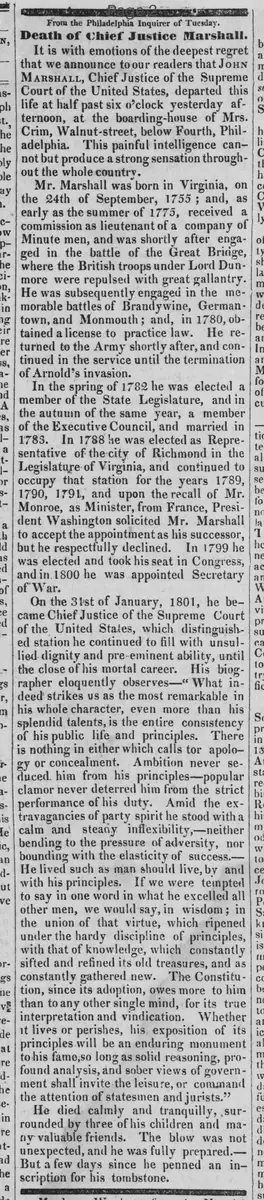
Death of Chief Justice Marshall.
It is with emotions of the deepest regret that we announce to our readers that John Marshall, Chief Justice of the Supreme Court of the United States, departed this life at half past six o'clock yesterday afternoon, at the boarding-house of Mrs. Crimm, Walnut-street, below Fourth, Philadelphia. This painful intelligence cannot but produce a strong sensation throughout the whole country.
Mr. Marshall was born in Virginia, on the 24th of September, 1755; and, as early as the summer of 1775, received a commission as lieutenant of a company of Minute men, and was shortly after engaged in the battle of the Great Bridge, where the British troops under Lord Dunmore were repulsed with great gallantry. He was subsequently engaged in the memorable battles of Brandywine, Germantown, and Monmouth; and, in 1780, obtained a license to practice law. He returned to the Army shortly after, and continued in the service until the termination of Arnold's invasion.
In the spring of 1782 he was elected a member of the State Legislature, and in the autumn of the same year, a member of the Executive Council, and married in 1783. In 1788 he was elected as Representative of the city of Richmond in the Legislature of Virginia, and continued to occupy that station for the years 1789, 1790, 1791, and upon the recall of Mr. Monroe, as Minister, from France, President Washington solicited Mr. Marshall to accept the appointment as his successor, but he respectfully declined. In 1799 he was elected and took his seat in Congress; and in 1800 he was appointed Secretary of War.
On the 31st of January, 1801, he became Chief Justice of the Supreme Court of the United States, which distinguished station he continued to fill with unsullied dignity and pre-eminent ability, until the close of his mortal career. His biographer eloquently observes—'What indeed strikes us as the most remarkable in his whole character, even more than his splendid talents, is the entire consistency of his public life and principles. There is nothing in either which calls for apology or concealment. Ambition never seduced him from his principles—popular clamor never deterred him from the strict performance of his duty. Amid the extravagancies of party spirit he stood with a calm and steady inflexibility,—neither bending to the pressure of adversity, nor bounding with the elasticity of success. He lived such as man should live, by and with his principles. If we were tempted to say in one word in what he excelled all other men, we would say, in wisdom; in the union of that virtue, which ripened under the hardy discipline of principles, with that of knowledge, which constantly sifted and refined its old treasures, and as constantly gathered new. The Constitution, since its adoption, owes more to him than to any other single mind, for its true interpretation and vindication. Whether it lives or perishes, his exposition of its principles will be an enduring monument to his fame, so long as solid reasoning, profound analysis, and sober views of government shall invite the leisure, or command the attention of statesmen and jurists.'
He died calmly and tranquilly, surrounded by three of his children and many valuable friends. The blow was not unexpected, and he was fully prepared.—But a few days since he penned an inscription for his tombstone.
What sub-type of article is it?
What themes does it cover?
What keywords are associated?
What entities or persons were involved?
Where did it happen?
Story Details
Key Persons
Location
Philadelphia
Event Date
Born 24th Of September, 1755; Died Half Past Six O'clock Yesterday Afternoon
Story Details
John Marshall, born in Virginia in 1755, served in the Revolutionary War, pursued a legal and political career including roles in the Virginia Legislature, Congress, and as Secretary of War, became Chief Justice in 1801, and died in Philadelphia surrounded by family and friends, praised for his principled life and contributions to the US Constitution.