Thank you for visiting SNEWPapers!
Sign up free
The Virginia Gazette
Richmond, Williamsburg, Richmond County, Virginia
What is this article about?
London political news: Justices investigate rumored mock execution at Tower Hill. Parliamentary debate features Lord North's budget opening and Burke's critique of ministry's handling of Wilkes. Wilkes meets supporters, declares intent to run for Sheriff; Oliver refuses to serve with him, fearing impact on Middlesex election.
Clipping
OCR Quality
Full Text
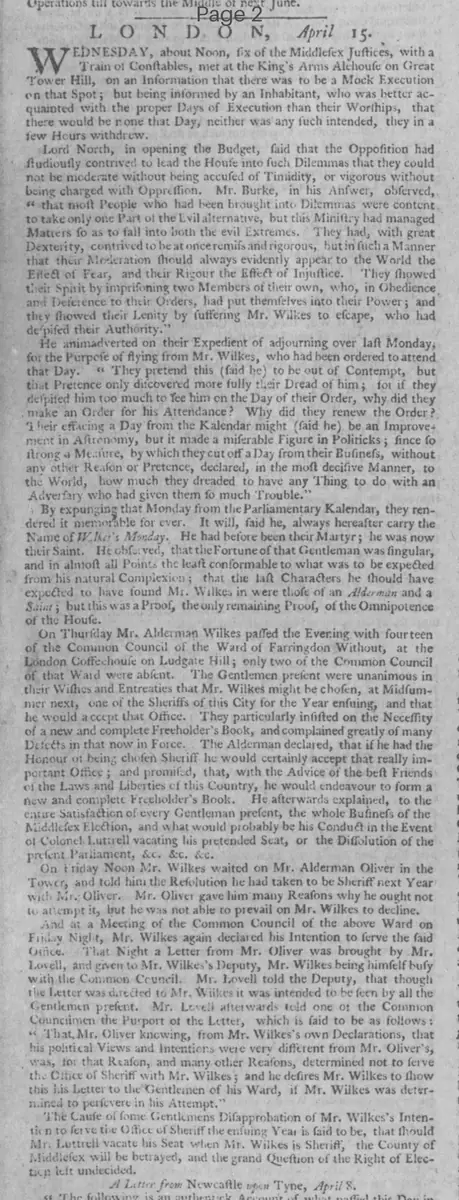
WEDNESDAY, about Noon, six of the Middlesex Justices, with a Train of Constables, met at the King's Arms Alehouse on Great Tower Hill, on an Information that there was to be a Mock Execution on that Spot; but being informed by an Inhabitant, who was better acquainted with the proper Days of Execution than their Worships, that there would be none that Day, neither was any such intended, they in a few Hours withdrew.
Lord North, in opening the Budget, said that the Opposition had studiously contrived to lead the House into such Dilemmas that they could not be moderate without being accused of Timidity, or vigorous without being charged with Oppression. Mr. Burke, in his Answer, observed, "that most People who had been brought into Dilemmas were content to take only one Part of the evil alternative, but this Ministry had managed Matters so as to fall into both the evil Extremes. They had, with great Dexterity, contrived to be at once remiss and rigorous, but in such a Manner that their Moderation should always evidently appear to the World the Effect of Fear, and their Rigour the Effect of Injustice. They showed their Spirit by imprisoning two Members of their own, who, in Obedience and Deference to their Orders, had put themselves into their Power; and they showed their Lenity by suffering Mr. Wilkes to escape, who had despised their Authority."
He animadverted on their Expedient of adjourning over last Monday, for the Purpose of flying from Mr. Wilkes, who had been ordered to attend that Day. "They pretend this (said he) to be out of Contempt, but that Pretence only discovered more fully their Dread of him; for if they despised him too much to see him on the Day of their Order, why did they make an Order for his Attendance? Why did they renew the Order? Their effacing a Day from the Kalendar might (said he) be an Improvement in Astronomy, but it made a miserable Figure in Politicks; since so strong a Measure, by which they cut off a Day from their Business, without any other Reason or Pretence, declared, in the most decisive Manner, to the World, how much they dreaded to have any Thing to do with an Adversary who had given them so much Trouble."
By expunging that Monday from the Parliamentary Kalendar, they rendered it memorable for ever. It will, said he, always hereafter carry the Name of Wilkes's Monday. He had before been their Martyr; he was now their Saint. He charged, that the Fortune of that Gentleman was singular, and in almost all Points the least conformable to what was to be expected from his natural Complexion; that the last Characters he should have expected to have found Mr. Wilkes in were those of an Alderman and a Saint; but this was a Proof, the only remaining Proof, of the Omnipotence of the House.
On Thursday Mr. Alderman Wilkes passed the Evening with fourteen of the Common Council of the Ward of Farringdon Without, at the London Coffeehouse on Ludgate Hill; only two of the Common Council of that Ward were absent. The Gentlemen present were unanimous in their Wishes and Entreaties that Mr. Wilkes might be chosen, at Midsummer next, one of the Sheriffs of this City for the Year ensuing, and that he would accept that Office. They particularly insisted on the Necessity of a new and complete Freeholder's Book, and complained greatly of many Defects in that now in Force. The Alderman declared, that if he had the Honour of being chosen Sheriff he would certainly accept that really important Office; and promised, that, with the Advice of the best Friends of the Laws and Liberties of this Country, he would endeavour to form a new and complete Freeholder's Book. He afterwards explained, to the entire Satisfaction of every Gentleman present, the whole Business of the Middlesex Election, and what would probably be his Conduct in the Event of Colonel Luttrell vacating his pretended Seat, or the Dissolution of the present Parliament, &c. &c. &c.
On Friday Noon Mr. Wilkes waited on Mr. Alderman Oliver in the Tower, and told him the Resolution he had taken to be Sheriff next Year with Mr. Oliver. Mr. Oliver gave him many Reasons why he ought not to attempt it, but he was not able to prevail on Mr. Wilkes to decline. And at a Meeting of the Common Council of the above Ward on Friday Night, Mr. Wilkes again declared his Intention to serve the said Office. That Night a Letter from Mr. Oliver was brought by Mr. Lovell, and given to Mr. Wilkes's Deputy, Mr. Wilkes being himself busy with the Common Council. Mr. Lovell told the Deputy, that though the Letter was directed to Mr. Wilkes it was intended to be seen by all the Gentlemen present. Mr. Lovell afterwards told one of the Common Councillors the Purport of the Letter, which is said to be as follows:
"That Mr. Oliver knowing, from Mr. Wilkes's own Declarations, that his political Views and Intentions were very different from Mr. Oliver's, was, for that Reason, and many other Reasons, determined not to serve the Office of Sheriff with Mr. Wilkes; and he desires Mr. Wilkes to show this his Letter to the Gentlemen of his Ward, if Mr. Wilkes was determined to persevere in his Attempt."
The Cause of some Gentlemen’s Disapprobation of Mr. Wilkes's Intention to serve the Office of Sheriff the ensuing Year is said to be, that should Mr. Luttrell vacate his Seat when Mr. Wilkes is Sheriff, the County of Middlesex will be betrayed, and the grand Question of the Right of Election left undecided.
What sub-type of article is it?
What keywords are associated?
What entities or persons were involved?
Where did it happen?
Foreign News Details
Primary Location
London
Event Date
Wednesday To Friday Preceding April 15
Key Persons
Outcome
wilkes declares intention to serve as sheriff; oliver declines to pair with him due to differing political views and concerns over middlesex election if luttrell vacates seat.
Event Details
Justices and constables gather at Tower Hill on false information of mock execution but withdraw. In Parliament, Lord North accuses Opposition of dilemmas; Burke criticizes ministry for being both remiss and rigorous, especially in handling Wilkes by adjourning to avoid him. Wilkes meets Common Council members, accepts potential Sheriff nomination, promises new Freeholder's Book, explains Middlesex election conduct. Wilkes informs Oliver of Sheriff intent; Oliver advises against and later writes refusing to serve together.