Thank you for visiting SNEWPapers!
Sign up free
National Gazette
Philadelphia, Philadelphia County, Pennsylvania
What is this article about?
An editorial critiquing the historical abuses of clerical power and influence worldwide, proposing reforms to divest clergy of temporal ranks and endowments, standardize modest stipends, simplify ordination, reduce church numbers, and ensure respectable provisions without excessive state burden.
Merged-components note: Continuation of the article on provisions for the clergy across pages; relabeled to editorial due to opinionated tone from a London paper.
Clippings
1 of 2
OCR Quality
Full Text
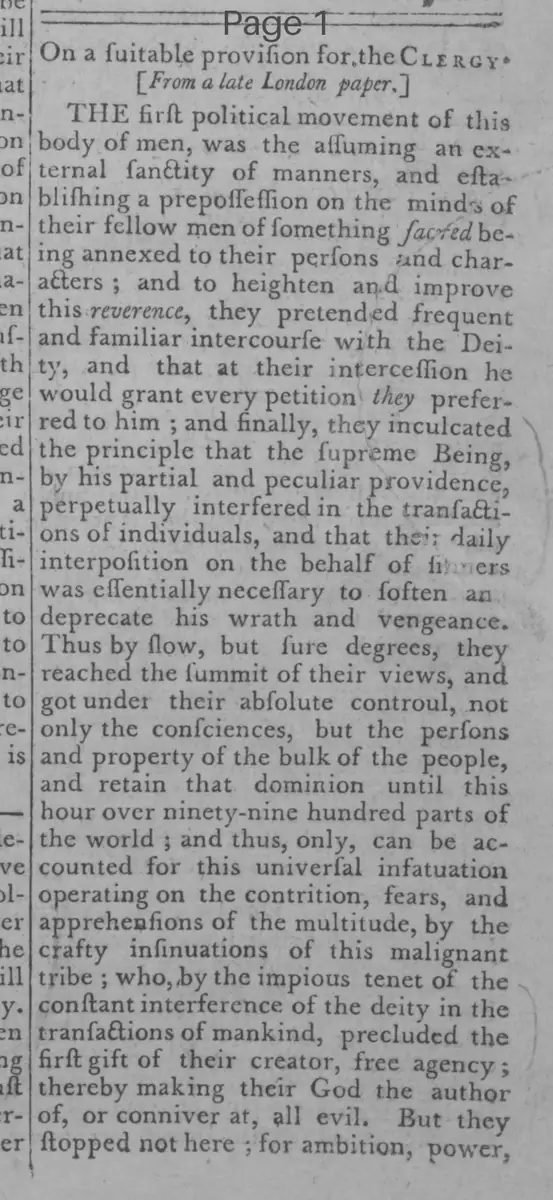
[From a late London paper.]
THE first political movement of this
body of men, was the assuming
an external sanctity of manners, and establishing a prepossession on the minds of
their fellow men of something sacred being
annexed to their persons and characters; and to heighten and improve
this reverence, they pretended frequent
and familiar intercourse with the Deity,
and that at their intercession he
would grant every petition they preferred
to him; and finally, they inculcated
the principle that the supreme Being,
by his partial and peculiar providence,
perpetually interfered in the transactions
of individuals, and that their daily
interposition on the behalf of sinners
was essentially necessary to soften and
deprecate his wrath and vengeance.
Thus by slow, but sure degrees, they
reached the summit of their views, and
got under their absolute control, not
only the consciences, but the persons
and property of the bulk of the people,
and retain that dominion until this
hour over ninety-nine hundred parts of
the world; and thus, only, can be accounted
for this universal infatuation
operating on the contrition, fears, and
apprehensions of the multitude, by the
crafty insinuations of this malignant
tribe; who, by the impious tenet of the
constant interference of the deity in the
transactions of mankind, precluded the
first gift of their creator, free agency;
thereby making their God the author
of, or conniver at, all evil. But they
stopped not here; for ambition, power,
and avarice know no bounds: in process of time they impiously assumed the prerogatives and attributes of the deity; they made themselves to be worshipped and adored; they possessed themselves of temporalities and principalities, and trod on the necks of kings; and, by the subordinate agency of their brethren, they swayed dissension, religious and civil, throughout every land, where they obtained a footing.
Upon a retrospect view of the history of all nations, we shall find them, either openly or covertly, the active promoters of persecutions, blood and slaughter, rebellions and murders.
The foregoing portrait, although more immediately applied to the christian clergy of former times, yet is also justly applicable to the same class in every nation of the Globe.
It was aptly said, by a very competent judge of human nature, that, priests of all religions are the same. Their power, their influence, their consequence, and depredations have ever been obtained under the insidious mask of some religious system or other; the mockery, the fallacy, the impiety of all, will be obvious to every unprejudiced mind, that strictly scrutinizes their internal and external tenets and principles; therefore, it is full time the mask should be taken off, and mankind released from the leading strings of such religious nurses, and restored to his native freedom, which has been shackled for so many ages in superstitious bondage.
We wish not the abolition of the churches, the priesthood, or religious worship; our aim is, to see them all reduced to such a standard as may do honour to the overruling power, and be consistent with reason, true piety, and propriety. It is true, the extensive arm of sacerdotal power and influence has in these latter times been shortened, and rendered less mischievous; but it is still too long, and it behoves every christian government to cut it off.
It is not our intention to end the priesthood a grazing, but only to reduce them to a respectable level. The abject slavery and dependence of the subaltern clergy, has long been a reproach to the church and legislature of every christian government; but if our plan takes place, there shall not be a ragged curate in his majesty's dominions at least. As propositions are now become the mode of address on all occasions, we shall here adopt it.
Proposition 1st. It is humbly proposed, that the dignified clergy, under every denomination, be divested of all rank, precedence, and title in the state and church; saving and excepting that of Doctor in Divinity only, which every member of the church shall indiscriminately enjoy on the same respectable and rational level.
2d. That a period be put to the long mischievous, illegal, and irreligious practice of mixing temporalities with spiritualities; and that all endowments whatsoever kind, annexed to cathedrals, churches, chapels, and colleges be sequestered, restored, and appropriated to the relief of exigencies of the state, and heavy burdens of the people.
3d. That the forms of ordination, subscription, and degrees, be wholly abolished as useless—and, to the full, as farcical as the noli episcopari; and that the king, as supreme head of the church, shall, by himself, or by delegation to his ministers of state, occasionally ordain and present men of sound and tried morals and understanding, to the best of their knowledge and information: profound learning and knowledge in the dead languages being absolutely non-essentials.
4th. That a considerable reduction shall be made in the number of churches, and every church be independent, and but one incumbent to each church: and in case of sickness or inability, his place shall be supplied by the incumbent of the next adjoining parish, on proper notice given of the necessary variation of the hour, for the commencement of the service.
5th. That a stipend of five hundred pounds per annum, exempt from all taxes, office fees, and deductions whatsoever, be established for every married incumbent, and three hundred for every one unmarried, in lieu of all tithes, surplice fees, and other perquisites, with a decent and commodious parsonage house, handsomely furnished at all points, in the vicinity of the church, the whole to be kept in repair by the government; the stipend to be paid from the treasury half yearly, the first half year in advance upon their induction; as those stipends are more than equal to landed estates of eight and five hundred pounds per annum, it cannot but be deemed a respectable provision. Whether the exigencies of the state can admit of this ample provision, the legislature alone are the competent judges.
6th. That the reduced dignitaries, in compensation for their losses in temporalities, shall have the preference on the new presentations taking place, and next to them the Doctors of Divinity of the present establishment; but as our plan only proposes one incumbent for each church, the supernumeraries in orders, which overflow the land, must not be left to starve: therefore, we propose an annuity of one hundred pounds shall be settled upon them for their lives; and as many of them will drop off annually, the state will soon be released from that burden.
7th. That the Doctors shall still retain the honorary titles, insignia, and emoluments [if there are any] of being chaplains to his majesty and the nobility.
What sub-type of article is it?
What keywords are associated?
What entities or persons were involved?
Editorial Details
Primary Topic
Reform Of Clerical Power And Provisions
Stance / Tone
Critical Of Clerical Abuses, Advocating Moderate Reforms
Key Figures
Key Arguments