Thank you for visiting SNEWPapers!
Sign up free
Kentucky Gazette
Lexington, Fayette County, Kentucky
What is this article about?
On December 10 and 12, 1820, the U.S. House debated the Missouri statehood question. Henry Clay's compromise committee report proposed amending the Senate resolution to bar Missouri from restricting free persons' settlement. After votes rejecting restrictions and the report, the amended resolution failed 80-83, with reconsideration pending.
Clipping
OCR Quality
Full Text
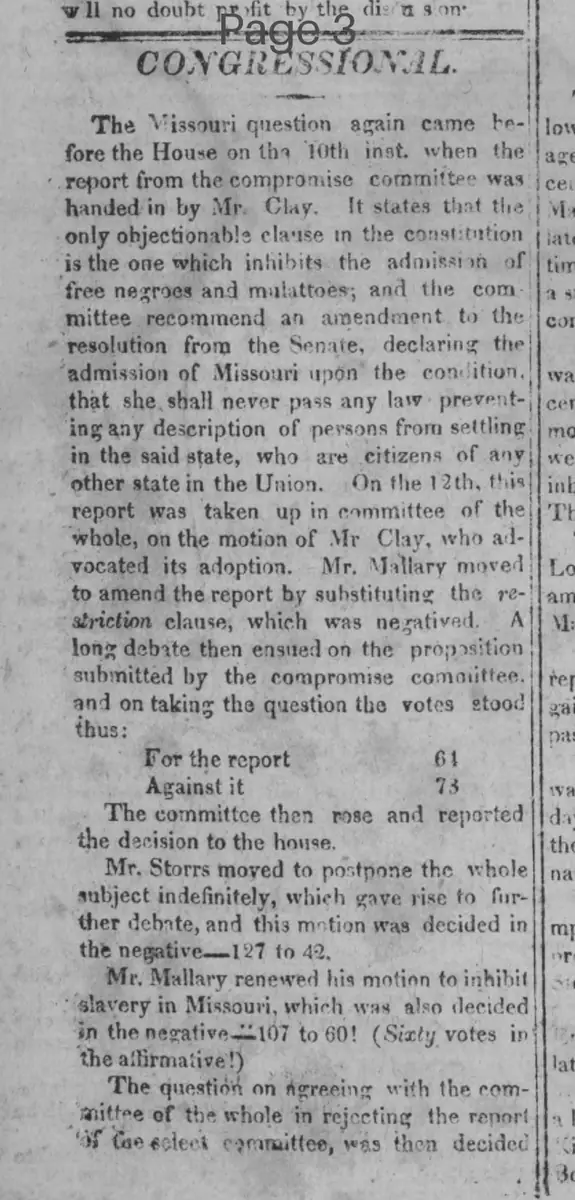
The Missouri question again came before the House on the 10th inst. when the report from the compromise committee was handed in by Mr. Clay. It states that the only objectionable clause in the constitution is the one which inhibits the admission of free negroes and mulattoes; and the committee recommend an amendment to the resolution from the Senate, declaring the admission of Missouri upon the condition that she shall never pass any law preventing any description of persons from settling in the said state, who are citizens of any other state in the Union.
On the 12th, this report was taken up in committee of the whole, on the motion of Mr. Clay, who advocated its adoption. Mr. Mallary moved to amend the report by substituting the restriction clause, which was negatived. A long debate then ensued on the proposition submitted by the compromise committee, and on taking the question the votes stood thus:
For the report 61
Against it 73
The committee then rose and reported the decision to the house. Mr. Storrs moved to postpone the whole subject indefinitely, which gave rise to further debate, and this motion was decided in the negative—127 to 42.
Mr. Mallary renewed his motion to inhibit slavery in Missouri, which was also decided in the negative 107 to 60! (Sixty votes in the affirmative!)
The question on agreeing with the committee of the whole in rejecting the report of the select committee, was then decided in the negative.
So the amendment proposed by the compromise committee to the Senate's resolution was agreed to.
The question was then stated on ordering the amended resolution to be read a third time, and the Clerk being about to proclaim the result, Mr. Kent, who was not in the House when his name was called, requested leave to record his vote. Mr. Jackson, under the same circumstances, made the same request.
The rules of the house in such case requires unanimous consent, and objection was made to their voting. Mr. Clay moved to dispense with the rule, but afterwards withdrew the motion, relying upon the unanimity of some member of the majority to move for a re-consideration of the question.
The result of the vote was then proclaimed:
For the third reading 80
Against it 83
So the resolution from the Senate in favor of the admission of Missouri, as well as the amendment proposed by the compromise committee, was rejected.
Mr. Livermore then gave notice that he would on the next day, at 1 o'clock, move for a reconsideration of the question. Here the matter rests—no later information having been received. What the result will be, it would be presumptuous, under such circumstances, to venture a prediction. But let the decision be either way for or against Missouri—we fear the question will not be settled.—Reporter.
What sub-type of article is it?
What keywords are associated?
What entities or persons were involved?
Where did it happen?
Domestic News Details
Primary Location
U.S. House Of Representatives
Event Date
10th And 12th Instant
Key Persons
Outcome
the amended senate resolution for missouri's admission was rejected 80-83; motion for reconsideration planned for the next day.
Event Details
The House considered the compromise committee's report on Missouri's constitution, proposing an amendment to prevent laws restricting settlement by free persons from other states. Debates and votes rejected slavery restrictions, initially agreed to the amendment, but ultimately rejected the resolution on third reading.