Thank you for visiting SNEWPapers!
Sign up free
Virginia Argus
Richmond, Virginia
What is this article about?
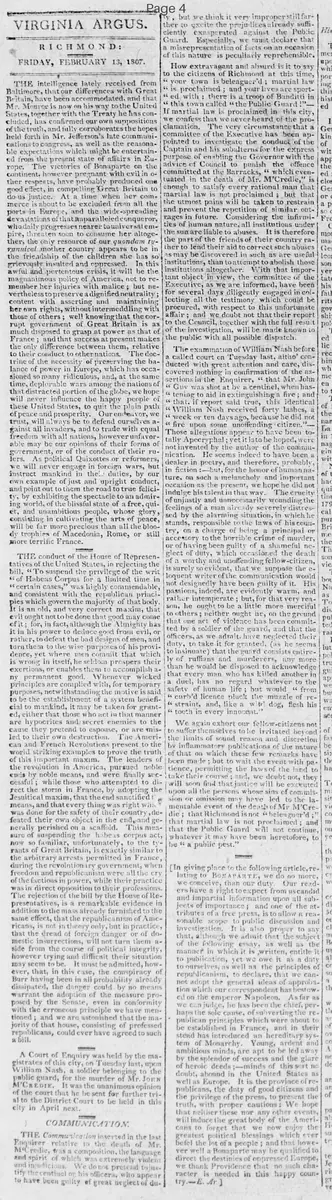
This letter responds to a prior communication in the Enquirer about the death of Mr. M'Credie at the hands of a sentinel in Richmond, criticizing its violent tone and factual misrepresentations, such as claims of martial law and banditti-like public guard. It highlights an ongoing executive investigation to address the neglect and prevent future incidents, urging citizens to await justice calmly.
Clipping
OCR Quality
Full Text
THE Communication inserted in the last Enquirer relative to the death of Mr. M'Credie, was a composition, the language and spirit of which was extremely violent and injudicious. We do not pretend to justify the sentinel by his officers, who appear to have been guilty of great neglect of duty, but we think it very improper still farther to excite the prejudices already sufficiently exasperated against the Public Guard. Especially, we must declare that a misrepresentation of facts on an occasion of this nature is peculiarly reprehensible. How extravagant and absurd is it to say to the citizens of Richmond at this time, "your town is beleaguered; martial law is proclaimed; and your lives are sported with: there is a troop of Banditti in this town called 'the Public Guard!'" If martial law is proclaimed in this city, we confess that we never heard of the proclamation. The very circumstance that a committee of the Executive has been appointed to investigate the conduct of the Captain and his subalterns for the express purpose of enabling the Governor with the advice of Council to punish the offence committed at the Barracks, "which eventuated in the death of Mr. M'Credie," is enough to satisfy every rational man that martial law is not proclaimed; but that the utmost pains will be taken to restrain and prevent the repetition of similar outrages in future. Considering the infirmities of human nature, all institutions under the sun are liable to abuses. It is therefore the part of the friends of their country rather to lend their aid to correct such abuses as may be discovered in such as are useful institutions, than to attempt to abolish those institutions altogether. With that important object in view, the committee of the Executive, as we are informed, have been for several days diligently engaged in collecting all the testimony which could be procured, with respect to this unfortunate affair: and we doubt not that their report to the Council, together with the full result of the investigation, will be made known to the public with all possible dispatch. The examination of William Nash before a called court on Tuesday last, although conducted with great attention and care, discovered nothing in confirmation of the assertions in the Enquirer, "that Mr. John Guy was shot at by a sentinel, when hastening to aid in extinguishing a fire; and that, if report be said true, this identical William Nash received forty lashes, a week or ten days ago, because he did not fire upon some unoffending citizen." Those allegations appear to have been totally Apocryphal; yet it is to be hoped, were not invented by the author of the communication. He seems indeed to have been a dealer in poetry, and therefore, probably, in fiction: but, for the honor of human nature, on such a melancholy and important occasion as the present, we hope he did not indulge his talent in that way. The cruelty of unjustly and unnecessarily wounding the feelings of a man already severely distressed by the alarming situation, in which he stands, responsible to the laws of his country, on a charge of being a principal or accessory to the horrible crime of murder, or of having been guilty of a shameful neglect of duty, which occasioned the death of a worthy and unoffending fellow-citizen, is surely so evident, that we suppose the eloquent writer of the communication would not designedly have been guilty of it. His passions, indeed, are evidently warm, and rather intemperate; but, for that very reason, he ought to be a little more merciful to others; neither ought he, on the ground that one act of violence has been committed by a soldier of the guard, and that the officers, as we admit, have neglected their duty, to take it for granted, (as he seems to insinuate) that the guard consists entirely of ruffians and murderers, any more than he would be disposed to acknowledge that every man who has killed another in a duel, has no regard whatever to the safety of human life; but would "from curb'd licence pluck the muzzle of restraint, and, like a with' dog, flesh his tooth in every innocent." We again exhort our fellow-citizens not to suffer themselves to be irritated beyond the limits of sound reason and discretion by inflammatory publications of the nature of that on which these few remarks have been made; but to wait the event with patience, permitting the laws of the land to take their course; and, we doubt not, they will soon find that justice will be executed upon all the persons whose sins of commission or omission may have led to the lamentable event of the death of Mr. M'Credie; that Richmond is not "beleaguered;" that martial law is not proclaimed; and that the Public Guard will not continue, whatever it may have been heretofore, to be "a public pest."
What sub-type of article is it?
What themes does it cover?
What keywords are associated?
Letter to Editor Details
Main Argument
the prior communication on mr. m'credie's death was inflammatory and misrepresented facts like martial law and the public guard as banditti; an executive investigation is underway to punish negligence and prevent recurrences, so citizens should remain calm and let justice proceed.
Notable Details