Thank you for visiting SNEWPapers!
Sign up free
Gadsden County Times
Quincy, Gadsden County, Florida
What is this article about?
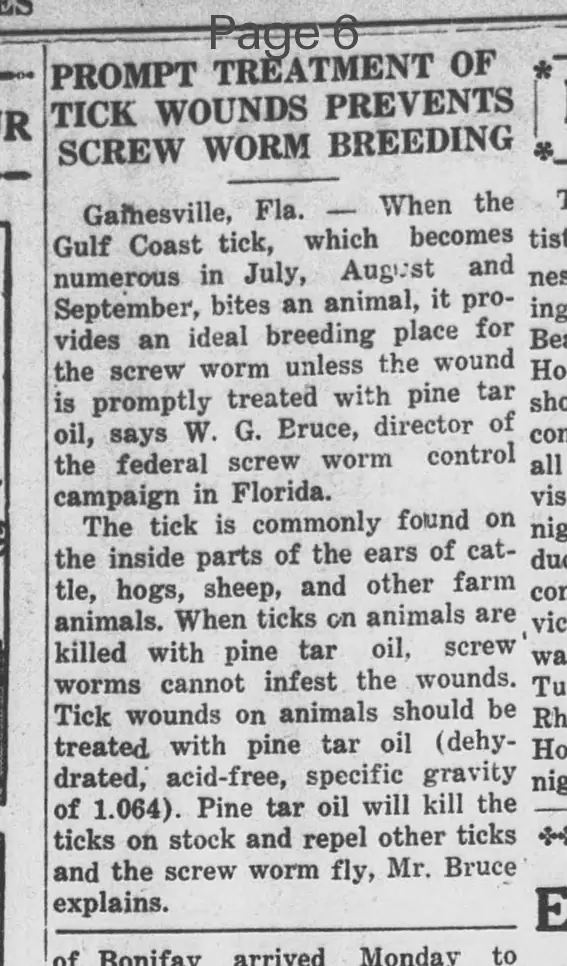
W. G. Bruce, director of the federal screw worm control campaign in Florida, advises prompt treatment of Gulf Coast tick wounds on cattle, hogs, sheep, and other farm animals with pine tar oil to prevent screw worm breeding, especially in July through September.
Clipping
OCR Quality
Full Text
TICK WOUNDS PREVENTS
SCREW WORM BREEDING
Gainesville, Fla. When the Gulf Coast tick, which becomes numerous in July, August and September, bites an animal, it provides an ideal breeding place for the screw worm unless the wound is promptly treated with pine tar oil, says W. G. Bruce, director of the federal screw worm control campaign in Florida.
The tick is commonly found on the inside parts of the ears of cattle, hogs, sheep, and other farm animals. When ticks on animals are killed with pine tar oil, screw worms cannot infest the wounds.
Tick wounds on animals should be treated with pine tar oil (dehydrated, acid-free, specific gravity of 1.064). Pine tar oil will kill the ticks on stock and repel other ticks and the screw worm fly, Mr. Bruce explains.
What sub-type of article is it?
What keywords are associated?
What entities or persons were involved?
Where did it happen?
Domestic News Details
Primary Location
Gainesville, Fla.
Key Persons
Event Details
When the Gulf Coast tick, which becomes numerous in July, August and September, bites an animal, it provides an ideal breeding place for the screw worm unless the wound is promptly treated with pine tar oil. The tick is commonly found on the inside parts of the ears of cattle, hogs, sheep, and other farm animals. When ticks on animals are killed with pine tar oil, screw worms cannot infest the wounds. Tick wounds on animals should be treated with pine tar oil (dehydrated, acid-free, specific gravity of 1.064). Pine tar oil will kill the ticks on stock and repel other ticks and the screw worm fly.