Thank you for visiting SNEWPapers!
Sign up free
Plentywood Herald
Plentywood, Sheridan County, Montana
What is this article about?
The article reflects on the recent death of Peter Thompson, a claimed survivor of Custer's Last Stand at Little Bighorn in 1876, and examines other survivors' stories and numerous imposters who fabricated involvement in the tragic battle.
Merged-components note: Image is an illustration within the bounding box of the Custer battle story, indicating spatial association.
Clipping
OCR Quality
Full Text
(By W. H. Banfill)
The recent death of Peter Thompson of Ekalaka, who claimed that he missed the fate of Custer and his command only by reason that his horse became lame on the march, brings to mind that scores of men since the day of the tragic battle of the Little Big Horn, have posed as survivors of the fight or the last to see Custer alive.
Thompson's record in this respect is far more substantial than most of those who have aspired to the limelight or who have been thrust into it by some unusual association with Custer. Thompson, according to the account he gave at Hardin in 1921 when a commemorative stone was unveiled on the 45th anniversary of the battle, was a member of one of the troops that was under Custer's immediate command when he rode away from the detachments under Reno and Benteen.
According to Thompson, while on the trail after the separation, his horse cast a shoe and became lame and he was unable to keep up with the band. With the heat, he became exhausted and finding he would be unable to overtake his comrades, he joined two other stragglers and they made their way back to McDougall's pack train and finally joined Reno's command, entrenched in the hills.
During the siege of Reno and Benteen by the Indians, he was slightly wounded. In spite of his wounds, however, he went for water for his comrades, a venture of great danger, as the Indians endeavored to cut the force off from water, to compel them to abandon their entrenched positions. Thompson was the proud possessor of a congressional medal, given for his heroism on July 25 and 26, 1876.
Whether or not he could justly lay claim to having been the last white man to see Custer of those who lived to tell the tale, is another question. As far as his being a survivor of the battle is concerned, his title is perhaps somewhat better than that of a former resident of Huntley who died several years ago. He also might have met his death along with Custer but he was placed in the guardhouse at Fort Abraham Lincoln for being drunk or some other misconduct before the expedition started and was left behind. His troop was one that was annihilated.
For many years there lived at Billings, an old, taciturn man, John Burkman, who for many years had charge of General Custer's horses and dogs and who saddled his horse, Vic, the morning of the fatal charge. Burkman had been interviewed and queried so often about Custer and the circumstances of his defeat that the mere mention of Custer's name was sufficient for him to shut up like a clam and only a few who had known him long could get him to talk on the subject at all. Burkman lived to be nearly 90 and then, threatened with blindness, committed suicide.
Custer Changed Horses
On the morning of the fatal day, Custer, who had been riding his favorite horse, Dandy, in an early hour scouting trip to locate the Indian village, returned to camp and after deciding on the plans for the attack with his officers, changed to Victor, the Kentucky thoroughbred, who shared with him the fate of the battlefield. Burkman was at least one of the last men left behind to whom Custer spoke.
Burkman had been with Custer since the reconstruction days in Kentucky and Tennessee where breaking up moonshine distilleries and suppressing the Ku Klux Klan were the principal tasks. His service under the general continued through the four years at Fort Abraham Lincoln, including the Stanley expedition and the Black Hills episodes until the final tragedy.
Scattered through Montana and here and there in other states as well, are still a handful of men who can boast of some close connection with Custer's last battle: men who were besieged on the hills with Reno and Benteen and fought desperately to ward off a similar fate; soldiers in Gibbon's command who were the first to see the awful carnage field; men who were with the steamer Far West which bore back Reno's wounded soldiers and the cruel news of disaster. And as these men pass on one by one, the story of Custer's last stand, with all its dramatic elements, will be made new again.
News dispatches not so long ago carried an account of the death of a certain "last survivor" of Custer's command. As new survivors spring up with a fair regularity, the supply must still be large in spite of occasional deaths. Although with the exception of perhaps Curley, the Crow scout, historians of the battle remain firm in the belief that none escaped, there have been sole survivors enough to equal Custer's command.
Benton, he said, "My horse must have carried me across, one of those times when I didn't know much of what was happening." As the Yellowstone is commonly a raging torrent in the latter part of June, his explanation, to say the least, did not sound plausible.
At Fort Benton, Finkle said that he heard for the first time of the complete annihilation of Custer's men. He told no one of his part in the fight, merely saying that he had been ill.
Seven or eight years ago while on a newspaper staff at Walla Walla, I interviewed a man named Finkle who posed as the only survivor of the battle. He claimed that he enlisted under the name of Frank Hall although his account would have been better if he had stuck to his own name, as there was a man named Finkle killed with Custer, although the first name was not the same. On the other hand, no Hall was on the muster roll.
Although the old gentleman had rather a hazy conception of directions, his account of his escape was thrilling enough to make up for other deficiencies. In the early part of the battle he was wounded in the foot while another bullet was imbedded in the flesh of the muscles above his hips. His horse was wounded in the flank and another bullet cut one of the bridle reins. Still another bullet hit the iron of his gun and a splinter struck him between the eyes, causing the blood to spurt over his face, blinding him so that he was unable to see.
His horse bolted for the hills and with only one line, he was unable to control it. He remembered hearing bullets whistle above his head but could not recall going through the Indian lines.
For some time he rode, dazed and almost unconscious, with a hazy idea of getting back to the other troops but with no idea of direction. Finally he got off his horse and picketed him and slept awhile. On the second day, he saw some mountains at a distance and started for them. On the third day, he reached the cabin of some trappers, where he found two men, one of whom was sick with the mountain fever, from which he died a few days later. Here Finkle remained for four months, the surviving trapper nursing him back to health.
Near Fort Benton
When he came to leave, Bill, the only name the trapper gave, told him he was about two days' journey from Fort Benton and showed him the route to take. When the attention of Finkle was called to the necessity of crossing the Yellowstone river to get from Custer's battlefield to Fort Benton, he said his horse must have carried him across.
Finally induced the captain to carry him as far as Sioux City. Finkle said that he had never made any effort to obtain an army discharge or to gain official recognition; he had lost all his papers, the officers that he knew had all been killed and he "wasn't going to chase all over the country to find some one to discharge me."
An article which recounted Finkle's claim to fame, brought several letters in reply from various people who have made a "hobby" of Custer battle memorabilia, including E. A. Brininstool, the author of "A Trooper With Custer," and other books on frontier wars. Mr. Brininstool said that the woods were full of Custer survivors and that he had a friend in Chicago who was acquainted with 14 men who claimed to be survivors.
Some Annoyed Mrs. Custer
Brininstool told of one man who claimed that he lay on a hill half a mile from the battlefield and watched the fight through a spyglass. The man described the battle in great detail and was able to clear up all the controversial points about the battle which have always been a matter of speculation. Some of these imposters have even been bold enough to endeavor to get an audience with Mrs. Custer herself in the hope that they could gain her help in furthering their recognition, and she has been given no little annoyance by their efforts.
The first "survivor" to seek and gain notoriety was one Sebastian Best, whose story went the rounds of the national press as early as 1881 or 1882. Best's claim, however, was rather that of an eye-witness as he avowed that he was a captive among the Sioux Indians at the time of the battle.
According to Best, he was a captive among the Sioux for six years until he was regarded as almost one of them. He said that the Sioux built a decoy camp, placing billets of wood covered with blankets around the camp fires to represent seated Indians. When Custer rode down and opened fire on the "faked" camp, 3,000 Sioux warriors rode down off the mountain sides and surrounded him. Custer with his sabre left many a ragged edge cross as a trademark on the redskins' faces but finally fell, pierced with seven bullets.
Best claimed that he saw the intrepid officer die and that when his foes closed in at last and he saw there was no escape, he exclaimed, "I am all alone. I have done my best. The boys are all gone and I go with them."
Best finally escaped from the Indians after traveling for a long distance with a fleeing band and made his way back to a frontier town. Like many of the other survivors, Best waited, however, until he had returned east to give his tale to a credulous world.
Indians Saw One Escape
Although historians of the battle are agreed that there were no survivors of the battle with the possible exception of Curley, the Crow scout, it is of interest to note that several of the battle chiefs of the Sioux and Cheyennes in the account which they gave of the fight years afterward, said that one trooper severely wounded got through their lines. Perhaps they had heard of one of the many "sole survivors" and thought they might as well leave him a loop-hole of escape.
The soldiers who were sent in the next year to complete the hasty job of burial which Gibbon's men had done, were able to account for all of the squadron but two. Later the skeleton of two men were found at some distance from the scene of conflict so that avenue of escape would seem to be closed. The soldier whom the chiefs thought escaped might have been one of these men who got away from the main body only to perish a little way on. Mistakes are made in counting up the dead on a battlefield however, and one of Reno's dead might have got mixed in by mistake.
If there is any element of doubt, however, it is very small indeed. And even if the chance of one survivor were conceded, the historian would have a herculean job in discovering the true survivor from the army of imposters. Probably like the Man in the Iron Mask, the "Lost Dauphin" and the czar's daughter, Anastasia, the sole survivor of the Custer fight will continue to bob up in the field of speculation in spite of all the historians can do to bury him under the facts, and we doubtless haven't heard the last of him yet.
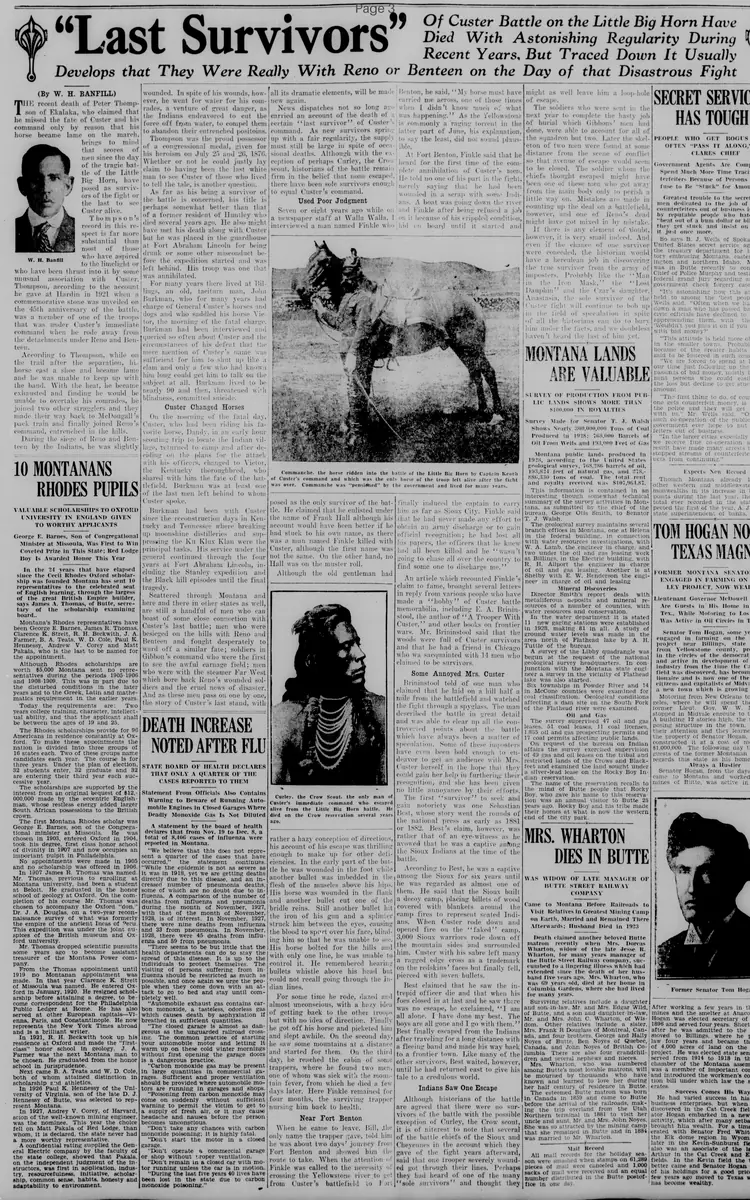
*Commanche, the horse ridden into the battle of the Little Big Horn by Captain Keogh of Custer's command and which was the only horse of the troop left alive after the fight was over. Commanche was "pensioned" by the government and lived for many years.*
What sub-type of article is it?
What themes does it cover?
What keywords are associated?
What entities or persons were involved?
Where did it happen?
Story Details
Key Persons
Location
Little Big Horn, Montana
Event Date
1876 07 25
Story Details
Article discusses the death of claimed Custer survivor Peter Thompson and recounts stories of other purported survivors and imposters of the Battle of the Little Bighorn, highlighting the battle's tragedy and the prevalence of false claims.