Thank you for visiting SNEWPapers!
Sign up free
The National Intelligencer And Washington Advertiser
Washington, District Of Columbia
What is this article about?
Proclamation from the French Consuls in Paris on July 12, 1799? celebrating the 14th of July anniversary of the Revolution, praising reforms against feudalism, equality, and the restoration of liberty under the Consulate after Brumaire, while noting military victories and peace.
Clipping
OCR Quality
Full Text
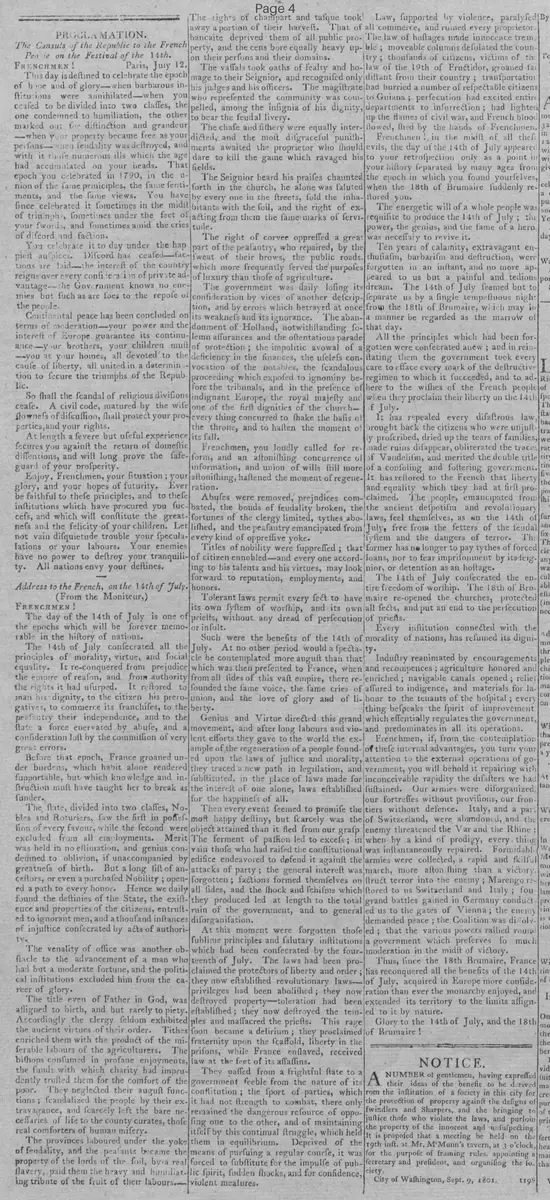
The Consuls of the Republic to the French People on the Festival of the 14th.
FRENCHMEN!
Paris, July 12.
This day is destined to celebrate the epoch of hope and of glory—when barbarous institutions were annihilated—when you ceased to be divided into two classes, the one condemned to humiliation, the other marked out for distinction and grandeur—when your property became free as your persons—when feudality was destroyed, and with it those numerous ills which the age had accumulated on your heads. That epoch you celebrated in 1790, in the union of the same principles, the same sentiments, and the same views. You have since celebrated it sometimes in the midst of triumph, sometimes under the feet of your swords, and sometimes amid the cries of discord and faction.
You celebrate it today under the happiest auspices. Discord has ceased—factions are laid—the interest of the country reigns over every consideration of private advantage—the Government knows no enemies but such as are foes to the repose of the people.
Continental peace has been concluded on terms of moderation—your power and the interest of Europe guarantee its continuance—your brothers, your children must—you at your homes, all devoted to the cause of liberty, all united in a determination to secure the triumphs of the Republic.
So shall the scandal of religious divisions cease. A civil code, matured by the wisdom of discussion, shall protect your properties and your rights.
At length a severe but useful experience secures you against the return of domestic dissensions, and will long prove the safeguard of your prosperity.
Enjoy, Frenchmen, your situation; your glory, and your hopes of futurity. Ever be faithful to those principles, and to those institutions which have procured you success, and which will constitute the greatness and the felicity of your children. Let not vain disquietude trouble your speculations or your labours. Your enemies have no power to destroy your tranquillity. All nations envy your destinies.
Address to the French, on the 14th of July.
(From the Moniteur,)
FRENCHMEN!
The day of the 14th of July is one of the epochs which will be forever memorable in the history of nations.
The 14th of July consecrated all the principles of morality, virtue, and social equality. It re-conquered from prejudice the empire of reason, and from authority the rights it had usurped. It restored to man his dignity, to the citizen his prerogatives, to commerce its franchises, to the peasantry their independence, and to the state a force enervated by abuse, and a consideration lost by the commission of very great errors.
Before that epoch, France groaned under burdens, which habit alone rendered supportable, but which knowledge and instruction must have taught her to break asunder.
The state, divided into two classes, Nobles and Roturiers, saw the first in possession of every favour, while the second were excluded from all employments. Merit was held in no estimation, and genius condemned to oblivion, if unaccompanied by greatness of birth. But a long list of ancestors, or even a purchased Nobility, opened a path to every honor. Hence we daily found the destinies of the State, the existence and properties of the citizens, entrusted to ignorant men, and a thousand instances of injustice consecrated by acts of authority.
The venality of office was another obstacle to the advancement of a man who had but a moderate fortune, and the political institutions excluded him from the career of glory.
The title even of Father in God, was assigned to birth, and but rarely to piety. Accordingly the clergy seldom exhibited the ancient virtues of their order. Tithes enriched them with the product of the miserable labours of the agriculturists. The bishops consumed in profane enjoyments the funds with which charity had imprudently trusted them for the comfort of the poor. They neglected their august functions; scandalized the people by their extravagance, and scarcely left the bare necessaries of life to the Country curates, those real comforters of human misery.
The provinces laboured under the yoke of feudality, and the peasants became the property of the lords of the soil, by a real slavery, paid them the heavy and humiliating tribute of the fruit of their labours.
The rights of champart and taigue took away a portion of their harvest. That of banalite deprived them of all public property, and the cens bore equally heavy upon their persons and their domains.
The vassals took oaths of fealty and homage to their Seignior, and recognised only his judges and his officers. The magistrate who represented the community was compelled, among the insignia of his dignity, to bear the feudal livery.
The chase and fishery were equally interdicted, and the most disgraceful punishments awaited the proprietor who should dare to kill the game which ravaged his fields.
The Seignior heard his praises chaunted forth in the church, he alone was saluted by every one in the streets, sold the inhabitants with the soil, and the right of exacting from them the same marks of servitude.
The right of corvee oppressed a great part of the peasantry, who repaired, by the sweat of their brows, the public roads, which more frequently served the purposes of luxury than those of agriculture.
The government was daily losing its consideration by vices of another description, and by errors which betrayed at once its weakness and its ignorance. The abandonment of Holland, notwithstanding solemn assurances and the ostentatious parade of protection; the impolitic avowal of a deficiency in the finances, the useless convocation of the notables, the scandalous proceeding which exposed to ignominy before the tribunals, and in the presence of indignant Europe, the royal majesty and one of the first dignities of the church—every thing concurred to shake the basis of the throne, and to hasten the moment of its fall.
Frenchmen, you loudly called for reform, and an astonishing concurrence of information, and union of wills still more astonishing, hastened the moment of regeneration.
Abuses were removed, prejudices combated, the bonds of feudality broken, the fortunes of the clergy limited, tythes abolished, and the peasantry emancipated from every kind of oppressive yoke.
Titles of nobility were suppressed; that of citizen ennobled—and every one according to his talents and his virtues, may look forward to reputation, employments, and honors.
Tolerant laws permit every sect to have its own system of worship, and its own priests, without any dread of persecution or insult.
Such were the benefits of the 14th of July. At no other period would a spectacle be contemplated more august than that which was then presented to France, when from all sides of this vast empire, there resounded the same voice, the same cries of union, and the love of glory and of liberty.
Genius and Virtue directed this grand movement, and after long labours and violent efforts they gave to the world the example of the regeneration of a people founded upon the laws of justice and morality. They traced a new path in legislation, and substituted, in the place of laws made for the interest of one alone, laws established for the happiness of all.
Then every event seemed to promise the most happy destiny, but scarcely was the object attained than it fled from our grasp. The ferment of passion led to excess; in vain those who had raised the constitutional edifice endeavored to defend it against the attacks of party; the general interest was forgotten; factions formed themselves on all sides, and the shock and claims which they produced led at length to the total ruin of the government, and to general disorganization.
At this moment were forgotten those sublime principles and salutary institutions which had been consecrated by the fourteenth of July. The laws had been proclaimed the protectors of liberty and order; they now established revolutionary laws—privileges had been abolished; they now destroyed property—toleration had been established; they now destroyed the temples and massacred the priests. This rage soon became a delirium; they proclaimed fraternity upon the scaffold, liberty in the prisons, while France enslaved, received law at the feet of its assassins.
They passed from a frightful state to a government feeble from the nature of its constitution; the sport of parties, which it had not strength to combat, there only remained the dangerous resource of opposing one to the other, and of maintaining itself by this continual struggle, which held them in equilibrium. Deprived of the means of pursuing a regular course, it was forced to substitute for the impulse of public spirit, sudden shocks, and for confidence, violent measures.
Law, supported by violence, paralyzed all commerce, and ruined every proprietor. The law of hostages made innocence tremble; moveable columns desolated the country; thousands of citizens, victims of the law of the 19th of Fructidor, groaned far distant from their country; transportation had hurried a number of respectable citizens to Guiana; persecution had excited entire departments to insurrection: had lighted up the flames of civil war, and French blood flowed, shed by the hands of Frenchmen.
Frenchmen! in the midst of all these evils, the day of the 14th of July appeared to your retrospection only as a point in your history separated by many ages from the epoch in which you found yourselves.
When the 18th of Brumaire suddenly restored you. The energetic will of a whole people was requisite to produce the 14th of July; the power, the genius, and the fame of a hero was necessary to revive it.
Ten years of calamity, extravagant enthusiasm, barbarism and destruction, were forgotten in an instant, and no more appeared to us but a painful and tedious dream. The 14th of July seemed but to separate us by a single tempestuous night from the 18th of Brumaire, which may in a manner be regarded as the morrow of that day.
All the principles which had been forgotten were consecrated anew; and in reinstating them the government took every care to efface every mark of the destructive regimen to which it succeeded, and to adhere to the wishes of the French people when they proclaimed their liberty on the 14th of July.
It has repealed every disastrous law, brought back the citizens who were unjustly proscribed, dried up the tears of families, made ruins disappear, obliterated the traces of Vandalism, and merited the double title of a consoling and fostering government.
It has restored to the French that liberty and equality which they had at first proclaimed. The people, emancipated from the ancient despotism and revolutionary laws, feel themselves, as on the 14th of July, free from the fetters of the feudal system and the dangers of terror. The former has no longer to pay tythes of forced loans, nor to fear imprisonment by its seignior, or detention as an hostage.
The 14th of July consecrated the entire freedom of worship. The 18th of Brumaire re-opened the churches, protected all sects, and put an end to the persecution of priests.
Every institution connected with the morality of nations, has resumed its dignity.
Industry reanimated by encouragements and recompences; agriculture honored and enriched; navigable canals opened; relief assured to indigence, and materials for labour to the tenants of the hospital; every thing bespeaks the spirit of improvement which essentially regulates the government, and predominates in all its operations.
Frenchmen, if, from the contemplation of these internal advantages, you turn your attention to the external operations of government, you will behold it repairing with inconceivable rapidity the disasters we had sustained. Our armies were disorganized, our fortresses without provisions, our frontiers without defence. Italy, and a part of Switzerland, were abandoned, and the enemy threatened the Var and the Rhine; when by a kind of prodigy, every thing was instantaneously repaired. Formidable armies were collected, a rapid and skilful march, more astonishing than a victory, struck terror into the enemy; Marengo restored to us Switzerland and Italy; four grand battles gained in Germany conducted us to the gates of Vienna; the enemy demanded peace; the Coalition was dissolved; that the various powers rallied round a government which preserves so much moderation in the midst of victory.
Thus, since the 18th Brumaire, France has reconquered all the benefits of the 14th of July, acquired in Europe more consideration than ever the monarchy enjoyed, and extended its territory to the limits assigned to it by nature.
Glory to the 14th of July, and the 18th of Brumaire!
What sub-type of article is it?
What keywords are associated?
What entities or persons were involved?
Where did it happen?
Foreign News Details
Primary Location
Paris
Event Date
July 12
Key Persons
Outcome
continental peace concluded; factions ceased; liberty and equality restored; military victories at marengo and in germany; coalition dissolved.
Event Details
Proclamation celebrating the 14th of July as the epoch of revolution destroying feudalism, nobility, and clerical abuses, restoring equality and rights; reflects on subsequent excesses and terror; praises the 18th Brumaire for reviving principles, repealing disastrous laws, restoring worship, industry, and military successes leading to peace.