Thank you for visiting SNEWPapers!
Sign up free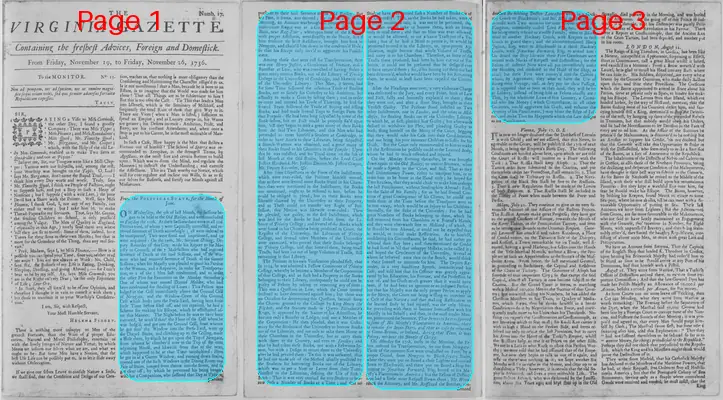
The Virginia Gazette
Richmond, Williamsburg, Richmond County, Virginia
What is this article about?
Report from the Political State for June on Old Bailey sessions in May: 106 tried, 7 capitally convicted (5 executed, 2 reprieved for transport), 58 transported, others fined/imprisoned/acquitted. Details Daniel Malden's escape and recapture; Henry Justice's conviction for stealing books from Cambridge libraries and sentencing to 7 years transportation; departure of felons to America.
Merged-components note: These components form a single continuous article on the Old Bailey sessions, convictions, escape, and transportation of felons, spanning pages 1-3 with direct text continuation.
Clippings
1 of 3
OCR Quality
Full Text
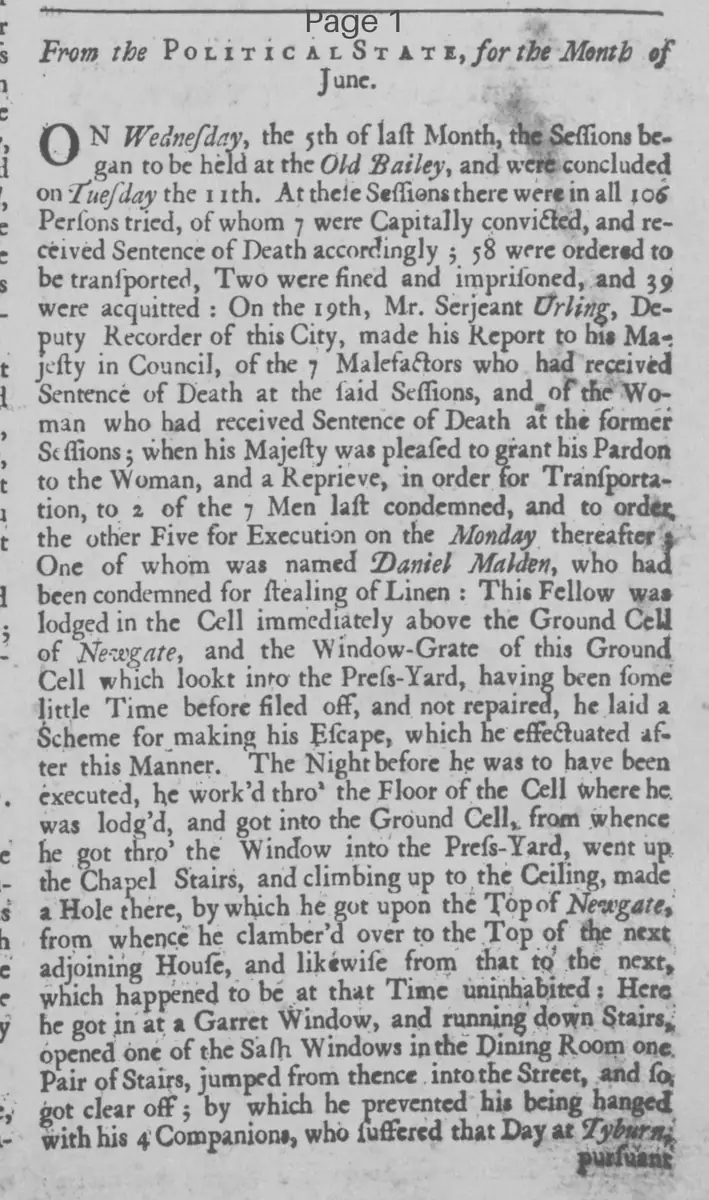
On Wednesday, the 5th of last Month, the Sessions began to be held at the Old Bailey, and were concluded on Tuesday the 11th. At these Sessions there were in all 106 Persons tried, of whom 7 were Capitally convicted, and received Sentence of Death accordingly; 58 were ordered to be transported, Two were fined and imprisoned, and 39 were acquitted: On the 19th, Mr. Serjeant Urlings, Deputy Recorder of this City, made his Report to his Majesty in Council, of the 7 Malefactors who had received Sentence of Death at the said Sessions, and of the Woman who had received Sentence of Death at the former Sessions; when his Majesty was pleased to grant his Pardon to the Woman, and a Reprieve, in order for Transportation, to 2 of the 7 Men last condemned, and to order the other Five for Execution on the Monday thereafter: One of whom was named Daniel Malden, who had been condemned for stealing of Linen: This Fellow was lodged in the Cell immediately above the Ground Cell of Newgate, and the Window-Grate of this Ground Cell which lookt into the Press-Yard, having been some little Time before filed off, and not repaired, he laid a Scheme for making his Escape, which he effectuated after this Manner. The Night before he was to have been executed, he work'd thro' the Floor of the Cell where he was lodg'd, and got into the Ground Cell, from whence he got thro' the Window into the Press-Yard, went up the Chapel Stairs, and climbing up to the Ceiling, made a Hole there, by which he got upon the Top of Newgate, from whence he clamber'd over to the Top of the next adjoining House, and likewise from that to the next, which happened to be at that Time uninhabited: Here he got in at a Garret Window, and running down Stairs, opened one of the Sash Windows in the Dining Room one Pair of Stairs, jumped from thence into the Street, and so got clear off; by which he prevented his being hanged with his 4 Companions, who suffered that Day at Tyburn: Pursuant to their said Sentence at the Old Bailey: But his Fate, it seems, was decreed; for on the 28th in the Morning, an Account was brought to Newgate, that this unfortunate Rogue was at a Gin-house on Salt Petre Bank, near Rag-Fair; whereupon some of the Keepers, with proper Assistants, went directly to the House, seized him without the least Resistance, brought him back to Newgate, and chained him down in the condemned Hole: So that his Escape only served to aggravate his Punishment.
Among those that were cast for Transportation, there was one Henry Fullice, a Gentleman of Fortune, and a Barrister at Law, who was convicted of having stolen a great many curious Books, out of the Library of Trinity College in the University of Cambridge, and likewise out of the University Library: This Man, it seems, had for some Time followed the infamous Trade of stealing Books, not to satisfy his Curiosity or his Ambition, but actually to make a Gain by selling them; and in order to cover and conceal his Trade of Thieving, he had for several Years followed the Trade of buying and selling Books, and had made several Trips to foreign Parts for that Purpose: He had been long suspected by some of the Book-sellers, but no Fact could be properly fixed upon him, 'till they began to miss a great many of their Books from the said Two Libraries, and this Man who had pretended to enter himself a Student at Cambridge, in order to have Access to their Libraries, being suspected, a Search-Warrant was obtained, and a great many of their Books found at his Chambers in the Temple: Upon this he was indicted, and his Trial came on the 8th of last Month at the Old-Bailey, before the Lord Chief Justice Hardwick, Mr. Justice Denton, Mr. Justice Comyns, Mr. Deputy Recorder, &c.
After some Objections to the Form of the Indictment, which were over-ruled, the Prisoner himself moved, that as there were several more Books seized in his Chambers than were mentioned in the Indictment, the Books not mentioned, ought to be restored to him, before he could be obliged to plead; but as these Books were likewise claimed by the University as their Property, and as Theft could not transfer any Right of Possession, this Motion was likewise over-ruled: Then he pleaded, not guilty, to the first Indictment, which was laid for the Books he had stolen from the Library of Trinity College; and several of the Books which were found in his Chambers being produced in Court, the Register of the University, the Librarian of Trinity College, and several other Members of the University were examined, who proved that these Books belonged to Trinity College, and that some of them, being small Tracts, had been cut out of large Volumes of Tracts, still remaining in that Library.
The Prisoner in his own Vindication pleaded first, that in 1734, he was admitted a Fellow Commoner of Trinity College, whereby he became a Member of the Corporation of that College, and as such had a Property in the Books belonging to their Library, consequently he could not be guilty of Felony by taking or removing any of them: This was a Question in Law, which the Court seemed inclined to have determined against him; but there was no Occasion for determining this Question, because from the Charter granted to the College by King Henry the Eighth, and the Statutes made in Queen Elizabeth's Reign, it appeared by the Nature of his Admission, he became only a Boarder or Lodger, and not a Member of the Corporation: He then pleaded, that it was Customary for the Students of that University to borrow Books out of the Libraries, and not only to take them Home to their Chambers in the University, but to carry them with them to the Country, and even to London; and that he had taken these Books, not with a Felonious Intent, but with a Design to return them to the University after he had perused them: To this it was answered, that he had not made use of the Method usually practiced by the Students for borrowing Books out of the Library, which was to get a Note or Letter from their Tutor, directed to the Librarian, desiring the Use of such a Book: That it was very unusual for any Student to borrow such a Number of Books at a Time; and that no Student have ever carried such a Number of Books out of the University: That, as the Books he had taken, were of so many various Kinds, it was not to be presumed, that any Man would take or borrow them, with an Intent only to read them; and that no Man was ever allowed, or would be allowed, to cut a scarce Tract out of a Volume; but if he had a Mind to peruse it, he would be permitted to read it in the Library, or, upon proper Application, might borrow that whole Volume of Tracts, and carry it to his Chambers: Therefore, as some of the Tracts there produced, had been by him cut out of Volumes, it could not be presumed that he designed ever to have returned them; for, if his having cut them out had been discovered, which it would have been by his Returning them, he would at least have been expelled the University.
After the Pleadings were over, a very elaborate Charge was delivered to the Jury, and every Point, both of Law and Fact, fully and learnedly explained to them; then they went out, and after a short Stay, brought in their Verdict Guilty. The Prisoner stood indicted on Two other Indictments, one in London, and the other in Middlesex, for stealing Books out of the University Library, to which he, at first, pleaded Not Guilty; but afterwards desired to withdraw his Plea, and pleading Guilty to both, flung himself on the Mercy of the Court, begging that they would take his Case into their Consideration, and not bring his poor innocent Children to suffer for his Guilt. But the Court only recommended to him to make all the Restitution he possibly could to the Learned Body, whom he had so much offended and injured.
On the Monday Evening thereafter, he was brought down again to the Old Bailey, to receive Sentence, when he made a Speech to the Court, and said, That as they had Discretionary Power, either to transport him, or to order him to be burnt in the Hand only; he hoped for Two Reasons, that they would choose to make him undergo the last Punishment, without Sending him Abroad: First, for the Sake of his Family; for as he had several Concerns of great Consequence of his Clients, he could not settle them in the Time before the Transports were to be sent away, which would be an Injury to his Children: Secondly, for the Sake of the University: For he had great Numbers of Books belonging to them, which he first removed from his Chambers to a Friend's Hands, and they were afterwards sent to Holland; of which, if he should be sent Abroad, it could not be expected that he would, or could make Restitution. As to himself, considering his Circumstances, he said, he had rather go Abroad than stay here; and then mentioned the Credit he had lived in 'til that unhappy Mistake, as he called it: and hoped the Gentlemen of the University, several of whom he believed were then on the Bench, would think it their Interest to intercede for him. The Deputy Recorder, in a very handsome Speech, commiserated his Case, and told him that his Offence was greatly aggravated by his Education, his Fortune, and the Profession he was of, and his Guilt much greater than it would have been, if he had been an ignorant or an indigent Person; but that his Majesty was the only proper Person to apply to for Mercy, the Court not being willing to interfere in a Case of that Nature; and that making Restitution to the learned Body he had injured, was the only Means for prevailing with them to become Intercessors with his Majesty in his Behalf; and then, in the most tender Manner, pronounced the Sentence, That he was to be transported to Some of His Majesty's Plantations in America, there to remain for Seven Years, and that in case he returned to Great-Britain, or Ireland, during that Time, it was Felony, without the Benefit of Clergy.
On Monday the 17th, early in the Morning, the Felons ordered for Transportation, set out from Newgate: Those of the common Sort were conducted on Foot, by a proper Guard, from Newgate to Black-fryars Stairs, where they were put on Board a close Lighter and carried down to Blackwall, and there put on Board a Ship belonging to Jonathan Forward, Esq; bound to his Majesty's Plantations in America; but the Felons of Distinction had a little more Respect Shewn them; Mr. Wreathock the Attorney, and Mr. Ruffhead the Butcher, condemned for robbing Doctor Lancaster, went in a Hackney Coach to Blackwall; and Mr. Bird the Bailiff, condemned with Two more for the same Robbery, and Mr. Vaughan, commonly called Lord Vaughan, because of his being nearly related to a noble Family, went to Blackwall in another Hackney Coach, with Keepers in each Coach to guard them; and the above-mentioned Henry Justice, Esq; went to Blackwall in a third Hackney Coach, with Jonathan Forward, Esq; to attend him:
On Board the Ship likewise these Five Gentlemen were treated with Marks of Respect and Distinction; for the Felons of inferior Note were all put immediately under the Hatches, and confined in the Hold of the Ship, as usual, but these Five were convey'd into the Cabbin; which, by Agreement, they were to have the Use of during their Voyage; and, as they pay for their Passage, it is supposed that as soon as they land, they will be set at Liberty, instead of being sold as Felons usually are:
Thus, by the wholsome Laws of this Country, a Criminal who has Money (which Circumstance, in all other Countries, would aggravate his Guilt, and enhance the Severity of his Punishment,) may blunt the Edge of Justice, and make That his Happiness which the Law designs as his Punishment.
What sub-type of article is it?
What keywords are associated?
What entities or persons were involved?
Where did it happen?
Foreign News Details
Primary Location
London
Event Date
5th To 11th Of Last Month (May), Reported In June
Key Persons
Outcome
106 tried: 7 capitally convicted (5 executed at tyburn, 1 woman pardoned, 2 men reprieved for transportation); 58 transported to america for 7 years; 2 fined and imprisoned; 39 acquitted. malden recaptured and punished. justice convicted of felony theft, sentenced to 7 years transportation.
Event Details
Old Bailey sessions held from May 5-11, with trials, convictions, and sentences. Report to the King on May 19 resulted in pardons, reprieves, and orders for execution. Daniel Malden escaped from Newgate night before execution, recaptured on 28th at a gin-house. Detailed trial of Henry Justice (Fullice) for stealing and selling books from Cambridge libraries, convicted despite defenses, sentenced to transportation on Monday after trial. Felons transported on June 17, with distinguished ones like Justice treated better.