Thank you for visiting SNEWPapers!
Sign up free
Story
January 10, 1862
Delaware State Journal And Statesman
Wilmington, New Castle County, Delaware
What is this article about?
Union forces under Gen. Stevens launched a surprise attack on Confederate positions at Port Royal Ferry, S.C., on January 1, 1862, dislodging the enemy, capturing a gun, and inflicting heavy losses with minimal Union casualties.
Clipping
OCR Quality
98%
Excellent
Full Text
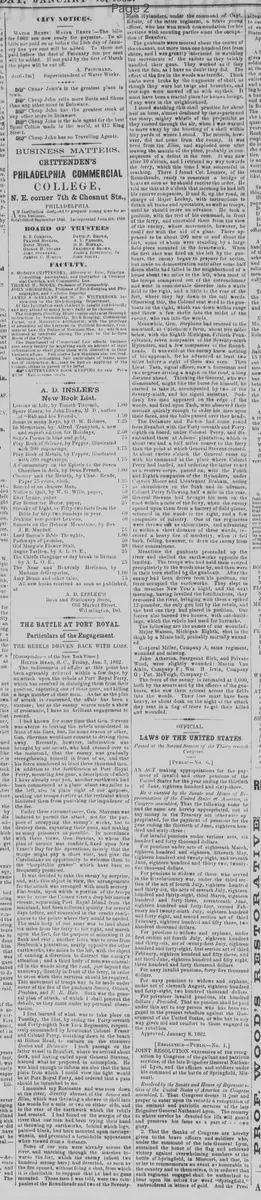
THE BATTLE AT PORT ROYAL.
Particulars of the Engagement.
THE REBELS DRIVEN BACK WITH LOSS.
[Correspondence of the New York Times]
HILTON HEAD, S. C., Friday, Jan. 8, 1862.
The tediousness of affairs at this point has been agreeably relieved within a few days, by an attack upon the rebels at Port Royal Ferry, which has resulted in dislodging them from their position, capturing one of their guns, and killing a large number of their men. As far as the plan of attack is concerned, the affair has been a success; but as the enemy scarce made a show of resistance, I have no brilliant engagement to record.
I had known for some time that Gen. Stevens was averse to leaving the rebels unmolested in front of his lines, but, for some reason or other, Gen. Sherman would not consent to driving them away. Recently, however, information was brought by our scouts, who had crossed over to the mainland, that the enemy was gradually strengthening himself in front of us, and that his force numbered at least three thousand men. In addition to the fortification at Port Royal Ferry, mounting five guns, a description of which I have already sent you, another earthwork had been commenced at a place about two miles to the left, also in plain sight of our outposts, making our troops restive at the restraint which hindered them from punishing the impudence of the foe.
Under these circumstances, Gen. Sherman was induced to permit the attack, not for the purpose of occupying the enemy's works, but to destroy them, capturing their guns, and making as many prisoners as possible. In accordance with these views, Gen. Stevens, to whom the plan of assault was confided, fixed upon New Year's Day for his operations, merely that the troops might pay a short visit, and give the Carolinians an opportunity to welcome them to the "hospitable graves" which have been so frequently promised.
It was decided to take the enemy by surprise, and, with this object in view, the arrangements for the attack was arranged with much secrecy. Flat-boats, upon which a portion of the troops was to cross the Coosaw river—a deep but narrow stream, separating Port Royal Island from the mainland, had been collected quietly for several days before, and concealed in the creeks contiguous to the points where they would be needed. The main body of our army was to land about six miles from the ferry to the right, and march upon the fort, for the purpose of attacking it in flank and rear; another force was to cross from Seabrook's plantation, nearly opposite the other earthworks, two miles to the left, with the object of causing a diversion to distract the enemy's attention; and a third body of men was concealed in the woods along the road, just beyond the causeway, directly in front of the ferry, in order to cross when their services should be required. This movement of troops was to be made under cover of the fire of the gunboats Seneca, Ottawa, Pembina, and E. B. Hale. Such was the general plan of attack, of which I shall present the details, as they came under my personal observation.
I first learned of what was to take place on Tuesday, the 31st, by seeing the Forty-seventh and Forty-eighth New York Regiments, respectively commanded by Lieutenant Colonel Fraser and Colonel Perry, marching down to the beach at Hilton Head, to embark on the steamers Boston and Delaware. I took passage on the latter vessel to Beaufort, where we arrived about dark, and having called upon General Stevens, learned what he proposed to accomplish. He was kind enough to inform me also that the best place from which I could view the fight would be at Port Royal Ferry, and ordered that a pass should be furnished to me.
I mounted my Rosinante and was soon down at the river, directly abreast of the Seneca and Ellen, which was throwing a shower of shell into the woods for a mile or two on either side, and in the rear of the earthwork which the rebels had erected. I had found on the margin of the river that our men had been trying their hand at throwing up earthworks, behind which logs, painted black, had been mounted upon carriage-wheels, and presented a formidable appearance when viewed from a distance.
Some of our men were already across the river, and marching through the marshes towards the fort, which the enemy (about two hundred strong here) had deserted, as soon as the fire opened, without firing a shot, from which it is charitable to suppose that he had no guns mounted. These men I was told, were two companies of the Roundheads and two of the Seventy-ninth Highlanders, under the command of Capt. Elliott, of the latter regiment, a brave young officer, who has won much commendation for his services with scouting parties since the occupation of Beaufort.
The gunboats were moored about the centre of the channel, not more than one hundred feet from shore, and I was greatly interested in watching the movements of the sailors as they briskly handled their guns. They worked as if they liked the fun, as I have no doubt they did. The effect of the fire in the woods was terrific. Thick limbs were broke by the fragments of shell, as though they were but twigs and branches, and tree tops were mowed off as with scythes. It must have been a fearful place for human beings, if any were in the neighborhood.
of his approach, for he advanced at least two miles before a sight of them was seen. Then Lieut. Tash, signal officer, saw a horseman and two negroes driving a wagon on the road, a long distance ahead. Thinking the General, who was dismounted, might like the horse for himself, he started to take it, accompanied by two of the Seventy-ninth, and his signal assistant. Suddenly five men appeared on the edge of the woods, and fired upon Tash, who observed their motions quickly enough to order his men upon their knees. The balls passed over their heads.
The Delaware and Boston had come round from Beaufort with the Forty-seventh and Forty-eighth on board, under Colonel Perry, and disembarked them at Barnwell's plantation, which is about two and a half miles nearer to the ferry than the point at which General Stevens crossed. At about twelve o'clock the General came up with his command at the place where Colonel Perry had landed, and ordering the latter to act as a reserve corps, pushed on, with the Fourth and Eighth companies of the Highlanders, under Captain Moore and Lieutenants Brubaker, acting as skirmishers on the flank and in advance, Colonel Perry following half a mile in the rear.
General Stevens had brought his men on the road within a mile of the ferry, when the enemy opened upon them from a battery of field-pieces, secreted in the woods to the right, and a few companies of infantry. One of the regiments were thrown out as skirmishers, and advancing to within a short distance of these woods, received a heavy fire of musketry, when it fell back, failing, however, to draw the enemy from their concealment.
Meantime the gunboats proceeded up the river and shelled the earthworks opposite the landing. The troops who had held these retired precipitately to the woods near by, and then were in their turn shelled by the gunboats. After the enemy had been driven from his position, our force occupied the earthworks. They slept in the trenches New Year's night, and the next morning, having levelled the fortifications, they recrossed the river, bringing with them a spiked 12-pounder, the only gun left by the rebels, and the best one they had placed in position. Our forces also burned two houses, with out-buildings, which the rebels had used for barracks.
The following are the names of our wounded:
Major Watson, Michigan Eighth, shot in the thigh by a Minie ball, probably mortally wounded.
Corporal Miller, Company A, same regiment, wounded and missing.
John Atherton, Sergeant Rich, and Private Wood, were slightly wounded: Martin Van Aikin, Company F; Wm. H. Irvin, Company G; Pat. McVeigh, Company C.
The force of the enemy is estimated at 3,000, both by the scouts and by the officers of the gunboats, who saw them retreat across the fields into the woods. Their loss must have been heavy, as about dusk on the night of the attack they sent in a flag of truce to get their killed and wounded.
Particulars of the Engagement.
THE REBELS DRIVEN BACK WITH LOSS.
[Correspondence of the New York Times]
HILTON HEAD, S. C., Friday, Jan. 8, 1862.
The tediousness of affairs at this point has been agreeably relieved within a few days, by an attack upon the rebels at Port Royal Ferry, which has resulted in dislodging them from their position, capturing one of their guns, and killing a large number of their men. As far as the plan of attack is concerned, the affair has been a success; but as the enemy scarce made a show of resistance, I have no brilliant engagement to record.
I had known for some time that Gen. Stevens was averse to leaving the rebels unmolested in front of his lines, but, for some reason or other, Gen. Sherman would not consent to driving them away. Recently, however, information was brought by our scouts, who had crossed over to the mainland, that the enemy was gradually strengthening himself in front of us, and that his force numbered at least three thousand men. In addition to the fortification at Port Royal Ferry, mounting five guns, a description of which I have already sent you, another earthwork had been commenced at a place about two miles to the left, also in plain sight of our outposts, making our troops restive at the restraint which hindered them from punishing the impudence of the foe.
Under these circumstances, Gen. Sherman was induced to permit the attack, not for the purpose of occupying the enemy's works, but to destroy them, capturing their guns, and making as many prisoners as possible. In accordance with these views, Gen. Stevens, to whom the plan of assault was confided, fixed upon New Year's Day for his operations, merely that the troops might pay a short visit, and give the Carolinians an opportunity to welcome them to the "hospitable graves" which have been so frequently promised.
It was decided to take the enemy by surprise, and, with this object in view, the arrangements for the attack was arranged with much secrecy. Flat-boats, upon which a portion of the troops was to cross the Coosaw river—a deep but narrow stream, separating Port Royal Island from the mainland, had been collected quietly for several days before, and concealed in the creeks contiguous to the points where they would be needed. The main body of our army was to land about six miles from the ferry to the right, and march upon the fort, for the purpose of attacking it in flank and rear; another force was to cross from Seabrook's plantation, nearly opposite the other earthworks, two miles to the left, with the object of causing a diversion to distract the enemy's attention; and a third body of men was concealed in the woods along the road, just beyond the causeway, directly in front of the ferry, in order to cross when their services should be required. This movement of troops was to be made under cover of the fire of the gunboats Seneca, Ottawa, Pembina, and E. B. Hale. Such was the general plan of attack, of which I shall present the details, as they came under my personal observation.
I first learned of what was to take place on Tuesday, the 31st, by seeing the Forty-seventh and Forty-eighth New York Regiments, respectively commanded by Lieutenant Colonel Fraser and Colonel Perry, marching down to the beach at Hilton Head, to embark on the steamers Boston and Delaware. I took passage on the latter vessel to Beaufort, where we arrived about dark, and having called upon General Stevens, learned what he proposed to accomplish. He was kind enough to inform me also that the best place from which I could view the fight would be at Port Royal Ferry, and ordered that a pass should be furnished to me.
I mounted my Rosinante and was soon down at the river, directly abreast of the Seneca and Ellen, which was throwing a shower of shell into the woods for a mile or two on either side, and in the rear of the earthwork which the rebels had erected. I had found on the margin of the river that our men had been trying their hand at throwing up earthworks, behind which logs, painted black, had been mounted upon carriage-wheels, and presented a formidable appearance when viewed from a distance.
Some of our men were already across the river, and marching through the marshes towards the fort, which the enemy (about two hundred strong here) had deserted, as soon as the fire opened, without firing a shot, from which it is charitable to suppose that he had no guns mounted. These men I was told, were two companies of the Roundheads and two of the Seventy-ninth Highlanders, under the command of Capt. Elliott, of the latter regiment, a brave young officer, who has won much commendation for his services with scouting parties since the occupation of Beaufort.
The gunboats were moored about the centre of the channel, not more than one hundred feet from shore, and I was greatly interested in watching the movements of the sailors as they briskly handled their guns. They worked as if they liked the fun, as I have no doubt they did. The effect of the fire in the woods was terrific. Thick limbs were broke by the fragments of shell, as though they were but twigs and branches, and tree tops were mowed off as with scythes. It must have been a fearful place for human beings, if any were in the neighborhood.
of his approach, for he advanced at least two miles before a sight of them was seen. Then Lieut. Tash, signal officer, saw a horseman and two negroes driving a wagon on the road, a long distance ahead. Thinking the General, who was dismounted, might like the horse for himself, he started to take it, accompanied by two of the Seventy-ninth, and his signal assistant. Suddenly five men appeared on the edge of the woods, and fired upon Tash, who observed their motions quickly enough to order his men upon their knees. The balls passed over their heads.
The Delaware and Boston had come round from Beaufort with the Forty-seventh and Forty-eighth on board, under Colonel Perry, and disembarked them at Barnwell's plantation, which is about two and a half miles nearer to the ferry than the point at which General Stevens crossed. At about twelve o'clock the General came up with his command at the place where Colonel Perry had landed, and ordering the latter to act as a reserve corps, pushed on, with the Fourth and Eighth companies of the Highlanders, under Captain Moore and Lieutenants Brubaker, acting as skirmishers on the flank and in advance, Colonel Perry following half a mile in the rear.
General Stevens had brought his men on the road within a mile of the ferry, when the enemy opened upon them from a battery of field-pieces, secreted in the woods to the right, and a few companies of infantry. One of the regiments were thrown out as skirmishers, and advancing to within a short distance of these woods, received a heavy fire of musketry, when it fell back, failing, however, to draw the enemy from their concealment.
Meantime the gunboats proceeded up the river and shelled the earthworks opposite the landing. The troops who had held these retired precipitately to the woods near by, and then were in their turn shelled by the gunboats. After the enemy had been driven from his position, our force occupied the earthworks. They slept in the trenches New Year's night, and the next morning, having levelled the fortifications, they recrossed the river, bringing with them a spiked 12-pounder, the only gun left by the rebels, and the best one they had placed in position. Our forces also burned two houses, with out-buildings, which the rebels had used for barracks.
The following are the names of our wounded:
Major Watson, Michigan Eighth, shot in the thigh by a Minie ball, probably mortally wounded.
Corporal Miller, Company A, same regiment, wounded and missing.
John Atherton, Sergeant Rich, and Private Wood, were slightly wounded: Martin Van Aikin, Company F; Wm. H. Irvin, Company G; Pat. McVeigh, Company C.
The force of the enemy is estimated at 3,000, both by the scouts and by the officers of the gunboats, who saw them retreat across the fields into the woods. Their loss must have been heavy, as about dusk on the night of the attack they sent in a flag of truce to get their killed and wounded.
What sub-type of article is it?
Military Action
Historical Event
Naval Engagement
What themes does it cover?
Triumph
Bravery Heroism
What keywords are associated?
Battle Port Royal
Union Attack
Confederate Retreat
Gunboat Support
Civil War Engagement
Gen Stevens
What entities or persons were involved?
Gen. Stevens
Gen. Sherman
Colonel Perry
Capt. Elliott
Lieut. Tash
Major Watson
Where did it happen?
Port Royal Ferry, S.C.
Story Details
Key Persons
Gen. Stevens
Gen. Sherman
Colonel Perry
Capt. Elliott
Lieut. Tash
Major Watson
Location
Port Royal Ferry, S.C.
Event Date
January 1, 1862
Story Details
Union forces under Gen. Stevens surprised and attacked Confederate earthworks at Port Royal Ferry, supported by gunboats; rebels retreated with heavy losses, Union captured a 12-pounder gun and destroyed fortifications with light casualties.