Thank you for visiting SNEWPapers!
Sign up free
The Liberator
Boston, Suffolk County, Massachusetts
What is this article about?
Leander Eaton defends his protest against the 'war spirit' at Captain Lincoln's funeral during the Mexican War, displaying a placard 'No homage paid to murderers.' He argues that Christians bear responsibility for supporting war, which violates biblical commands like 'thou shalt not kill,' and urges them to actively oppose it through actions and disfellowship.
Clipping
OCR Quality
Full Text
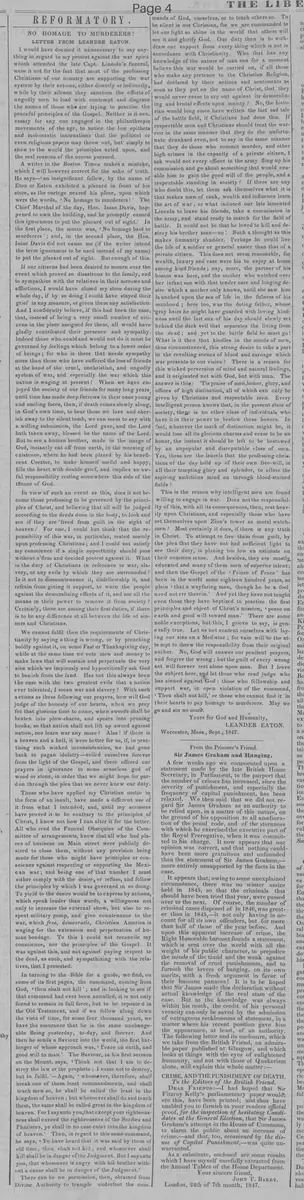
NO HOMAGE TO MURDERERS!
LETTER FROM LEANDER EATON.
I would have deemed it unnecessary to say anything in regard to my protest against the war spirit which attended the late Capt. Lincoln's funeral, were it not for the fact that most of the professing Christians of our country are supporting the war system by their actions, either directly or indirectly, while by their silence they sanction the efforts of ungodly men to load with contempt and disgrace the names of those who are trying to practise the peaceful principles of the Gospel. Neither is it necessary for any one engaged in the philanthropic movements of the age, to notice the low epithets and mobocratic insinuations that the political or even religious papers may throw out, but simply to show to the world the principles acted upon, and the real reasons of the course pursued.
A writer in the Boston Times makes a mistake, which I will however correct for the sake of truth. He says—'an insignificant fellow, by the name of Eton or Eaton exhibited a placard in front of his store, as the cortege neared his place, upon which were the words, No homage to murderers!' The Chief Marshal of the day, Hon. Isaac Davis, happened to own the building, and he promptly caused this ignoramus to put the placard out of sight.' In the first place, the motto was, 'No homage paid to murderers'; and, in the second place, the Hon. Isaac Davis did not cause me (if the writer intend the term ignoramus to be used instead of my name) to put the placard out of sight. But enough of this.
If our citizens had been desired to mourn over the event which proved so disastrous to the family, and to sympathize with the relatives in their sorrows and afflictions, I would have closed my store during the whole day, if by so doing I could have stayed their grief in any measure, or given them any satisfaction. And I confidently believe, if this had been the case, that, instead of being a very small number of citizens in the place assigned for them, all would have gladly contributed their presence and sympathy. Indeed those who could and would not do it must be governed by feelings which belong to a lower order of beings; for who is there that needs sympathy more than those who have suffered the loss of friends at the hand of the cruel, unchristian, and ungodly system of war, and especially the war which this nation is waging at present? When we have enjoyed the society of our friends for many long years until time has made deep furrows in their once young and smiling faces, then, if death comes slowly along, in God's own time, to bear those we love and cherish away to the silent tomb, we can seem to say with a willing submission, the Lord gave, and the Lord hath taken away, blessed be the name of the Lord. But to see a human brother, made in the image of God, instantly cut off from earth, in the morning of existence, where he had been placed by his beneficient Creator, to make himself useful and happy, fills the heart with double grief, and implies an awful responsibility resting somewhere this side of the throne of God.
In view of such an event as this, does it not become those professing to be governed by the principles of Christ, and believing that all will be judged according to the deeds done in the body, to look and see if they are freed from guilt in the sight of heaven? For one, I could but think that the responsibility of this war, in particular, rested mainly upon professing Christians; and I could not satisfy my conscience if a single opportunity should pass without a firm and decided protest against it. What is the duty of Christians in reference to war, slavery, or any evils by which they are surrounded? Is it not to discountenance it, disfellowship it, and refrain from giving it support, to warn the people against the demoralizing effects of it, and use all the means in their power to remove it from society? Certainly, these are among their first duties, if there is to be any difference at all between the life of sinners and Christians.
We cannot fulfil the requirements of Christianity by saying a thing is wrong, or by preaching boldly against it, on some Fast or Thanksgiving day, while at the same time we vote men and money to make laws that will sustain and perpetuate the very sins which we impiously and hypocritically ask God to banish from the land. Has not this always been the case with the two greatest evils that a nation ever tolerated, I mean war and slavery? With such actions as these following our prayers, how will God judge of the honesty of our hearts, when we pray for that glorious time to come, when swords shall be beaten into plow-shares, and spears into pruning hooks, so that nation shall not lift up sword against nation, nor learn war any more? Alas! if there is a heaven and a hell, it were better for us, if, in practising such wicked inconsistencies, we had gone back to pagan idolatry—veiled ourselves forever from the light of the Gospel, and there offered our prayers in ignorance to some senseless god of wood or stone, in order that we might hope for pardon through the plea that we never knew our duty
Those who have applied my Christian motto in the form of an insult, have made a different use of it from what I intended, and, until my accusers have proved it to be contrary to the principles of Christ, I know not how I can alter it for the better. All who read the Funeral Obsequies of the Committee of arrangements, know that all who had places of business on Main street were publicly desired to close them, without any provision being made for those who might have principles or conscience against respecting or supporting the Mexican war; and being one of that number I must either comply with the desire, or refuse, and follow the principles by which I was governed in so doing. To yield to the desire would be to express by actions, which speak louder than words, a willingness not only to increase the external show, but also to respect military pomp, and give countenance to the war, which free, democratic, Christian America is waging for the extension and perpetuation of human bondage. To this I could not reconcile my conscience, nor the principles of the Gospel. It was against this, and not against paying respect to the dead, as such, and sympathizing with the relatives, that I protested.
In turning to the Bible for a guide, we find, on some of its first pages, the command, coming from God, 'thou shalt not kill'; and in looking to see if that command had ever been annulled, it is not only found to remain in full force, but to be repeated in the Old Testament, and if we follow along down the vista of time, for some four thousand years, we have the assurance that he is the same unchangeable Being yesterday, to-day, and forever. And then he sends a Saviour into the world, the first harbinger of whose approach was, Peace on earth, and good will to man.' The Saviour, in his first sermon on the Mount, says, 'Think not that I am to destroy the law or the prophets; I came not to destroy, but to fulfil.'—Again, 'whosoever, therefore, shall break one of these least commandments, and shall teach men so, he shall be called the least in the kingdom of heaven; but whosoever shall do and teach them, the same shall be called great in the kingdom of heaven. For I say unto you, that except your righteousness shall exceed the righteousness of the Scribes and Pharisees, ye shall in no case enter into the kingdom of heaven.' Then, in regard to this same command he says, Ye have heard that it was said by them of old time, thou shalt not kill; and whosoever shall kill shall be in danger of the Judgment. But I say unto you, that whosoever is angry with his brother without a cause shall be in danger of the Judgment.'
There can be no permission, then, obtained from Divine Authority to trample underfoot the commands of God, ourselves, or to teach others so. To be silent is not Christian, for we are commanded to let our light so shine in the world that others will see it and glorify God. Our duty then is to withdraw our support from every thing which is not in accordance with Christianity. Who that has any knowledge of the nature of man can for a moment believe this war would be carried on, if all those who make any pretence to the Christian Religion, had declared by their actions and sentiments as soon as they put on the name of Christ, that they would never cease to cry out against its demoralizing and brutal effects upon society? No, the historian would long since have written the last sad tale of the battle field, if Christians had done this. If respectable men and Christians should treat the warrior in the same manner that they do the unfortunate drunkard even, not to say in the same manner that they do those who commit murder, and other high crimes in the capacity of a private citizen, I ask would not every officer in the army fling up his commission and go about something that would enable him to gain the good will of the people, and a respectable standing in society? If there are any who doubt this, let them ask themselves what it is that makes men of rank, wealth and influence learn the art of war; or what induced our late lamented Lincoln to leave his friends, take a commission in the army, and stand ready to march for the field of battle. It could not be that he loved to kill and destroy his brother man—no! Such a thought as this makes humanity shudder. Perhaps he could live the life of a soldier or general easier than that of a private citizen. This does not seem reasonable, for wealth, luxury and ease were his to enjoy at home among kind friends; nay, more, the partner of his bosom was here, and the mother who watched over her infant son with that tender care and longing desire which a mother only knows, until she saw him launched upon the sea of life in the fulness of his manhood; here too, was the doting father, whose gray hairs he might have guarded with loving kindness until the last sun of his day should slowly set behind the dark veil that separates the living from the dead; and yet to the battle field he must go!
What is it then that kindles in the minds of men, thus circumstanced, this strong desire to take a part in the revolting scenes of blood and carnage which war presents to our vision? There is a reason for this wicked perversion of mind and natural feelings, and it originated not with God, but with man. The answer is this: 'Tis praise of men, honor, glory, and offices of high distinction, all of which can only be given by Christians and respectable men. Every intelligent person knows that, in the present state of society, there is no other class of individuals who have it in their power to bestow these honors. In fact, whatever the mark of distinction might be, it would lose all its glorious charms and cease to be an honor, the instant it should be left to be bestowed by an unpopular and disreputable class of men. Yes, these are the laurels that the professing christians of the day hold up of their own free-will, in all their tempting glory and splendor, to allure the aspiring ambitious mind on through blood-stained fields!
This is the reason why intelligent men are found willing to engage in war. Does not the responsibility of this, with all its consequences, then, rest heavily upon Christians, and especially those who have set themselves upon Zion's tower as moral watchmen? Most certainly it does, if there is any truth in Christ. To attempt to free them from guilt, by the plea that they have not had sufficient light to see their duty, is placing too low an estimate on their common sense. And besides, they are mostly educated and many of them men of superior talent; and then the Gospel of the Prince of Peace has been in the world some eighteen hundred years, so plain 'that a wayfaring man, though he be a fool need not err therein.' And yet they have not taught even those they have baptized to practise the first principles and object of Christ's mission, 'peace on earth and good will toward man.' There are some noble exceptions, but this, I grieve to say, is generally true. Let us not content ourselves with laying our sins on a Mediator; for vain will be the attempt to throw the responsibility from their original author. No, God will answer our penitent prayers, and forgive the wrong; but the guilt of every wrong act will forever rest alone upon man. But I leave the subject here, and let those who read judge who has sinned against God: those who fellowship and support war, in open violation of the command, 'Thou shalt not kill,' or those who cannot find it in their hearts to pay homage to murderers. May we go and sin no more.
Yours for God and Humanity,
LEANDER EATON.
Worcester, Mass., Sept., 1847.
What sub-type of article is it?
What themes does it cover?
What keywords are associated?
What entities or persons were involved?
Letter to Editor Details
Author
Leander Eaton
Main Argument
christians must actively protest and withdraw support from the mexican war, as it violates the biblical commandment 'thou shalt not kill' and contradicts christ's teachings of peace; paying homage to military figures like the deceased captain lincoln endorses this unchristian system.
Notable Details