Thank you for visiting SNEWPapers!
Sign up free
Letter to Editor
August 3, 1809
Alexandria Daily Gazette, Commercial & Political
Alexandria, Virginia
What is this article about?
An anonymous letter defends British minister David Erskine's diplomatic efforts to resolve US-British tensions over trade restrictions and orders in council, arguing he adhered to ambiguous instructions from George Canning, while criticizing the British government's insincerity and constitutional overreach.
Clipping
OCR Quality
98%
Excellent
Full Text
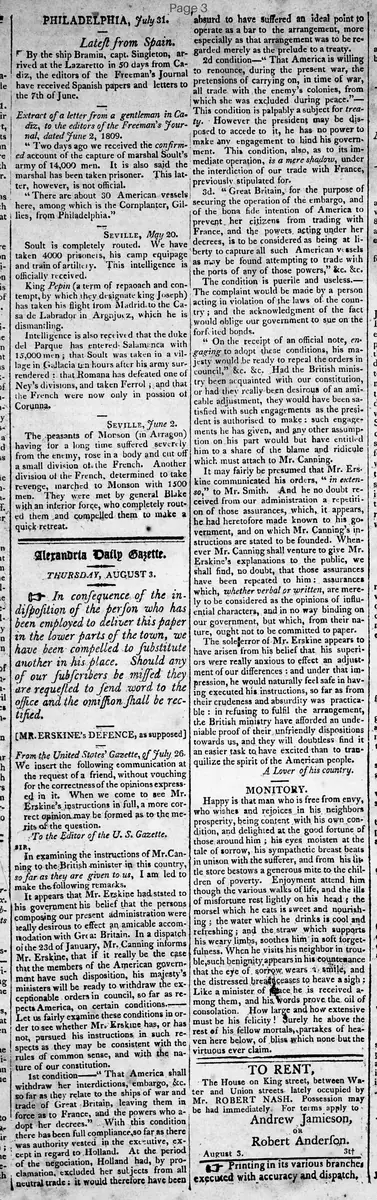
[MR. ERSKINE'S DEFENCE, as supposed]
From the United States' Gazette, of July 26.
We insert the following communication at the request of a friend, without vouching for the correctness of the opinions expressed in it. When we come to see Mr. Erskine's instructions in full, a more correct opinion may be formed as to the merits of the question.
To the Editor of the U. S. Gazette.
SIR,
In examining the instructions of Mr. Canning to the British minister in this country, so far as they are given to us, I am led to make the following remarks.
It appears that Mr. Erskine had stated to his government his belief that the persons composing our present administration were really desirous to effect an amicable accommodation with Great Britain. In a dispatch of the 23d of January, Mr. Canning informs Mr. Erskine, that if it really be the case that the members of the American government have such disposition, his majesty's ministers will be ready to withdraw the exceptionable orders in council, so far as respects America, on certain conditions.-- Let us fairly examine these conditions in order to see whether Mr. Erskine has, or has not, pursued his instructions in such respects as they may be consistent with the rules of common sense, and with the nature of our constitution.
1st condition-- "That America shall withdraw her interdictions, embargo, &c. so far as they relate to the ships of war and trade of Great Britain, leaving them in force as to France, and the powers who adopt her decrees." With this condition there has been full compliance, so far as there was authority vested in the executive, except in regard to Holland. At the period of the negociation, Holland had, by proclamation, excluded her subjects from all neutral trade: it would therefore have been absurd to have suffered an ideal point to operate as a bar to the arrangement, more especially as that arrangement was to be regarded merely as the prelude to a treaty.
2d condition- "That America is willing to renounce, during the present war, the pretensions of carrying on, in time of war, all trade with the enemy's colonies, from which she was excluded during peace."-- This condition is palpably a subject for treaty. However the president may be disposed to accede to it, he has no power to make any engagement to bind his government. This condition, also, as to its immediate operation, is a mere shadow, under the interdiction of our trade with France, previously stipulated for.
3d. "Great Britain, for the purpose of securing the operation of the embargo, and of the bona fide intention of America to prevent her citizens from trading with France, and the powers, acting under her decrees, is to be considered as being at liberty to capture all such American vessels as may be found attempting to trade with the ports of any of those powers," &c. &c.
The condition is puerile and useless.- The complaint would be made by a person acting in violation of the laws of the country; and the acknowledgment of the fact would oblige our government to sue on the forfeited bonds.
"On the receipt of an official note, engaging to adopt these conditions, his majesty would be ready to repeal the orders in council," &c. &c. Had the British ministry been acquainted with our constitution, or had they really been desirous of an amicable adjustment, they would have been satisfied with such engagements as the president is authorised to make: such engagements he has given, and any other assumption on his part would but have entitled him to a share of the blame and ridicule which must attach to Mr. Canning.
It may fairly be presumed that Mr. Erskine communicated his orders, "in extenso," to Mr. Smith. And he no doubt received from our administration a repetition of those assurances, which, it appears, he had heretofore made known to his government, and on which Mr. Canning's instructions are stated to be founded. Whenever Mr. Canning shall venture to give Mr. Erskine's explanations to the public, we shall find, no doubt, that those assurances have been repeated to him: assurances which, whether verbal or written, are merely to be considered as the opinions of influential characters, and in no way binding on our government, but which, from their nature, ought not to be committed to paper.
The sole error of Mr. Erskine appears to have arisen from his belief that his superiors were really anxious to effect an adjustment of our differences: and under that impression, he would naturally feel safe in having executed his instructions, so far as from their crudeness and absurdity was practicable: in refusing to fulfil the arrangement, the British ministry have afforded an undeniable proof of their unfriendly dispositions towards us, and they will doubtless find it an easier task to have excited than to tranquillize the spirit of the American people.
A Lover of his country.
From the United States' Gazette, of July 26.
We insert the following communication at the request of a friend, without vouching for the correctness of the opinions expressed in it. When we come to see Mr. Erskine's instructions in full, a more correct opinion may be formed as to the merits of the question.
To the Editor of the U. S. Gazette.
SIR,
In examining the instructions of Mr. Canning to the British minister in this country, so far as they are given to us, I am led to make the following remarks.
It appears that Mr. Erskine had stated to his government his belief that the persons composing our present administration were really desirous to effect an amicable accommodation with Great Britain. In a dispatch of the 23d of January, Mr. Canning informs Mr. Erskine, that if it really be the case that the members of the American government have such disposition, his majesty's ministers will be ready to withdraw the exceptionable orders in council, so far as respects America, on certain conditions.-- Let us fairly examine these conditions in order to see whether Mr. Erskine has, or has not, pursued his instructions in such respects as they may be consistent with the rules of common sense, and with the nature of our constitution.
1st condition-- "That America shall withdraw her interdictions, embargo, &c. so far as they relate to the ships of war and trade of Great Britain, leaving them in force as to France, and the powers who adopt her decrees." With this condition there has been full compliance, so far as there was authority vested in the executive, except in regard to Holland. At the period of the negociation, Holland had, by proclamation, excluded her subjects from all neutral trade: it would therefore have been absurd to have suffered an ideal point to operate as a bar to the arrangement, more especially as that arrangement was to be regarded merely as the prelude to a treaty.
2d condition- "That America is willing to renounce, during the present war, the pretensions of carrying on, in time of war, all trade with the enemy's colonies, from which she was excluded during peace."-- This condition is palpably a subject for treaty. However the president may be disposed to accede to it, he has no power to make any engagement to bind his government. This condition, also, as to its immediate operation, is a mere shadow, under the interdiction of our trade with France, previously stipulated for.
3d. "Great Britain, for the purpose of securing the operation of the embargo, and of the bona fide intention of America to prevent her citizens from trading with France, and the powers, acting under her decrees, is to be considered as being at liberty to capture all such American vessels as may be found attempting to trade with the ports of any of those powers," &c. &c.
The condition is puerile and useless.- The complaint would be made by a person acting in violation of the laws of the country; and the acknowledgment of the fact would oblige our government to sue on the forfeited bonds.
"On the receipt of an official note, engaging to adopt these conditions, his majesty would be ready to repeal the orders in council," &c. &c. Had the British ministry been acquainted with our constitution, or had they really been desirous of an amicable adjustment, they would have been satisfied with such engagements as the president is authorised to make: such engagements he has given, and any other assumption on his part would but have entitled him to a share of the blame and ridicule which must attach to Mr. Canning.
It may fairly be presumed that Mr. Erskine communicated his orders, "in extenso," to Mr. Smith. And he no doubt received from our administration a repetition of those assurances, which, it appears, he had heretofore made known to his government, and on which Mr. Canning's instructions are stated to be founded. Whenever Mr. Canning shall venture to give Mr. Erskine's explanations to the public, we shall find, no doubt, that those assurances have been repeated to him: assurances which, whether verbal or written, are merely to be considered as the opinions of influential characters, and in no way binding on our government, but which, from their nature, ought not to be committed to paper.
The sole error of Mr. Erskine appears to have arisen from his belief that his superiors were really anxious to effect an adjustment of our differences: and under that impression, he would naturally feel safe in having executed his instructions, so far as from their crudeness and absurdity was practicable: in refusing to fulfil the arrangement, the British ministry have afforded an undeniable proof of their unfriendly dispositions towards us, and they will doubtless find it an easier task to have excited than to tranquillize the spirit of the American people.
A Lover of his country.
What sub-type of article is it?
Persuasive
Political
Informative
What themes does it cover?
Politics
Economic Policy
Constitutional Rights
What keywords are associated?
Mr Erskine
Mr Canning
Orders In Council
Embargo
British Ministry
Us Constitution
Diplomatic Negotiations
Trade Restrictions
What entities or persons were involved?
A Lover Of His Country
To The Editor Of The U. S. Gazette
Letter to Editor Details
Author
A Lover Of His Country
Recipient
To The Editor Of The U. S. Gazette
Main Argument
mr. erskine followed his instructions reasonably given the us constitution's limits on executive power, and the british ministry's rejection reveals their lack of genuine interest in amicable resolution of trade disputes.
Notable Details
Examines Three Conditions From Canning's Instructions
References Dispatch Of January 23
Mentions Compliance Except Regarding Holland
Criticizes Third Condition As Puerile
Presumes Communication To Mr. Smith