Thank you for visiting SNEWPapers!
Sign up free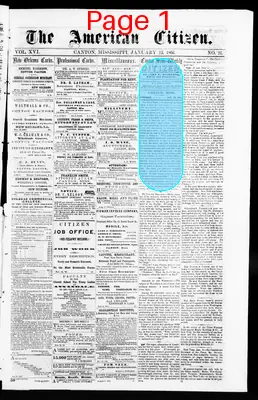
Editorial
January 13, 1866
American Citizen
Canton, Madison County, Mississippi
What is this article about?
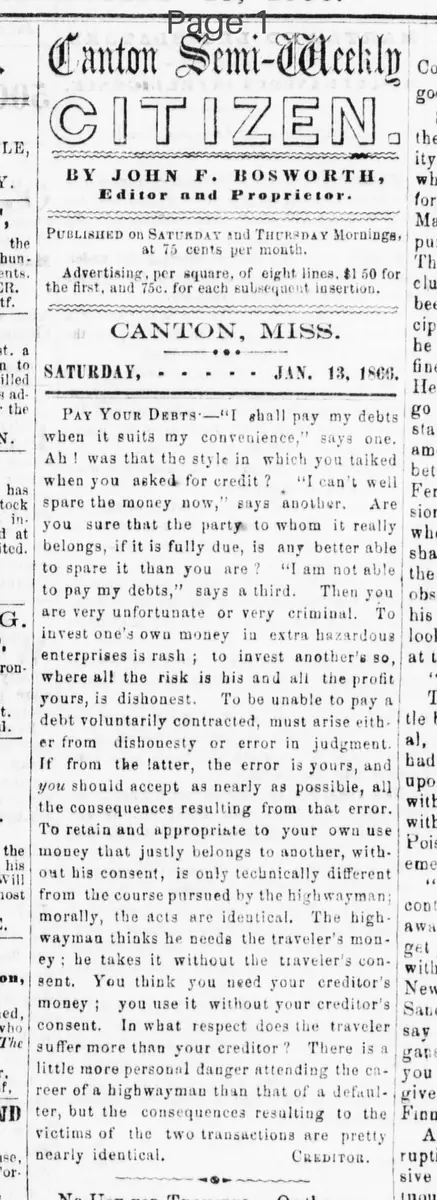
An editorial in the Canton Semi-weekly Citizen urges readers to pay their debts, criticizing excuses for non-payment and equating deliberate default with moral theft akin to highway robbery.
Clipping
OCR Quality
95%
Excellent
Full Text
Canton Semi-weekly
CITIZEN.
BY JOHN F. BOSWORTH,
Editor and Proprietor.
Published on Saturday and Thursday Mornings,
at 75 cents per month.
Advertising, per square, of eight lines. $1 50 for
the first, and 75c. for each subsequent insertion.
CANTON, MISS.
SATURDAY,
JAN. 13, 1866.
Pay Your Debts:--"I shall pay my debts
when it suits my convenience," says one.
Ah! was that the style in which you talked
when you asked for credit? "I can't well
spare the money now," says another, Are
you sure that the party to whom it really
belongs, if it is fully due, is any better able
to spare it than you are? "I am not able
to pay my debts,"
says a third.
Then you
are very unfortunate or very criminal. To
invest one's own money in extra hazardous
enterprises is rash; to invest another's so,
where all the risk is his and all the profit
yours, is dishonest. To be unable to pay a
debt voluntarily contracted, must arise eith-
er from dishonesty or error in judgment.
If from the latter, the error is yours, and
you should accept as nearly as possible, all
the consequences resulting from that error.
To retain and appropriate to your own use
money that justly belongs to another, with-
out his consent, is only technically different
from the course pursued by the highwayman;
morally, the acts are identical. The high-
wayman thinks he needs the traveler's mon-
ey: he takes it without the traveler's con-
sent. You think you need your creditor's
money; you use it without your creditor's
consent. In what respect does the traveler
suffer more than your creditor? There is a
little more personal danger attending the ca-
reer of a highwayman than that of a defaul-
ter, but the consequences resulting to the
victims of the two transactions are pretty
nearly identical.
CREDITOR.
CITIZEN.
BY JOHN F. BOSWORTH,
Editor and Proprietor.
Published on Saturday and Thursday Mornings,
at 75 cents per month.
Advertising, per square, of eight lines. $1 50 for
the first, and 75c. for each subsequent insertion.
CANTON, MISS.
SATURDAY,
JAN. 13, 1866.
Pay Your Debts:--"I shall pay my debts
when it suits my convenience," says one.
Ah! was that the style in which you talked
when you asked for credit? "I can't well
spare the money now," says another, Are
you sure that the party to whom it really
belongs, if it is fully due, is any better able
to spare it than you are? "I am not able
to pay my debts,"
says a third.
Then you
are very unfortunate or very criminal. To
invest one's own money in extra hazardous
enterprises is rash; to invest another's so,
where all the risk is his and all the profit
yours, is dishonest. To be unable to pay a
debt voluntarily contracted, must arise eith-
er from dishonesty or error in judgment.
If from the latter, the error is yours, and
you should accept as nearly as possible, all
the consequences resulting from that error.
To retain and appropriate to your own use
money that justly belongs to another, with-
out his consent, is only technically different
from the course pursued by the highwayman;
morally, the acts are identical. The high-
wayman thinks he needs the traveler's mon-
ey: he takes it without the traveler's con-
sent. You think you need your creditor's
money; you use it without your creditor's
consent. In what respect does the traveler
suffer more than your creditor? There is a
little more personal danger attending the ca-
reer of a highwayman than that of a defaul-
ter, but the consequences resulting to the
victims of the two transactions are pretty
nearly identical.
CREDITOR.
What sub-type of article is it?
Moral Or Religious
What keywords are associated?
Debt Payment
Honesty
Creditors
Morality
Defaulting
Editorial Details
Primary Topic
Moral Duty To Pay Debts
Stance / Tone
Moral Exhortation Against Debt Default
Key Arguments
Excuses For Delaying Debt Payment Are Unjust
Non Payment Due To Inability Often Stems From Dishonesty Or Poor Judgment
Retaining Others' Money Without Consent Is Morally Equivalent To Theft
Defaulting Harms Creditors Similarly To Robbery Victims