Thank you for visiting SNEWPapers!
Sign up free
The Evening Standard
Ogden, Weber County, Utah
What is this article about?
Professor B.C. Buffum at Wyoming's Worland experimental farm develops 'ommer,' a drought-resistant cattle feed grain from Russian spelt and American wheat crosses, yielding 90-100 bushels/acre after four years of trials. Owned by company with director Luther Burbank.
Clipping
OCR Quality
Full Text
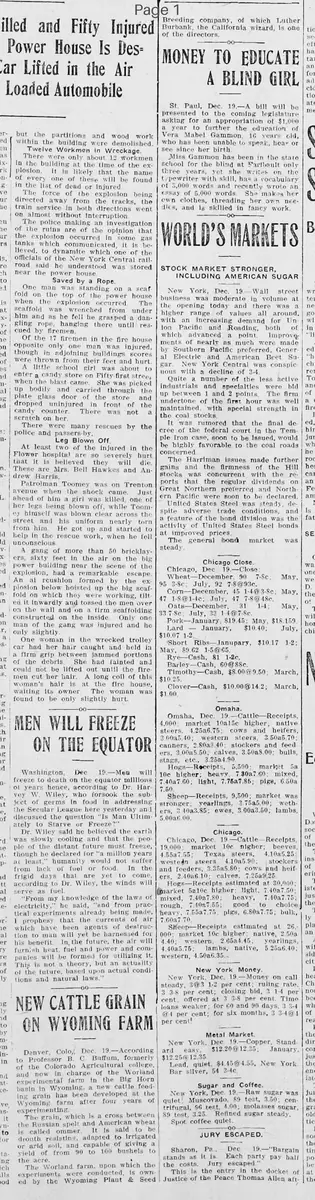
Denver, Colo., Dec. 19—According to Professor B. C. Buffum, formerly of the Colorado Agricultural college, and now in charge of the Worland experimental farm in the Big Horn basin in Wyoming, a new cattle feeding grain has been developed at the Wyoming farm after four years of experimenting.
The grain, which is a cross between the Russian spelt and American wheat is called ommer. It is said to be drought resisting, adapted to irrigated or arid soil, and capable of giving a yield of from 90 to 100 bushels to the acre.
The Worland farm, upon which the experiments were conducted, is owned by the Wyoming Plant & Seed Breeding company, of which Luther Burbank, the California wizard, is one of the directors.
What sub-type of article is it?
What themes does it cover?
What keywords are associated?
What entities or persons were involved?
Where did it happen?
Story Details
Key Persons
Location
Worland Experimental Farm In The Big Horn Basin In Wyoming
Event Date
Dec. 19
Story Details
Professor B. C. Buffum developed a new cattle feeding grain called ommer, a cross between Russian spelt and American wheat, after four years of experimenting at the Worland farm. It is drought resisting, adapted to irrigated or arid soil, and yields 90 to 100 bushels per acre. The farm is owned by the Wyoming Plant & Seed Breeding company, with Luther Burbank as a director.