Thank you for visiting SNEWPapers!
Sign up free
Editorial
April 6, 1958
Atlanta Daily World
Atlanta, Fulton County, Georgia
What is this article about?
Biblical reflection on Judas's thirty pieces of silver as 'price of blood,' rejected for the temple treasury and used to buy a potter's field for burying strangers. Draws parallels to historical empires' exploitation and modern conscience funds, emphasizing moral redemption through charity for the poor.
Clipping
OCR Quality
98%
Excellent
Full Text
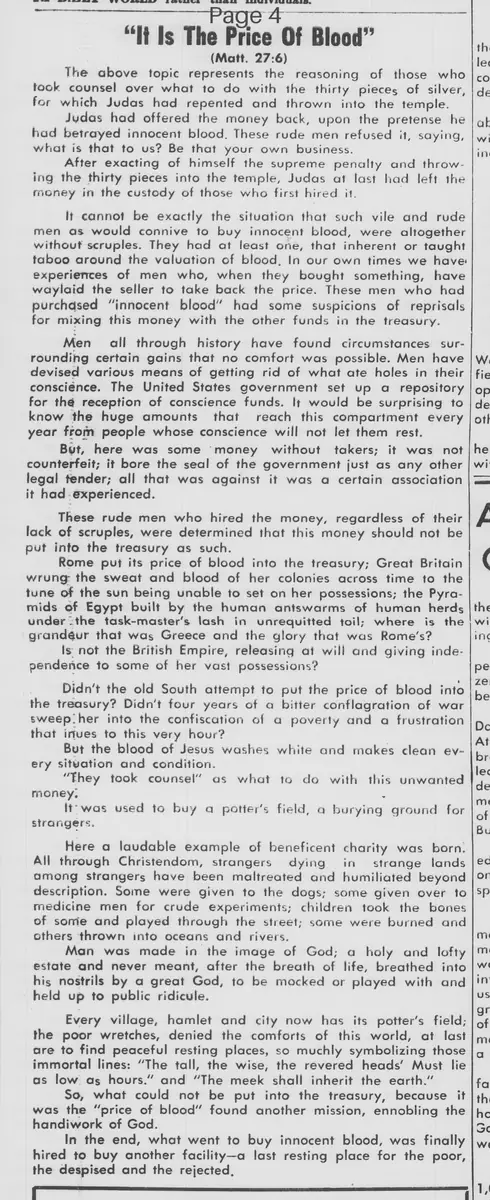
"It Is The Price Of Blood"
(Matt. 27:6)
The above topic represents the reasoning of those who took counsel over what to do with the thirty pieces of silver, for which Judas had repented and thrown into the temple.
Judas had offered the money back, upon the pretense he had betrayed innocent blood. These rude men refused it, saying, what is that to us? Be that your own business.
After exacting of himself the supreme penalty and throwing the thirty pieces into the temple, Judas at last had left the money in the custody of those who first hired it.
It cannot be exactly the situation that such vile and rude men as would connive to buy innocent blood, were altogether without scruples. They had at least one, that inherent or taught taboo around the valuation of blood. In our own times we have experiences of men who, when they bought something, have waylaid the seller to take back the price. These men who had purchased "innocent blood" had some suspicions of reprisals for mixing this money with the other funds in the treasury.
Men all through history have found circumstances surrounding certain gains that no comfort was possible. Men have devised various means of getting rid of what ate holes in their conscience. The United States government set up a repository for the reception of conscience funds. It would be surprising to know the huge amounts that reach this compartment every year from people whose conscience will not let them rest.
But, here was some money without takers; it was not counterfeit; it bore the seal of the government just as any other legal tender; all that was against it was a certain association it had experienced.
These rude men who hired the money, regardless of their lack of scruples, were determined that this money should not be put into the treasury as such.
Rome put its price of blood into the treasury; Great Britain wrung the sweat and blood of her colonies across time to the tune of the sun being unable to set on her possessions; the Pyramids of Egypt built by the human ant-swarm of human herds under the task-master's lash in unrequited toil; where is the grandeur that was Greece and the glory that was Rome's?
Is not the British Empire, releasing at will and giving independence to some of her vast possessions?
Didn't the old South attempt to put the price of blood into the treasury? Didn't four years of a bitter conflagration of war sweep her into the confiscation of a poverty and a frustration that inures to this very hour?
But the blood of Jesus washes white and makes clean every situation and condition.
"They took counsel" as what to do with this unwanted money:
It was used to buy a potter's field, a burying ground for strangers.
Here a laudable example of beneficent charity was born.
All through Christendom, strangers dying in strange lands among strangers have been maltreated and humiliated beyond description. Some were given to the dogs; some given over to medicine men for crude experiments; children took the bones of some and played through the street; some were burned and others thrown into oceans and rivers.
Man was made in the image of God; a holy and lofty estate and never meant, after the breath of life, breathed into his nostrils by a great God, to be mocked or played with and held up to public ridicule.
Every village, hamlet and city now has its potter's field; the poor wretches, denied the comforts of this world, at last are to find peaceful resting places, so muchly symbolizing those immortal lines: "The tall, the wise, the revered heads' Must lie as low as hours." and "The meek shall inherit the earth."
So, what could not be put into the treasury, because it was the "price of blood" found another mission, ennobling the handiwork of God.
In the end, what went to buy innocent blood, was finally hired to buy another facility-a last resting place for the poor, the despised and the rejected.
(Matt. 27:6)
The above topic represents the reasoning of those who took counsel over what to do with the thirty pieces of silver, for which Judas had repented and thrown into the temple.
Judas had offered the money back, upon the pretense he had betrayed innocent blood. These rude men refused it, saying, what is that to us? Be that your own business.
After exacting of himself the supreme penalty and throwing the thirty pieces into the temple, Judas at last had left the money in the custody of those who first hired it.
It cannot be exactly the situation that such vile and rude men as would connive to buy innocent blood, were altogether without scruples. They had at least one, that inherent or taught taboo around the valuation of blood. In our own times we have experiences of men who, when they bought something, have waylaid the seller to take back the price. These men who had purchased "innocent blood" had some suspicions of reprisals for mixing this money with the other funds in the treasury.
Men all through history have found circumstances surrounding certain gains that no comfort was possible. Men have devised various means of getting rid of what ate holes in their conscience. The United States government set up a repository for the reception of conscience funds. It would be surprising to know the huge amounts that reach this compartment every year from people whose conscience will not let them rest.
But, here was some money without takers; it was not counterfeit; it bore the seal of the government just as any other legal tender; all that was against it was a certain association it had experienced.
These rude men who hired the money, regardless of their lack of scruples, were determined that this money should not be put into the treasury as such.
Rome put its price of blood into the treasury; Great Britain wrung the sweat and blood of her colonies across time to the tune of the sun being unable to set on her possessions; the Pyramids of Egypt built by the human ant-swarm of human herds under the task-master's lash in unrequited toil; where is the grandeur that was Greece and the glory that was Rome's?
Is not the British Empire, releasing at will and giving independence to some of her vast possessions?
Didn't the old South attempt to put the price of blood into the treasury? Didn't four years of a bitter conflagration of war sweep her into the confiscation of a poverty and a frustration that inures to this very hour?
But the blood of Jesus washes white and makes clean every situation and condition.
"They took counsel" as what to do with this unwanted money:
It was used to buy a potter's field, a burying ground for strangers.
Here a laudable example of beneficent charity was born.
All through Christendom, strangers dying in strange lands among strangers have been maltreated and humiliated beyond description. Some were given to the dogs; some given over to medicine men for crude experiments; children took the bones of some and played through the street; some were burned and others thrown into oceans and rivers.
Man was made in the image of God; a holy and lofty estate and never meant, after the breath of life, breathed into his nostrils by a great God, to be mocked or played with and held up to public ridicule.
Every village, hamlet and city now has its potter's field; the poor wretches, denied the comforts of this world, at last are to find peaceful resting places, so muchly symbolizing those immortal lines: "The tall, the wise, the revered heads' Must lie as low as hours." and "The meek shall inherit the earth."
So, what could not be put into the treasury, because it was the "price of blood" found another mission, ennobling the handiwork of God.
In the end, what went to buy innocent blood, was finally hired to buy another facility-a last resting place for the poor, the despised and the rejected.
What sub-type of article is it?
Moral Or Religious
Social Reform
What keywords are associated?
Price Of Blood
Judas Betrayal
Potters Field
Conscience Funds
Moral Redemption
Charity For Poor
Biblical Reflection
What entities or persons were involved?
Judas
Priests
Jesus
Rome
Great Britain
United States Government
Old South
Editorial Details
Primary Topic
Redemption Of The Price Of Blood Through Charity For The Poor
Stance / Tone
Reflective Moral Exhortation
Key Figures
Judas
Priests
Jesus
Rome
Great Britain
United States Government
Old South
Key Arguments
The Thirty Pieces Of Silver, As Price Of Blood, Could Not Enter The Temple Treasury Due To Moral Taboo.
Historical Empires Like Rome And Britain Suffered Consequences For Exploiting Blood And Sweat.
The Money Was Used To Buy A Potter's Field, Providing Burial For Strangers And The Poor.
This Act Symbolizes Beneficent Charity And Redemption Through Christ's Blood.
Modern Conscience Funds Show Ongoing Human Struggle With Ill Gotten Gains.
Man, Made In God's Image, Deserves Dignified Burial Regardless Of Status.