Thank you for visiting SNEWPapers!
Sign up free
Editorial
March 25, 1825
The National Republican And Ohio Political Register
Cincinnati, Hamilton County, Ohio
What is this article about?
Editorial defends General Jackson's character and suitability for the presidency against insinuations that his election would endanger liberties, emphasizing constitutional safeguards and his dignified conduct during the campaign.
Clipping
OCR Quality
98%
Excellent
Full Text
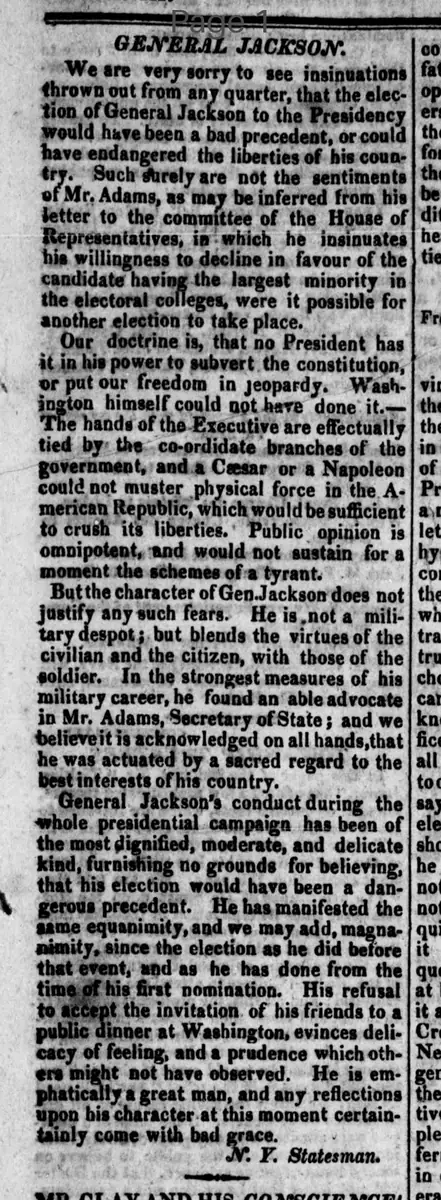
GENERAL JACKSON.
We are very sorry to see insinuations thrown out from any quarter, that the election of General Jackson to the Presidency would have been a bad precedent, or could have endangered the liberties of his country. Such surely are not the sentiments of Mr. Adams, as may be inferred from his letter to the committee of the House of Representatives, in which he insinuates his willingness to decline in favour of the candidate having the largest minority in the electoral colleges, were it possible for another election to take place.
Our doctrine is, that no President has it in his power to subvert the constitution, or put our freedom in jeopardy. Washington himself could not have done it. The hands of the Executive are effectually tied by the co-ordinate branches of the government, and a Caesar or a Napoleon could not muster physical force in the American Republic, which would be sufficient to crush its liberties. Public opinion is omnipotent, and would not sustain for a moment the schemes of a tyrant.
But the character of Gen. Jackson does not justify any such fears. He is not a military despot; but blends the virtues of the civilian and the citizen, with those of the soldier. In the strongest measures of his military career, he found an able advocate in Mr. Adams, Secretary of State; and we believe it is acknowledged on all hands, that he was actuated by a sacred regard to the best interests of his country.
General Jackson's conduct during the whole presidential campaign has been of the most dignified, moderate, and delicate kind, furnishing no grounds for believing that his election would have been a dangerous precedent. He has manifested the same equanimity, and we may add, magnanimity, since the election as he did before that event, and as he has done from the time of his first nomination. His refusal to accept the invitation of his friends to a public dinner at Washington, evinces delicacy of feeling, and a prudence which others might not have observed. He is emphatically a great man, and any reflections upon his character at this moment certainly come with bad grace.
N. Y. Statesman.
We are very sorry to see insinuations thrown out from any quarter, that the election of General Jackson to the Presidency would have been a bad precedent, or could have endangered the liberties of his country. Such surely are not the sentiments of Mr. Adams, as may be inferred from his letter to the committee of the House of Representatives, in which he insinuates his willingness to decline in favour of the candidate having the largest minority in the electoral colleges, were it possible for another election to take place.
Our doctrine is, that no President has it in his power to subvert the constitution, or put our freedom in jeopardy. Washington himself could not have done it. The hands of the Executive are effectually tied by the co-ordinate branches of the government, and a Caesar or a Napoleon could not muster physical force in the American Republic, which would be sufficient to crush its liberties. Public opinion is omnipotent, and would not sustain for a moment the schemes of a tyrant.
But the character of Gen. Jackson does not justify any such fears. He is not a military despot; but blends the virtues of the civilian and the citizen, with those of the soldier. In the strongest measures of his military career, he found an able advocate in Mr. Adams, Secretary of State; and we believe it is acknowledged on all hands, that he was actuated by a sacred regard to the best interests of his country.
General Jackson's conduct during the whole presidential campaign has been of the most dignified, moderate, and delicate kind, furnishing no grounds for believing that his election would have been a dangerous precedent. He has manifested the same equanimity, and we may add, magnanimity, since the election as he did before that event, and as he has done from the time of his first nomination. His refusal to accept the invitation of his friends to a public dinner at Washington, evinces delicacy of feeling, and a prudence which others might not have observed. He is emphatically a great man, and any reflections upon his character at this moment certainly come with bad grace.
N. Y. Statesman.
What sub-type of article is it?
Partisan Politics
Constitutional
What keywords are associated?
Jackson Presidency
Electoral Election
Constitutional Safeguards
Military Character
Public Opinion
What entities or persons were involved?
General Jackson
Mr. Adams
Washington
Caesar
Napoleon
Editorial Details
Primary Topic
Defense Of General Jackson's Presidential Candidacy
Stance / Tone
Strongly Supportive Of Jackson, Dismissive Of Fears Of Tyranny
Key Figures
General Jackson
Mr. Adams
Washington
Caesar
Napoleon
Key Arguments
No President Can Subvert The Constitution Due To Checks By Other Branches
Public Opinion Prevents Tyranny
Jackson Blends Civilian And Military Virtues
Adams Supported Jackson's Military Actions
Jackson's Campaign Conduct Was Dignified And Moderate