Thank you for visiting SNEWPapers!
Sign up free
Literary
June 19, 1839
The Rhode Island Republican
Newport, Newport County, Rhode Island
What is this article about?
After the Battle of Culloden, Bonnie Prince Charlie flees to the Mackenzie home, where the laird's son has died aiding him. Daughter Phemie hides the prince and disguises herself as him to draw pursuers away, getting captured but later released. She marries the prince, and their descendants preserve the marked oaken chair.
Clipping
OCR Quality
98%
Excellent
Full Text
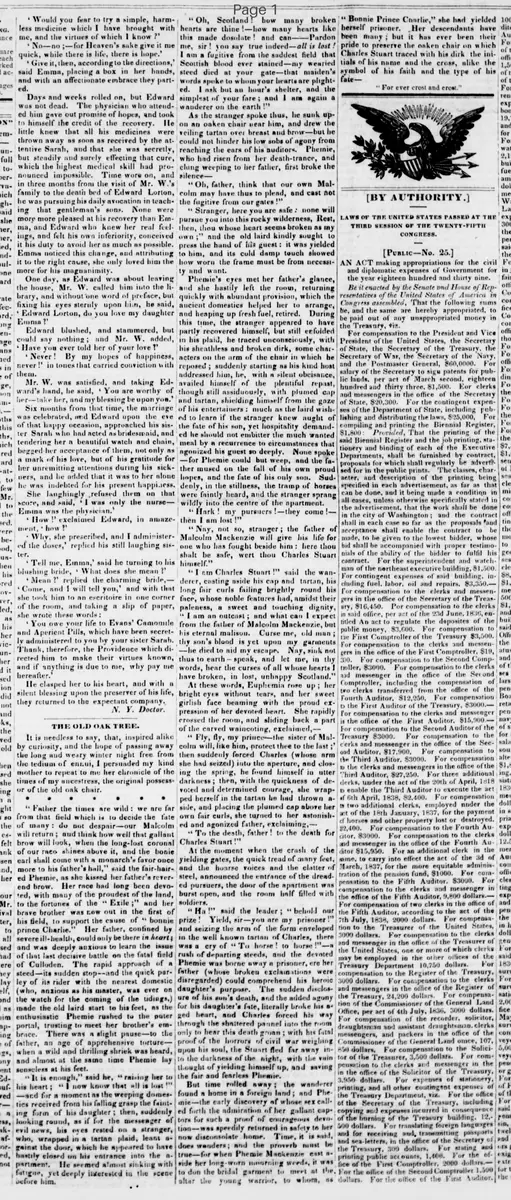
THE OLD OAK TREE.
It is needless to say, that, inspired alike by curiosity, and the hope of passing away the long and weary winter night free from the tedium of ennui, I persuaded my kind mother to repeat to me her chronicle of the times of my ancestress, the original possessor of the old oak chair.
"Father the times are wild: we are far from that field which is to decide the fate of many: do not despair—our Malcolm will return; and think how well that gallant brow will look, when the long-lost coronal of our race shines above it, and the bonnie earl shall come with a monarch's favor once more to his father's hall," said the fair-haired Phemie, as she kissed her father's reverend brow. Her race had long been devoted, with many of the proudest of the land, to the fortunes of the "Exile;" and her brave brother was now out in the first of his field, to support the cause of "bonnie prince Charlie." Her father, confined by severe ill-health, could only be there in heart; and was deeply anxious to learn the issue of that last decisive battle on the fatal field of Culloden. The rapid approach of a steed—its sudden stop—and the quick parley of its rider with the nearest domestic (who, anxious as his master, was ever on the watch for the coming of the tidings,) made the old laird start to his feet, as the enthusiastic Phemie rushed to the outer portal, trusting to meet her brother's embrace. There was a slight pause—to the father, an age of apprehensive torture—when a wild and thrilling shriek was heard, and almost at the same time Phemie lay senseless at his feet.
"It is enough," said he, "raising her to his heart;" I now know that all is lost!"—and for a moment as the weeping domestics received from his falling grasp the fainting form of his daughter; then, suddenly looking round, as if for the messenger of evil news, his eyes rested on a stranger, who, wrapped in a tartan plaid, leant against the door, which he appeared to have hastily closed on his entrance into the apartment. He seemed almost sinking with fatigue, yet deeply interested in the scene before him.
"Oh, Scotland! how many broken hearts are thine!—how many hearts like this made desolate! and can—Pardon me, sir! you say true indeed—all is lost! I am a fugitive from the saddest field that Scottish blood ever stained—my wearied steed died at your gate—that maiden's words spoke to whom your hearts are plighted. I ask but an hour's shelter, and the simplest of your fare; and I am again a wanderer on the earth!"
As the stranger spoke thus, he sunk upon an oaken chair near him, and drew the veiling tartan over breast and brow—but he could not hinder his low sobs of agony from reaching the ears of his auditors. Phemie, who had risen from her death-trance, and clung weeping to her father, first broke the silence—
"Oh, father, think that our own Malcolm may have thus to plead, and cast not the fugitive from our gates!"
"Stranger, here you are safe: none will pursue you into this rocky wilderness. Rest, then, thou whose heart seems broken as my own;" and the old laird kindly sought to press the hand of his guest: it was yielded to him, and its cold damp touch showed how worn the frame must be from necessity and want.
Phemie's eyes met her father's glance, and she hastily left the room, returning quickly with abundant provision, which the ancient domestics helped her to arrange, and heaping up fresh fuel, retired. During this time, the stranger appeared to have partly recovered himself, but still enfolded in his plaid, he traced unconsciously, with his sheathless and broken dirk, some characters on the arm of the chair in which he reposed; suddenly starting as his kind host addressed him, he, with a silent obeisance, availed himself of the plentiful repast, though still assiduously, with plumed cap and tartan, shielding himself from the gaze of his entertainers: much as the laird wished to learn if the stranger knew aught of the fate of his son, yet hospitality demanded he should not embitter the much-wanted meal by a recurrence to circumstances that agonized his guest so deeply. None spoke—for Phemie could but weep, and the father mused on the fall of his own proud hopes, and the fate of his only son. Suddenly, in the stillness, the tramp of horses were faintly heard, and the stranger sprang wildly into the centre of the apartment.
"Hark! my pursuers!—they come!—then I am lost!"
"Nay, not so, stranger; the father of Malcolm Mackenzie will give his life for one who has fought beside him: here thou shalt be safe, wert thou Charles Stuart himself."
"I am Charles Stuart!" said the wanderer, casting aside his cap and tartan, his long fair curls falling brightly round his face, whose noble features had, amidst their paleness, a sweet and touching dignity, "I am an outcast; and what can I expect from the father of Malcolm Mackenzie, but his eternal malison. Curse me, old man; thy son's blood is yet upon my garments—he died to aid my escape. Nay, sink not thus to earth—speak, and let me, in thy words, hear the curses of all whose hearts I have broken, in lost, unhappy Scotland."
At these words, Euphemia rose up; her bright eyes without tears, and her sweet girlish face beaming with the proud expression of her devoted heart. She rapidly crossed the room, and sliding back a part of the carved wainscoting, exclaimed,—
"Fly, ay, my prince—the sister of Malcolm will, like him, protect thee to the last;" then suddenly forced Charles (whose arm she had seized) into the aperture, and closing the spring, he found himself in utter darkness; then, with the quickness of devoted and determined courage, she wrapped herself in the tartan he had thrown aside, and placing the plumed cap above her own fair curls, she turned to her astonished and agonized father, exclaiming,—
"To the death, father! to the death for Charles Stuart!"
At the moment when the crash of the yielding gates, the quick tread of many feet, and the hoarse voices and the clatter of steel, announced the entrance of the dreaded pursuers, the door of the apartment was burst open, and the room half filled with soldiers.
"Ha!" said the leader: "behold our prize! Yield, sir—you are my prisoner!" and seizing the arm of the form enveloped in the well known tartan of Charles, there was a cry of "To horse! to horse!"—a rush of departing steeds, and the devoted Phemie was borne away a prisoner, ere her father (whose broken exclamations were disregarded) could comprehend his heroic daughter's purpose. The sudden disclosure of his son's death, and the added agony for his daughter's fate, literally broke his aged heart, and Charles forced his way through the shattered panel into the room only to hear this death groan; with his fatal proof of the horrors of civil war weighing upon his soul, the Stuart fled far away into the darkness of the night, with the vain thought of yielding himself up, and saving the fair and fearless Phemie.
But time rolled away: the wanderer found a home in a foreign land; and Phemie—the early discovery of whose sex called forth the admiration of her gallant captors for such a proof of courageous devotion—was speedily returned in safety to her now disconsolate home. Time, it is said, does wonders; and the proverb must be true—for when Phemie Mackenzie cast aside her long-worn mourning weeds, it was to don the bridal garment! to meet at the altar the young warrior, to whom, as "Bonnie Prince Charlie," she had yielded herself prisoner. Her descendants have been many; but it has ever been their pride to preserve the oaken chair on which Charles Stuart traced with his dirk the initials of his name and the cross, alike the symbol of his faith and the type of his fate—
"For ever crost and crost."
It is needless to say, that, inspired alike by curiosity, and the hope of passing away the long and weary winter night free from the tedium of ennui, I persuaded my kind mother to repeat to me her chronicle of the times of my ancestress, the original possessor of the old oak chair.
"Father the times are wild: we are far from that field which is to decide the fate of many: do not despair—our Malcolm will return; and think how well that gallant brow will look, when the long-lost coronal of our race shines above it, and the bonnie earl shall come with a monarch's favor once more to his father's hall," said the fair-haired Phemie, as she kissed her father's reverend brow. Her race had long been devoted, with many of the proudest of the land, to the fortunes of the "Exile;" and her brave brother was now out in the first of his field, to support the cause of "bonnie prince Charlie." Her father, confined by severe ill-health, could only be there in heart; and was deeply anxious to learn the issue of that last decisive battle on the fatal field of Culloden. The rapid approach of a steed—its sudden stop—and the quick parley of its rider with the nearest domestic (who, anxious as his master, was ever on the watch for the coming of the tidings,) made the old laird start to his feet, as the enthusiastic Phemie rushed to the outer portal, trusting to meet her brother's embrace. There was a slight pause—to the father, an age of apprehensive torture—when a wild and thrilling shriek was heard, and almost at the same time Phemie lay senseless at his feet.
"It is enough," said he, "raising her to his heart;" I now know that all is lost!"—and for a moment as the weeping domestics received from his falling grasp the fainting form of his daughter; then, suddenly looking round, as if for the messenger of evil news, his eyes rested on a stranger, who, wrapped in a tartan plaid, leant against the door, which he appeared to have hastily closed on his entrance into the apartment. He seemed almost sinking with fatigue, yet deeply interested in the scene before him.
"Oh, Scotland! how many broken hearts are thine!—how many hearts like this made desolate! and can—Pardon me, sir! you say true indeed—all is lost! I am a fugitive from the saddest field that Scottish blood ever stained—my wearied steed died at your gate—that maiden's words spoke to whom your hearts are plighted. I ask but an hour's shelter, and the simplest of your fare; and I am again a wanderer on the earth!"
As the stranger spoke thus, he sunk upon an oaken chair near him, and drew the veiling tartan over breast and brow—but he could not hinder his low sobs of agony from reaching the ears of his auditors. Phemie, who had risen from her death-trance, and clung weeping to her father, first broke the silence—
"Oh, father, think that our own Malcolm may have thus to plead, and cast not the fugitive from our gates!"
"Stranger, here you are safe: none will pursue you into this rocky wilderness. Rest, then, thou whose heart seems broken as my own;" and the old laird kindly sought to press the hand of his guest: it was yielded to him, and its cold damp touch showed how worn the frame must be from necessity and want.
Phemie's eyes met her father's glance, and she hastily left the room, returning quickly with abundant provision, which the ancient domestics helped her to arrange, and heaping up fresh fuel, retired. During this time, the stranger appeared to have partly recovered himself, but still enfolded in his plaid, he traced unconsciously, with his sheathless and broken dirk, some characters on the arm of the chair in which he reposed; suddenly starting as his kind host addressed him, he, with a silent obeisance, availed himself of the plentiful repast, though still assiduously, with plumed cap and tartan, shielding himself from the gaze of his entertainers: much as the laird wished to learn if the stranger knew aught of the fate of his son, yet hospitality demanded he should not embitter the much-wanted meal by a recurrence to circumstances that agonized his guest so deeply. None spoke—for Phemie could but weep, and the father mused on the fall of his own proud hopes, and the fate of his only son. Suddenly, in the stillness, the tramp of horses were faintly heard, and the stranger sprang wildly into the centre of the apartment.
"Hark! my pursuers!—they come!—then I am lost!"
"Nay, not so, stranger; the father of Malcolm Mackenzie will give his life for one who has fought beside him: here thou shalt be safe, wert thou Charles Stuart himself."
"I am Charles Stuart!" said the wanderer, casting aside his cap and tartan, his long fair curls falling brightly round his face, whose noble features had, amidst their paleness, a sweet and touching dignity, "I am an outcast; and what can I expect from the father of Malcolm Mackenzie, but his eternal malison. Curse me, old man; thy son's blood is yet upon my garments—he died to aid my escape. Nay, sink not thus to earth—speak, and let me, in thy words, hear the curses of all whose hearts I have broken, in lost, unhappy Scotland."
At these words, Euphemia rose up; her bright eyes without tears, and her sweet girlish face beaming with the proud expression of her devoted heart. She rapidly crossed the room, and sliding back a part of the carved wainscoting, exclaimed,—
"Fly, ay, my prince—the sister of Malcolm will, like him, protect thee to the last;" then suddenly forced Charles (whose arm she had seized) into the aperture, and closing the spring, he found himself in utter darkness; then, with the quickness of devoted and determined courage, she wrapped herself in the tartan he had thrown aside, and placing the plumed cap above her own fair curls, she turned to her astonished and agonized father, exclaiming,—
"To the death, father! to the death for Charles Stuart!"
At the moment when the crash of the yielding gates, the quick tread of many feet, and the hoarse voices and the clatter of steel, announced the entrance of the dreaded pursuers, the door of the apartment was burst open, and the room half filled with soldiers.
"Ha!" said the leader: "behold our prize! Yield, sir—you are my prisoner!" and seizing the arm of the form enveloped in the well known tartan of Charles, there was a cry of "To horse! to horse!"—a rush of departing steeds, and the devoted Phemie was borne away a prisoner, ere her father (whose broken exclamations were disregarded) could comprehend his heroic daughter's purpose. The sudden disclosure of his son's death, and the added agony for his daughter's fate, literally broke his aged heart, and Charles forced his way through the shattered panel into the room only to hear this death groan; with his fatal proof of the horrors of civil war weighing upon his soul, the Stuart fled far away into the darkness of the night, with the vain thought of yielding himself up, and saving the fair and fearless Phemie.
But time rolled away: the wanderer found a home in a foreign land; and Phemie—the early discovery of whose sex called forth the admiration of her gallant captors for such a proof of courageous devotion—was speedily returned in safety to her now disconsolate home. Time, it is said, does wonders; and the proverb must be true—for when Phemie Mackenzie cast aside her long-worn mourning weeds, it was to don the bridal garment! to meet at the altar the young warrior, to whom, as "Bonnie Prince Charlie," she had yielded herself prisoner. Her descendants have been many; but it has ever been their pride to preserve the oaken chair on which Charles Stuart traced with his dirk the initials of his name and the cross, alike the symbol of his faith and the type of his fate—
"For ever crost and crost."
What sub-type of article is it?
Prose Fiction
What themes does it cover?
Liberty Freedom
Political
War Peace
What keywords are associated?
Bonnie Prince Charlie
Culloden
Jacobite
Escape
Loyalty
Oaken Chair
Phémie Mackenzie
Literary Details
Title
The Old Oak Tree.
Subject
The Escape Of Charles Stuart After The Battle Of Culloden
Key Lines
"I Am Charles Stuart!" Said The Wanderer, Casting Aside His Cap And Tartan, His Long Fair Curls Falling Brightly Round His Face, Whose Noble Features Had, Amidst Their Paleness, A Sweet And Touching Dignity, "I Am An Outcast; And What Can I Expect From The Father Of Malcolm Mackenzie, But His Eternal Malison. Curse Me, Old Man; Thy Son's Blood Is Yet Upon My Garments—He Died To Aid My Escape."
"To The Death, Father! To The Death For Charles Stuart!"
"For Ever Crost And Crost."